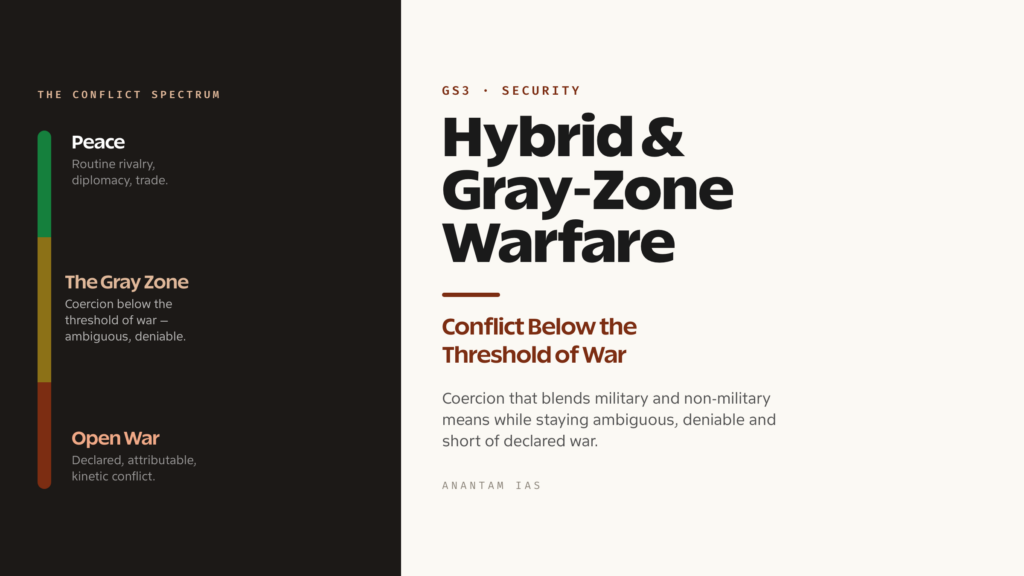
There’s an old line from Sun Tzu that the supreme art of war is to subdue the enemy without fighting. For most of the twentieth century that sounded like a poet’s flourish, because war meant tanks crossing borders and a formal declaration to mark the moment peace ended. But look at how rivals pressure each other today and the flourish reads like a manual. A power can sabotage an undersea cable, flood a neighbour’s feeds with deepfakes, choke its exports of a critical mineral, nibble at its frontier metre by metre, and fund a proxy that bleeds it — all without firing the shot that would let the victim call it war. This is hybrid and gray-zone warfare: competition and coercion that deliberately blends military and non-military, conventional and unconventional means, while staying just below the line that triggers open, declared conflict.
For a UPSC aspirant, this is one of the most examinable security ideas of the decade, and it cuts across papers. It is no longer enough to know about armies and arsenals; you have to understand the contest that happens in the spaces between them — in information, in cyberspace, in economics, in law, and along contested borders. India sits squarely in the path of this kind of pressure, faced with a two-front gray-zone challenge that rarely crosses into shooting but never quite stops either. Understanding the concept — what the gray zone is, why states love it, and why it is so hard for democracies to answer — turns a vague headline anxiety into a structured, mark-scoring argument.
What the Gray Zone Is: The Spectrum Between Peace and War
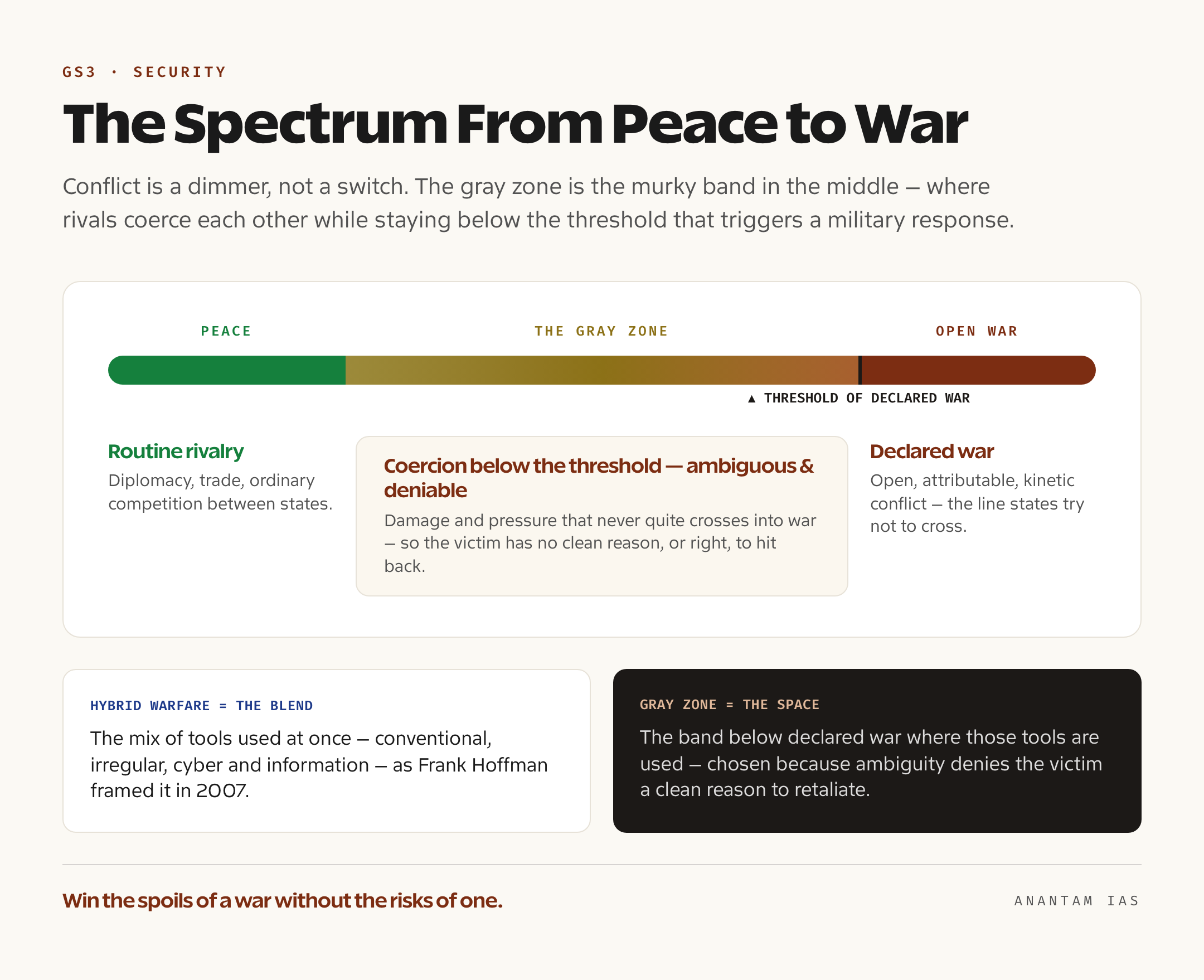
Begin with a mental picture, because the whole idea rests on one. Imagine a single line with pure peace at one end and open, declared war at the other. For most of history, strategists treated that line as a switch — you were either at peace or at war, and crossing over was a clear, public, legally loaded act. The gray zone is the realisation that the switch is actually a dimmer. There is a wide, murky band in the middle where states compete hard, coerce, and damage each other, yet never flip fully into war. That band is the gray zone: a sphere of contestation that lives between routine peacetime rivalry and full-scale conflict, where ambiguity is not an accident but the whole point.
The companion term is hybrid warfare, and the two are intimately linked without being identical. The American scholar Frank Hoffman gave the concept its modern shape in 2007, describing hybrid threats as the simultaneous, blended use of several modes of conflict at once — conventional military capability, irregular tactics, terrorism and criminal disorder — fused by an adversary smart enough to mix whatever fits the moment. Hybrid warfare, in that framing, is about the blend of tools; the gray zone is about the space in which they are used. In practice they fuse: a rival applies hybrid methods precisely because they let it operate in the gray zone, achieving its aims while denying the victim a clean reason to retaliate. Many of the sharpest tools — disinformation, economic pressure, the use of deniable proxies — never rise to the level of formal, attributable state aggression at all.
It helps to separate two things that often get bundled together. The first is the spectrum idea itself, which is durable and widely accepted: conflict is a continuum, not a binary, and most modern rivalry plays out in the murky middle. The second is the much-debated question of whether any single power has codified all this into a grand doctrine. The most famous example is the so-called “Gerasimov doctrine,” named after a 2013 article by Russia’s top general about the blurring of war and peace. But the analyst who coined that label, Mark Galeotti, has since publicly disowned it — writing in Foreign Policy that the “doctrine” he is credited with naming does not actually exist, that Gerasimov’s piece was descriptive rather than a battle plan, and that clinging to the myth misdirects how the West reads its rivals. The lesson for an answer is to use the gray-zone spectrum as a sound analytical frame while treating talk of a neat, named master-doctrine with care. The ambiguity is real; a single secret blueprint behind it usually is not.
The Instruments of Hybrid Warfare and Why States Use Them
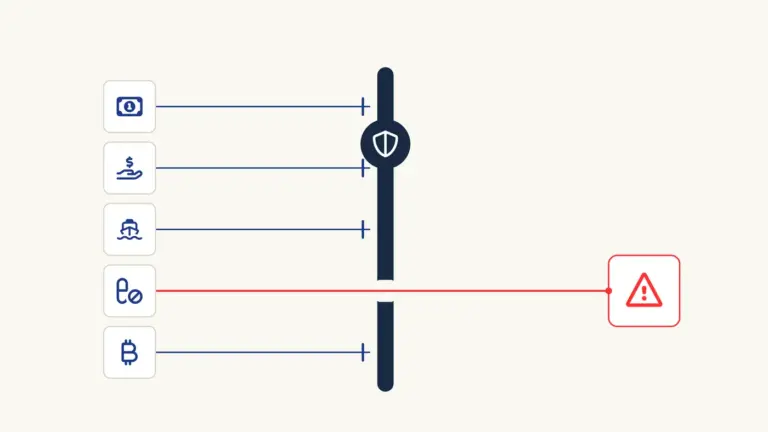
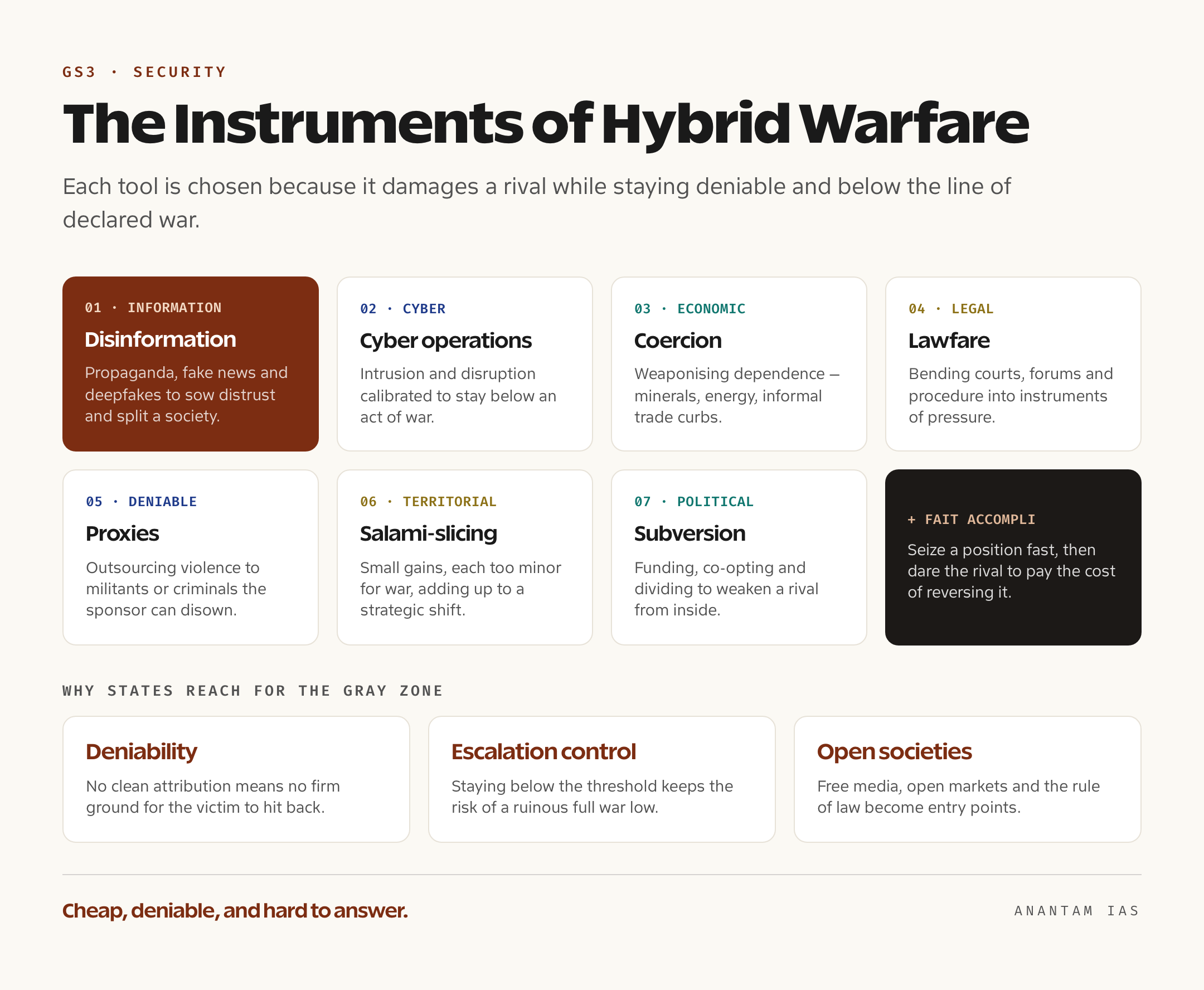
What makes the gray zone work is a toolkit, and a strong answer can name its pieces. The first instrument is information and disinformation — shaping perceptions, sowing distrust, and amplifying a society’s own divisions through propaganda, fabricated stories and, increasingly, synthetic deepfake media. The second is cyber operations conducted at a level calibrated to disrupt, surveil and intimidate without crossing into the kind of destruction that looks like an act of war; India’s own debate has long flagged the persistent mapping of strategic networks by state-linked actors who hide behind “hacktivist” fronts to keep their fingerprints off the keyboard. India’s broader exposure here connects directly to the wider story of cyber security in India, where the same logic of ambiguity applies.
The list runs on. Economic coercion uses dependence as a weapon — withholding a critical input like rare-earth minerals, or imposing informal trade restrictions as quiet punishment. Lawfare bends legal systems and international forums into instruments of pressure, filing claims, manufacturing precedents and weaponising procedure to tie a rival in knots. Proxies let a state outsource violence to militants, mercenaries or criminal networks so the sponsor can shrug and deny. And two tactical patterns recur: salami-slicing, the steady accumulation of small territorial or positional gains, each one too minor to justify a war yet adding up to a strategic shift; and the fait accompli, seizing a position quickly and then daring the other side to bear the cost of reversing it. Behind all of these sits political subversion — funding, co-opting and dividing, to weaken a rival from inside rather than across a border. The disinformation and proxy strands lean heavily on open media, which is why the role of media and social networks in internal security has become a frontline concern rather than a soft one.
So why do states reach for this messy, indirect way of fighting instead of simply going to war? Three reasons explain almost every case. The first is deniability: if an action cannot be cleanly pinned on you, your victim has no firm legal or political ground to hit back, and the world has no clear villain to condemn. The second is escalation control — by staying below the threshold that would trigger a military response or treaty obligations, an aggressor reaps gains while keeping the risk of a ruinous full war low. The third is that open societies are unusually easy to target this way: their free media, contested politics, open markets and rule of law are strengths that a patient adversary can turn into entry points. Gray-zone pressure is, in short, cheap, deniable and hard to answer — which is exactly why it has become the default mode of competition between rivals who do not want a war but do want the spoils of one.
Why the Gray Zone Is So Hard for Democracies to Answer
The cruel feature of gray-zone warfare is that it is built to exploit exactly the qualities that make a democracy a democracy. Start with attribution, the most basic problem. Because hybrid attacks are deliberately ambiguous and routed through proxies and deniable channels, it is often genuinely hard to prove who did what — and without confident attribution a state lacks the legal standing and political confidence to retaliate, especially with force. The aggressor’s whole design is to keep the victim trapped in doubt: by the time you are sure, the moment to respond has passed, and responding to the wrong actor is its own disaster.
Then there is the asymmetry of speed and consensus. An authoritarian regime can act quickly, secretly and as one; a democracy must build agreement, answer to courts and a free press, and act in the open. A coercive move can be launched in an afternoon and take a democratic system weeks of debate to even name, let alone counter. Layered on this is the threshold trap: a single salami slice or one cyber intrusion is, on its own, never quite serious enough to justify a strong reaction, so each provocation is rationally absorbed — and the slices accumulate into a strategic loss that no single decision ever authorised. This is the “defender’s dilemma,” where every individual restraint is sensible yet the sum of restraint is defeat.
Two further problems complete the picture. Deterrence, which works for conventional war because the costs of crossing a clear red line are obvious, struggles in the gray zone because there is no bright line to draw and breaches are deniable — so the answer increasingly stressed by strategists is deterrence by denial: making your society so resilient that the coercion simply fails to produce the intended effect, removing the incentive to try. And the response itself cannot live in any one ministry. Countering information operations, cyber intrusions, economic coercion and border salami-slicing at once demands a whole-of-government effort that breaks the usual silos between the military, intelligence, diplomats, regulators and the police — and, increasingly, a whole-of-society effort, because the targets are citizens, companies and civic trust as much as soldiers.
The India Angle: Multi-Domain Pressure and a Whole-of-Government Response
India is one of the most heavily targeted democracies in the gray zone, and the reason is structural: it faces a collusive two-front challenge in which pressure from one rival reinforces pressure from the other, almost always below the level of open war. Indian strategic writing, including work from the Observer Research Foundation, has mapped how this plays out across domains at once — disinformation campaigns that amplify social and religious fault lines, persistent cyber-espionage against strategic institutions, salami-slicing and face-offs along contested stretches of the northern frontier, proxy militancy sustained from across the western border, and coordinated diplomatic and lawfare pressure in multilateral forums. The pattern around the 2025 cross-border crisis was illustrative: a kinetic episode was quickly wrapped in an information offensive of doctored videos and false advisories, the cyber-and-narrative layer escalating even as the shooting was meant to stay limited. The ORF analysis even reaches back to Kautilya’s notion of tushnim yuddha, or “silent war,” to make the point that coercion short of open battle is an old idea in Indian statecraft, not a foreign import.
India’s institutional answer has been taking shape, though it remains a work in progress. The country already has the building blocks: the Computer Emergency Response Team (CERT-In) for incident response, the National Technical Research Organisation for technical intelligence, and the tri-services Defence Cyber Agency, set up in 2019 and operational since 2021, to handle the military’s cyber operations. A real shift came in 2024, when the Chief of Defence Staff released a Joint Doctrine for Cyberspace Operations — a move from a reactive posture toward a unified, anticipatory approach that integrates defence with deterrence. At the apex, the National Security Council Secretariat was given a stronger coordinating mandate in 2024 to knit ministries together on cyber and hybrid threats. Strategic commentators argue the next steps are a formal, declared gray-zone doctrine that sets out India’s red lines, and tighter integration of cyber, space, intelligence and information functions so the country can act as one rather than as a scatter of agencies.
But the deepest lesson from how others have coped is that institutions alone are not enough — resilience has to reach into society. The models most often cited are Finland and Taiwan, both of which live under constant gray-zone pressure and both of which have answered with a whole-of-society approach: media-literacy education that inoculates citizens against disinformation, fact-checking partnerships, hardened critical infrastructure, and a civic culture that treats national security as a shared responsibility rather than the army’s alone. For India, that translates into a familiar but demanding agenda — public resilience against fake news and deepfakes, secure digital and physical infrastructure, faster and more credible official communication to crowd out hostile narratives, and a shift from absorbing each provocation reactively to shaping the contest deliberately. The goal is not to win a war in the old sense. It is to make the coercion fail — to deny the adversary the cheap, deniable gains that make the gray zone attractive in the first place.
For Your Mains Answer
This is a high-value theme for GS Paper 3, which covers security — including the linkages between development and the spread of extremism, the role of external state and non-state actors in creating internal-security challenges, the basics of cyber security, and the security challenges of new domains. It also feeds GS Paper 2 on India’s relations with its neighbourhood and the design of institutions, and offers a sharp, current example for the Essay paper on themes of conflict, technology and an open society’s vulnerabilities. The skill examiners reward is conceptual control: define the gray zone cleanly, name the instruments, explain why democracies struggle, and land it on India with a balanced way forward.
How to Build the Answer
Open with the spectrum, not the jargon — peace and war are not a switch but a dimmer, and the gray zone is the murky band in the middle. Then move in a chain: define hybrid warfare (the blend, via Hoffman) versus the gray zone (the space); list the instruments (information, cyber, economic coercion, lawfare, proxies, salami-slicing, subversion); explain the three motives (deniability, escalation control, exploiting open societies); set out why democracies struggle (attribution, speed-versus-consensus, the threshold trap, weak deterrence); and finish on India’s two-front exposure and a whole-of-government plus whole-of-society response. That arc — spectrum, instruments, motives, defender’s dilemma, India and way forward — fits almost any gray-zone question.
Common Mistakes to Avoid
Don’t treat hybrid warfare and the gray zone as synonyms — one is the blend of tools, the other is the space below the war threshold. Don’t present the “Gerasimov doctrine” as established fact; note that its own coiner has disowned it, and use the spectrum idea instead. Don’t reduce the topic to cyber alone — its power lies in combining many domains at once. And don’t end with alarm; the mark-scoring move is the constructive shift to deterrence by denial and societal resilience.
A Compact Answer Spine
Conflict is a spectrum, not a switch → the gray zone is the ambiguous band below declared war → hybrid warfare blends conventional, irregular, cyber and information tools (Hoffman, 2007) → instruments: disinformation, cyber, economic coercion, lawfare, proxies, salami-slicing, subversion → why used: deniability, escalation control, exploiting open societies → why democracies struggle: attribution, speed vs consensus, the threshold trap, weak deterrence → India faces collusive two-front gray-zone pressure across domains → answer: a declared doctrine, whole-of-government integration (CERT-In, NTRO, Defence Cyber Agency, JDCO-2024, NSCS) and whole-of-society resilience (Finland/Taiwan model) → goal: deterrence by denial, making coercion fail.
Diagram or Flowchart Idea
Draw the conflict spectrum as a horizontal bar — PEACE on the left, OPEN WAR on the right, and a shaded GRAY ZONE band in the middle marked “below the threshold of war.” Beneath it, stack a short row of instrument boxes (info, cyber, economic, lawfare, proxies, salami-slicing). This single visual carries the whole concept and is quick to sketch under time pressure.
A Balanced-Conclusion Line
A line that lands the marks: “The gray zone rewards the patient and punishes the slow — so India’s task is less to win a war than to deny one, building a whole-of-government and whole-of-society resilience that makes coercion below the threshold simply fail to pay.”
How to Use Data Without Cramming
You need concepts and a few anchors, not statistics. Carry four: Hoffman’s 2007 framing of hybrid threats, the gray zone as the band “below the threshold of war,” India’s 2024 Joint Doctrine for Cyberspace Operations as the institutional pivot, and Finland and Taiwan as the whole-of-society models. Attribute them plainly — “as Frank Hoffman framed it,” “as Indian strategic writing has mapped” — rather than reaching for invented numbers, which weaken rather than strengthen a security answer.
Frequently Asked Questions
What is the difference between hybrid warfare and gray-zone warfare?
They are closely linked but not the same. Hybrid warfare, as Frank Hoffman framed it in 2007, refers to the blend of tools an adversary uses at once — conventional forces, irregular tactics, terrorism, cyber and information operations. The gray zone refers to the space in which rivals compete: the ambiguous band between peace and declared war where they coerce each other while staying below the threshold that would trigger open conflict. In practice they fuse, because hybrid methods are precisely what let a state operate in the gray zone without being caught fighting a war.
Why do states prefer fighting in the gray zone?
For three reasons. Deniability — if an action can’t be cleanly attributed, the victim lacks firm grounds to retaliate. Escalation control — staying below the war threshold lets an aggressor make gains while avoiding a ruinous full conflict. And the vulnerability of open societies — free media, open markets, contested politics and the rule of law are strengths that a patient rival can exploit as entry points. Gray-zone coercion is cheap, deniable and hard to answer, which is why it has become the default mode of rivalry.
Why is the gray zone so hard for democracies to counter?
Because it exploits their strengths. Attribution is hard when attacks run through proxies and deniable channels, so retaliation is risky. Democracies act slowly and openly while authoritarian rivals act fast and in secret. Each individual provocation is too small to justify a strong response, so they get absorbed one by one until they add up to a strategic loss — the “defender’s dilemma.” And conventional deterrence struggles where there is no clear red line, pushing states toward deterrence by denial and a whole-of-government, whole-of-society response instead.
How does gray-zone warfare affect India specifically?
India faces a collusive two-front gray-zone challenge that plays out across many domains at once — disinformation that amplifies social fault lines, cyber-espionage against strategic institutions, salami-slicing along contested borders, proxy militancy, and coordinated pressure in international forums — almost always below the level of open war. India’s response is taking shape through institutions such as CERT-In, the National Technical Research Organisation and the Defence Cyber Agency, the 2024 Joint Doctrine for Cyberspace Operations, and a stronger coordinating role for the National Security Council Secretariat, with strategists urging a formal gray-zone doctrine and Finland- and Taiwan-style societal resilience.
Practice Questions
Prelims MCQs
- The “gray zone” in strategic studies is best described as which of the following?
(a) The buffer territory between two warring states
(b) The ambiguous band of competition and coercion that lies between peace and open, declared war
(c) A zone of the electromagnetic spectrum used for military communication
(d) The neutral ground policed by United Nations forces
Answer: (b) The gray zone is the contested space below the threshold of declared war, where states coerce each other through ambiguous, deniable means. - The modern concept of “hybrid warfare” is most closely associated with which scholar?
(a) Carl von Clausewitz
(b) Sun Tzu
(c) Frank Hoffman
(d) Samuel Huntington
Answer: (c) Frank Hoffman gave hybrid warfare its modern shape in 2007, describing the simultaneous, blended use of conventional, irregular, terrorist and cyber means. - With reference to the so-called “Gerasimov doctrine,” which statement is correct?
(a) It is a formally codified and published battle plan of the Russian military
(b) The analyst who coined the term has publicly argued that no such doctrine actually exists
(c) It was authored by Frank Hoffman in 2007
(d) It refers to India’s joint cyber doctrine
Answer: (b) Mark Galeotti, who coined the label, later wrote that the “doctrine” does not exist as a prescriptive blueprint and that the original article was descriptive. - “Salami-slicing,” as a gray-zone tactic, refers to which of the following?
(a) The rapid seizure of an entire region in a single offensive
(b) The gradual accumulation of small gains, each too minor to justify war, that add up to a strategic shift
(c) The economic blockade of a rival’s ports
(d) The mass production of disinformation videos
Answer: (b) Salami-slicing wins incrementally, with each slice staying below the threshold that would provoke a strong response. - Which of the following best captures why attribution is a central problem in countering gray-zone warfare?
(a) Attacks are always claimed openly by the attacking state
(b) International law forbids any investigation of cyber incidents
(c) Attacks are deliberately routed through proxies and deniable channels, making it hard to prove who is responsible
(d) Democracies are legally barred from retaliating under any circumstances
Answer: (c) Deliberate ambiguity and the use of proxies make confident attribution difficult, which in turn deprives a victim of firm grounds to respond.
Mains Practice Questions
- Explain the concept of the “gray zone” in contemporary conflict. How does hybrid warfare allow states to pursue strategic objectives while staying below the threshold of open war? (15 marks, 250 words)
- “The instruments of hybrid warfare are chosen because they are deniable, deviating from the battlefield and into society itself.” Discuss the main instruments of gray-zone coercion and the reasons states prefer them to conventional war. (15 marks, 250 words)
- Why is gray-zone warfare particularly difficult for democracies to counter? Analyse the problems of attribution, decision-making speed and deterrence in this context. (15 marks, 250 words)
- Examine the multi-domain gray-zone pressures India faces along its borders and in the information and cyber space. What should a whole-of-government and whole-of-society response look like? (15 marks, 250 words)
- “In the gray zone, the goal is not to win a war but to deny one.” Critically examine deterrence by denial and societal resilience as the core of an effective response to hybrid threats. (10 marks, 150 words)
Tell Google you want more of this.
Add Anantam IAS as a preferred sourceOne tap, and this site shows up more often in your own Top Stories, AI Overviews and AI Mode. Remove it any time.