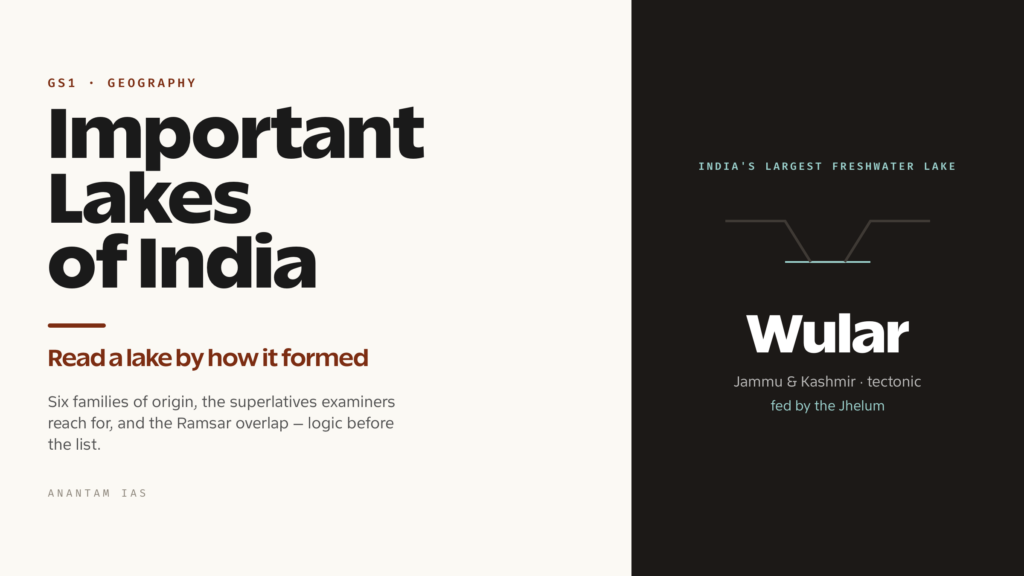
A lake is simply a body of water sitting in a hollow on the land, cut off from the sea, fed by rivers, rain, springs or melting ice. That plain definition hides a lot of variety. Some Indian lakes are sweet enough to drink from, others are saltier than the sea. Some are older than the Himalaya, others were filled by engineers in the 1960s. Knowing which is which is the whole game.
For an aspirant, lakes are a quiet, high-yield corner of geography. Prelims loves the superlatives (largest, highest, only one of its kind) and the odd one out in a match-the-pairs set. Mains and environment papers reach for lakes as case studies in wetland loss, the Ramsar Convention, and inland water security. The trouble is that most material treats lakes as a flat list to be crammed. This page does the opposite: it teaches you to read a lake by how it formed, so the names stick to a logic instead of floating loose in your memory.
Why Lakes Matter Beyond the Map
Lakes are not scenery. They are working parts of the water cycle and, in India, increasingly fragile ones. A lake stores monsoon runoff and releases it slowly, which is why a healthy lake softens both floods and droughts. It recharges the groundwater under nearby fields. And it carries a startling share of biodiversity for its size, which is exactly why so many Indian lakes are protected as Ramsar sites, the global label for “wetlands of international importance.”
Take Chilika in Odisha. It is a fishing economy for over 200,000 people, a winter home for lakhs of migratory birds, and the last refuge of the rare Irrawaddy dolphin in India. Or Loktak in Manipur, whose floating mats of vegetation, the phumdis, hold up the world’s only floating national park and shelter the endangered Sangai deer. Loktak sits on the Montreux Record, the Ramsar list of wetlands in ecological trouble, a reminder that a lake can be world-famous and dying at the same time. Tourism, salt production at Sambhar, hydropower at the big reservoirs, snake-boat races on Vembanad: lakes earn their keep in a dozen ways, which is the deeper reason the exam keeps coming back to them. If you want the broader context, our explainer on the aquatic ecosystem sets out the zones and food chains that make these waters tick.
Types of Lakes by Formation
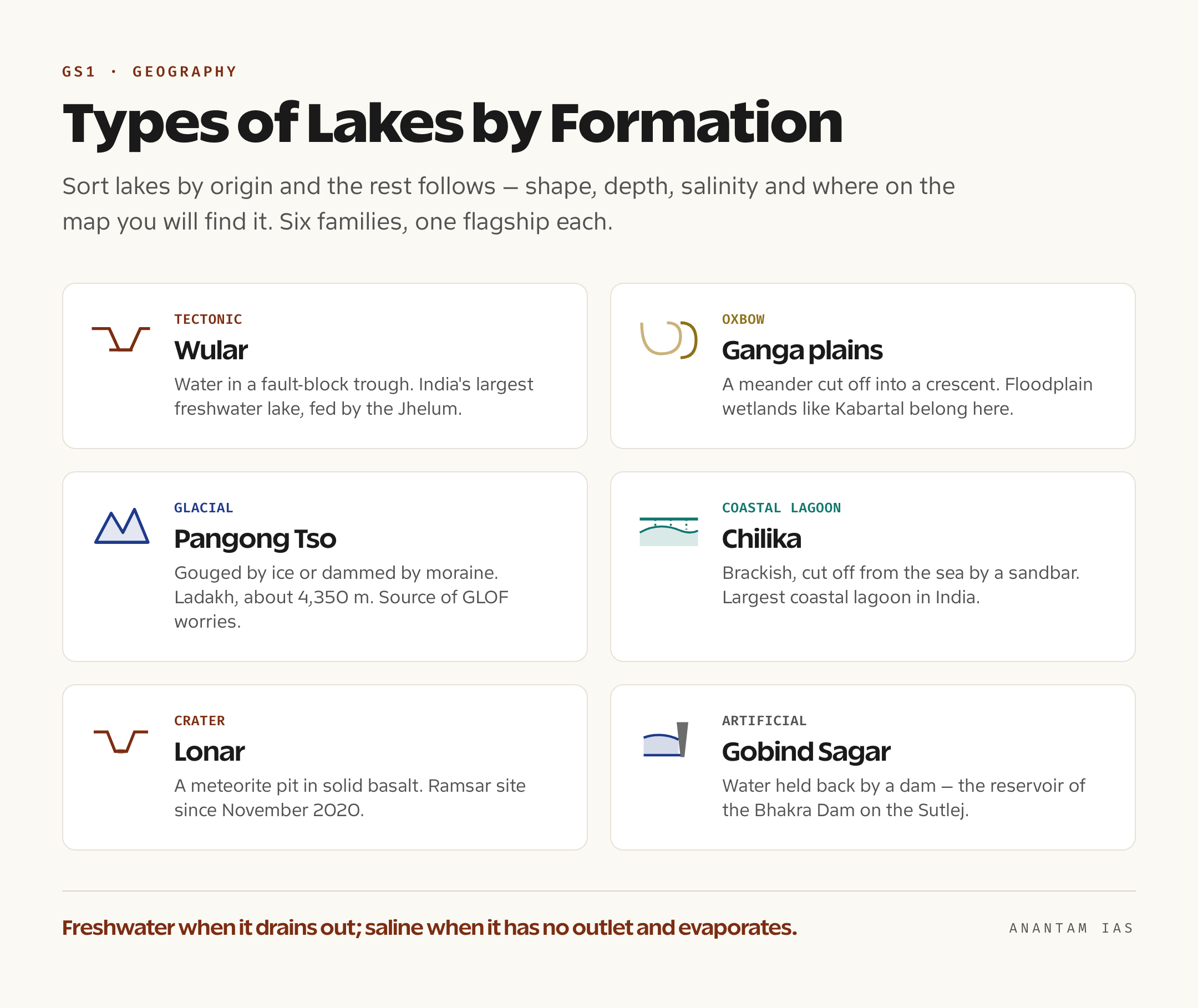
The cleanest way to learn Indian lakes is to sort them by origin, because formation decides almost everything else: shape, depth, salinity, and where on the map you will find it. There are six families worth knowing cold, and each has a flagship Indian example.
Tectonic lakes sit in basins created by the movement and faulting of the Earth’s crust. When a block of land subsides between fault lines, water collects in the depression. India’s largest freshwater lake, Wular in Jammu and Kashmir, formed this way, in a tectonic trough fed by the Jhelum. Most of the high-altitude lakes of the Kashmir and Ladakh region trace back to crustal movement.
Oxbow lakes are the signature of a meandering river. As a river in its plains stage swings in big loops, it eventually cuts across the neck of a loop and abandons the curve, leaving a crescent of standing water shaped like a bow. The Ganga plains are full of them, and several Ramsar wetlands of Bihar and Uttar Pradesh, such as Kabartal and Deepor Beel further east, are floodplain lakes of this lineage. If a question describes a curved, cut-off lake on a flat alluvial plain, it is an oxbow.
Glacial lakes form where a glacier has gouged out a hollow or where its melt collects behind a dam of rock debris (a moraine). The Himalaya is studded with them. Pangong Tso in Ladakh, a long ribbon of brackish water at about 4,350 metres, and Tsomgo (Changu) in Sikkim at roughly 3,753 metres, are the textbook examples. These are the lakes behind the modern worry over glacial lake outburst floods.
Lagoon and coastal lakes are shallow brackish stretches of water cut off from the sea by a sandbar or spit, so they mix salt and fresh water. This is where India holds a genuine world record: Chilika is the largest coastal lagoon in India and the second largest in the world. Pulicat on the Andhra-Tamil Nadu border and Vembanad in Kerala belong to the same coastal family.
Crater lakes fill a volcanic crater or a meteorite impact pit. India’s standout is Lonar in Maharashtra, gouged out by a meteorite strike into solid basalt, one of only a handful of such hyper-velocity craters in basalt anywhere on Earth. It became a Ramsar site in November 2020.
That leaves the man-made family. Artificial lakes, or reservoirs, are simply the water held back by a dam. Gobind Sagar behind the Bhakra Dam on the Sutlej, and Govind Ballabh Pant Sagar behind the Rihand Dam in Uttar Pradesh, are the giants here. The salinity story cuts across all of these: a lake is freshwater when rivers flow through and out of it, and saline when it has no outlet and the sun evaporates the water away, leaving the salts behind. Sambhar is the classic closed, evaporating basin; Dal and Wular are flushed by the Jhelum and stay fresh.
Superlatives Every Aspirant Must Know
If you remember nothing else, remember the records, because Prelims tests them almost every year. Here is the short list, with the trap that usually comes attached.
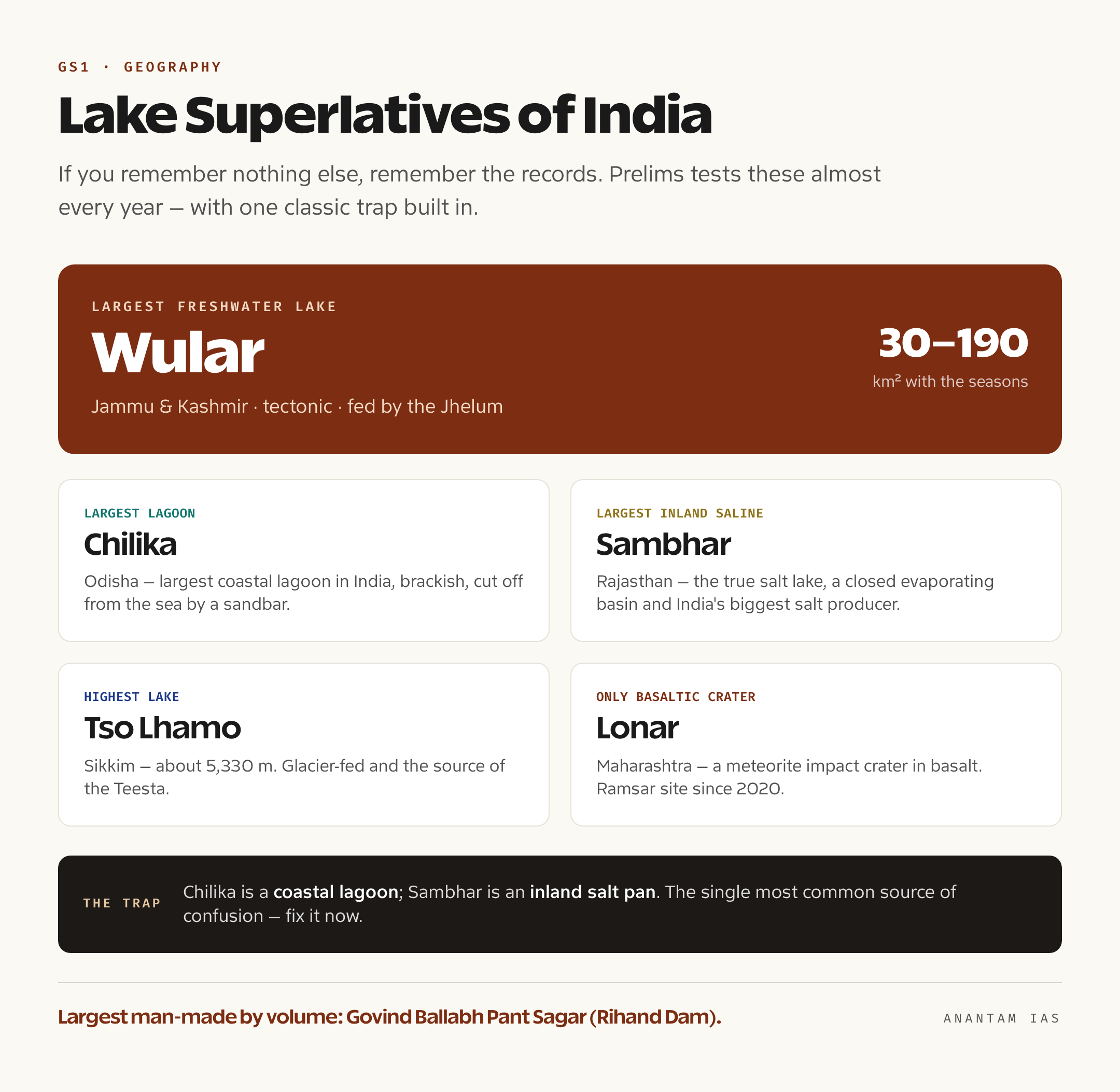
The largest freshwater lake is Wular in Jammu and Kashmir, whose extent swells from around 30 to nearly 190 square kilometres with the seasons. The largest saltwater lake, in the lagoon sense, is Chilika in Odisha, the largest brackish-water lagoon in the country. But the largest inland saline lake, the true salt lake, is Sambhar in Rajasthan, a Ramsar site and India’s biggest salt producer. That Chilika-versus-Sambhar distinction is the single most common source of confusion, so fix it now: Chilika is a coastal lagoon, Sambhar is an inland salt pan.
The highest lake is Tso Lhamo, also written Cholamu, in Sikkim at about 5,330 metres, fed by Himalayan glaciers and the source of the Teesta river. The only basaltic crater lake, born of a meteorite, is Lonar in Maharashtra. And among reservoirs, the largest man-made lake by water volume is Govind Ballabh Pant Sagar behind the Rihand Dam in Sonbhadra, Uttar Pradesh. Memorise these six and you have covered the bulk of what an objective paper will throw at you.
Complete List of Important Lakes of India
The table below is the working reference you will come back to. Read it once by state to anchor the geography, then a second time by type using the column on the right. Where a lake is a Ramsar site, the note says so, because the lakes list and the Ramsar list overlap heavily and examiners enjoy exploiting that overlap. For the full wetland picture, pair this with our guide to the Ramsar sites in India.
| Lake | State / UT | Type | Note |
|---|---|---|---|
| Wular | Jammu & Kashmir | Tectonic, freshwater | Largest freshwater lake; Ramsar site; fed by Jhelum |
| Dal | Jammu & Kashmir | Freshwater | Srinagar’s “jewel”; shrinking from encroachment |
| Pangong Tso | Ladakh | Glacial, brackish | About 4,350 m; extends into Tibet; endorheic |
| Tso Lhamo (Cholamu) | Sikkim | Glacial | Highest lake in India, about 5,330 m; source of Teesta |
| Tsomgo (Changu) | Sikkim | Glacial | Sacred high-altitude lake, about 3,753 m |
| Sambhar | Rajasthan | Inland saline | Largest inland salt lake; Ramsar site; salt production |
| Dhebar (Jaisamand) | Rajasthan | Artificial | Among the largest man-made lakes; built in 17th century |
| Lonar | Maharashtra | Crater (meteorite) | Only basaltic impact crater lake; Ramsar site (2020) |
| Chilika | Odisha | Coastal lagoon | Largest coastal lagoon in India; Ramsar; Irrawaddy dolphins |
| Pulicat | Andhra Pradesh / Tamil Nadu | Coastal lagoon | Second largest brackish lagoon; Pulicat bird sanctuary |
| Vembanad | Kerala | Coastal lagoon | Longest lake in India; Ramsar; Nehru Trophy boat race |
| Loktak | Manipur | Freshwater | Largest in NE India; floating phumdis; on Montreux Record |
| Kolleru | Andhra Pradesh | Freshwater | Between Krishna and Godavari deltas; Ramsar site |
| Gobind Sagar | Himachal Pradesh | Artificial | Reservoir of Bhakra Dam on the Sutlej |
| Govind Ballabh Pant Sagar | Uttar Pradesh | Artificial | Largest man-made lake by volume; Rihand Dam |
| Pushkar | Rajasthan | Freshwater | Sacred lake; famous cattle fair |
| Hussain Sagar | Telangana | Artificial | Heart-shaped lake linking Hyderabad and Secunderabad |
| Bhimtal / Nainital | Uttarakhand | Tectonic / glacial | Kumaon lake district; tectonic-origin basins |
How to Study This for UPSC
Start with formation, not the list. Spend your first sitting learning the six origin types and pinning one example to each: Wular for tectonic, an oxbow for the Ganga plains, Pangong Tso for glacial, Chilika for lagoon, Lonar for crater, Gobind Sagar for man-made. Once the categories are in place, the long list reads itself, because every new lake slots into a family you already know. This is the step most aspirants skip, and it is the whole secret to retaining names you would otherwise forget by exam day.
Next, lock the superlatives and the Ramsar overlap. For Prelims, build a one-line “record” sheet (largest freshwater, largest saline, highest, longest, only crater) and revise it weekly until it is automatic, since these are nearly free marks. Cross-check each lake against the Ramsar list using our wetlands of India page, because match-the-pairs questions love to mix a lake’s state, its type, and its Ramsar status in one set. For Mains and the environment paper, do not memorise the table; instead, prepare two or three lakes as living case studies of wetland degradation, Loktak and Dal being the obvious choices, and connect them to encroachment, eutrophication, and the Ramsar Convention’s wise-use principle. Skip the encyclopaedic depth on minor lakes. You need recognition, not a dissertation. For the river systems that feed many of these basins, the Indus river system note is a useful companion.
Frequently Asked Questions
Which is the largest freshwater lake in India? Wular Lake in Jammu and Kashmir is the largest freshwater lake in India. It is a tectonic-origin lake fed mainly by the Jhelum river, and its surface area expands and contracts dramatically with the seasons, from roughly 30 to nearly 190 square kilometres.
What is the difference between Chilika and Sambhar lakes? Both are salty, but in different ways. Chilika in Odisha is the largest coastal lagoon, a brackish body cut off from the sea by a sandbar, so it is the largest saltwater lake in that lagoon sense. Sambhar in Rajasthan is the largest inland saline lake, a closed basin where evaporation concentrates the salt, and India’s biggest source of salt.
Which is the highest lake in India? Tso Lhamo, also spelled Cholamu, in Sikkim is India’s highest lake at about 5,330 metres. It is fed by Himalayan glaciers and is the source of the Teesta river, lying close to the international border with China.
Why is Lonar Lake special? Lonar in Maharashtra is the only lake in India formed by a meteorite striking solid basalt rock, making it one of very few hyper-velocity impact craters in basalt on Earth. It is both saline and alkaline, an unusual combination, and was declared a Ramsar site in 2020.
Are lakes and Ramsar sites the same thing? No. A lake is a landform; a Ramsar site is a conservation status given to a wetland of international importance, which may be a lake, marsh, river stretch, or coastal area. Many famous Indian lakes such as Wular, Chilika, Sambhar, Loktak and Vembanad are also Ramsar sites, but plenty of lakes are not, and plenty of Ramsar sites are not lakes.
Practice Questions
Prelims MCQs
- Which of the following is the largest freshwater lake in India? (a) Dal (b) Chilika (c) Wular (d) Loktak. Answer: (c) Wular Lake in Jammu and Kashmir, a tectonic lake fed by the Jhelum, is the largest freshwater lake in the country.
- Tso Lhamo (Cholamu) Lake, the highest lake in India, is located in which state and feeds which river? (a) Ladakh; Indus (b) Sikkim; Teesta (c) Himachal Pradesh; Sutlej (d) Arunachal Pradesh; Subansiri. Answer: (b) Tso Lhamo lies in Sikkim at about 5,330 metres and is the source of the Teesta.
- Which lake of India was formed by a meteorite impact into basaltic rock? (a) Sambhar (b) Kolleru (c) Lonar (d) Pulicat. Answer: (c) Lonar Lake in Maharashtra is the only basaltic impact-crater lake in India and a Ramsar site since 2020.
- With reference to lake formation, which pair is correctly matched? (a) Pangong Tso – oxbow (b) Wular – glacial (c) Chilika – coastal lagoon (d) Sambhar – tectonic. Answer: (c) Chilika is a coastal lagoon; Pangong Tso is glacial, Wular is tectonic, and Sambhar is an inland saline basin.
- The reservoir Govind Ballabh Pant Sagar is associated with which dam? (a) Bhakra (b) Rihand (c) Hirakud (d) Tehri. Answer: (b) Govind Ballabh Pant Sagar, India’s largest man-made lake by volume, is the reservoir of the Rihand Dam in Uttar Pradesh.
Mains Practice Questions
- Classify the lakes of India on the basis of their mode of formation, illustrating each type with a suitable example. (10 marks, 150 words)
- “India’s lakes are both ecological assets and economic lifelines, yet many are dying.” Examine this statement with reference to two threatened lakes. (15 marks, 250 words)
- Discuss the significance of the Ramsar Convention for the conservation of India’s lakes and wetlands, and assess how far it has succeeded. (15 marks, 250 words)
- High-altitude glacial lakes in the Himalaya pose a growing hazard. Explain the phenomenon of glacial lake outburst floods and suggest measures to manage the risk. (10 marks, 150 words)
- Differentiate between freshwater and saline lakes in terms of their formation and distribution in India, and explain why some inland lakes turn saline. (10 marks, 150 words)
Lakes reward the aspirant who learns the logic before the list. Once you can look at any name and place it in a formation family, the superlatives and the Ramsar overlaps stop being separate facts to cram and become consequences you can reason out under exam pressure. Keep the records sheet close, treat one or two threatened lakes as case studies you genuinely understand, and let the rest of the table do what reference pages are for: a quick glance before the exam, not a wall to memorise. That shift, from list to logic, is what turns this quiet corner of geography into easy, dependable marks.
Tell Google you want more of this.
Add Anantam IAS as a preferred sourceOne tap, and this site shows up more often in your own Top Stories, AI Overviews and AI Mode. Remove it any time.