Ishwar Chandra Vidyasagar (1820–1891) was one of the most towering figures of the Bengal Renaissance — a scholar, educator, writer, social reformer, and philanthropist whose efforts transformed Bengali society in the 19th century. Born Ishwar Chandra Bandyopadhyay, he earned the title “Vidyasagar” (Ocean of Knowledge) from the Sanskrit College in Calcutta for his extraordinary scholarship. His crusade for widow remarriage, opposition to child marriage, and reform of Bengali education make him an indispensable figure in Modern Indian History for UPSC.
Early Life and Education
- Born: 26 September 1820, in Birsingha village, Midnapore district (present-day West Midnapore, West Bengal).
- Family: Born into a poor Brahmin family; father Thakurdas Bandyopadhyay was of modest means.
- Education: Walked with his father from Midnapore to Calcutta at the age of 9 to pursue education. Studied at the Sanskrit College, Calcutta, where he excelled in Sanskrit, Bengali, astronomy, Hindu law, Vedanta philosophy, and English.
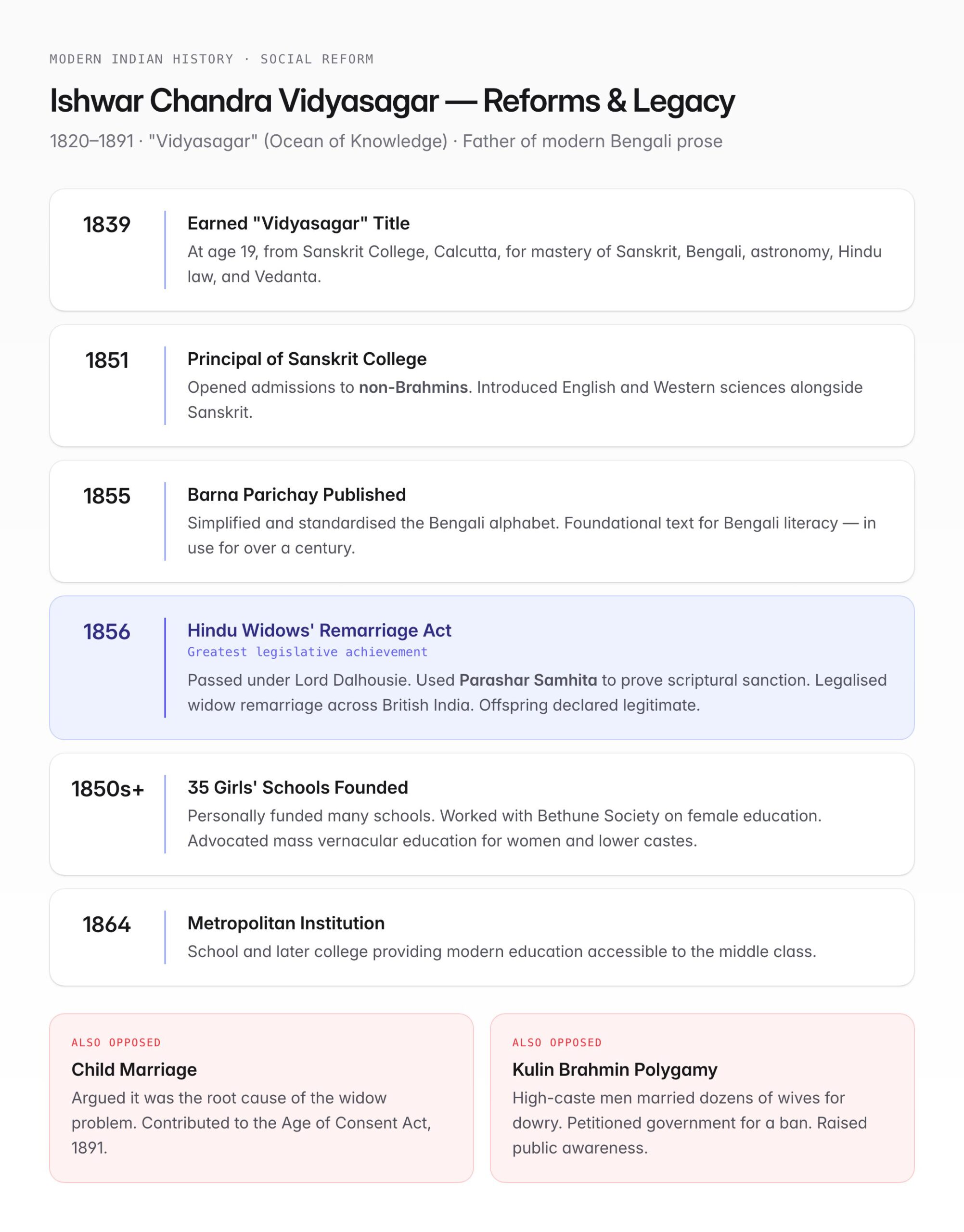
- Title: Earned the title "Vidyasagar" in 1839 at the age of 19 from the Sanskrit College, in recognition of his unparalleled mastery of multiple disciplines.
- Career at Sanskrit College: Became a professor and later the Principal of Sanskrit College (1851), where he introduced sweeping reforms.
Education Reform
Vidyasagar's contributions to education were revolutionary on multiple fronts:
Reform of the Bengali Alphabet and Prose
- Simplified the Bengali alphabet — reorganised and standardised Bengali script, reducing its complexity and making it more accessible for mass education.
- His primer, "Barna Parichay" (Introduction to the Alphabet), published in 1855, is still regarded as the foundational text for learning Bengali. It remained in use for over a century.
- Modernised Bengali prose — his writing style broke with the ornate, Sanskritised tradition and introduced a clear, flowing, accessible prose. His works are considered to have established modern Bengali prose as a literary medium.
- Key literary works include adaptations from Sanskrit such as "Shakuntala", "Sitar Banabas" (Exile of Sita), and "Bhranti Bilash" (an adaptation of Shakespeare's The Comedy of Errors).
Institutional Reforms at Sanskrit College
- As Principal of Sanskrit College, he:
- Opened admissions to non-Brahmin students — previously, only Brahmins could study at the Sanskrit College. Vidyasagar argued that Sanskrit learning should not be confined to a single caste.
- Introduced the study of English and Western sciences alongside Sanskrit, recognising the importance of modern education.
- Promoted a secular, rational approach to education.
Establishment of Schools
- Founded 35 girls' schools across Bengal, personally funding many of them.
- Established the Metropolitan Institution (1864) — a school and later a college — to provide modern education accessible to the middle class.
- Advocated for mass vernacular education, particularly for women and lower castes who had been systematically excluded.
- Worked with the Bethune Society to promote female education; the Bethune School (established 1849 by John Elliot Drinkwater Bethune with Vidyasagar's active support) was one of the first schools for Hindu girls in India.
Widow Remarriage Movement
Vidyasagar's most celebrated contribution to social reform was his tireless campaign for Hindu widow remarriage:
The Problem
- In 19th-century Hindu society, widows — often child widows whose husbands had died before the marriage was even consummated — were condemned to a life of severe deprivation.
- Widows were forced to shave their heads, wear white, eat one meal a day, and live in social isolation.
- Remarriage was prohibited by prevailing social and religious norms, condemning thousands of young women to lifelong suffering.
- The practice of Sati (self-immolation on the husband’s funeral pyre) had been banned by Lord William Bentinck in 1829 through the efforts of Raja Ram Mohan Roy, but the condition of surviving widows remained deplorable.
Vidyasagar's Strategy
- Vidyasagar adopted a brilliant strategy of using Hindu scriptural authority to argue for reform. He studied the Parashar Samhita (an ancient Hindu legal text) and demonstrated that widow remarriage was sanctioned by the Shastras in specific circumstances.
- This approach was strategic — by citing religious texts, he neutralised the orthodox argument that remarriage was against Hindu religion.
- He wrote extensively, including his influential treatise "Marriage of Hindu Widows" (1855), which marshalled scriptural, logical, and humanitarian arguments.
- He petitioned the government, gathering thousands of signatures in support of legislation.
The Hindu Widows' Remarriage Act, 1856
Vidyasagar's campaign culminated in the passing of the Hindu Widows' Remarriage Act XV of 1856 by Lord Dalhousie's government:
- The Act legalised the remarriage of Hindu widows across all of British India.
- It declared that the offspring of such remarriages would be legitimate.
- However, a widow who remarried would forfeit her rights in the deceased husband's property.
- The Act faced fierce opposition from orthodox Hindu groups, who organised counter-petitions and social boycotts of reformers.
Aftermath
- Despite the law, social resistance meant that very few widow remarriages actually took place in the initial decades.
- Vidyasagar personally organised and financed several widow remarriages, including one for his own son, who married a widow.
- He spent a large part of his personal wealth supporting widows and their families.
Opposition to Child Marriage
Vidyasagar was equally vocal against child marriage (also called Bal Vivah):
- He argued that child marriage was the root cause of the widow problem — girls married at ages as young as 5 or 6 were widowed before adolescence.
- He campaigned for raising the age of marriage and advocated that consent should be a prerequisite.
- His efforts contributed to the broader reform movement that eventually led to the Age of Consent Act, 1891 (which raised the age of consent for girls to 12, applicable to marital relations).
Opposition to Polygamy
Vidyasagar also campaigned against Kulin Brahmin polygamy — a practice in Bengal whereby high-caste Brahmins married multiple wives (sometimes dozens) for dowry and social status, while the wives lived in neglect:
- He submitted petitions to the government seeking a ban on polygamy.
- Though legislation was not enacted during his lifetime, his campaign raised public awareness and contributed to the gradual decline of the practice.
Character and Legacy
Vidyasagar was known for his extraordinary compassion and personal integrity:
- Michael Madhusudan Dutt, the great Bengali poet, said of him: "A man among men, one who embodied the best of the ancient and the modern."
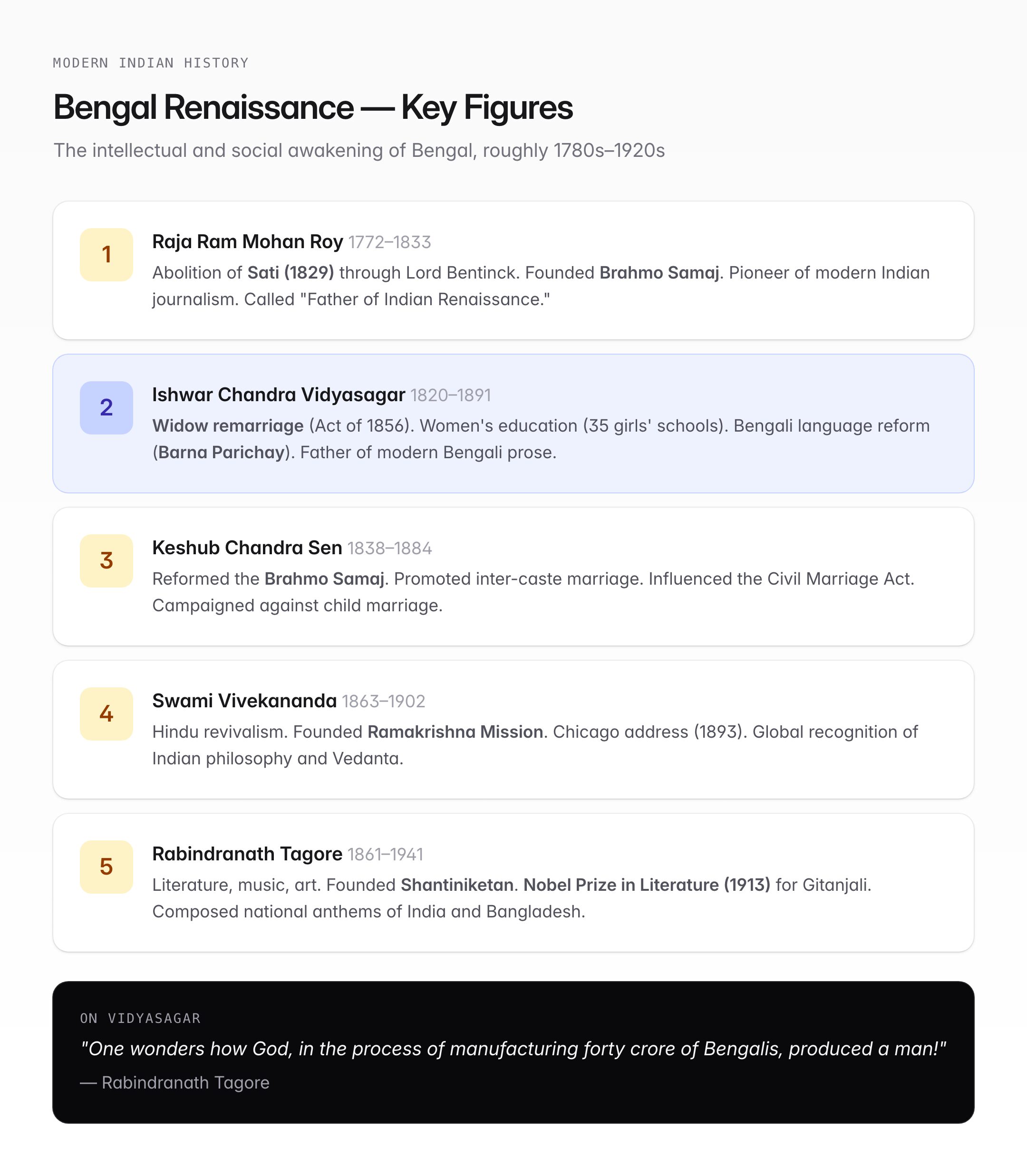
- Rabindranath Tagore wrote: “One wonders how God, in the process of manufacturing forty crore of Bengalis, produced a man!”
- He spent his later years in Karmatand, Jharkhand, among the Santhal tribal community, disillusioned by the orthodoxy and ingratitude of Bengali society.
- He died on 29 July 1891 in Calcutta.
Key Legacy
- Father of modern Bengali prose — his contribution to the Bengali language is foundational.
- Pioneer of women's education in Bengal.
- The Hindu Widows' Remarriage Act, 1856 remains his greatest legislative achievement.
- His pragmatic approach — combining scriptural argument with legislative action — became a model for later social reformers.
- Vidyasagar Setu (Second Hooghly Bridge, Kolkata) and Vidyasagar University (Midnapore) are named after him.
Place in the Bengal Renaissance
The Bengal Renaissance (roughly 1780s–1920s) was a period of cultural, intellectual, and social awakening in Bengal. Vidyasagar, along with Raja Ram Mohan Roy, Swami Vivekananda, Rabindranath Tagore, and Bankim Chandra Chattopadhyay, was a central figure:
| Reformer | Key Contribution |
|---|---|
| Raja Ram Mohan Roy | Abolition of Sati (1829); Brahmo Samaj; modern Indian journalism |
| Ishwar Chandra Vidyasagar | Widow remarriage; women's education; Bengali language reform |
| Keshub Chandra Sen | Brahmo Samaj reform; promoted inter-caste marriage |
| Swami Vivekananda | Hindu revivalism; Ramakrishna Mission; global recognition of Indian philosophy |
| Rabindranath Tagore | Literature; Shantiniketan; Nobel Prize (1913) |
UPSC Relevance
GS Paper I — Modern Indian History: Social reform movements; education in British India; Bengal Renaissance.
GS Paper I — Society: Role of women; social empowerment.
Prelims key facts:
- Ishwar Chandra Vidyasagar (1820–1891) earned the title "Vidyasagar" (Ocean of Knowledge) from Sanskrit College.
- His campaign led to the Hindu Widows' Remarriage Act, 1856, passed under Lord Dalhousie.
- He used the Parashar Samhita to argue that widow remarriage was sanctioned by Hindu scripture.
- He is called the "Father of modern Bengali prose"; his primer "Barna Parichay" reformed Bengali script.
- He opened Sanskrit College to non-Brahmins and founded 35 girls' schools in Bengal.
- He established the Metropolitan Institution (1864) for modern education.
- He opposed child marriage and Kulin Brahmin polygamy.
- Sati was abolished in 1829 by Lord Bentinck through the efforts of Raja Ram Mohan Roy — Vidyasagar's widow remarriage movement addressed the plight of surviving widows.
- The Age of Consent Act, 1891 was partly influenced by the broader reform movement Vidyasagar championed.
Tell Google you want more of this.
Add Anantam IAS as a preferred sourceOne tap, and this site shows up more often in your own Top Stories, AI Overviews and AI Mode. Remove it any time.