
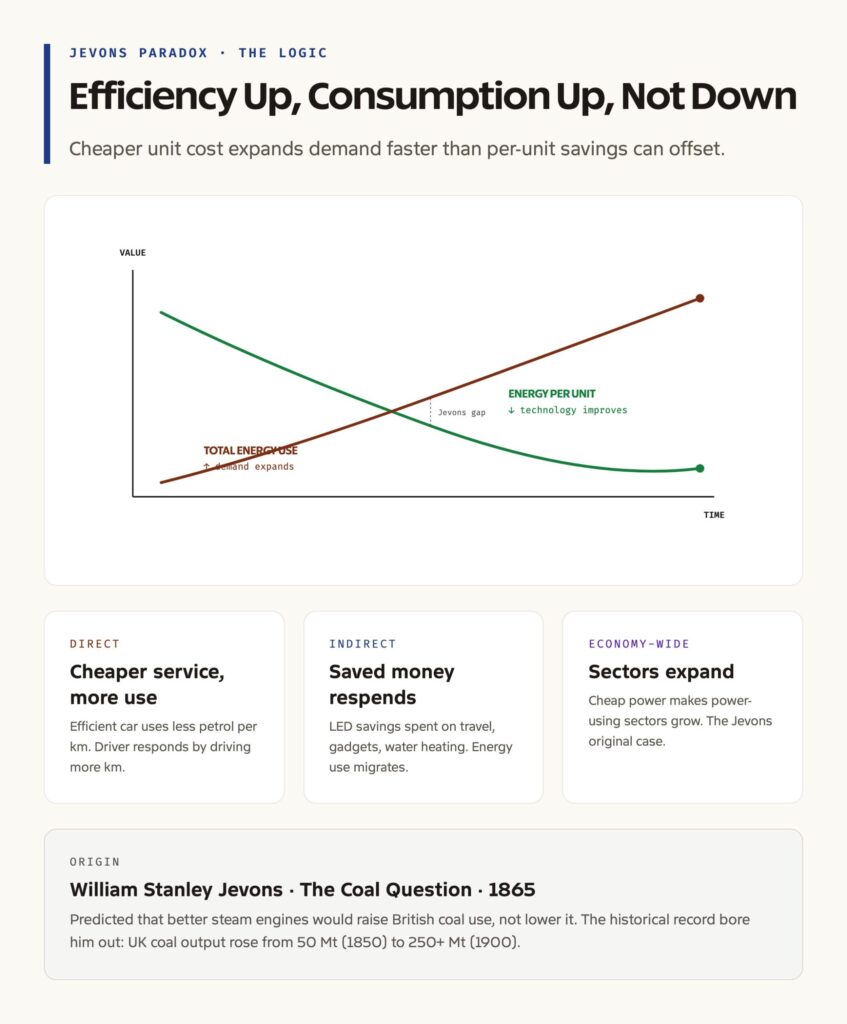
The Jevons Paradox is the observation that improvements in the efficiency with which a resource is used often increase, rather than decrease, the total consumption of that resource. The idea was first set out by the English economist William Stanley Jevons in 1865, in a book called The Coal Question. Jevons argued that more efficient steam engines would not save coal in British factories. They would lower the cost of using coal, raise demand for coal-fired services, and end up burning more coal in absolute terms. The historical record bore him out for the next half century.
The paradox has returned to centre stage. Efficient artificial intelligence systems have lowered the cost of running each query, and the volume of queries has exploded. LED lighting has cut the electricity used per lumen, and lighting demand worldwide has risen. More efficient air conditioners have driven cooling penetration, and cooling demand in tropical countries is among the fastest-growing electricity loads. Each case follows the Jevons pattern.
This article explains what the Jevons Paradox is, why it works, where it appears in the modern Indian economy, and what it means for energy and climate policy.
Quick Facts on the Jevons Paradox
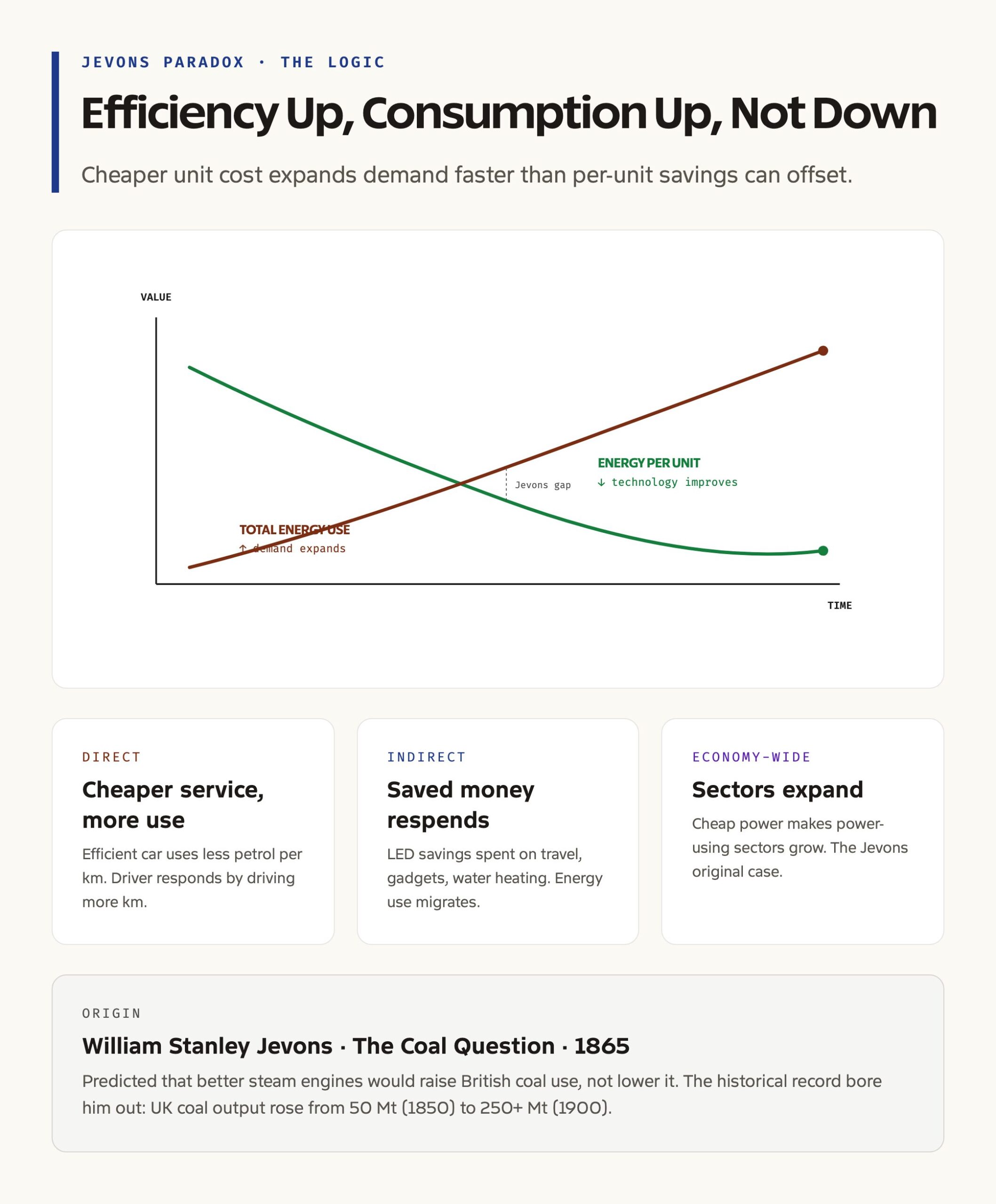
The Jevons Paradox states that technological progress, by making a resource cheaper or more efficient to use, can increase overall demand for that resource and therefore raise total consumption. It was named for William Stanley Jevons, who set out the argument in The Coal Question in 1865.
The phenomenon is sometimes called the rebound effect, though the rebound effect is technically broader. A rebound is any increase in resource use that follows from an efficiency improvement. The Jevons Paradox is the special case where the rebound is so large that total use rises rather than falls. The economists Daniel Khazzoom and Leonard Brookes formalised the relationship in the 1980s, and the result is sometimes called the Khazzoom-Brookes postulate.
The paradox is most often observed in three places. First, in basic energy commodities such as coal, oil, and electricity. Second, in technologies whose efficiency improvements directly lower the user cost of an attractive service, such as lighting, mobility, and computing. Third, in services whose elasticity of demand is high, meaning that a small drop in cost produces a large jump in usage.
The 1865 Coal Question
The Coal Question is one of the founding texts of resource economics. Jevons looked at the British economy of the mid-nineteenth century, dominated by coal-fired steam, and asked whether the country was at risk of running out of coal. The dominant view at the time was that better steam engines would solve the problem by burning less coal per unit of work. Jevons disagreed.
His argument had three steps. First, more efficient engines lowered the cost of mechanical power. Second, lower cost of mechanical power raised the profitability of coal-using industries, including ironworks, textiles, railways, and shipping. Third, the expansion of those industries drove a larger increase in coal demand than the efficiency improvement saved per unit. The net effect was higher coal consumption.
The historical record validated the argument. British coal output rose from roughly fifty million tonnes in 1850 to over two hundred and fifty million tonnes by 1900, even as the steam engine became radically more efficient.
Why the Paradox Works
Three mechanisms drive the rebound. The first is the direct rebound. A more efficient car uses less petrol per kilometre, so the cost of each kilometre falls, and the driver responds by driving more. The energy saved per kilometre is partially offset by the additional kilometres.
The second is the indirect rebound. The money saved on petrol is spent on other goods and services, most of which also embody energy use. A household that saves on lighting bills with LEDs spends the saved money on electronics, on travel, or on heated water. Each of these adds energy demand.
The third is the economy-wide rebound. Efficiency improvements that affect a whole sector lower production costs, raise output, and shift the structure of the economy toward energy-intensive activities. The classic Jevons case is at this level. Industrial coal use rose because coal-using industries grew, not just because each factory drove its boiler harder.
The size of the rebound depends on the elasticity of demand for the energy service, on the share of energy in total cost, and on how much the saved income is redirected into other energy-intensive consumption. Where elasticity is low and energy share is small, rebound is small. Where elasticity is high and the saved cost is large, rebound can exceed unity, and the Jevons Paradox holds.
The AI Case
The most-discussed contemporary case is artificial intelligence. The cost of a single inference query, measured in compute and electricity, has fallen by orders of magnitude over the last five years. Model architectures have become more efficient. Hardware accelerators have become more capable. The energy cost per query for a typical large language model query is a small fraction of what it was in 2020.
Total energy use by AI has not fallen. It has risen sharply. The number of queries has grown faster than the per-query efficiency gain. The number of models in production has multiplied. The number of users has crossed the billion mark. Data centre electricity demand attributable to AI workloads has become a noticeable item on national grid forecasts. The International Energy Agency, in its 2024 outlook, identified AI compute as one of the fastest-growing electricity loads of the decade.
This is a textbook Jevons case. Efficiency went up. Cost per unit went down. Demand expanded. Total consumption rose. The argument that efficient AI will reduce its environmental footprint, taken on its own, fails the historical test.
Indian Cases of the Jevons Pattern
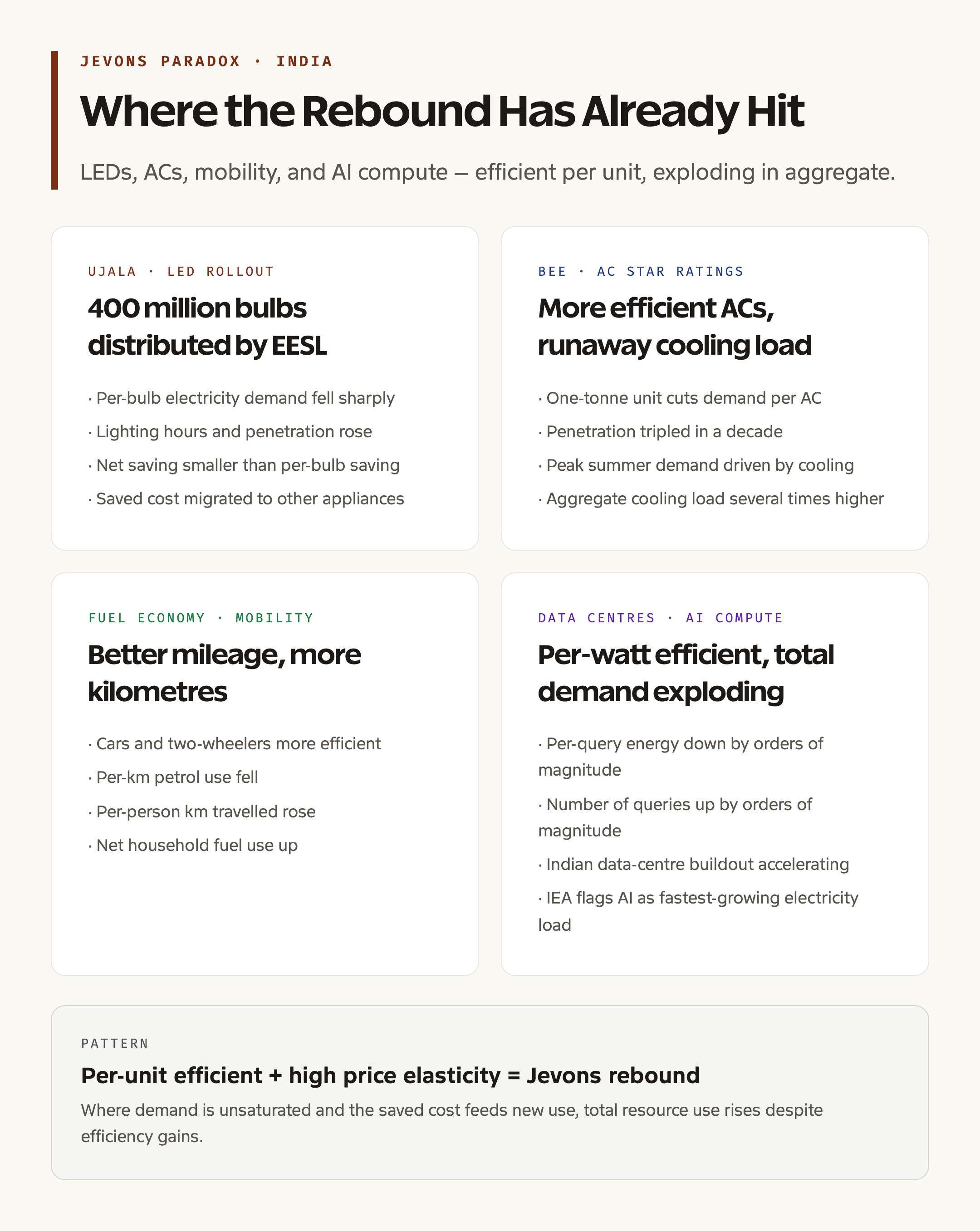
India offers several clear examples. The first is the LED lighting rollout. The Unnat Jyoti by Affordable LEDs for All programme distributed close to four hundred million LED bulbs through Energy Efficiency Services Limited. Each bulb consumes a fraction of the electricity of the incandescent it replaced. Lighting electricity demand per household fell. Total household lighting hours rose, as cheap-to-run lights stayed on longer and were installed in spaces previously left unlit. The net electricity saving was lower than the per-bulb saving suggested.
The second is air conditioning. Bureau of Energy Efficiency star ratings have steadily lowered the electricity demand of a one-tonne air conditioner. Cooling penetration has risen sharply. India added more air conditioning units in the last decade than in the previous three combined. The per-unit efficiency improvement was real. The aggregate cooling load on the grid is now several times what it was. Peak summer demand has been driven hard by cooling.
The third is mobility. More fuel-efficient cars and two-wheelers, combined with rising household incomes, have multiplied the kilometres travelled per person. The per-kilometre fuel efficiency has improved. The per-person fuel use has risen.
The fourth is data centres and AI compute. Indian data centre capacity has grown rapidly, supported by the hyperscaler build-out and the data localisation requirements. Each watt of compute is more efficient than five years ago. Total compute, and therefore total electricity consumption, is many times higher. The same Jevons pattern repeats.
The Policy Implication
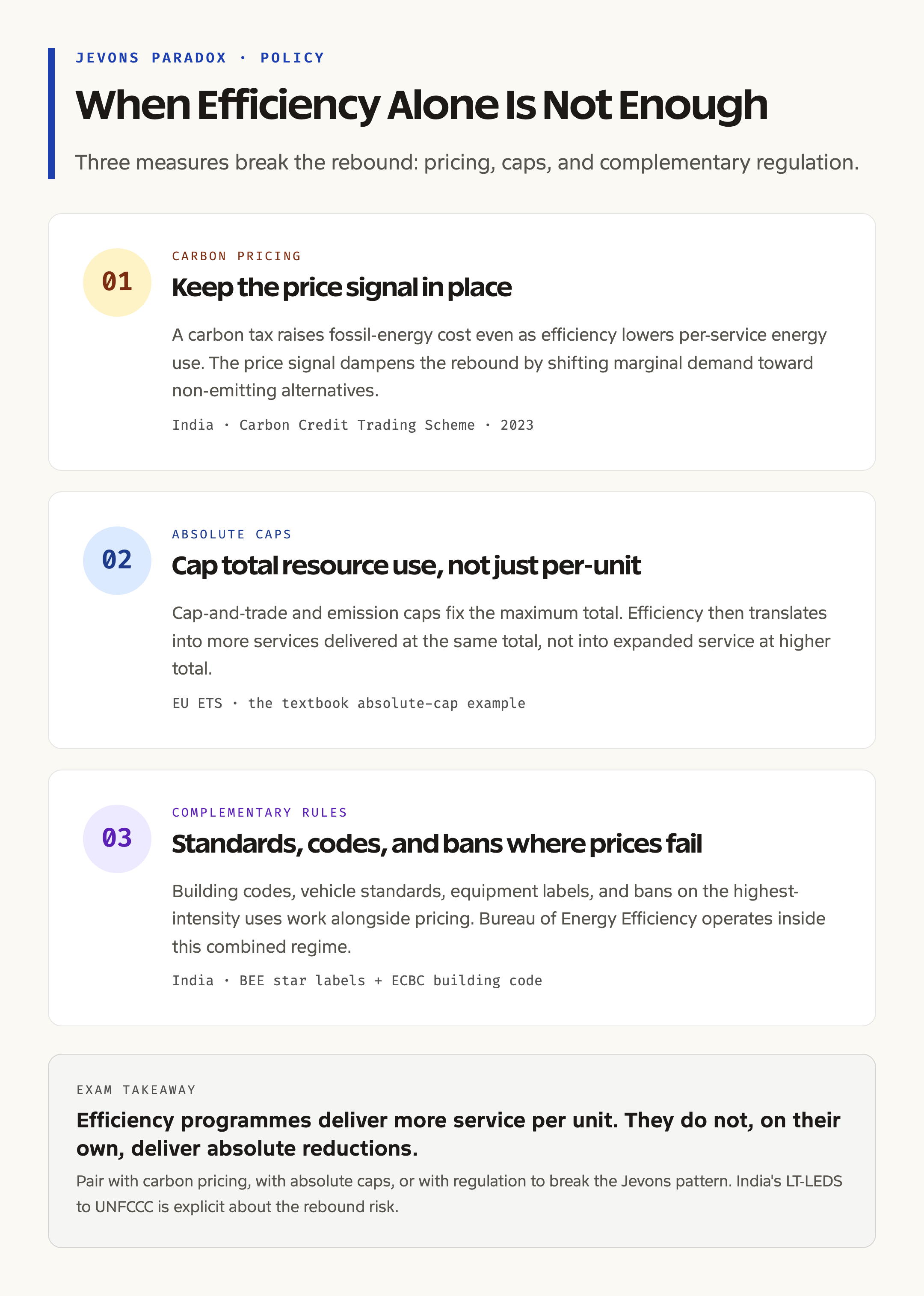
The honest reading of the Jevons Paradox is not that efficiency programmes are pointless. It is that efficiency programmes, on their own, do not deliver absolute reductions in resource use. They deliver more service per unit of resource. Whether total resource use falls or rises depends on how the saved cost is spent and on whether the policy regime caps the absolute level of resource use.
Three complementary measures break the rebound. The first is carbon pricing or resource pricing. A carbon tax raises the cost of fossil-energy use even as efficiency lowers the energy intensity of each service. The price signal stays in place, dampening the rebound.
The second is absolute caps. A cap-and-trade system or an emissions cap puts a hard limit on total resource use. Efficiency improvements then translate into more services delivered at the same or lower total resource use, rather than into expanded service at higher total use.
The third is complementary regulation. Building codes, vehicle standards, and equipment standards backed by labels work in tandem with efficiency. The Bureau of Energy Efficiency operates inside this combined regime. Standards plus pricing plus targeted bans, particularly for the highest-intensity uses, are what break the Jevons pattern.
The Indian National Energy Policy and the Long-Term Low Emission Development Strategy submitted to the UNFCCC are explicit about the rebound risk. Both call for efficiency to be paired with carbon pricing instruments and with absolute emission targets. The Carbon Credit Trading Scheme notified in 2023 is a step toward the absolute-cap leg of that policy mix. The Cooling and BEE programmes recognise the rebound in cooling explicitly.
Where the Paradox Does Not Apply
Not every efficiency improvement triggers the Jevons Paradox. Where demand is saturated, where price elasticity is low, or where the resource is heavily regulated, efficiency improvements deliver real absolute reductions.
Refrigeration in the United States is one example. Refrigerator efficiency improved roughly threefold between 1975 and 2010, and per-household refrigeration electricity demand fell. The saturation of refrigerator ownership, the slow turnover of installed appliances, and the absence of a parallel growth in refrigeration uses kept the rebound modest.
Industrial coal in the European Union is another. Tight emission caps under the EU Emissions Trading System forced absolute coal reductions even as the efficiency of remaining coal plants improved. The hard cap blocked the Jevons mechanism.
The lesson is that the paradox is not a universal law. It is a contingent outcome of high price elasticity, expanding demand, and weak absolute constraints. Where any of these is absent, efficiency improvements can deliver the savings they advertise.
Why This Matters for the UPSC Syllabus
The Jevons Paradox sits at the intersection of GS-III environment, GS-III economy, and GS-III science and technology. It explains why India’s renewable energy push, the Bureau of Energy Efficiency programmes, and the LED rollout have not, on their own, produced absolute reductions in coal use or peak electricity demand.
For prelims, the safe set of facts is the 1865 origin in Jevons’s The Coal Question, the Khazzoom-Brookes formalisation, the rebound mechanism, and the standard examples of LEDs, AI compute, and fuel-efficient vehicles. For mains, the paradox is most usefully deployed in answers on energy policy, climate mitigation, and the limits of efficiency-only strategies. It pairs naturally with coal sector reforms, the energy sector, and the question of energy poverty in India.
Frequently Asked Questions
Who first described the Jevons Paradox?
The English economist William Stanley Jevons, in his 1865 book The Coal Question. He observed that more efficient steam engines were associated with rising, not falling, coal consumption in British factories.
Is the Jevons Paradox the same as the rebound effect?
No. The rebound effect is any increase in resource use that follows from an efficiency improvement. The Jevons Paradox is the special case where the rebound exceeds 100 per cent and total consumption rises rather than falls.
Why does AI use more energy if each query is more efficient?
Because the number of queries, the number of models in production, and the number of users have all risen faster than per-query efficiency has improved. Total compute has expanded, and total electricity demand has expanded with it.
Does the Jevons Paradox mean efficiency programmes are useless?
No. Efficiency improvements still deliver more service per unit of resource. They do not, on their own, reduce total resource use. They have to be paired with carbon pricing, absolute emission caps, or complementary regulation to deliver an absolute reduction.
How does the paradox apply to India’s LED rollout?
The Unnat Jyoti programme cut electricity per bulb sharply. Lighting hours and lighting penetration both rose, partially offsetting the per-bulb saving. The rollout still delivered net savings, but the savings were smaller than the per-bulb efficiency suggested.
Tell Google you want more of this.
Add Anantam IAS as a preferred sourceOne tap, and this site shows up more often in your own Top Stories, AI Overviews and AI Mode. Remove it any time.