The RECLAIM Framework is the Ministry of Coal’s flagship 2025 initiative to convert closed mines from environmental scars into productive landscapes. Launched in July 2025 by the Coal Controller Organisation in partnership with the Heartfulness Institute, it tackles a problem India can no longer postpone: hundreds of mines are nearing exhaustion, energy policy is shifting toward renewables, and mining communities risk being abandoned without livelihoods or restored land.
What sets RECLAIM apart is its insistence that mine closure is a social process, not just an engineering one. The acronym stands for Reviving Environment, Communities, Livelihoods Around Impacted Mines, and each word is load-bearing. For UPSC aspirants, RECLAIM sits at the intersection of GS-III environment, GS-II governance, and the just transition debate that anchors India’s net-zero pathway.
Quick Facts
- Full form: Reviving Environment, Communities, Livelihoods Around Impacted Mines
- Launched: July 2025
- Nodal ministry: Ministry of Coal, Government of India
- Lead implementing agency: Coal Controller Organisation (CCO)
- Knowledge partner: Heartfulness Institute
- Type: Community engagement and post-closure rehabilitation framework
- Target: Coal and mineral mining regions facing closure due to resource exhaustion or energy transition
- Approach: Socially just, environmentally restorative, livelihood-oriented
- Status: Voluntary framework, complementary to statutory Mine Closure Plans
What is the RECLAIM Framework?
RECLAIM is a structured methodology for handling the entire arc of mine closure, from pre-closure community consultation through long-term post-closure rehabilitation. It was developed because India’s existing Mine Closure Plan rules, while technically sound, focus heavily on physical reclamation: backfilling pits, stabilising slopes, replanting cover. They say less about what happens to the workers, the families, and the village economies built around a mine that no longer pays wages.
The framework treats a closing mine as a transition zone rather than a write-off. It asks five questions in sequence. What does the land become? What do the workers do next? How is local trust rebuilt? Who pays for long-term monitoring? And how is success measured beyond the date the gates lock? RECLAIM is voluntary but is expected to inform future statutory revisions to mine closure obligations under the Mines and Minerals (Development and Regulation) Act framework.
Background and Context
India’s coal sector is at an inflection point. Coal India Limited operates over 300 mines, and a significant share have either reached end-of-life or are heading there within a decade. Add to this the international pressure from the COP climate negotiations and India’s own Panchamrit commitments, and a clear pattern emerges: some mines will close earlier than their geological reserves dictate.
Historically, closed mines in India have left behind subsidence, acidic water bodies, degraded farmland, and unemployment. The Jharia coalfield fires, the Raniganj subsidence, and the post-closure ghost economies in parts of Dhanbad and Korba illustrate what happens when closure is treated as paperwork. Globally, Germany’s Ruhr Valley transformation and Australia’s Latrobe Valley plan offered templates, but India needed an indigenous framework that fit its scale, its forest-tribal interface, and its informal-sector mining workforce. RECLAIM is the Ministry of Coal’s answer.
Key Pillars of RECLAIM
The framework rests on five operating pillars that together define a complete closure cycle.
- Environmental restoration: Soil rebuilding, water body remediation, biodiversity recovery, and integration with biodiversity in India corridors where applicable.
- Community engagement: Pre-closure consultations, gram sabha integration, women-led committees, and tribal council participation under Forest Rights Act compliance.
- Livelihood transition: Reskilling for renewables, agro-forestry, eco-tourism, and small-enterprise formation around restored sites.
- Land repurposing: Conversion of mined-out land into solar parks, pumped-storage hydro sites, plantation forests, fisheries, or community spaces.
- Long-term monitoring: Structured post-closure stewardship, typically thirty years, with measurable ecological and socio-economic indicators.
Each pillar has a designated lead within the CCO and a partner agency, with the Heartfulness Institute providing the human-engagement and well-being dimension that traditional engineering plans omit.
Why RECLAIM Matters
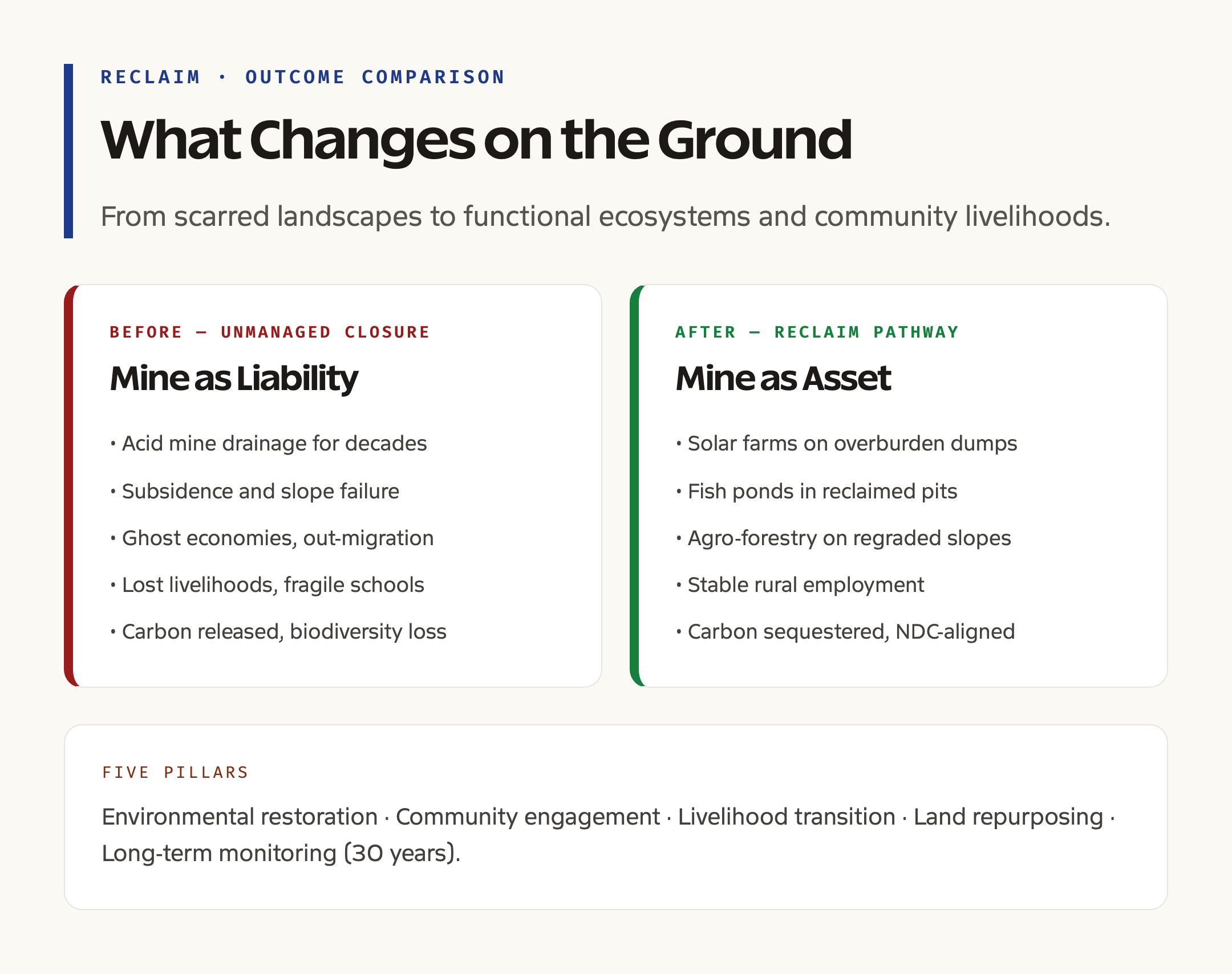
RECLAIM matters because mine closure done badly is a multi-decade liability. Acid mine drainage continues for decades. Subsidence affects roads and railways. Communities migrate, schools empty out, and the social fabric frays. Done well, however, closure can be a catalyst. Solar farms on overburden dumps, fish ponds in reclaimed pits, and agro-forestry on regraded slopes can generate more steady income than late-stage mining did.
There’s a fiscal dimension too. The Mine Closure Cost is held in escrow by the regulator, and RECLAIM provides a quality framework for how that money is actually spent. There’s a climate dimension, since restored land sequesters carbon and counts toward India’s nationally determined contributions. And there’s an equity dimension, since mining regions like Korba, Dhanbad, Singrauli, and Talcher overlap with tribal and forest-dependent populations that have historically borne the costs of extraction without proportionate benefits.
How RECLAIM Operates: The Process
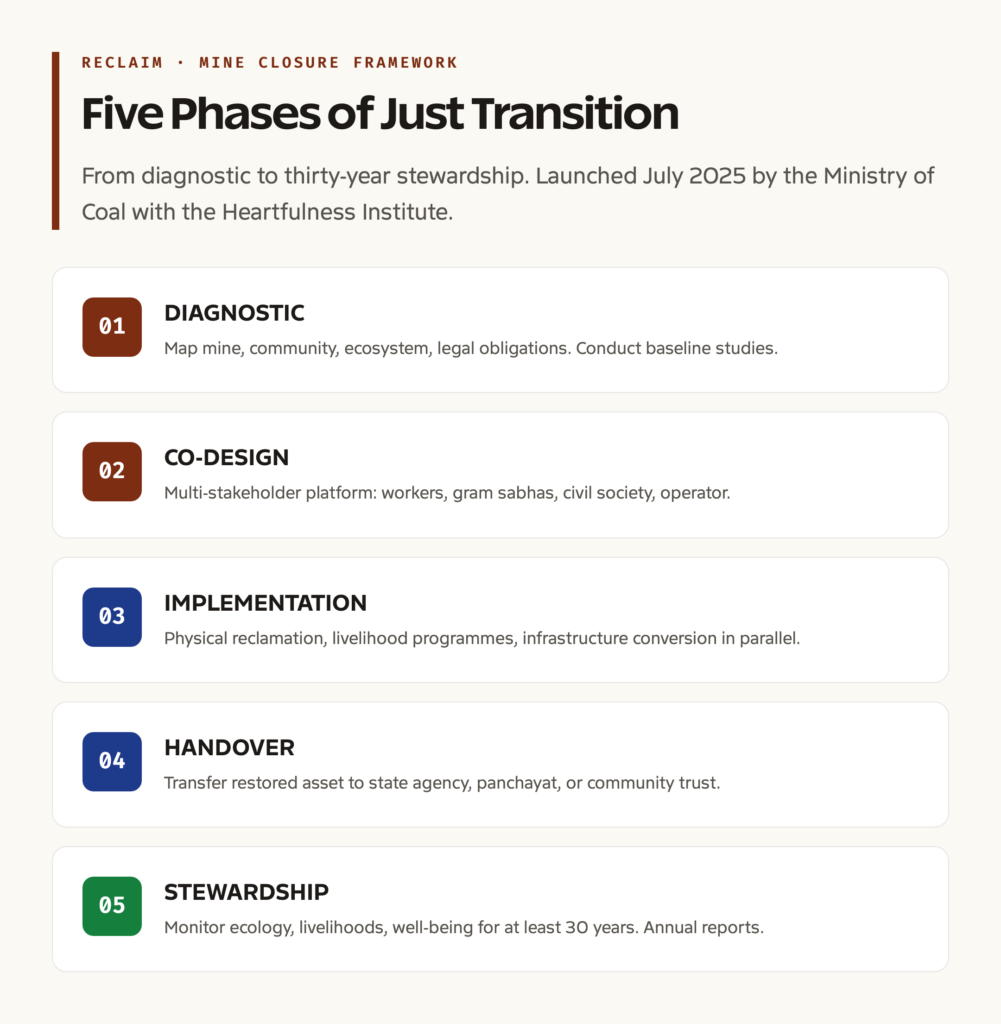
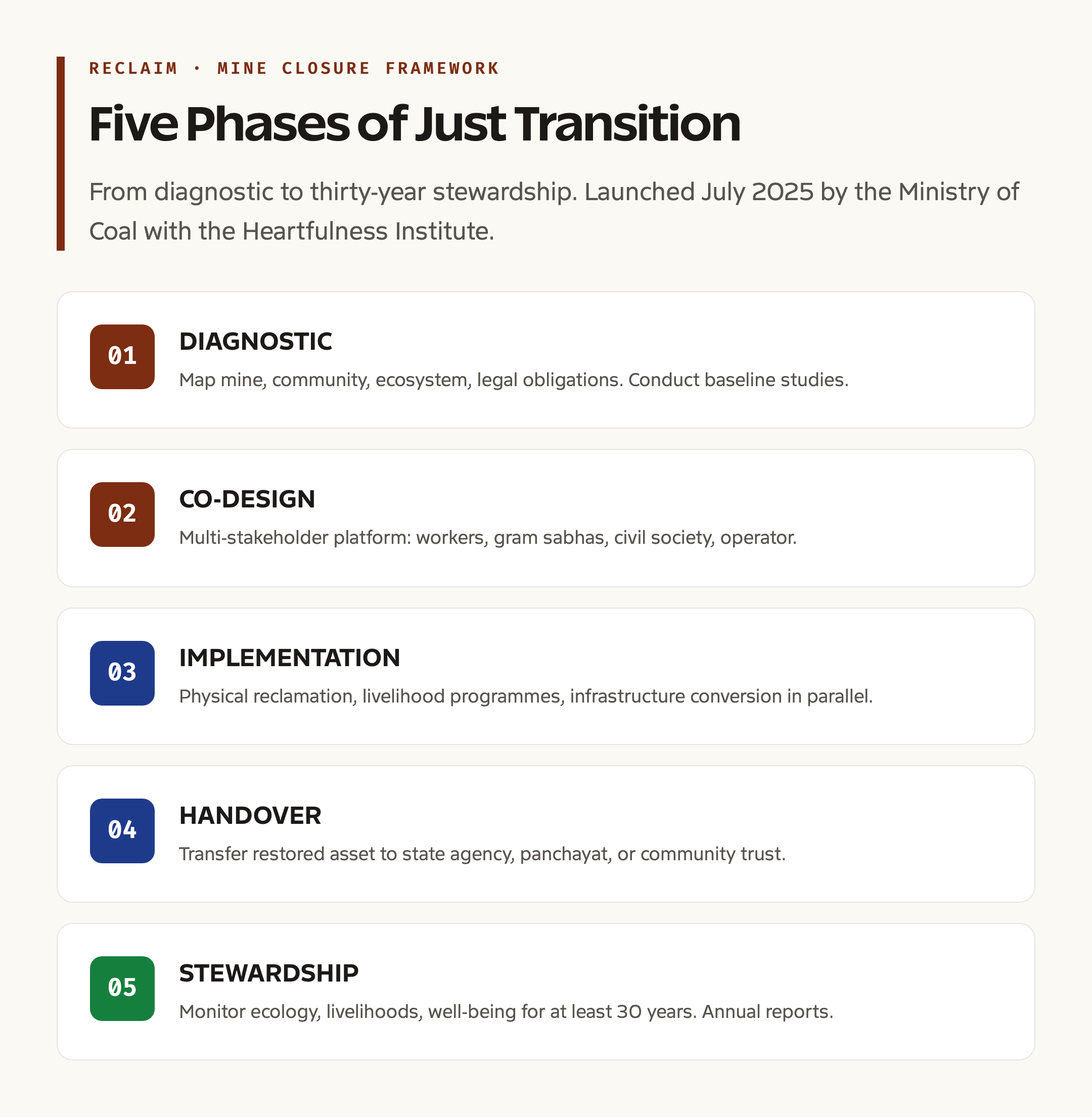
The framework defines a five-phase implementation cycle:
- Phase 1 — Diagnostic: Map the mine, the community, the ecosystem, and the legal obligations. Conduct social impact and environmental baseline studies.
- Phase 2 — Co-design: Convene a multi-stakeholder platform. Workers, gram sabhas, civil society, and the mine operator jointly draft a transition plan.
- Phase 3 — Implementation: Execute physical reclamation, livelihood programmes, and infrastructure conversion in parallel rather than sequence.
- Phase 4 — Handover: Transfer the restored asset to a custodian, typically a state agency, panchayat, or community trust, with a documented stewardship plan.
- Phase 5 — Stewardship: Monitor ecological recovery, livelihood outcomes, and community well-being for at least three decades. Publish annual reports.
This phased model is what distinguishes RECLAIM from a one-shot reclamation project. The continuum from diagnostic to stewardship is the framework’s core innovation.
RECLAIM vs Statutory Mine Closure Plan
| Dimension | Statutory MCP | RECLAIM Framework |
|---|---|---|
| Legal status | Mandatory | Voluntary (best-practice) |
| Focus | Physical reclamation | Holistic transition |
| Community role | Limited consultation | Co-design partner |
| Livelihood plan | Optional | Core pillar |
| Monitoring period | Up to 5 years | 30 years recommended |
| Lead agency | Mine operator | CCO + community |
| Knowledge partner | None mandated | Heartfulness Institute |
The two are complementary. RECLAIM is intended to elevate the quality of MCP submissions and may eventually inform statutory amendments.
Challenges and Critiques
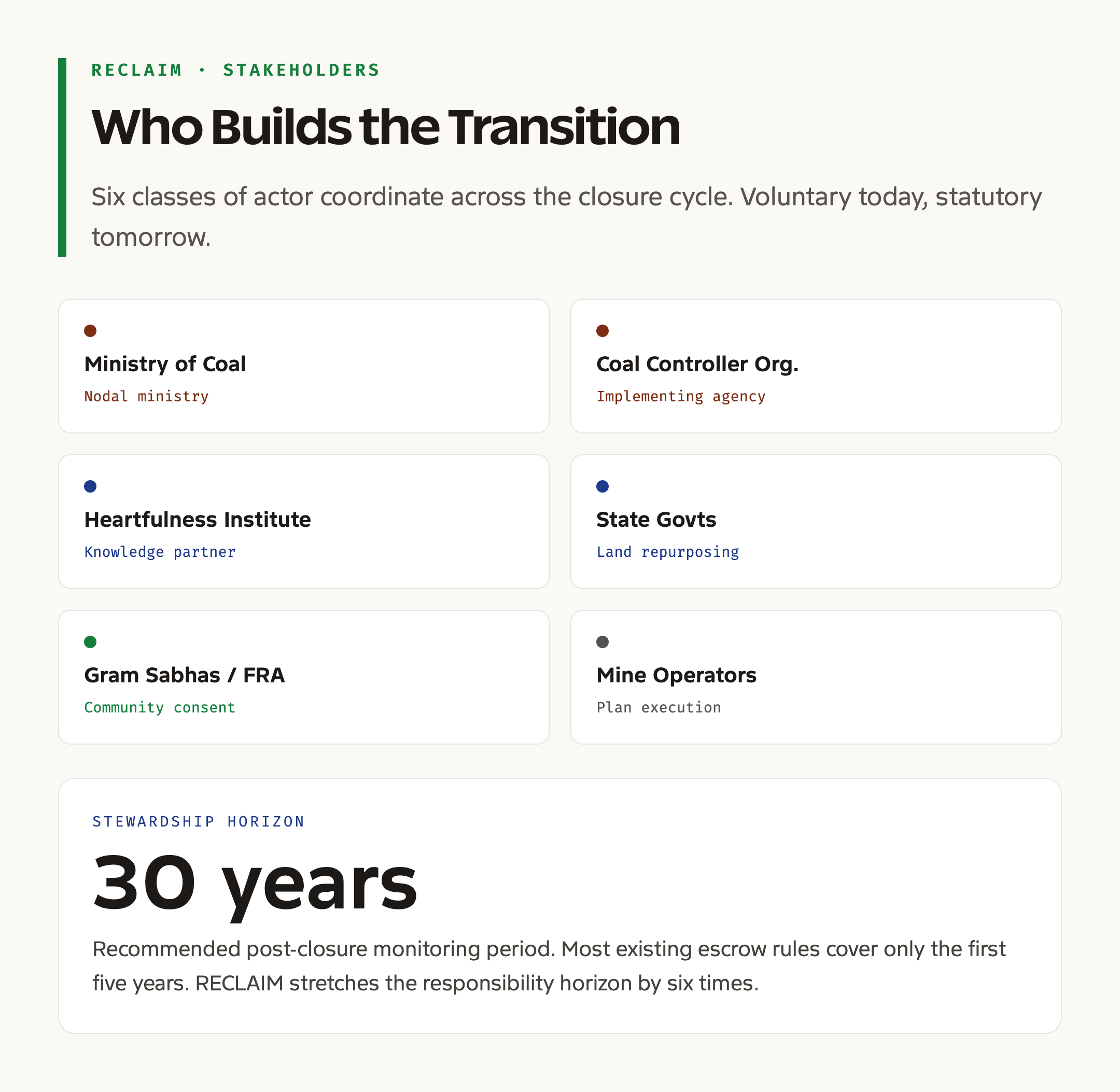
RECLAIM’s voluntary status is its biggest vulnerability. Without legal teeth, operators can sign on for the optics and revert to minimum-compliance behaviour during execution. Funding is another open question. Existing escrow rules don’t fully cover three-decade stewardship, and supplementary financing from state mineral funds or carbon markets remains untested at scale.
There are also capacity gaps. Many mining districts lack the institutional depth to host complex multi-stakeholder transitions. Civil society organisations with experience in environmental impact assessment processes are concentrated in metros, not in coal belts. The framework also doesn’t yet address the informal mining workforce, which is large in states like Jharkhand and Odisha and falls outside formal worker registers.
Prelims Pointers
- RECLAIM was launched in July 2025 by the Ministry of Coal.
- The full form is Reviving Environment, Communities, Livelihoods Around Impacted Mines.
- It was developed by the Coal Controller Organisation in partnership with the Heartfulness Institute.
- It is a voluntary framework, complementary to the statutory Mine Closure Plan.
- The recommended post-closure stewardship period is 30 years.
- It rests on five pillars: environment, community, livelihood, land repurposing, monitoring.
- The framework is part of India’s broader just transition strategy aligned with COP commitments.
Mains Angles
- GS-III, Environment: Discuss how RECLAIM operationalises the principle of just transition in India’s coal sector. Compare with international precedents like Germany’s Ruhr Valley.
- GS-III, Economy: Evaluate the fiscal architecture of mine closure in India. Should RECLAIM be made statutory? Examine the role of escrow funds and carbon markets in financing long-term stewardship.
- GS-II, Governance: Analyse the multi-stakeholder governance model proposed under RECLAIM. How does it interact with gram sabha authority under PESA and FRA?
- GS-I, Society: Mining-dependent communities face acute vulnerability during closure. Discuss how RECLAIM addresses social equity and the gendered dimensions of livelihood transition.
- Essay: “An empty mine is not the end of a story. It is the beginning of a different one.” Critically examine in light of India’s mine closure policy.
Way Forward
The most important next step for RECLAIM is institutional embedding. The framework needs a permanent secretariat within the CCO, dedicated budget lines, and clear escalation pathways when an operator fails to deliver. Pilot demonstrations in two or three mature mining districts, with transparent annual reporting, would build the evidence base for eventual statutory adoption.
Convergence with other missions matters too. RECLAIM should align with the Green Credit Programme for plantation, with carbon credit trading for sequestration revenue, and with state renewable energy plans for solar repurposing of overburden dumps. A national mine-closure dashboard, publicly accessible, would lock in accountability. Done right, RECLAIM can transform how India thinks about extractive industries: not as one-way damage, but as transitions that must end as carefully as they began.
Frequently Asked Questions
What does RECLAIM stand for?
RECLAIM stands for Reviving Environment, Communities, Livelihoods Around Impacted Mines. It is a community engagement and post-closure rehabilitation framework launched by the Ministry of Coal in July 2025.
Who developed the RECLAIM Framework?
The framework was developed by the Coal Controller Organisation, the regulatory body under the Ministry of Coal, in partnership with the Heartfulness Institute, which contributes the human-engagement and community well-being dimension.
Is RECLAIM legally binding on mine operators?
No. RECLAIM is a voluntary best-practice framework. Mine operators continue to be governed by the statutory Mine Closure Plan rules, but RECLAIM is expected to influence future amendments and is treated as the gold standard for closure quality.
What are the five pillars of the RECLAIM Framework?
The five pillars are environmental restoration, community engagement, livelihood transition, land repurposing, and long-term monitoring. Each has a designated lead within the Coal Controller Organisation.
How is RECLAIM different from a Mine Closure Plan?
A Mine Closure Plan is mandatory and focuses primarily on physical reclamation over a short post-closure window. RECLAIM is voluntary, broader in scope, treats community as co-designers rather than consultees, and recommends thirty-year stewardship monitoring.
Why was RECLAIM launched in 2025?
India’s coal sector faces simultaneous pressures from resource exhaustion at older mines and the energy transition driven by climate commitments. RECLAIM responds by providing a structured framework so that closure becomes a development opportunity rather than a social and ecological liability.
What is the role of the Heartfulness Institute?
The Heartfulness Institute is the knowledge partner that brings expertise in community engagement, mental well-being, and reflective stakeholder dialogue. It helps translate technical reclamation plans into processes that local communities trust and own.
How does RECLAIM connect to the just transition debate?
Just transition is the principle that the shift away from fossil fuels must protect workers and host communities. RECLAIM is India’s first formal mine-level operationalisation of that principle, ensuring closure produces livelihoods, not displacement.
Does RECLAIM cover non-coal mines?
Yes, the framework is designed for both coal and other mineral mining regions. Its five-pillar structure is mineral-agnostic, though early implementation is concentrated in the coal belt.
Where can I read the official RECLAIM document?
The framework was launched by the Ministry of Coal in July 2025. Official documentation is published on the Coal Controller Organisation portal and through Ministry of Coal press releases.
Tell Google you want more of this.
Add Anantam IAS as a preferred sourceOne tap, and this site shows up more often in your own Top Stories, AI Overviews and AI Mode. Remove it any time.