Pick up a Kalighat painting and you are holding the cheapest art a 19th-century Indian could buy and the sharpest gossip a 19th-century Indian could see. It is a single sheet of mill-made paper, painted in minutes with a few sweeping brush strokes and flat watercolour — a goddess, or a fat dandy in patent shoes, or a priest caught in a murder scandal. It cost a pilgrim less than a meal. And it told the truth about colonial Calcutta in a way no oil portrait in a drawing room ever would.
That is what makes Kalighat painting unusual among India’s folk traditions. Most folk art looks inward and backward, to gods and harvests and village rhythm. Kalighat looked out of the window. It painted the city it lived in — the new Anglicised gentleman, the courtroom scandal in the morning paper, the moral panic of a society changing faster than it could cope with. For a few decades it was Bengal’s first popular pictorial press and its devotional souvenir trade rolled into one, and then cheap printing killed it. But it had already done enough to shape the modern Indian painter who came after, and that is why it still matters far beyond the temple gate it was born beside.
What Kalighat Painting Is
So start with the plain definition, because the name carries the whole story. Kalighat painting — often called Kalighat pat — is a school of popular Indian painting that emerged in the early-to-mid 19th century around the Kalighat Kali temple in Calcutta, now Kolkata. The temple, rebuilt in its present form in 1809, drew growing streams of pilgrims through the century, and where pilgrims go, a souvenir trade follows. The artists set up stalls along the lanes to the temple and sold painted sheets the way a modern shrine sells laminated prints.
What you actually get is a small, fast watercolour on paper. The V&A in London, which holds the world’s largest collection of these works, describes the typical sheet as A3 size or smaller, some no bigger than a postcard at roughly 13 by 8 centimetres. A single figure or a tight pair fills the page, set against almost nothing — no landscape, no architecture, just the painted body floating on bare paper. It is the opposite of the crowded, detailed miniature. And that emptiness is deliberate, because these were made to be made quickly and sold cheaply, by the thousand.
The two words that unlock the tradition are pat and patua. A pat is a painted scroll; a patua (the community also calls itself Chitrakar, literally “picture-maker”) is the hereditary scroll-painter who carried it from village to village, unrolling it frame by frame while singing the story it told. Kalighat painting is what happened when that wandering storyteller arrived in a colonial city and discovered that nobody had time to sit through a sung scroll — but everybody would pay a pice for a single bright picture to carry home. The art changed shape to fit the market. The hand stayed the same.
Origins and the Look of the Style
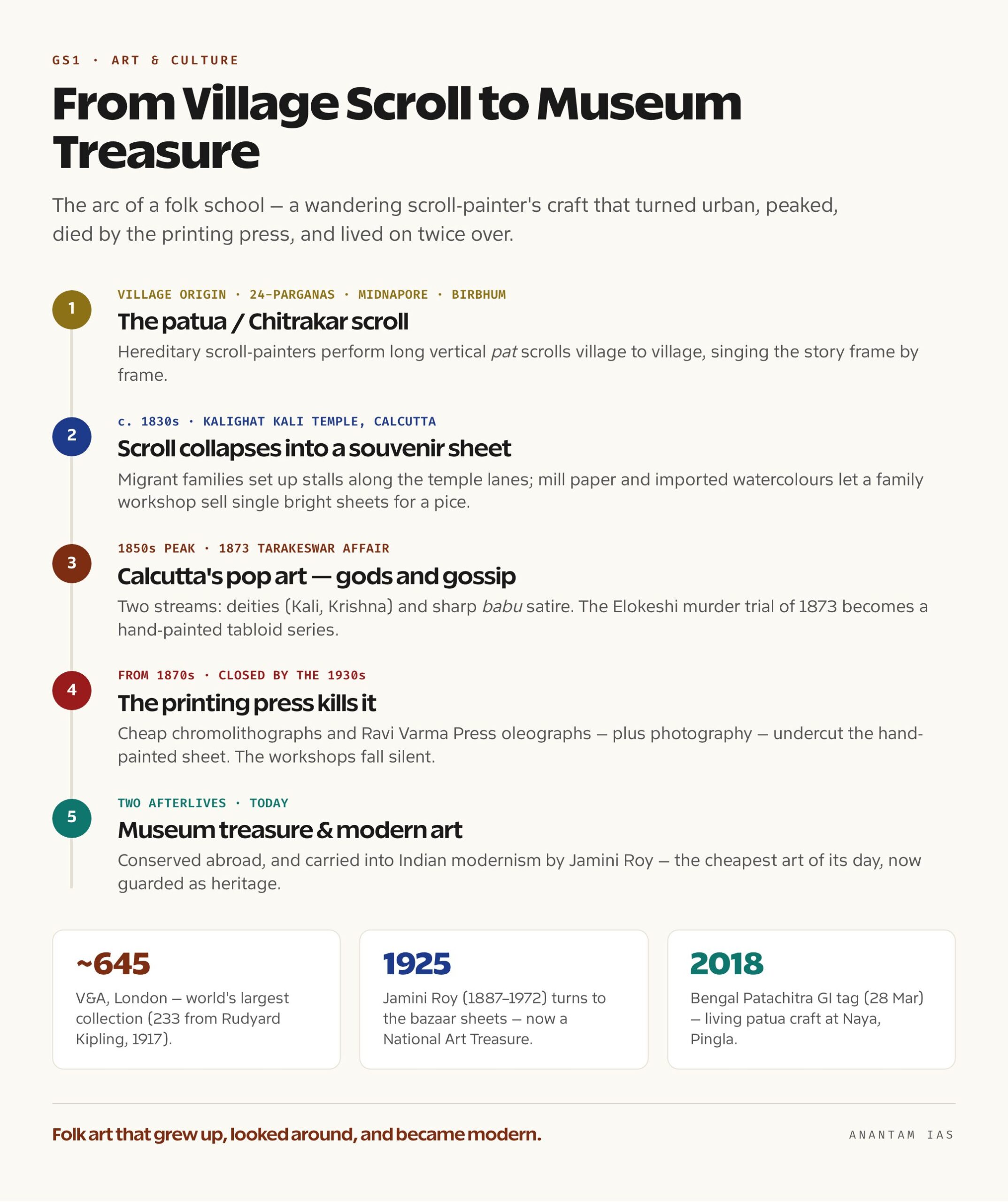
The deeper origin is a migration story. Through the 19th century, patua and kumbhakar (potter-painter) families drifted into Calcutta from the surrounding districts of 24-Parganas, Midnapore and Birbhum, pulled by the city’s spiritual economy and its harbour trade. In the village they had painted long vertical pat scrolls on cloth-backed paper and performed them as travelling entertainment. In the city they faced a new kind of buyer — a pilgrim or a clerk who wanted one image, now, cheap. So the form collapsed from a narrative scroll into a single souvenir sheet, and a folk craft turned into a small urban industry.
Three material shifts made it possible, and all three came from the colonial economy the artists were satirising. They swapped handmade scroll-paper for cheap mill-made paper. They swapped slow mineral colours for ready-made watercolours imported from Britain, which the V&A notes let them work far faster. And they organised the work like a small factory — the family worked as an assembly line, one hand laying the outline, another flooding in colour, a third adding tin or silver highlights — so a workshop could turn out sheets in volume and price them at a pice to a few annas.
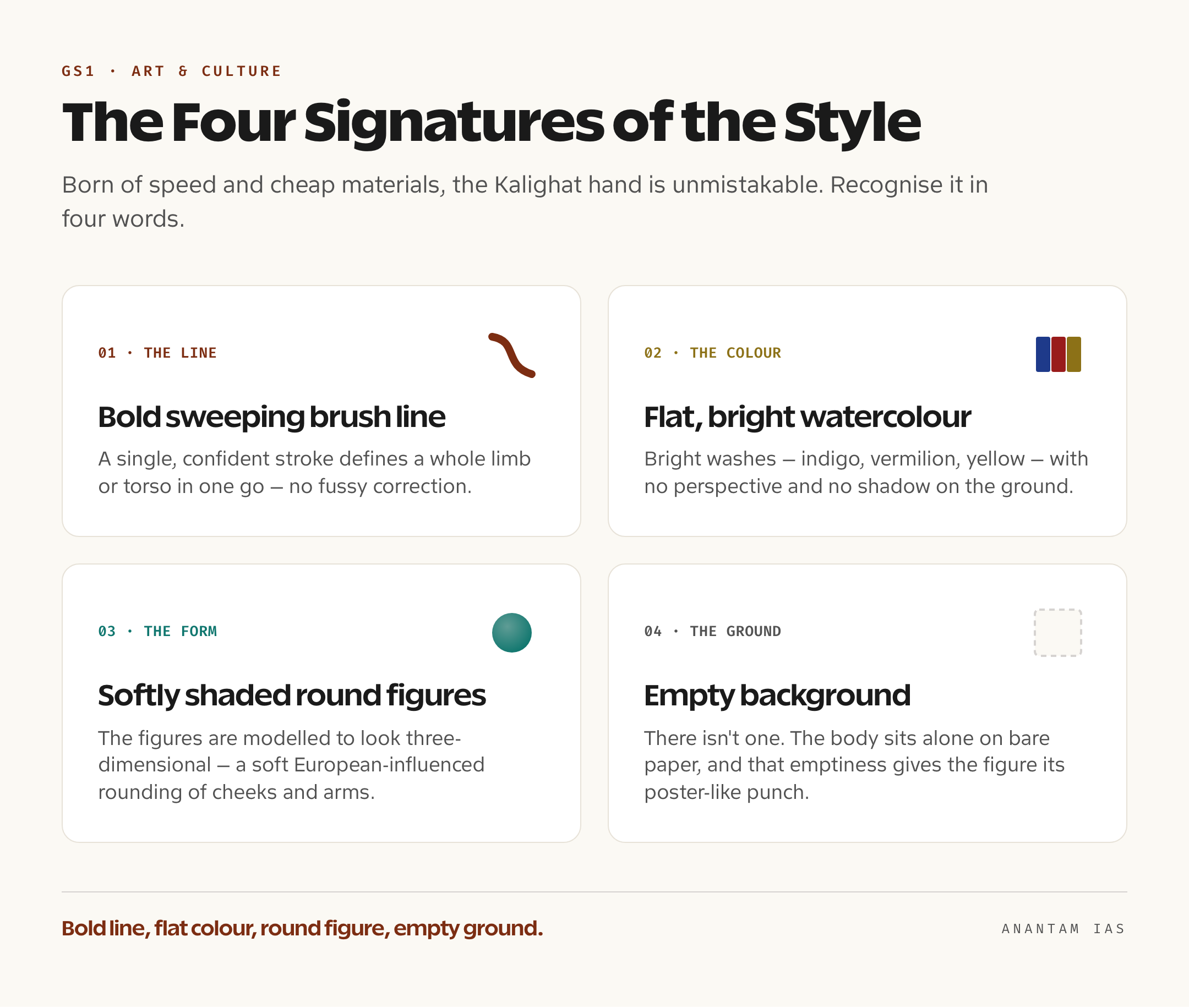
Out of that speed came a style you can recognise instantly, and it rests on four signatures. First, the line: a single, confident, sweeping brush stroke that defines a whole limb or torso in one go, with no fussy correction. Second, the colour: flat, bright washes — indigo, vermilion, yellow — with no perspective and no shadow on the ground. Third, the form: although the background is flat, the figures are shaded to look round and three-dimensional, a soft modelling of cheeks, arms and breasts that the artists almost certainly picked up from European “Company” painting and academic prints. Fourth, the background: there isn’t one. The body sits alone on the paper, and that emptiness gives the figure its poster-like punch. Bold line, flat colour, round figure, empty ground — that is Kalighat in four words.
Themes, Satire and Exponents
The subjects split into two streams, and it is the second one that makes Kalighat famous. The first stream is devotional, which is what the temple trade demanded: Kali above all, in her terrifying Bengal form, along with Durga, Lakshmi, Saraswati and the wider Shakta goddess world that Bengal worships so intensely; then Krishna and Radha, Rama and Sita, and saints such as Chaitanya Mahaprabhu. These are the souvenirs a pilgrim bought at the shrine, and they kept the workshops fed.
The second stream is what no other Indian folk art was doing — sharp social satire of the world outside the temple. The great target was the babu: the new Anglicised Bengali gentleman, the office clerk grown rich and pretentious, who appears again and again as a figure of ridicule. The Kalighat artists painted him as a vain dandy in fancy slippers, a hen-pecked husband under the slipper of a domineering wife, a fop being led by the nose by a courtesan, a cat in pious posture with a fish in its mouth — a hypocrite pretending to virtue. This was a community of village migrants drawing the urban elite that looked down on them, and the drawings bite.
The most striking example is the school’s coverage of a real crime, the Tarakeswar affair of 1873. Elokeshi, the young wife of a government clerk named Nobin Chandra, was drawn into a relationship with the Mahant — the head priest — of the Tarakeswar Shiva temple; on 27 May 1873 Nobin killed her with a fish knife, and the sensational trial that followed gripped Calcutta. The Kalighat workshops turned the scandal into a whole series of paintings — Elokeshi offering the Mahant a betel leaf, the seduction, the murder, the Mahant in jail — sold while the trial was still in the news. It is the closest thing colonial Calcutta had to tabloid front pages, painted by hand. That instinct to record the public mood is why historians treat Kalighat painting as a visual archive of 19th-century Bengal as much as an art form, and why later sheets even carried nationalist figures such as Rani Lakshmibai.
As for exponents, Kalighat painting is mostly anonymous — these were jobbing workshop artists who rarely signed — but two names anchor it. One was the painter and lithographer Nibaran Chandra Ghosh, among the few identifiable Kalighat hands. The far more important name belongs to the artist the tradition fed: Jamini Roy. He is the bridge from this bazaar art to modern Indian painting, and that is the subject worth dwelling on.
Where Kalighat Painting Stands Today
The original Kalighat school died, and the cause was technology. From the 1870s onward, cheap mechanically printed pictures flooded the same market — German chromolithographs, and the mass oleographs of the Ravi Varma Press, which gave buyers slicker, gaudier gods at a lower price. Photography ate into the rest. The hand-painted sheet could not compete on price or polish, the senior patuas died with few apprentices, and by the early 1930s the Kalighat workshops had essentially closed. The V&A dates the school’s working life from roughly the 1830s to the 1930s — a single century, and then silence.
But two afterlives kept it alive. The first is in the museums, because the flimsy paper that made the art cheap also made it rare — most sheets simply did not survive. The most important holdings are abroad: the Victoria and Albert Museum in London has the largest collection in the world, around 645 paintings and drawings, of which 233 came as a single donation from the writer Rudyard Kipling in 1917. Other significant collections sit at the Indian Museum in Kolkata, the Gurusaday Museum in Bengal and museums in Britain. So the cheapest art of its day is now conserved as treasure, which is its own quiet irony.
The second afterlife is in living craft and modern art. The wider patua scroll tradition the Kalighat artists came from never fully died — it survives in Bengal villages, most famously Naya in the Pingla block of Paschim Medinipur district, the “village of singing painters,” whose Chitrakars still paint and perform narrative scrolls. That broader Bengal pat tradition won a Geographical Indication tag as “Bengal Patachitra,” registered on 28 March 2018, which gives the craft legal protection and a marketing identity. And the Kalighat aesthetic itself was carried into the heart of modern Indian art by Jamini Roy. Around 1925 Roy abandoned his British-style academic training and turned to the bazaar paintings sold outside the Kalighat temple, building from their flat colour and sweeping line a deliberately Indian modernism. Roy (1887-1972) is now one of the nine artists whose work the Government of India has declared a National Art Treasure — notified under the Antiquities and Art Treasures Act of 1972 through orders of 1976 and 1979 — so that exporting his paintings is restricted. The folk art that died at the temple gate lived on in the work of a man the state now guards as national heritage.
Why Kalighat Painting Matters
Pull back, and Kalighat painting matters for three reasons that go beyond any single sheet. The first is that it was modern before “modern” was a category in Indian art. This was a folk tradition that responded directly to the city, the market and the newspaper — that painted current events for a paying public and organised itself like a small business. No other Indian folk school did that, and it makes Kalighat a hinge between village craft and urban popular culture.
The second is that it is a social record. Elite painting and colonial photography largely ignored the texture of ordinary Calcutta life — its hypocrites, its scandals, its anxieties about a society being remade under British rule. Kalighat painted exactly that, with a satirist’s eye, which is why a stack of cheap souvenir sheets now reads as social history.
And the third is influence: through Jamini Roy, the flat line and bold colour of the bazaar entered the bloodstream of modern Indian painting and helped define what an “Indian” modernism could look like, against the imported academic style. So the next time you see a Jamini Roy — those almond-eyed figures in flat planes of colour — remember that the line began at a temple stall, in the hand of a migrant patua who painted gods in the morning and gossip in the afternoon, and sold both for the price of a meal.
For Your Mains Answer
This topic sits squarely in GS Paper 1, under “salient aspects of Art Forms, Literature and Architecture from ancient to modern times,” and it doubles as material for the colonial-society and social-reform sections of modern Indian history. The smart move is to treat Kalighat not as one more name on a folk-art list but as a case study of how folk art turned urban, commercial and political under colonialism — that framing lifts you above the candidates who just recite features.
How to Build the Answer
Lead with what makes Kalighat different, not with a definition. Open on the satire — a folk tradition that painted the babu and a murder trial — then explain how it got there: the patua migration to Calcutta, the shift from scroll to single sheet, the new cheap materials, the assembly-line workshop. Cover the style in one tight cluster (bold line, flat colour, shaded figures, empty ground), the two subject streams (devotional and satirical), the decline by chromolithograph, and the afterlife in museums and in Jamini Roy. Close by naming what it represents: folk art becoming modern.
Common Mistakes to Avoid
Don’t confuse Kalighat pat with Odisha’s Pattachitra or Bengal’s village patachitra scrolls — Kalighat is the urban, single-sheet, souvenir offshoot. Don’t call it ancient; it is a 19th-century school. Don’t reduce it to “religious paintings near a temple” and miss the satire, which is the whole point. And don’t forget the modern link — leaving out Jamini Roy throws away the easiest source of marks.
A Compact Answer Spine
Folk pat tradition → patua/Chitrakar migrate to Calcutta around the Kalighat temple (19th c.) → scroll becomes single cheap watercolour sheet → style of bold line, flat colour, shaded round figures, empty ground → two streams: deities (Kali, Krishna) and sharp babu satire plus the Tarakeswar affair → decline by the 1930s under chromolithographs and photography → afterlife in the V&A and other museums, in living patua craft (Bengal Patachitra GI, 2018) and in Jamini Roy’s modernism.
Diagram or Flowchart Idea
Draw a simple horizontal arrow: “Village pat scroll” → “Kalighat single-sheet souvenir (c. 1830s-1930s)” → two branches at the end, one to “Museum collections (V&A)” and one to “Modern Indian art (Jamini Roy).” A clean lineage diagram like this signals that you understand evolution, not just a list of traits.
A Balanced-Conclusion Line
A good closing line names the paradox: Kalighat was the cheapest, most disposable art of its day, and precisely because it painted the everyday city it has become one of our most valuable records of 19th-century Bengal — folk art that grew up, looked around, and became modern.
How to Use Data Without Cramming
Two or three anchors are enough: the school’s lifespan (roughly the 1830s to the 1930s), the V&A’s collection as the world’s largest (around 645 works, 233 from Kipling in 1917), and one dated event — the Tarakeswar affair of 1873 or the Bengal Patachitra GI tag of 2018. Drop these in as evidence, not as a data dump; one precise date does more work than five vague ones.
FAQ
What is Kalighat painting, in one line? It is a school of cheap, fast watercolour paintings on paper made in 19th-century Calcutta around the Kalighat Kali temple, by patua or Chitrakar artists, known for bold sweeping brush lines, flat bright colour, softly shaded figures on an empty background, and a unique line in social satire alongside images of gods.
Why is Kalighat painting famous for satire? Because it did what no other Indian folk art did — it mocked the world outside the temple. Its artists ridiculed the Anglicised babu, the hen-pecked husband and the hypocritical priest, and even turned a real murder scandal, the Tarakeswar affair of 1873, into a series of paintings sold while the trial was still in the news. That makes it a near-journalistic record of colonial Bengal.
How is Kalighat painting connected to Jamini Roy? Around 1925 the modernist Jamini Roy rejected his academic European training and turned to the bazaar paintings sold outside the Kalighat temple, building a deliberately Indian modern style from their flat colour and bold line. Roy is now one of the nine artists whose work India has declared a National Art Treasure, so Kalighat’s folk aesthetic lives on at the centre of modern Indian art.
Where can you see original Kalighat paintings, and do they have any protection today? The largest collection in the world is at the Victoria and Albert Museum in London (around 645 works, 233 donated by Rudyard Kipling in 1917); the Indian Museum and Gurusaday Museum in Bengal also hold them. The broader Bengal patachitra scroll tradition the artists came from received a Geographical Indication tag as “Bengal Patachitra” on 28 March 2018.
Practice Questions
Prelims MCQs
- With reference to Kalighat painting, consider the following statements about its artists. The painters were drawn mainly from the patua or Chitrakar community, hereditary scroll-painters who migrated to Calcutta from surrounding districts.
Which of the following is the correct description of this community’s traditional occupation?
(a) Stone sculptors of temple icons
(b) Hereditary painters and performers of narrative pat scrolls
(c) Weavers of brocade textiles
(d) Makers of bronze ritual lamps.
Answer: (b) The patua/Chitrakar were travelling scroll-painters who sang the stories on their pat scrolls before adapting to single-sheet work in Calcutta. - Which of the following are characteristic features of Kalighat painting? 1. A single sweeping brush outline.
2. Flat, bright watercolour without perspective.
3. Figures softly shaded to appear rounded.
4. Densely detailed landscape backgrounds. Select the correct answer:
(a) 1 and 4 only
(b) 1, 2 and 3 only
(c) 2, 3 and 4 only
(d) 1, 2, 3 and 4.
Answer: (b) Kalighat figures are bold, flat-coloured and rounded but sit on an empty background, not a detailed landscape. - The Kalighat paintings of the 1870s famously depicted the “Tarakeswar affair.” This affair is best described as:
(a) a peasant revolt against indigo planters
(b) a temple-entry movement
(c) a murder scandal involving a temple Mahant and a young woman named Elokeshi
(d) a famine relief controversy.
Answer: (c) The 1873 Tarakeswar case — the killing of Elokeshi amid her relationship with the temple Mahant — was turned into a popular Kalighat painting series. - The modern Indian painter most closely associated with drawing inspiration from Kalighat painting is:
(a) Raja Ravi Varma
(b) Amrita Sher-Gil
(c) Jamini Roy
(d) Nandalal Bose.
Answer: (c) Jamini Roy built his folk-modernist style on the flat colour and bold line of the bazaar paintings sold outside the Kalighat temple. - With reference to the present status of Bengal’s pat traditions, consider the following statements.
1. The largest collection of Kalighat paintings is held at the Victoria and Albert Museum, London.
2. “Bengal Patachitra” has been registered with a Geographical Indication tag.
Which of the statements given above is/are correct?
(a) 1 only
(b) 2 only
(c) Both 1 and 2
(d) Neither 1 nor 2.
Answer: (c) The V&A holds the world’s largest Kalighat collection, and Bengal Patachitra received a GI tag in 2018.
Mains Practice Questions
- “The Kalighat paintings of 19th-century Bengal are as much a social document as they are a devotional art form.” Discuss with examples. (15 marks, 250 words)
- Trace the evolution of the patua scroll tradition into the urban Kalighat school of painting, and explain how the colonial city shaped its form, materials and subjects. (15 marks, 250 words)
- Examine how Kalighat painting bridged folk art and modern Indian painting, with particular reference to its influence on Jamini Roy. (10 marks, 150 words)
- Account for the decline of Kalighat painting in the early 20th century, and assess the efforts made to preserve and revive Bengal’s pat traditions today. (15 marks, 250 words)
- “Folk art in colonial India was not merely nostalgic but could be sharply contemporary.” Critically examine this statement using Kalighat painting as a case study. (15 marks, 250 words)
Tell Google you want more of this.
Add Anantam IAS as a preferred sourceOne tap, and this site shows up more often in your own Top Stories, AI Overviews and AI Mode. Remove it any time.