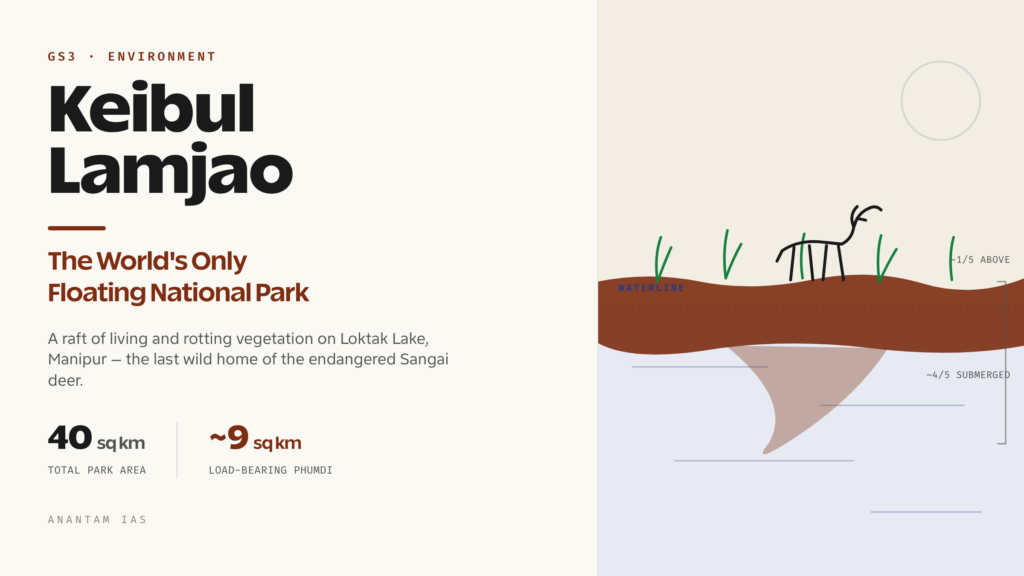
Most national parks ask you to stand on solid ground and look out. Keibul Lamjao asks you to question what “ground” even means. The forest floor here is not soil at all — it’s a thick, springy raft of rotting and living vegetation that rides on the surface of a lake, rising and falling with the water beneath it. Walk on it and it gives, like a waterbed the size of a district. This is the only floating national park on Earth, tucked into the southern reach of Loktak Lake in Manipur’s Bishnupur district, and almost everything strange about it follows from that single fact.
It matters because this floating mat is the last wild home of the Sangai, the Manipur brow-antlered deer, a creature that was declared extinct in 1951 and then found again on these very mats. Save the floating forest and you save the deer; let it sink and the Sangai goes with it. That tight, almost cruel dependence is what turns a small 40-square-kilometre park into one of the sharpest tests in Indian conservation — a place where a hydropower dam, a thinning vegetation raft and an endangered deer are all locked into the same equation.
What and Where Keibul Lamjao Is
Keibul Lamjao sits about 53 kilometres south of Imphal, near the town of Moirang, on the southeastern fringe of Loktak Lake — the largest freshwater lake in northeast India. The land was first protected as a wildlife sanctuary in 1966 and then gazetted as a national park on 28 March 1977, specifically to shield the Sangai and its peculiar habitat. At roughly 40 square kilometres, it’s a small park by Indian standards, but it carries an outsized identity: it’s the world’s only floating national park, and India has nominated it to the UNESCO World Heritage tentative list as the “Keibul Lamjao Conservation Area,” a wider unit that folds in a buffer of Loktak Lake and the neighbouring Pumlen Pat wetland.
The park is really three things stacked together — open water, swampy edges, and the floating phumdi mats that cover most of its area. The hills along the rim, like Pabot, Toya and Chingjao, give the few patches of genuinely dry land where animals retreat in high water. But the heart of the park is the floating layer, and that’s where the story lives. Because the habitat isn’t anchored to the earth, the entire ecosystem behaves less like a forest and more like a slow, breathing organism that responds to every change in the lake’s water level — which, as we’ll see, is exactly where the trouble starts.
The Phumdi: A Forest That Floats
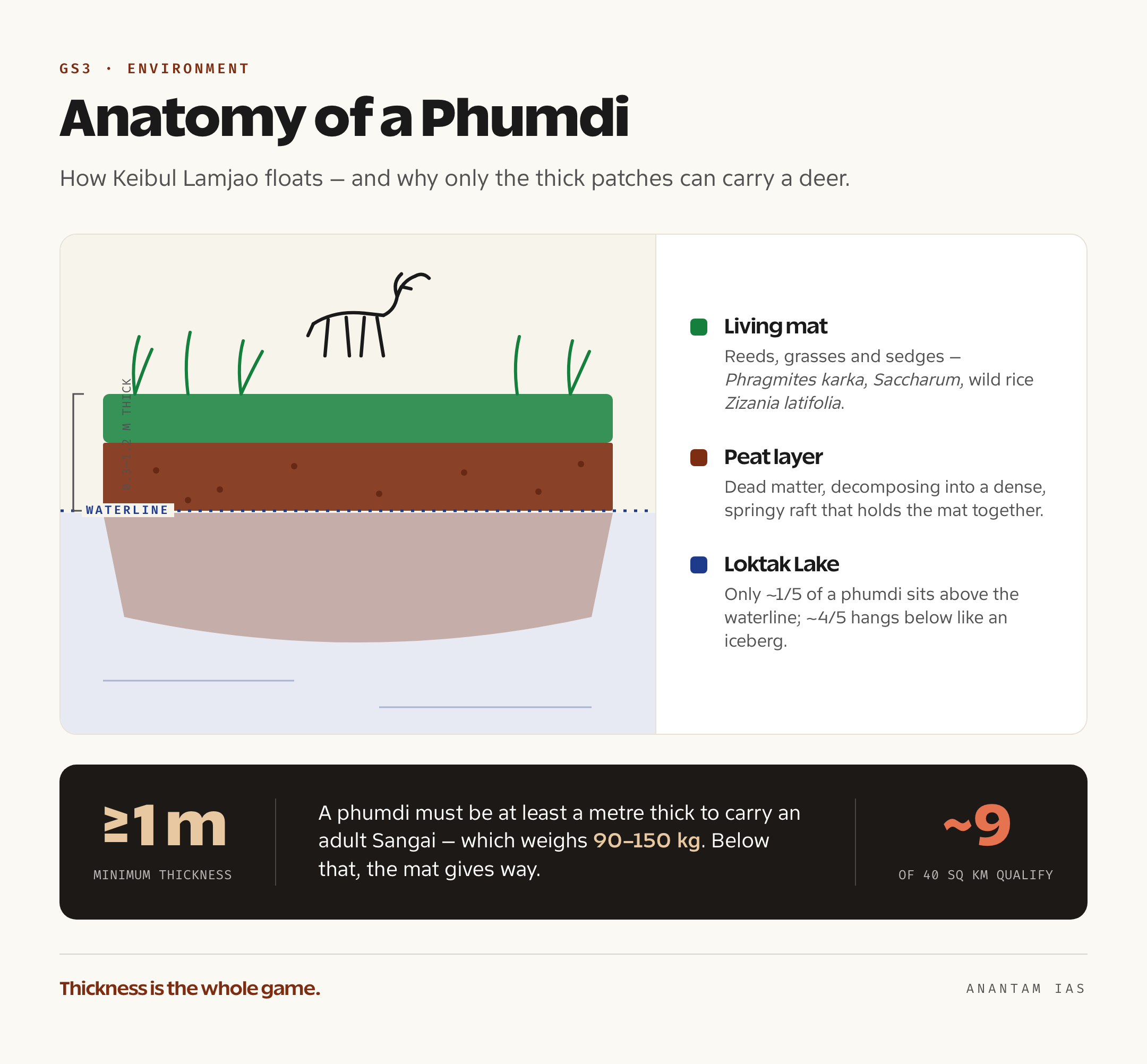
A phumdi (sometimes spelled phumdi or fumdi) is a heterogeneous floating mass of vegetation, soil and organic matter at every stage of decomposition. Picture a compost mat that never stops growing: living reeds, grasses and sedges grow on top, their dead matter sinks and rots into a dense peaty layer below, and the whole slab floats because trapped gases and buoyant plant tissue keep it afloat. Roughly a fifth of a phumdi sits above the waterline; the rest hangs below like the submerged bulk of an iceberg. When the lake rises, the mat rises; when it falls, the mat settles onto the bed and draws nutrients from the soil before floating free again. That seasonal contact with the lakebed is the engine that keeps phumdis thick and healthy.
Thickness is the whole game. Keibul Lamjao’s phumdis range from about a foot to four feet thick (roughly 0.3 to 1.2 metres), and the dominant plant cover is tough grasses and reeds — Phragmites karka, Saccharum species, Erianthus, and the wild rice Zizania latifolia that gives the deer both food and cover. For a phumdi to carry an adult Sangai, which weighs somewhere between 90 and 150 kilograms, the mat needs to be at least a metre thick. And here is the figure that should worry every reader: of the park’s 40 square kilometres, conservation scientists estimate only about nine square kilometres now carry phumdis of that load-bearing thickness. The deer’s usable world is a fraction of the map.
The Sangai itself is built for this surface and nowhere else. Its hooves are long, narrow and unusually flexible, splaying out to spread the animal’s weight across the springy mat so it doesn’t break through — which is why, as it picks its way across the unstable surface, it appears to dance. That gait earned it the name “dancing deer,” and it’s not just folklore: the deer is genuinely a specialist of the floating world, unable to thrive on the firm ground that a hog deer or wild boar would prefer. Beyond the Sangai, the park shelters hog deer, wild boar, Asiatic jackal, jungle cat, otter and the Asian rock python, with hooded cranes, sarus cranes and dozens of waterbirds working the open water and reed edges.
The Sangai: A Deer Brought Back From Extinction
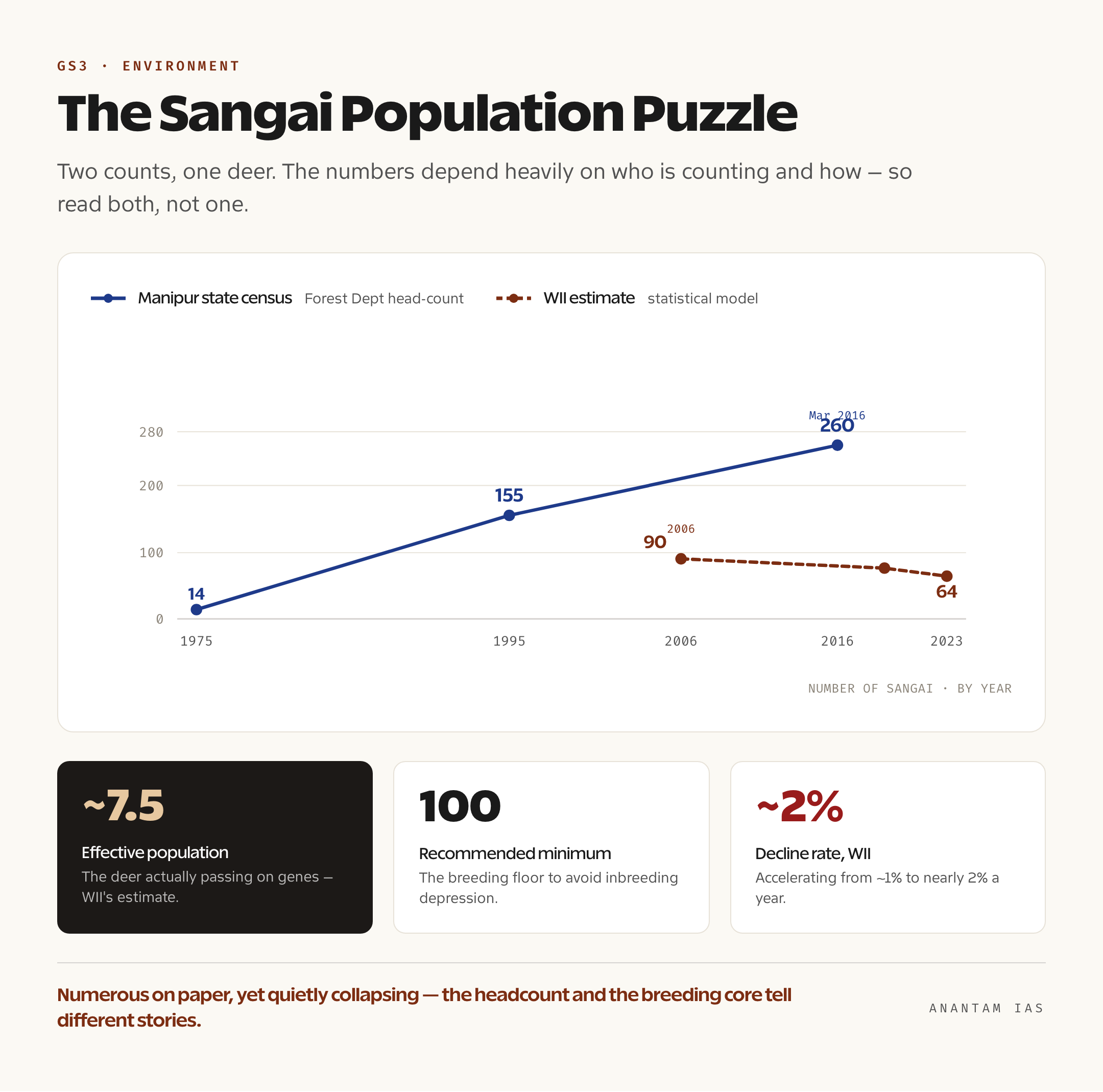
The Sangai (the Eld’s deer subspecies endemic to Manipur, often written Rucervus eldii eldii) is the reason the park exists, and its story reads like a near-miss. It was reported extinct in 1951, then rediscovered on the Keibul Lamjao phumdis, and by 1975 only about 14 animals survived. Decades of protection — fencing off poaching pressure, guarding the habitat, naming it Manipur’s state animal — pulled it back from that brink. The deer is listed as Endangered on the IUCN Red List, placed on Appendix I of CITES, and protected under Schedule I of India’s Wild Life (Protection) Act, the strongest tier of legal cover the country offers.
But how many Sangai are there now? This is where you have to be honest, because the answer depends entirely on who is counting. The Manipur Forest Department’s periodic census — most recently the head-count conducted when the park was closed to visitors from 20 to 27 February 2026 — has historically reported the larger, more optimistic numbers, climbing from 14 in 1975 to around 155 in 1995 and roughly 260 in the March 2016 count. A separate scientific assessment presented by the Wildlife Institute of India tells a starker story: a mean estimate of about 90 deer in 2006, falling to 76 in 2019 and just 64 by 2023, with the rate of decline accelerating from about 1 per cent a year to nearly 2 per cent.
Both can be partly true — census walks and statistical models measure differently — but the WII finding carries a warning that no head-count can soften. It puts the deer’s effective population (the number actually contributing genes to the next generation) at around 7.5, against a recommended minimum of 100 to avoid inbreeding depression. So even if a few hundred animals exist on paper, the breeding core may be dangerously small. A species can be numerous and still be quietly collapsing from the inside, and the Sangai is the textbook case for why a single park, a single deer and a single thinning habitat make for a fragile bet.
Loktak Under Stress: The Ithai Barrage Problem
To understand the threat, you have to look past the park’s boundary to the lake it floats on. Loktak Lake covers roughly 287 square kilometres in a normal year (swelling far larger in the monsoon), fed by the Imphal, Iril, Thoubal, Sekmai and Khuga rivers, and it supports about 100,000 people in some 55 hamlets who fish, farm and live on and around the water. Its importance is recognised internationally: Loktak became a Ramsar site — a wetland of international importance — on 23 March 1990, and was placed on the Montreux Record, the Ramsar list of wetlands in ecological trouble, on 16 June 1993.
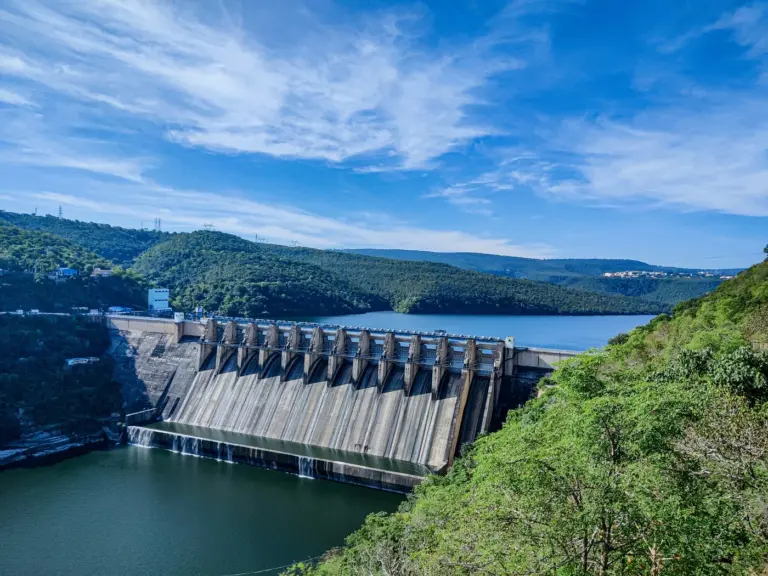
That trouble has a name: the Ithai Barrage. Commissioned in 1983 on the Manipur River to feed the 105-megawatt Loktak Hydroelectric Project run by NHPC, the barrage holds the lake at a near-constant high level so the turbines have water year-round. It’s a real public good — power and irrigation for a power-starved state — but it broke the lake’s natural rhythm. Loktak used to rise in the rains and fall in the dry months, and that yearly drop let the phumdis settle onto the lakebed and recharge on its nutrients. With the water now held permanently high, many phumdis no longer touch bottom, lose that recharge, and grow thinner and weaker — which is precisely the load-bearing crisis that is squeezing the Sangai onto less and less usable ground.
The barrage is the headline, but it’s not the only pressure. Agricultural runoff and untreated sewage have fouled the water, with a major flood in May 2024 leaving the lake choked with silt, debris and pollutants. Invasive water hyacinth and salvinia smother stretches of open water. Athaphum fishing — building artificial circular phumdi pens to trap fish — has fragmented the mats and changed how the lake works. And the closing of the Loktak Hydroelectric Project also blocked the old fish migration route from the Chindwin-Irrawaddy system in Myanmar, reshaping which species survive here. Layer on the ethnic conflict that has gripped Manipur since 2023, which has stretched the state’s administrative and conservation capacity thin, and the lake is under stress from several directions at once.
Conservation: Saving the Mat to Save the Deer
The logic of saving Keibul Lamjao is simple to state and hard to do: fix the phumdi and you fix the deer, because everything funnels back to the thickness of that floating mat. The custodians are the Manipur Forest Department for the park and the Loktak Development Authority — set up under the Manipur Loktak Lake (Protection) Act, 2006 — for the wider lake. The Sangai is also on the Centre’s list of species under the Recovery Programme, and with funding from CAMPA (the Compensatory Afforestation Fund), the Wildlife Institute of India has built a dedicated conservation action plan: long-term population monitoring, habitat restoration, and the politically sensitive idea of establishing a second, insurance population in another suitable wetland so the species is no longer staking its entire future on one fragile park.
The bigger lever is restoring Loktak’s hydrology. India’s stated goal is to get Loktak off the Montreux Record, and the route runs through an integrated wetland management approach under the National Plan for Conservation of Aquatic Ecosystems — restoring more natural water-level fluctuation, managing phumdis actively, cleaning up pollution and catchment erosion, and crucially, working with the lake’s communities through “Wetland Mitra” volunteers rather than against them. That last point is the lesson of the 2011 eviction drive, when the clearing of fishers’ floating huts on the lake sparked lasting resentment: conservation that ignores the roughly 100,000 people who depend on Loktak doesn’t hold. The honest verdict is that Keibul Lamjao is stable but not safe — the deer survives, the mat persists, but both depend on choices about a dam, a lake and a community that have yet to be fully made.
For Your Mains Answer
This topic is a clean fit for GS Paper 3 — conservation, environmental degradation, and the trade-off between development and ecology — and it doubles as a ready-made example in any answer on wetlands, endangered-species recovery, or large infrastructure’s environmental cost. The strength of Keibul Lamjao as an example is its specificity: one park, one deer, one barrage, one lake, all causally linked. Examiners reward a candidate who can show the chain — dam to water level to phumdi thickness to deer — rather than listing disconnected facts.
How to Build the Answer
Open with the hook that does the work: the world’s only floating national park, where the habitat itself floats. Establish the dependency chain early — Sangai depends on metre-thick phumdis, phumdis depend on Loktak’s natural water cycle, that cycle was broken by the Ithai Barrage. Then widen out to the other stressors (pollution, invasives, the May 2024 flood, conflict), and close on the way forward: hydrological restoration, a second insurance population, and community-led wetland management to exit the Montreux Record. That object-to-system arc works for almost any wetland or species question.
Common Mistakes to Avoid
Don’t quote a single Sangai number as gospel — note that the state census and the WII study diverge, and that effective population, not headcount, is the real worry. Don’t treat the Ithai Barrage as a villain; frame it as a genuine development-versus-ecology trade-off, which reads as balance. Don’t confuse the park with the lake: Keibul Lamjao is the national park; Loktak is the Ramsar site on the Montreux Record. And don’t forget the people — leaving out the 100,000 lake-dependent residents makes the answer one-sided.
A Compact Answer Spine
World’s only floating national park → habitat is the phumdi (floating vegetation mat, needs ≥1 m to bear a Sangai; only ~9 of 40 sq km qualify) → flagship is the endangered Sangai (extinct-rediscovered, IUCN Endangered, Schedule I) → core threat is the Ithai Barrage (1983) holding Loktak high and starving the phumdis → compounding stress (pollution, invasives, 2024 flood, conflict) → way forward (hydrological restoration, second population via WII-CAMPA plan, community-led management, exit the Montreux Record).
Diagram or Flowchart Idea
Draw a vertical cause-and-effect flow: “Ithai Barrage (1983) → constant high water → phumdis stop touching lakebed → mats thin below 1 m → Sangai habitat shrinks to ~9 sq km → population stress.” A single clean causal chain like this earns marks fast and proves you understand the mechanism, not just the headline.
A Balanced-Conclusion Line
End on the trade-off, not a slogan: the challenge at Loktak isn’t to choose power over the Sangai or the Sangai over power, but to redesign the barrage’s operation so the lake can breathe again — restoring the seasonal water cycle that both the phumdis and the people downstream evolved with.
How to Use Data Without Cramming
Pick three anchors and stop: the park is 40 sq km but only ~9 sq km has load-bearing phumdi; the Sangai fell to 14 animals in 1975; Loktak went on the Montreux Record in 1993 after the 1983 barrage. Three precise figures, each tied to a point, beat a paragraph of memorised statistics.
FAQ
Why is Keibul Lamjao called the world’s only floating national park? Because most of its area isn’t solid land — it’s made of phumdis, thick floating mats of living and decomposing vegetation that ride on the surface of Loktak Lake and rise and fall with the water. The “forest floor” literally floats, which no other national park on Earth can claim.
What is a phumdi, and why does its thickness matter? A phumdi is a floating mass of vegetation, soil and rotting organic matter, about a fifth of which sits above the waterline. Thickness is critical because an adult Sangai weighs 90 to 150 kilograms and needs a mat at least a metre thick to walk on without breaking through — and only about nine of the park’s 40 square kilometres currently meet that mark.
Why is the Sangai endangered if the park protects it? Protection saved the deer from poaching, but its habitat is shrinking from within. The Ithai Barrage holds Loktak Lake at a constant high level, so phumdis no longer settle on the lakebed to recharge and grow thin. With a tiny effective breeding population (estimated by the Wildlife Institute of India at around 7.5), the Sangai is vulnerable even where the headcount looks reassuring.
What is being done to save Loktak and the Sangai? The Loktak Development Authority and Manipur Forest Department, backed by a Wildlife Institute of India action plan funded through CAMPA, are working on habitat monitoring, phumdi management and a possible second Sangai population elsewhere. The wider aim is hydrological restoration of Loktak and community-led management to get the lake removed from the Montreux Record of threatened wetlands.
Practice Questions
Prelims MCQs
- With reference to Keibul Lamjao National Park, consider its key features.
Which one of the following statements is correct?
(a) It is located in Assam and protects the one-horned rhinoceros
(b) It is the world’s only floating national park and lies on Loktak Lake in Manipur
(c) It is a marine national park in the Gulf of Mannar
(d) It was designated as India’s first national park in 1936
Answer: (b) Keibul Lamjao, on the southern fringe of Loktak Lake in Manipur’s Bishnupur district, is the only floating national park in the world. - The “phumdis” associated with Keibul Lamjao National Park are best described as:
(a) limestone caves used by bats
(b) artificial fish ponds dug along the shore
(c) floating masses of vegetation, soil and decomposing organic matter
(d) seasonal sandbars formed by river deposition
Answer: (c) Phumdis are heterogeneous floating mats of living and rotting vegetation mixed with soil, on which most of the park rests. - The Sangai, the flagship species of Keibul Lamjao, is:
(a) the state bird of Manipur
(b) the Manipur brow-antlered deer and the state animal of Manipur
(c) a species of freshwater dolphin
(d) a subspecies of the Indian rhinoceros
Answer: (b) The Sangai, or Manipur brow-antlered deer (an Eld’s deer subspecies), is Manipur’s state animal and is famed as the “dancing deer.” - Loktak Lake was placed on the Montreux Record primarily because of:
(a) excessive tourism on its banks
(b) ecological changes linked to the Ithai Barrage and altered hydrology
(c) discovery of oil reserves beneath the lakebed
(d) its designation as a UNESCO World Heritage Site
Answer: (b) The Montreux Record listing in 1993 reflected ecological character changes driven largely by the Ithai Barrage holding the lake at a constant high level. - Consider the following about Loktak Lake:
1. It is the largest freshwater lake in northeast India.
2. It was designated a Ramsar site in 1990.
3. The Loktak Hydroelectric Project on it is operated by NHPC.
Which of the statements are correct?
(a) 1 and 2 only
(b) 2 and 3 only
(c) 1 and 3 only
(d) 1, 2 and 3
Answer: (d) Loktak is the largest freshwater lake in northeast India, a Ramsar site since 23 March 1990, and the 105 MW Loktak Hydroelectric Project there is run by NHPC.
Mains Practice Questions
- “The survival of the Sangai is a direct function of the thickness of a floating vegetation mat.” Examine how the hydrology of Loktak Lake links the Ithai Barrage to the fate of an endangered deer. (15 marks, 250 words)
- Wetlands on the Montreux Record represent a failure of the development-versus-conservation balance. Critically analyse this statement with reference to Loktak Lake. (15 marks, 250 words)
- Discuss the ecological significance of phumdis and the challenges in managing the world’s only floating national park. (10 marks, 150 words)
- “Protecting a single endangered species confined to one fragile habitat is inherently risky.” Evaluate this in the context of the Sangai and suggest a conservation strategy that reduces this risk. (15 marks, 250 words)
- Large hydropower projects in ecologically sensitive regions often impose hidden costs on biodiversity and local communities. Examine this with the Loktak Hydroelectric Project as a case study. (10 marks, 150 words)
Tell Google you want more of this.
Add Anantam IAS as a preferred sourceOne tap, and this site shows up more often in your own Top Stories, AI Overviews and AI Mode. Remove it any time.