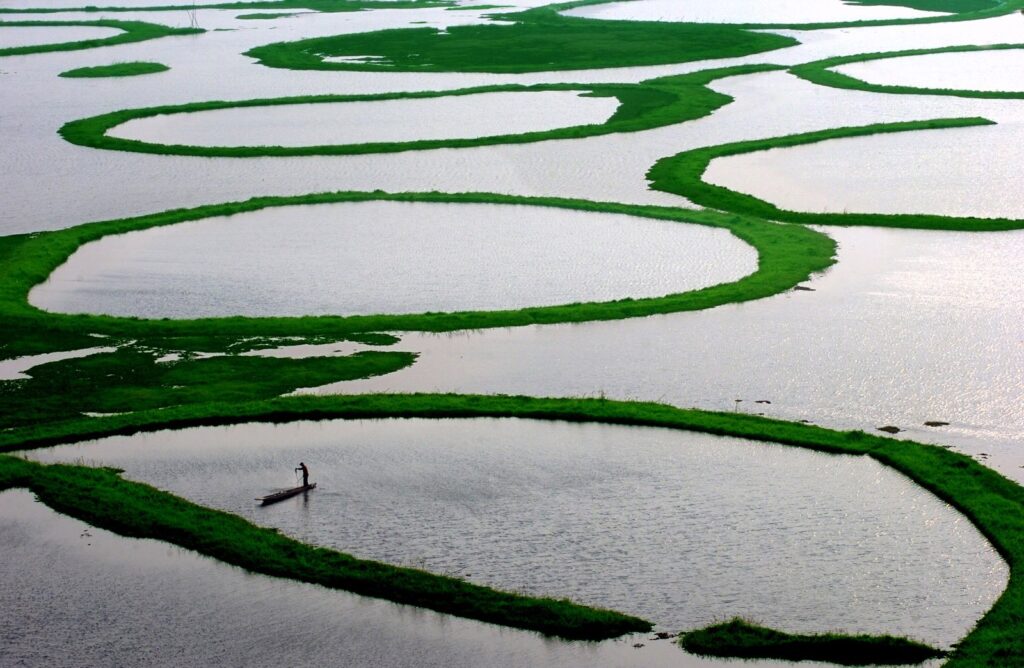
Loktak Lake, lying about 53 kilometres south of Imphal in the Bishnupur district of Manipur, is the largest freshwater lake in north-east India and one of the most ecologically distinctive wetlands on the subcontinent. Loktak Lake covers an area of roughly 287 square kilometres at high water and is celebrated worldwide for its phumdis — heterogeneous floating mats of vegetation, soil, and organic matter that drift across the lake’s surface and at the southern end coalesce into a thick floating raft thick enough to support large mammals. The largest of these phumdis carries the Keibul Lamjao National Park, the only floating national park in the world, and provides the last natural habitat of the critically endangered sangai or brow-antlered deer (Rucervus eldii eldii), the state animal of Manipur. Loktak Lake was designated a Ramsar wetland of international importance on 23 March 1990 and was placed on the Montreux Record in 1993, where it has remained ever since because of the continuing ecological pressure from the Ithai Barrage hydroelectric project at its outflow.
Geographical Setting and Origin
Loktak Lake lies in the southern part of the Manipur Valley, an intermontane basin enclosed by the Eastern Himalayan and Indo-Burmese hill ranges. The bed of Loktak Lake sits at an altitude of about 768 metres above mean sea level. The lake is roughly oval, about 35 kilometres long from north to south and up to 13 kilometres wide, and the shoreline is fringed by hills on the east and south, paddy fields on the west, and the populous Bishnupur urban corridor on the north.
Loktak Lake is the central component of a larger wetland complex that includes the Pumlen and Khoidum pats to the north and the Ikop Pat and Loushi Pat to the east. The lake is fed by the Manipur river and several smaller streams that drain the western hills, and it is drained at its southern end by the Khordak channel and the Ungamel channel into the Manipur river, which eventually flows south into Myanmar.
Phumdis — The Floating Islands of Loktak
The defining ecological feature of Loktak Lake is the phumdi. Phumdis are heterogeneous masses of vegetation, soil, and organic matter at various stages of decomposition that float on the surface of Loktak Lake. They develop where the lake water is shallow enough for the rooted aquatic plants — Phragmites karka, Erianthus ravennae, Saccharum munja, and Zizania latifolia — to consolidate their root mats with decaying organic matter into thick floating layers. In the deeper open water, phumdis drift seasonally with the wind, but in the shallow southern reaches they coalesce into a permanent floating raft up to two metres thick.
Phumdis support a unique aquatic plant community on their upper surface and a microhabitat for fish, amphibians, and birds beneath. The fisher communities of Loktak Lake have for centuries cut and shaped phumdis into circular fishing enclosures called athaphum, inside which fish are concentrated and harvested. The size and number of phumdis on Loktak Lake have changed dramatically since the construction of the Ithai Barrage in 1983.
Keibul Lamjao National Park
The Keibul Lamjao National Park, occupying about 40 square kilometres of the south-eastern phumdi raft of Loktak Lake, is the only floating national park in the world. It was first notified as a sanctuary in 1966 and upgraded to national park status in 1977. The park exists to protect the sangai or Manipur brow-antlered deer (Rucervus eldii eldii), the dancing deer of Manipur, an endemic subspecies that walks on the springy surface of the phumdi with a characteristic high-stepping gait.
The sangai was thought to be extinct until 1953, when a small population was rediscovered on the Keibul Lamjao phumdi. The 2024 sangai census recorded 260 individuals in the park, an increase from the post-rediscovery low of 14 in 1975 but still well below historic levels. The sangai is listed as Endangered on the IUCN Red List and is protected under Schedule I of the Wildlife (Protection) Act 1972. The Keibul Lamjao National Park also supports populations of the hog deer, wild boar, common otter, leopard cat, and a rich avifauna including the Indian python and over 100 species of resident and migratory waterbirds.
The Ithai Barrage and the Montreux Record
The hydrology of Loktak Lake was fundamentally altered by the construction of the Ithai Barrage in 1983 at the southern outflow of the lake. The barrage was built as the headworks of the Loktak Multipurpose Hydroelectric Project, which uses the lake as a permanent storage reservoir to feed a 105 megawatt run-of-the-river power station at Leimatak through a 6.3 kilometre headrace tunnel through the western hills.
The Ithai Barrage permanently raised the average water level of Loktak Lake by about a metre and eliminated the natural seasonal drawdown of the southern phumdi raft. The phumdi root mats, which historically grounded on the lake bed during the dry season and replenished their nutrient stock from the bottom sediments, lost contact with the bed and began to thin progressively. The submerged Keibul Lamjao phumdi has been losing thickness at an estimated rate of one centimetre per year, threatening the long-term viability of the sangai habitat. The barrage also altered the lake’s salinity, sediment regime, and fish migration patterns, with cascading effects on the artisanal fishery and the spawning of indigenous species such as the pengba.
It was on the strength of these continuing changes that Loktak Lake was placed on the Montreux Record of threatened Ramsar sites in 1993, and unlike Chilika Lake, Loktak Lake has not been delisted. It remains one of only two Indian Ramsar sites currently on the Montreux Record (the other being Keoladeo).
Loktak Lake and Keibul Lamjao: Quick Facts
| Feature | Detail |
|---|---|
| Location | Bishnupur district, Manipur (~53 km south of Imphal) |
| Area | ~287 sq km at high water — largest freshwater lake in north-east India |
| Defining feature | Phumdis — floating mats of vegetation, soil, and organic matter |
| Keibul Lamjao National Park | ~40 sq km; the only floating national park in the world (sanctuary 1966, national park 1977) |
| Flagship species | Sangai / Manipur brow-antlered deer (Rucervus eldii eldii) — state animal of Manipur, IUCN Endangered |
| Ramsar site | Designated 23 March 1990 |
| Montreux Record | Listed since 1993 (still on the Record) |
| Key pressure | Ithai Barrage (1983), headworks of the 105 MW Loktak Hydroelectric Project |
Conservation and the Loktak Development Authority
The Loktak Development Authority, set up by the Government of Manipur in 1986, is the lead agency for the conservation and management of Loktak Lake. It coordinates the catchment area treatment programme, the periodic phumdi removal drives, and the long-running rehabilitation plan funded by the National Plan for Conservation of Aquatic Ecosystems and the Wetlands International South Asia office. The Manipur Loktak Lake (Protection) Act 2006 brought the lake under a dedicated legal framework, dividing it into core, buffer, and peripheral zones with graded restrictions on phumdi-based fishing, settlement, and resource extraction.
The Loktak Lake (Protection) Act has been controversial. The relocation of fisher communities from phumdi-based settlements inside the core zone provoked sustained protest, and successive committees have recommended a phased and consultative approach to community-based management of Loktak Lake.
Comparative Context
Loktak Lake is one of the four lacustrine wetlands of India routinely studied together — the others being Chilika Lake in Odisha, Vembanad Lake in Kerala, and Wular Lake in Kashmir. Loktak Lake is also one of the most ecologically distinctive Ramsar sites of India, and the Indo-Burma transition zone in which it sits lies within one of the world’s recognised biodiversity hotspots.
Frequently Asked Questions
Why is Loktak Lake famous?
Loktak Lake is famous for three interlinked features. It is the largest freshwater lake in north-east India, it carries the only floating mats of vegetation called phumdis large enough to support a national park, and it is the only natural habitat of the critically endangered sangai deer of Manipur. It is also a Ramsar wetland of international importance on the Montreux Record.
What are phumdis?
Phumdis are heterogeneous floating masses of vegetation, soil, and organic matter that drift across the surface of Loktak Lake. They develop where shallow water allows rooted aquatic plants like Phragmites karka and Zizania latifolia to consolidate their root mats with decaying organic matter into thick floating layers that can be up to two metres thick in the southern reaches of Loktak Lake.
What is Keibul Lamjao National Park?
Keibul Lamjao National Park is a 40 square kilometre protected area on the southern phumdi raft of Loktak Lake, notified as a sanctuary in 1966 and upgraded to national park status in 1977. It is the only floating national park in the world and exists to protect the sangai or Manipur brow-antlered deer.
What is the sangai deer?
The sangai (Rucervus eldii eldii), also called the Manipur brow-antlered deer or the dancing deer of Manipur, is an endemic subspecies that walks on the springy surface of the phumdi raft with a characteristic high-stepping gait. It was thought extinct until rediscovered on the Keibul Lamjao phumdi in 1953. The 2024 census recorded 260 individuals in the park. It is the state animal of Manipur and is listed as Endangered on the IUCN Red List.
Why is Loktak Lake on the Montreux Record?
Loktak Lake was placed on the Montreux Record of threatened Ramsar sites in 1993 because of the continuing ecological pressure from the Ithai Barrage, which permanently raised the lake’s water level by about a metre, eliminated the seasonal drawdown of the phumdi raft, and triggered progressive thinning of the Keibul Lamjao phumdi at about one centimetre per year. Loktak Lake remains on the Montreux Record.
What is the Ithai Barrage?
The Ithai Barrage was built at the southern outflow of Loktak Lake in 1983 as the headworks of the 105 megawatt Loktak Multipurpose Hydroelectric Project. It uses Loktak Lake as a permanent storage reservoir and feeds the Leimatak power station through a 6.3 kilometre headrace tunnel. The barrage is the principal driver of the lake’s listing on the Montreux Record.
When was Loktak Lake designated a Ramsar site?
Loktak Lake was designated a Ramsar wetland of international importance on 23 March 1990, recognised for its unique phumdi ecosystem, the floating national park at Keibul Lamjao, and the last surviving habitat of the sangai deer.
What is the Loktak Development Authority?
The Loktak Development Authority was set up by the Government of Manipur in 1986 as the lead agency for the conservation of Loktak Lake. It coordinates catchment area treatment, periodic phumdi removal, and rehabilitation works under the Manipur Loktak Lake (Protection) Act 2006, which divides Loktak Lake into core, buffer, and peripheral zones with graded restrictions on phumdi-based fishing and settlement.
Tell Google you want more of this.
Add Anantam IAS as a preferred sourceOne tap, and this site shows up more often in your own Top Stories, AI Overviews and AI Mode. Remove it any time.