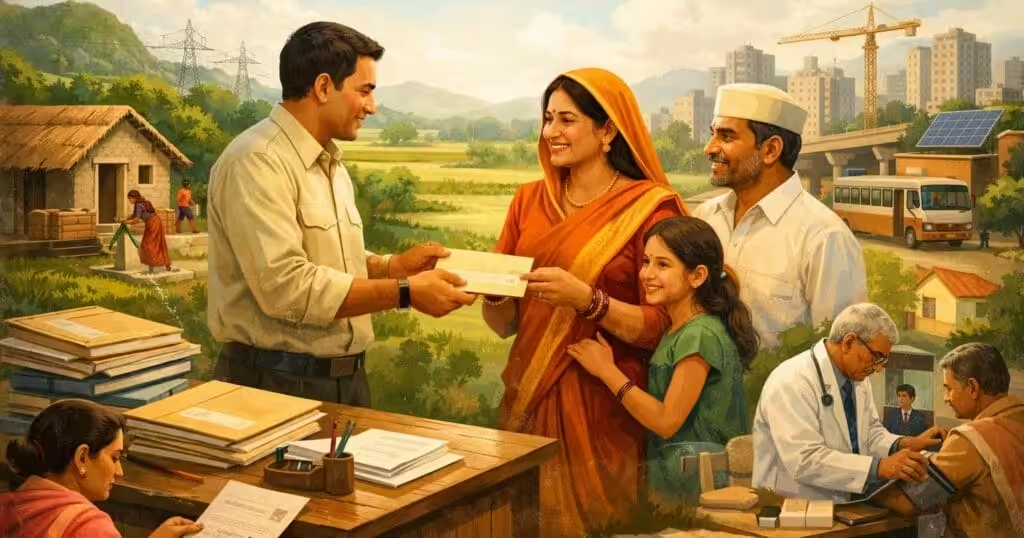
Ladli Behna Yojana is a Madhya Pradesh state government scheme that provides Rs 1,250 per month (Rs 15,000 per year) directly to eligible women through Direct Benefit Transfer. Launched on 5 March 2023 by Chief Minister Shivraj Singh Chouhan, the scheme aims to improve the economic independence and health and nutrition status of women and children in the state. Over 1.29 crore women have been enrolled since its inception.
For UPSC, this scheme is relevant under State Government Policies, Women Empowerment, and Social Welfare in GS Paper II.
What Is Ladli Behna Yojana?
The Mukhyamantri Ladli Behna Yojana was designed as a direct income support programme for women in Madhya Pradesh. Unlike loan-based or conditional schemes, Ladli Behna provides unconditional cash transfers to women aged 21–60 years who belong to economically weaker families. The scheme draws inspiration from similar state-level women's welfare programmes across India.
Key Features
- Monthly benefit: Rs 1,250 per woman (increased from initial Rs 1,000)
- Payment mode: Direct Benefit Transfer to Aadhaar-linked bank account
- Target group: Women aged 21–60 years in Madhya Pradesh
- Funding: State government of Madhya Pradesh
- Implementation: Department of Women and Child Development, MP
- Annual budget allocation: Approximately Rs 18,000 crore
Objectives of the Scheme
The scheme has five stated objectives: promoting women's economic independence, improving health and nutrition of women and children, restoring women's decisive role in the family, creating financial self-reliance, and reducing gender-based economic inequality.
Ladli Behna Yojana Eligibility Criteria
Eligibility is based on age, residency, income, and asset ownership. The criteria are designed to include the maximum number of economically weaker women.
Who Is Eligible?
- Women aged 21 to 60 years
- Married, widowed, divorced, or deserted women (including legally separated)
- Must be a native resident of Madhya Pradesh
- Family annual income should not exceed Rs 2.5 lakh
- Must not own more than 5 acres of agricultural land
- Must not own a four-wheeler vehicle
- Must not be an income tax payer or a family member of one
Who Is Not Eligible?
| Exclusion Category | Details |
|---|---|
| Government employees | Women or whose family members are government employees or officers |
| Tax-paying families | If any family member pays income tax |
| Large landholders | Families owning more than 5 acres of agricultural land |
| Existing pension recipients | Women already receiving Rs 1,000+ monthly pension from any government scheme |
| Elected representatives | Women who are current MPs, MLAs, Mayors, or Sarpanches |
Documents Required
- Samagra ID (MP's social security register)
- Aadhaar card linked to bank account
- Bank account passbook (with DBT enabled)
- Passport-size photograph
- Mobile number
How to Apply for Ladli Behna Yojana
The application process is both online and offline, with village and ward-level camps organized for mass enrollment.
Application Process
- Camp-based registration: Government organizes registration camps at Gram Panchayat and ward levels
- Form filling: Applicants fill the form with assistance from officials
- Document verification: Officials verify Samagra ID, Aadhaar, and bank details
- Photograph and eKYC: Biometric verification and photo capture
- Submission and receipt: Applicants receive an acknowledgment receipt
- Online portal: Applications can also be submitted at cmladlibahna.mp.gov.in
How to Check Ladli Behna Status
Beneficiaries can check their application and payment status through multiple channels:
- Official portal: Visit cmladlibahna.mp.gov.in, enter application number or Samagra ID
- SMS service: Send registered mobile number details to the designated number
- Gram Panchayat office: Visit the local Gram Panchayat or Ward office
- Helpline: Call the state helpline for status enquiries
Payment Structure and Schedule
Payments are made on the 10th of every month directly to the beneficiary's bank account.
Payment Timeline
| Phase | Monthly Amount | Period |
|---|---|---|
| Phase 1 (Launch) | Rs 1,000 | March–September 2023 |
| Phase 2 (Revision) | Rs 1,250 | October 2023 onwards |
| Proposed increase | Rs 1,500 | Subject to government decision |
| Long-term target | Rs 3,000 | As announced by state government |
The increase from Rs 1,000 to Rs 1,250 came ahead of the 2023 state elections. The government announced intentions to progressively raise the amount to Rs 3,000 per month.
Impact and Assessment
The scheme has had measurable social and economic impact in Madhya Pradesh, though it has also attracted debate.
Positive Outcomes
- Financial inclusion: Millions of women opened bank accounts for the first time
- Women's agency: Direct cash transfers give women greater decision-making power in households
- Health and nutrition: Evidence suggests increased spending on food and healthcare
- Samagra database: Large-scale enrollment strengthened the state's social registry
Criticism and Concerns
- Fiscal burden: Rs 18,000 crore annually strains the state budget
- Electoral motive: Critics argue the scheme is a populist measure linked to elections
- Sustainability: Questions about long-term fiscal sustainability without matching revenue growth
- Exclusion errors: Samagra ID-based filtering may exclude genuine beneficiaries with documentation issues
- No conditionality: Unlike schemes with health or education conditions, this is an unconditional transfer
Comparison with Similar State Schemes
Several states have launched similar women's income transfer schemes, creating a competitive welfare landscape.
| Feature | Ladli Behna (MP) | Mahalakshmi (Karnataka) | Kalia (Odisha – Women) | Aapki Beti Hamari Beti (Haryana) |
|---|---|---|---|---|
| Monthly amount | Rs 1,250 | Rs 2,000 | Rs 833 (Rs 10,000/year) | One-time Rs 21,000 |
| Age group | 21–60 years | 18+ | All women farmers | Girl child (at birth) |
| Coverage | 1.29 crore women | Proposed scheme | ~30 lakh | All BPL families |
| Condition | Unconditional | Unconditional | Land ownership | Birth registration |
| Payment | Monthly DBT | Monthly DBT | Twice yearly | One-time at maturity |
This table shows the variation in approach across states. Madhya Pradesh's scheme stands out for its wide age coverage and unconditional nature.
UPSC Relevance
Ladli Behna Yojana is a case study for understanding state-level welfare governance, women's empowerment through cash transfers, and the politics of social schemes in India.
Key Study Themes
- Direct cash transfers vs conditional transfers debate
- State fiscal capacity and welfare spending
- Women's economic empowerment and agency
- Competitive populism and welfare federalism
- Role of Aadhaar and social registries (Samagra ID) in scheme delivery
Mains Questions This Scheme Can Answer
- Discuss the role of direct benefit transfers in promoting women's empowerment
- Evaluate the fiscal sustainability of state-level welfare schemes
- Compare the approaches of different states toward women's economic security
Related: Women Empowerment in India: Schemes & UPSC Notes
Related: PM Kisan Samman Nidhi: Complete Guide & Status
Related: Jan Dhan Yojana: Financial Inclusion Scheme
Frequently Asked Questions
How much money do women receive under Ladli Behna Yojana?
Eligible women receive Rs 1,250 per month (Rs 15,000 per year) directly in their Aadhaar-linked bank accounts through Direct Benefit Transfer. The amount was increased from the initial Rs 1,000 per month, and the government has announced plans for further increases.
Can unmarried women apply for Ladli Behna Yojana?
The scheme initially targeted married, widowed, divorced, and deserted women aged 21–60 years. However, the government later expanded eligibility to include unmarried women as well, provided they meet all other criteria including age, income, and residency requirements.
What is the Samagra ID requirement for Ladli Behna?
Samagra ID is Madhya Pradesh's social security identifier that every resident family receives. A valid Samagra ID is mandatory for Ladli Behna Yojana enrollment. The ID must be linked to Aadhaar and should have updated family and personal details for the application to be processed.
Is Ladli Behna Yojana available in other states?
Ladli Behna Yojana is specific to Madhya Pradesh. However, inspired by its popularity, several states have launched or announced similar schemes under different names. Maharashtra launched Mukhyamantri Majhi Ladki Bahin Yojana, and other states have their own variants of women's income support programmes.
Tell Google you want more of this.
Add Anantam IAS as a preferred sourceOne tap, and this site shows up more often in your own Top Stories, AI Overviews and AI Mode. Remove it any time.