Every competent government talks to the industries it regulates, and it should. A ministry writing rules for pharmaceutical exports that has never spoken to an exporter will write rules that do not survive contact with a shipping schedule. The problem is not that private interests reach the state. It is that some of them reach it privately, and that what they take away is frequently not a better rule but a specific benefit with their own name on it.
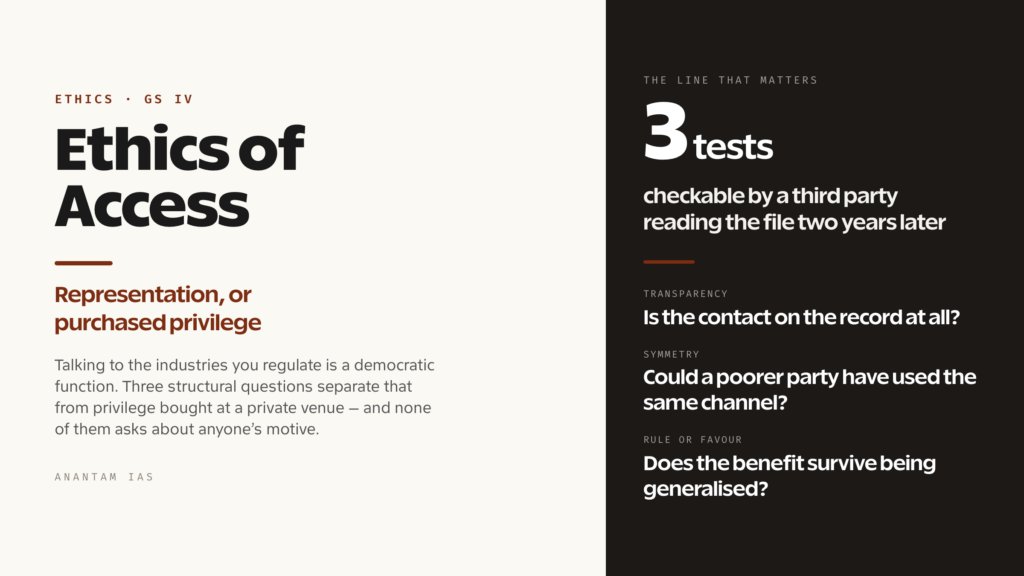
Three questions separate legitimate representation from purchased privilege, and they are worth carrying because nothing else in this area is as portable. Is the contact on the record? Could a similarly affected party with a tenth of the resources have made the same submission through the same channel? And is the outcome a general rule binding everyone in a category, or a favour that attaches to one applicant? A person who can answer yes, yes and rule is performing a democratic function. A person who answers no, no and favour is doing something else, whatever the visiting card says.
The Line That Actually Matters
Note what the three tests do not ask. They say nothing about the lobbyist’s motive, the official’s inner state, or whether anyone felt corrupted. All three are structural and checkable by a third party reading a file two years later, which is what makes them usable by an officer who cannot read minds and has twenty minutes.
Transparency asks whether the contact exists on paper. An undocumented meeting is not merely unrecorded; it is unreviewable, and unreviewability is usually the point of choosing that venue.
Symmetry asks about the channel rather than the content. If the only route by which a submission reached the decision-maker was a personal relationship, a club, or a former colleague now on retainer, the channel itself excluded everyone without one. The submission may have been correct. The process was still closed.
Rule or favour is the sharpest of the three. A general rule can be notified and applied to every future applicant, including those who will compete with the person who asked for it. A favour cannot be notified, because notifying it gives it away. If the benefit dies the moment it is generalised, it was a favour.
Against these sit the ordinary service obligations — Rule 3 of the Central Civil Services (Conduct) Rules, 1964 on integrity and devotion to duty, and the bar on using one’s position to further private interest. Those rules catch the crude case. The three tests catch the case where nothing crude happened at all, which is the ethics of access in its usual form and the version examined in corporate governance and business ethics from the company’s side of the table.
What Fills the Vacuum in India
India has no lobbying statute. Lobbying is not defined in law, lobbyists are not registered, expenditure on influencing policy is not disclosed, and no register of ministerial or official meetings is maintained as a matter of legal obligation. The activity happens continuously. The record of it does not exist.
Four things occupy the space. Industry associations make formal, published pre-Budget and pre-regulation submissions, and are the most transparent channel available precisely because they operate on the record. Informal access — the meeting obtained because of who one knows — is the least visible and most valuable. Retired officials convert institutional knowledge into a marketable asset; what is sold is not a decision but an accurate map of who signs what and which argument moves which desk. And funded research and media placement introduce a position into the policy conversation with its authorship visible and its financing not.
The best-documented Indian illustration remains the Radia recordings that surfaced in 2010-11, which showed the informal channel working across corporate houses, intermediaries, journalists and ministerial appointments. A second illustration is sharper still. In 2012 an American retailer’s statutory filings to the United States Senate disclosed lobbying expenditure on market access in India, which caused a row in the Indian Parliament. A record of lobbying on Indian policy existed only because a foreign statute compelled it.
There is one Indian instrument worth naming: the Pre-Legislative Consultation Policy of 2014, which asks that draft legislation and subordinate rules be placed in the public domain for thirty days with an explanatory note. It converts private submission into public comment, and its weakness is that compliance is uneven and unenforced.
The Mechanisms of Crony Capitalism
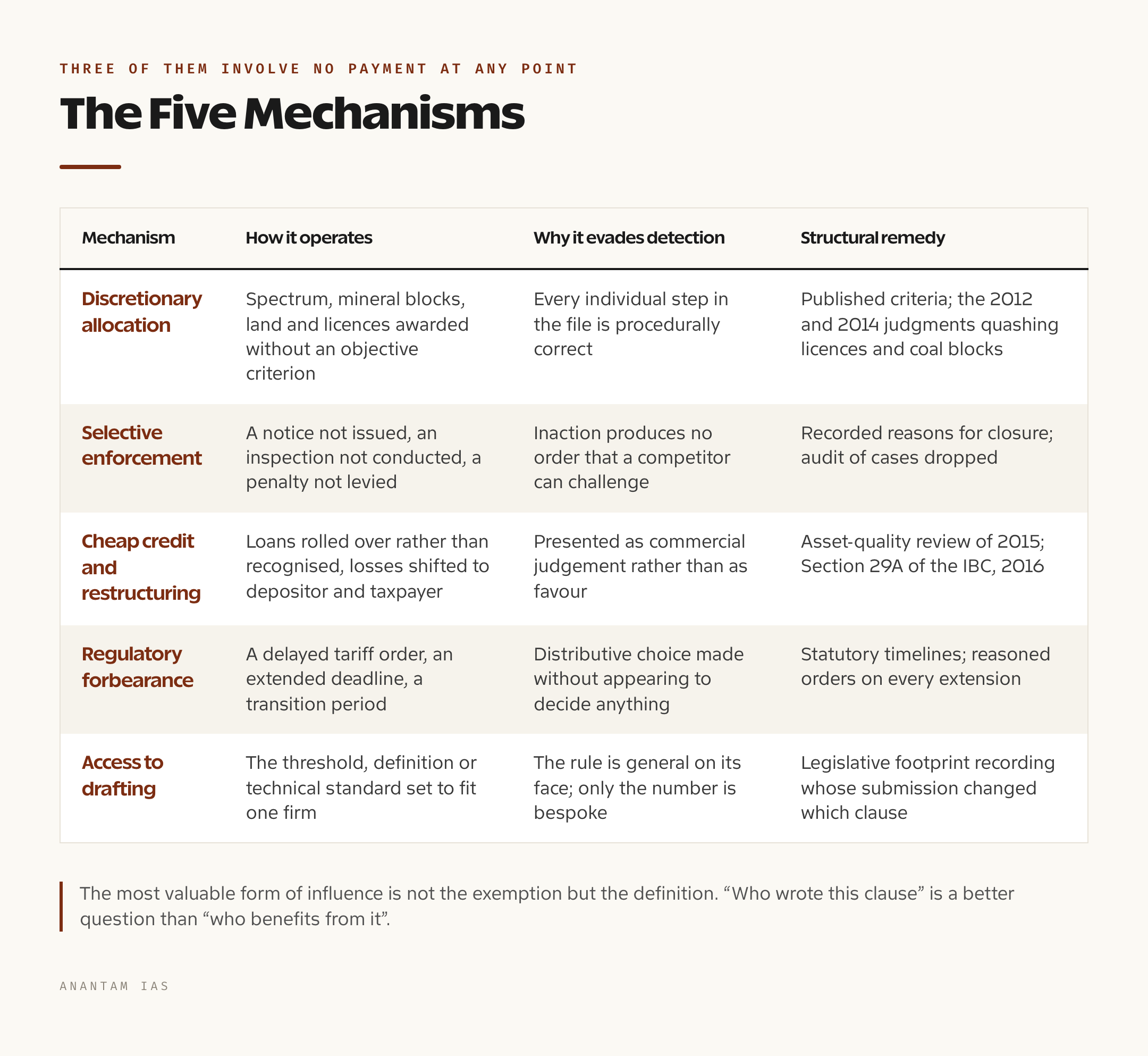
Discretionary allocation of scarce public assets. Spectrum, mineral blocks, land and licences are worth enormous sums, and whoever chooses the recipient holds that value in their gift. The two judicial landmarks are instructive. In 2012 the Supreme Court quashed 122 telecom licences, holding the first-come-first-served method as operated to be arbitrary. In 2014 it cancelled 204 of 218 coal block allocations on similar reasoning. The Court also clarified, in the presidential reference that followed the spectrum case, that auction is not constitutionally mandatory for every natural resource. The vice is arbitrariness and the absence of an objective criterion, not the choice of method.
Selective enforcement. The power not to act is worth as much as the power to act and is far harder to attack. An inspection not conducted, a notice not issued, a penalty not levied — none of these produces an order that anyone can challenge, and the beneficiary receives an advantage over compliant competitors without a single rupee changing hands.
Below-market credit and repeated restructuring. A loan that is rolled over rather than recognised as bad transfers the loss to the lender and eventually to the depositor and the taxpayer. Indian regulatory forbearance on restructured advances after 2008 was withdrawn through the asset-quality review of 2015, and the structural answer arrived with Section 29A of the Insolvency and Bankruptcy Code, 2016, which barred defaulting promoters from bidding for the assets they had run into the ground.
Regulatory forbearance more generally. A regulator that delays a tariff order, extends a deadline or grants a transition period is making a distributive decision without appearing to decide anything.
Access to drafting. The most valuable form of influence is not the exemption but the definition. A capacity threshold, an eligibility clause, a turnover floor, a technical standard — set the number and the rule is general on its face while excluding every competitor. This is why the question “who wrote this clause” is worth more than the question “who benefits from it”.
Rent-Seeking: Waste, Not Transfer
The economic vocabulary here is precise and often mangled. A rent is a return above what a competitive market would yield. Rent-seeking, named in Anne Krueger’s 1974 paper and anticipated by Gordon Tullock in 1967, is the expenditure of real resources to obtain such a return through the political process rather than through production.
The critical point is that rent-seeking is not a transfer. If a licence is worth a hundred and is awarded at discretion, competing firms will rationally spend up to a hundred in the contest — on agents, on retainers, on relationship maintenance, on waiting. That expenditure is consumed. It produces nothing. A transfer moves value from A to B; rent-seeking burns it in the corridor. This is why the cost of cronyism cannot be estimated from the size of the bribes.
Two further costs follow. First, it changes what firms invest in. Where returns to political capability exceed returns to productive capability, the rational firm builds a government-affairs department rather than a laboratory, and the efficient competitor loses on merit. Second, it selects for the wrong people at both ends — in business for those who are good at access, in office for those who are useful to them. Nations where connection outperforms competence do not merely lose money; they lose the signal that tells capital where to go. Composite measures like the Corruption Perceptions Index register the reputational tail of this, and understate the mechanism.
Political Finance Is the Engine
Any account of cronyism that stops at official misconduct has described the symptom. The demand side is elections, and the demand is structural and continuous: expenditure ceilings in India bind candidates rather than parties, campaigns cost far more than declared limits allow, and party organisations require money between elections as well as during them.
The supply side has been rearranged more than once. Section 182 of the Companies Act, 2013 governs corporate political contributions; the Finance Act, 2017 removed the ceiling of seven and a half per cent of average net profits and diluted the requirement to disclose contributions party-wise, while introducing the electoral bond instrument. In February 2024 the Supreme Court struck the bond scheme down as violating the right to information under Article 19(1)(a). What that judgment settled was the constitutional status of anonymity. What it did not settle is how campaigns are to be paid for, which remains an open question in Indian public policy.
The recommendation with the longest pedigree is partial state funding, urged in kind by the Indrajit Gupta Committee in 1998 and revisited by the Second Administrative Reforms Commission in its 2007 report on ethics in governance. The honest position is that funding reform is contested on its merits and that opacity closes the loop: undisclosed money creates an obligation that cannot be traced to a decision. An officer applying the three tests to a meeting is working downstream of this, and the same democratic infrastructure question runs through electoral roll integrity at the other end of the process.
“Access Is Not Influence”
The standard defence is that a meeting corrupts nobody. The official retains the decision; hearing an argument is not being bought; and the alternative is a state that legislates in ignorance. Each part of that is true, and the defence still fails when access is asymmetric — for four reasons that have nothing to do with anyone being purchased.
Agenda control comes first: access determines which problems get classified as problems at all, and a difficulty raised in eleven meetings acquires urgency while one raised nowhere does not exist. Information monopoly follows — if the only estimate on the file of what a regulation will cost an industry comes from that industry, the officer is not being deceived, merely informed by one party. Repetition does the rest, since influence accumulates through familiarity rather than through any single conversation, which is why it is invisible in every individual instance. And capacity is asymmetric: the organised interest can afford the eleven meetings, and the unorganised one cannot afford the first.
The defence also proves too much. If access genuinely had no effect on outcomes, nobody would pay for it, and a great deal of money is paid for it.
State Capture Is Not Ordinary Corruption
The distinction, drawn in World Bank work on transition economies at the turn of the century, is worth stating exactly. Administrative corruption bends the application of an existing rule — the inspector who takes money to overlook a violation. State capture shapes the rule itself, so that the statute, the licence condition or the tariff formula says what the captor wanted it to say.
The consequence is uncomfortable. Capture is legal on its face. There is no illicit payment at a counter, no false entry, no complainant, and nothing for an anti-corruption agency built around bribery to investigate. The output looks like ordinary policy, and every individual step in producing it was procedurally correct.
Regulatory capture is the sectoral version, described by George Stigler in 1971: an agency that comes over time to serve the industry it was created to discipline, through dependence on the industry for data, staff, expertise and post-retirement employment. Statutory independence does not prevent it; the relevant question is not what the enabling Act says but what the agency’s output over a decade has favoured, and that is the diagnostic the design of independent regulatory bodies has to answer for.
What the Officer Actually Does
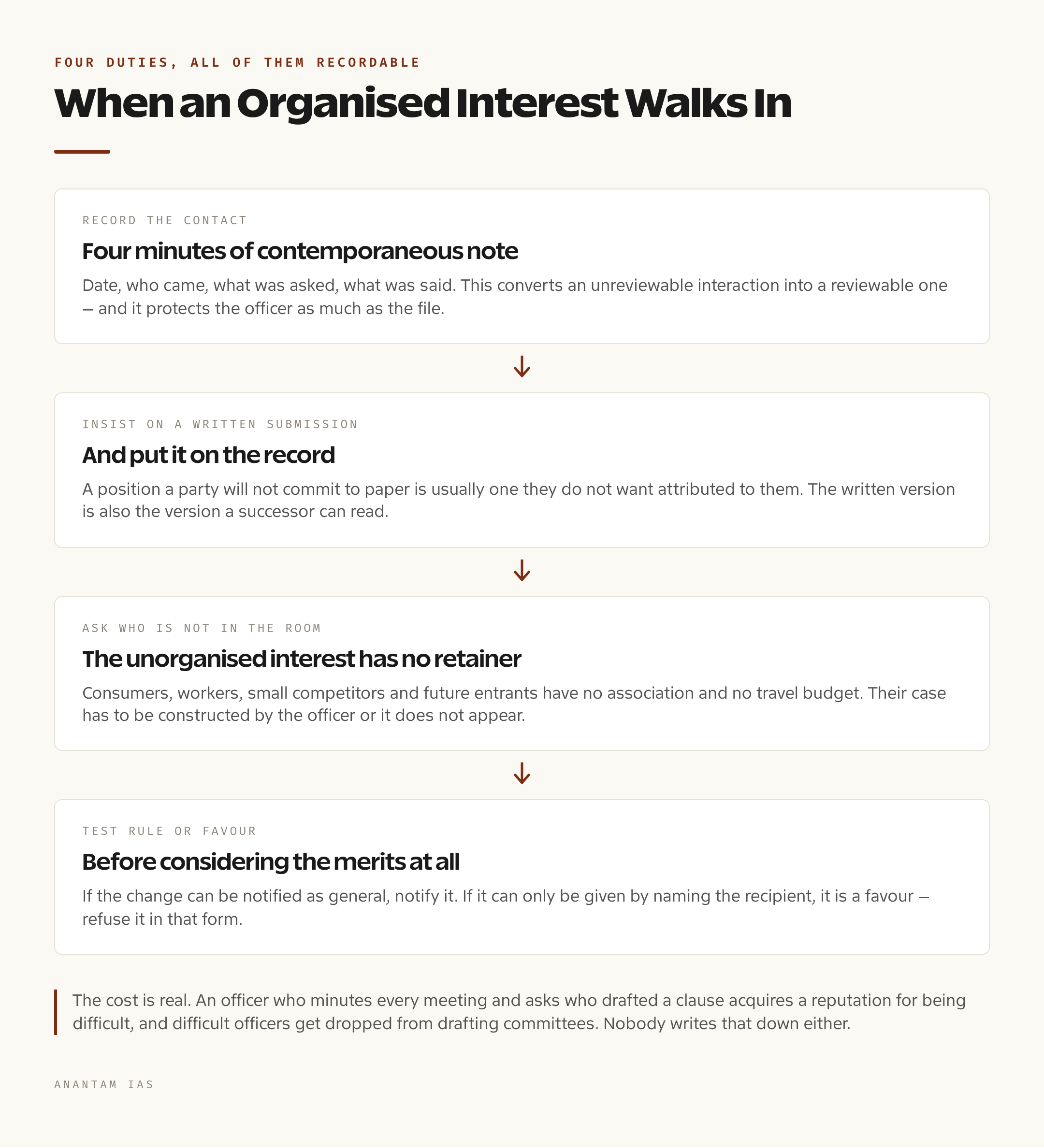
Record every substantive contact. A contemporaneous note — date, who came, what was asked, what was said — costs four minutes and converts an invisible interaction into a reviewable one. It also protects the officer, which is worth saying because the alternative framing is that integrity is uniformly costly.
Insist on written submissions and put them on the file. A position that a party will not commit to writing is usually a position they do not want attributed to them.
Ask who is not in the room. Consumers, workers, small competitors, future entrants and the next generation of users have no association, no travel budget and no retainer. Their interest has to be constructed by the officer or it will not appear at all.
Test rule or favour before anything else. If the requested change can be notified as general, notify it. If it can only be given by naming the recipient, refuse it in that form.
Refuse the private venue and graded hospitality. The Conduct Rules address gifts; they do not address the dinner, the conference in a resort or the sponsored study visit, all of which do the work that a gift used to do.
The cost is real and should not be softened. An officer who minutes every meeting, insists on written submissions and asks awkward questions about who drafted a clause acquires a reputation for being difficult to work with. Difficult officers get dropped from drafting committees, moved out of the ministries where the interesting files are, and left off the delegations. Nobody writes any of that down either.
Regulatory Approaches Elsewhere
Mandatory registers. The United States has required registration and periodic reporting by lobbyists since the Lobbying Disclosure Act of 1995, tightened in 2007. Canada operates a Lobbying Act with a dedicated Commissioner and a five-year post-employment prohibition on designated public office holders. The European Union maintains a joint transparency register, coupled with disclosure of senior officials’ meetings.
Meeting and drafting disclosure, and the legislative footprint. The footprint idea is the most transferable: a text is published with an annex recording whose submissions were received and which of them altered which clause. It answers “who wrote this” without prohibiting anyone from writing to government.
Post-employment restrictions. India already has partial versions. Group A officers require prior sanction for commercial employment within a year of retirement under the pension rules, and the All India Services rules run in parallel. Some statutes went further and then retreated: the Telecom Regulatory Authority of India Act originally barred its chairperson and members from further employment under the Central or a State Government, and that bar was relaxed by amendment in 2014.
The common design logic is worth noting. None of these regimes prohibits lobbying. They price it in daylight, on the theory that an interest willing to be seen asking is behaving differently from one that requires darkness.
The Honest Objections
Registers legitimise while formalising. Registration confers standing. Once an activity has a statutory name, a licence and a code of conduct, it becomes a recognised profession with a claim to be consulted, and the register turns into a credential rather than a constraint. Several jurisdictions have produced exactly this: more disclosure and more entrenched insiders.
Disclosure is regressive. Quarterly filings, itemised expenditure and compliance officers are trivial for a firm with a government-affairs division and prohibitive for a tenants’ union or a farmers’ collective. A transparency regime can widen the asymmetry it was built to correct, and the largest players are usually the ones best placed to welcome it.
Nobody agrees what lobbying is. Is a newspaper editorial lobbying? A trade body’s pre-Budget memorandum? A state government pressing the Centre for a package? A public-interest litigant’s petition? A researcher’s briefing? Every statutory attempt has had to draw arbitrary boundaries, and the boundaries are where the exemptions live. This is a real drafting problem rather than an alibi, and it goes some way to explaining the Indian position, which is genuinely unsettled: there is no statute, no register, no definition in law, and proposals have surfaced from time to time without becoming law. That is the accurate statement, and it should not be dressed up as an imminent reform.
Generality can be a disguise. The rule-or-favour test assumes a general rule is a fair one. A threshold written so that exactly one firm clears it is general in form and a favour in substance. The test remains the best available first cut; it is not a proof.
FAQ
Is lobbying illegal in India? No. Lobbying is neither prohibited nor regulated. There is no statute defining it, no register of lobbyists, no obligation to disclose expenditure on influencing policy, and no legally mandated record of official meetings. Bribery is separately punishable under the Prevention of Corruption Act, 1988, as amended in 2018.
What distinguishes lobbying from crony capitalism? Three tests. Whether the contact is recorded, whether a party with fewer resources could have used the same channel, and whether the outcome is a rule that binds a whole category or a benefit attaching to one name. Purchased privilege fails all three.
Why is rent-seeking described as a deadweight loss? Because the resources spent competing for a politically created advantage are consumed rather than transferred. Firms will rationally spend up to the value of the prize in the contest, and none of that expenditure produces anything.
How does state capture differ from corruption? Administrative corruption bends the application of an existing rule. State capture shapes the rule itself, so the resulting policy is lawful on its face and leaves no bribe, no complainant and nothing for a conventional anti-corruption agency to investigate.
What is a legislative footprint? A published annex to a draft law or regulation recording which outside submissions were received and which provisions they influenced. It discloses authorship of a text without restricting anyone’s right to petition government.
Why does electoral finance matter to this subject? Because the demand for political funds is the engine that drives the exchange, and opacity in funding creates obligations that cannot be traced to any particular decision. An anti-cronyism argument confined to official conduct addresses only the visible end.
Practice Questions
Prelims MCQs
- In its 2012 decision on telecom licences, the Supreme Court primarily objected to: (a) The use of auction for natural resources (b) The arbitrariness of the first-come-first-served method as operated (c) Foreign investment in telecom (d) The absence of a lobbying register — Answer: (b) the Court quashed 122 licences for arbitrariness and later clarified that auction is not constitutionally mandatory for every natural resource.
- Section 29A of the Insolvency and Bankruptcy Code, 2016 addresses cronyism by: (a) Capping corporate political donations (b) Barring defaulting promoters from bidding for their own stressed assets (c) Requiring lobbyists to register (d) Mandating auction of coal blocks — Answer: (b) it removes the incentive to run a company into insolvency and reacquire it at a discount.
- Rent-seeking is described as a deadweight loss because: (a) It transfers wealth from consumers to producers (b) The resources spent competing for the advantage are consumed without producing anything (c) It always involves an illegal payment (d) It reduces government revenue — Answer: (b) competitors will rationally spend up to the value of the prize, and that expenditure is burned rather than moved.
- Which best describes state capture as distinct from administrative corruption? (a) Bribery at the point of service delivery (b) Misappropriation of public funds by officials (c) Shaping the content of rules so that lawful policy reflects a private interest (d) Nepotism in recruitment — Answer: (c) capture operates on the rule itself, which is why it is legal on its face and invisible to bribery-focused enforcement.
- The Pre-Legislative Consultation Policy of 2014 requires that: (a) All lobbyists register with a commissioner (b) Draft legislation and rules be placed in the public domain, ordinarily for thirty days (c) Ministers publish their meeting diaries (d) Retired officers observe a five-year cooling-off period — Answer: (b) its purpose is to convert private submissions into public comment, and its weakness is uneven compliance.
Mains Practice Questions
- “Representation of interests is legitimate; purchased privilege is not.” Identify the criteria by which a public servant can distinguish the two in practice. (150 words)
- Rent-seeking imposes costs that cannot be measured by the size of the bribes paid. Examine this proposition with reference to the discretionary allocation of public resources. (250 words)
- Distinguish state capture from administrative corruption and explain why conventional anti-corruption machinery is poorly equipped to detect the former. (150 words)
- “A lobbying register may legitimise the activity it formalises, and disclosure obligations fall hardest on the weakest interests.” Critically examine the case for statutory regulation of lobbying in India. (250 words)
- Any serious attempt to address crony capitalism must address political finance. Discuss, and state the competing positions on reform of party funding. (250 words)
Tell Google you want more of this.
Add Anantam IAS as a preferred sourceOne tap, and this site shows up more often in your own Top Stories, AI Overviews and AI Mode. Remove it any time.