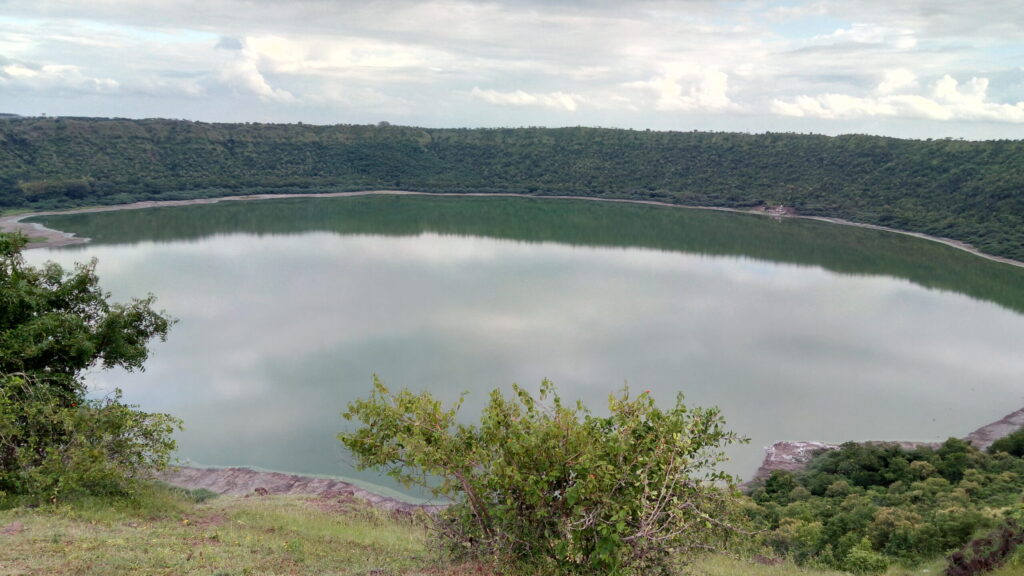
Lonar Lake, located in Buldhana district of Maharashtra, is a unique geological feature — India's only known meteorite impact crater lake and one of the few in the world formed by a basaltic rock impact. Formed approximately 52,000 years ago when a meteorite slammed into the Deccan Plateau, Lonar Lake is simultaneously saline and alkaline — a rare combination that supports unique microbial life and has fascinated scientists for over 170 years.
For UPSC, Lonar Lake is a frequently tested Geography and Environment topic — especially after its dramatic pink colour change in 2020 brought it international attention.
Formation
Meteorite Impact
Lonar Lake formed when a meteorite estimated at 2 million tons struck the Deccan Trap basalt rock at speeds of approximately 90,000 km/h:
- Time of impact: Approximately 52,000 years ago (estimates vary between 35,000-570,000 years)
- Impact energy: Equivalent to a 6 megaton hydrogen bomb
- Crater depth: Original depth ~500 m; current visible depth ~150 m (with lake water)
- Crater diameter: ~1.8 km
- Rim height: ~20 m above surrounding terrain
Why Unique
Lonar is one of only four known meteorite impact craters in basaltic rock worldwide. Others include:
- Lonar (India) — basaltic
- Manicouagan (Canada) — partial
- Most known craters are in sedimentary or granitic rock
- Basaltic craters are rare because basalt is hard and melts/vaporizes differently under impact
This makes Lonar a natural laboratory for understanding:
- Impact dynamics in different rock types
- Conditions similar to other planets (Mars, Moon — which have basaltic rocks)
- NASA and ISRO scientists have used Lonar for analog studies of extra-terrestrial craters
Historical Debate
The impact origin was not immediately accepted. Scientific theories over time:
- Volcanic (proposed by British geologists in the 19th century)
- Explosive (by Indian scientists in the early 20th century)
- Meteorite impact (proven in the 1970s through analysis of quartz deformation, iridium anomalies)
Final proof came from shocked quartz crystals found in the crater rim — only possible through meteorite impact.
Geographic Location
| Feature | Detail |
|---|---|
| State | Maharashtra |
| District | Buldhana |
| Tehsil | Lonar |
| Coordinates | ~19.98°N, 76.52°E |
| Altitude | ~350 m above sea level |
| Nearest airport | Aurangabad (~140 km) |
| Distance from Mumbai | ~550 km |
The lake lies approximately 160 km east of Aurangabad, accessible by road.
Water Characteristics
Lonar's water has unique chemical properties:
Saline-Alkaline Composition
| Property | Value |
|---|---|
| pH | ~10.5 (highly alkaline) |
| Salinity | ~10.5 g/L |
| Total dissolved solids | High |
| Calcium carbonate | Very high |
| Sodium carbonate | High |
| Sodium chloride | Moderate |
Most natural lakes are either saline OR alkaline — Lonar being both is unusual. This creates:
- Unique microbial communities (halophiles and alkaliphiles)
- Unusual chemical reactions
- Distinct coloration under certain conditions
Water Sources
The lake has no surface inlet — it is fed by:
- Groundwater seepage
- Small streams during monsoons
- Has two named streams: Purna and Penganga (not the major rivers of the same name)
No surface outflow either — makes it an endorheic (closed basin) lake.
The 2020 Pink Colour Change
In June 2020, Lonar Lake dramatically changed colour from green to bright pink-red, attracting global attention:
The Phenomenon
- Sudden change observed over ~48 hours
- Covered much of the lake's surface
- Colour was striking pink to deep red
Scientific Explanation
The pink colour was caused by a combination of:
- Halophile and haloalkaliphile bacteria (like Halorubrum) — produce pigments under stress
- Algal bloom of pink-pigmented species
- Sulphate-reducing bacteria activity
- Evaporative concentration due to high summer heat and reduced rainfall
- Low water levels creating high salinity stress
Similar phenomena occur in:
- Lake Hillier (Australia) — permanent pink colour
- Salton Sea occasional pink events
- Lake Urmia (Iran)
- Lake Retba (Senegal) — Lake Rose
Duration
Lonar's pink colour:
- Persisted for several weeks
- Returned to normal colour after monsoon rains diluted the lake
- Was recorded extensively by scientists for future study
This event was unprecedented in recorded history at Lonar.
Biodiversity
Despite harsh chemical conditions, Lonar supports remarkable biodiversity:
Unique Microbial Life
The lake's saline-alkaline waters host organisms found in few other places:
- Halophilic bacteria (Haloarchaea)
- Alkaliphilic bacteria
- Sulphate-reducing bacteria
- Cyanobacteria (blue-green algae)
- Multiple novel species discovered only at Lonar
Macro-biodiversity
| Category | Examples |
|---|---|
| Birds | 160+ species; migratory birds visit; including rarer species like the Indian Eagle-Owl, Shikra |
| Aquatic life | Limited fish (most cannot survive the high salinity); crustaceans |
| Plants | Mangrove-like species in the crater rim |
| Terrestrial fauna | Macaques, peacocks, jackals; hyenas historically |
Habitat Significance
- Stopover for migratory birds including pelicans, flamingos
- Important site for ornithology
- Designated as a Wildlife Sanctuary by Maharashtra
Temples Within and Around the Crater
Lonar crater is also a significant religious site with ancient temples dating from the Chalukya period (10th-12th century CE):
| Temple | Significance |
|---|---|
| Daityasudan Temple | On the crater rim; Chalukya architecture; dedicated to Vishnu |
| Kamalaja Devi Temple | Near the lake; major pilgrimage site |
| Vagheshwar Temple | Inside the crater |
| Narsimha Temple | Inside the crater |
| Yugeshwar Temple | Inside the crater |
| Numerous smaller shrines | Throughout the crater |
The temples are built of basalt and showcase classical Chalukya architecture. They are relatively well-preserved given their age.
Conservation Status
Protection
- Wildlife Sanctuary — designated by Maharashtra government
- Notified as Ramsar Site — in November 2020 (India's 41st Ramsar Site at the time, now one of 85)
- National Geological Monument — designated by Geological Survey of India
- Protected under the Wild Life (Protection) Act, 1972
Threats
Despite protection, Lonar faces threats:
- Encroachment around the crater rim
- Groundwater depletion — affects lake water level
- Pollution from surrounding agricultural runoff
- Tourist pressure — ~500,000 visitors annually
- Temple waste — religious offerings polluting the water
Conservation Efforts
- ASI (Archaeological Survey of India) protects the temples
- Maharashtra Forest Department manages the sanctuary
- Scientific monitoring by multiple research institutions
- Ramsar Site status provides additional protection
Scientific Research
Lonar has attracted significant research interest:
NASA Studies
- Analog site for Mars research
- Mars's Gusev Crater (where the Spirit rover landed) has basaltic conditions similar to Lonar
- Helps understand microbial survival in extreme environments
ISRO Involvement
- Space research using Lonar as an analog site
- Chandrayaan-2 and Chandrayaan-3 mission planners studied Lonar for lunar crater analogs
Ongoing Research
- Impact dynamics studies
- Microbial biology research (novel species discovery)
- Climate change indicators — Lonar's chemistry responds to climate
- Astrobiology — implications for life in extreme environments
UPSC Relevance
GS1 (Geography): Unique geological features, lakes, Deccan Plateau geology.
GS3 (Environment): Biodiversity, conservation, Ramsar Sites.
GS3 (Science & Technology): Impact cratering, astrobiology, space science.
Key Prelims facts:
- Location: Buldhana district, Maharashtra
- Formation: Meteorite impact ~52,000 years ago
- Diameter: ~1.8 km
- Depth: ~150 m (current)
- Unique: Formed in basaltic rock (rare globally)
- Water: Both saline AND alkaline (pH ~10.5)
- Endorheic: No surface outflow
- 2020 pink colour change: Due to halophile bacteria + algal bloom
- Ramsar Site status: November 2020
- Wildlife Sanctuary (Maharashtra)
- National Geological Monument (GSI)
- Ancient temples: Chalukya period (10-12 centuries)
- Scientific significance: Analog for Mars, Moon research
- Host organisms: Halophiles, alkaliphiles, cyanobacteria
- Nearest airport: Aurangabad
- Bird species recorded: 160+
- No major surface inlet; fed by groundwater
Tell Google you want more of this.
Add Anantam IAS as a preferred sourceOne tap, and this site shows up more often in your own Top Stories, AI Overviews and AI Mode. Remove it any time.