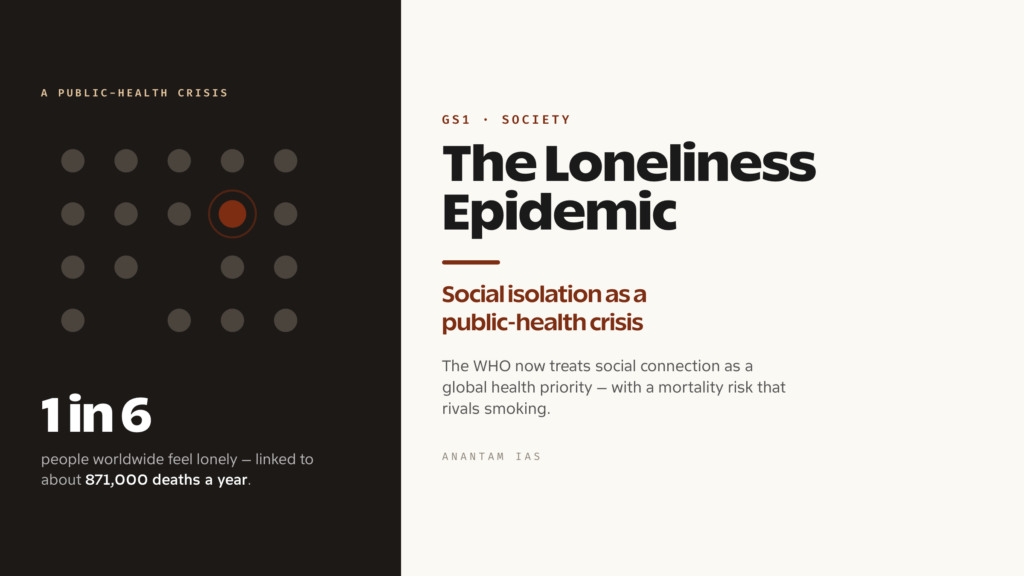
In June 2025 the World Health Organization did something it rarely does for a feeling. It put loneliness on the same shelf as the diseases it spends its life fighting. The flagship report of the WHO Commission on Social Connection, titled From Loneliness to Social Connection, declared that roughly one in six people on earth feels lonely, and that the lack of social connection is linked to an estimated 871,000 deaths every year — about 100 every hour. The Commission’s co-chairs, the former US Surgeon General Vivek Murthy and the African Union adviser Chido Mpemba, framed it bluntly: social connection is not a soft, private matter but a determinant of health, on par with diet, exercise and clean air. A few months earlier, the World Health Assembly had passed its first-ever resolution treating social connection as a standalone global health priority. A private ache had become public policy.
And that shift matters far beyond Geneva, because the numbers behind it are not abstract. Lacking social connection raises the risk of early death by more than 60 per cent — a hazard researchers compare to smoking up to 15 cigarettes a day. It is woven into heart disease, stroke, dementia and depression. It is rising fastest among the young, not the old. And by one widely cited Meta-Gallup survey, India sits among the loneliest large nations measured, with about 43 per cent of respondents reporting some loneliness. For a UPSC aspirant, this is exactly the kind of topic the GS1 Society paper now rewards — a social transformation with a hard public-health edge, a clear set of drivers, and a live policy debate that connects urbanisation, ageing, mental health and the welfare state in a single thread.
What the Loneliness Epidemic Actually Means
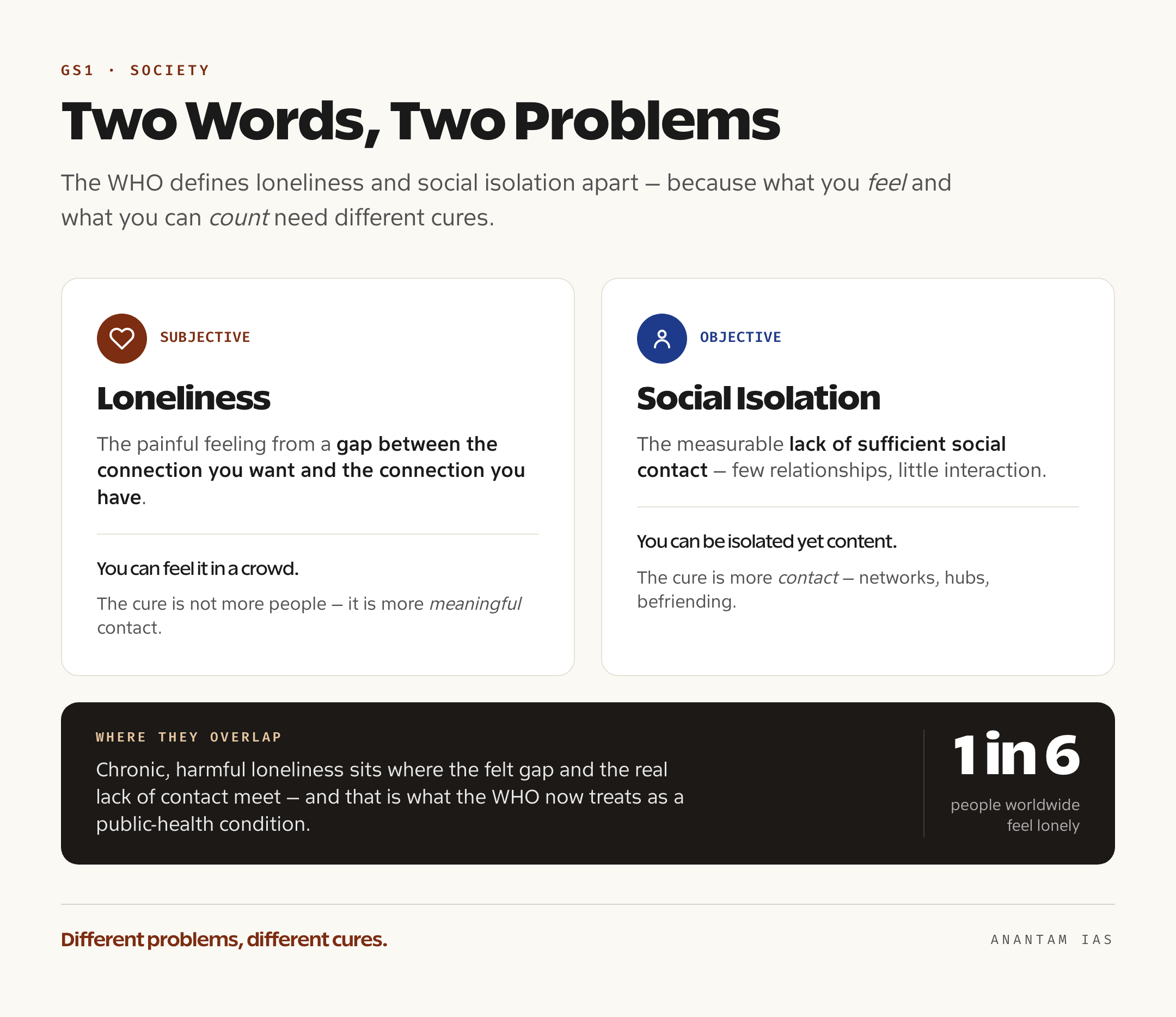
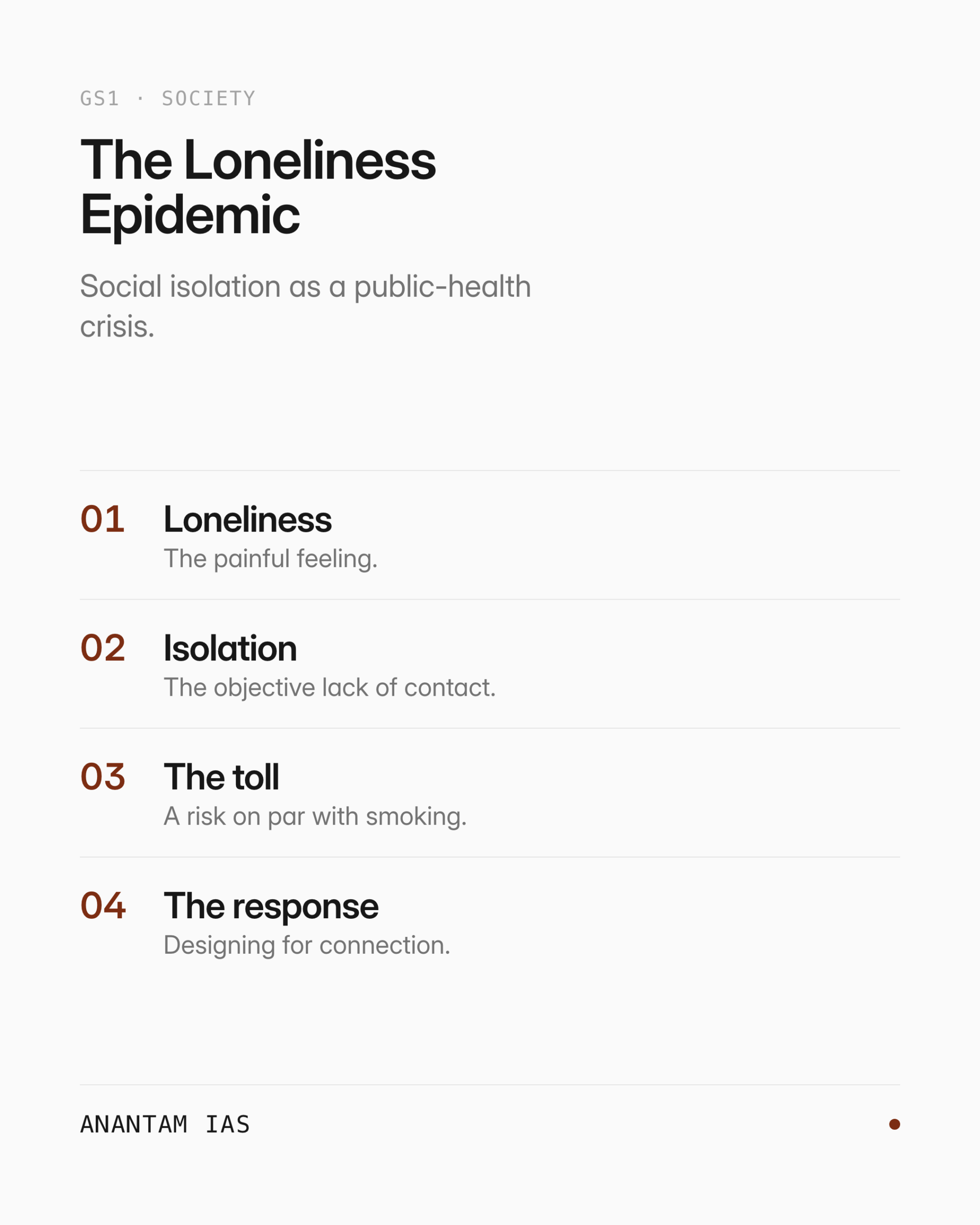
Start by separating two words people use as if they were one. Loneliness and social isolation are related but distinct, and the WHO is careful to define them apart. Loneliness is subjective — the painful feeling that arises from a gap between the social connections you want and the ones you actually have. You can feel it in a crowd, at a family dinner, inside a marriage. Social isolation is objective — the measurable lack of enough social contact, few relationships, little interaction, a thin network. The two often overlap, but not always. A person can be objectively isolated yet content, like a hermit by choice. And a person can be surrounded by people yet ache with loneliness. Holding this distinction is the first mark of a serious answer, because the two demand different remedies: isolation needs more contact, loneliness needs more meaningful contact.
Wrapping both is a third, more positive idea the WHO now centres — social connection, meaning the ways people relate to and interact with others, across its structural, functional and quality dimensions. The Commission’s reframing is deliberate. Rather than only fighting a deficit (loneliness), it asks states to build an asset (connection), the way public health builds immunity rather than only treating infection. That positive framing is why the report calls for a global Social Connection Index to measure the thing the way we measure literacy or life expectancy.
So why call it an “epidemic” at all, when loneliness is as old as the human heart? Because the scale and the trend now look epidemiological. The Meta-Gallup data put nearly a quarter of the world’s adults as feeling lonely, with more than one in five saying they felt lonely for much of the previous day. The burden is not even. It runs higher in low-income countries, where about 24 per cent report loneliness, than in high-income ones, near 11 per cent. And it is heaviest where you might least expect it — among adolescents and young adults, where 17 to 21 per cent report feeling lonely, the highest of any age band, against around 17 per cent for people over 65. A condition once filed under “old age” has quietly become a condition of youth. That inversion is the single most counter-intuitive fact in this whole topic, and it is worth carrying into any answer.

Why It Is a Public-Health Crisis, Not a Mood
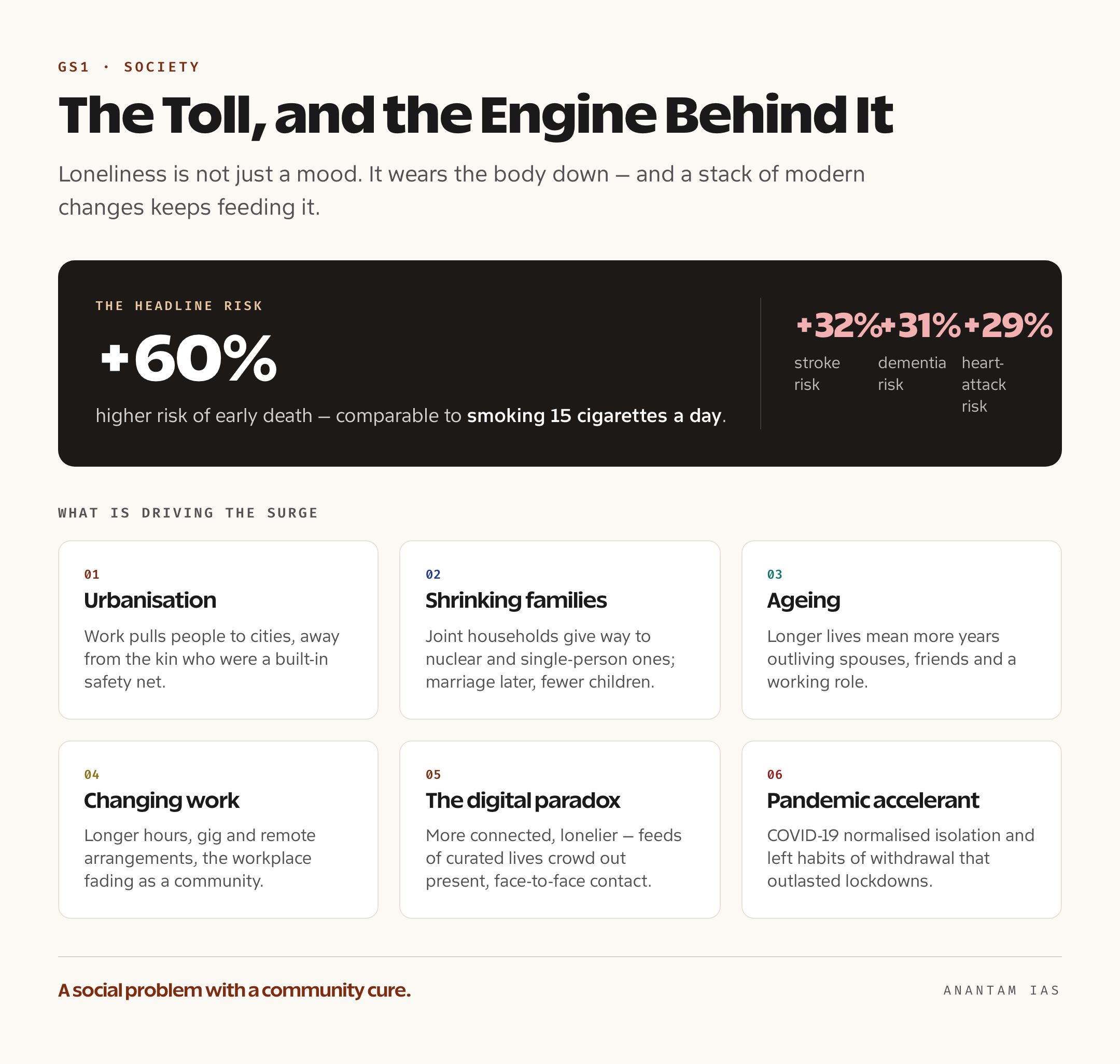
The reason the WHO got involved is that loneliness is not just unpleasant — it kills, slowly and measurably. The body treats chronic loneliness as a threat. It keeps the stress response switched on, raises levels of stress hormones, drives inflammation, disturbs sleep and weakens the immune system. Over years, that wear-and-tear shows up as disease. Socially isolated people carry roughly a 29 per cent higher risk of heart attack and about a 32 per cent higher risk of stroke. Feeling lonely is associated with around a 31 per cent higher risk of developing dementia, and with sharply higher rates of depression and anxiety. Pull it all together and the headline holds: lacking social connection raises the risk of premature death by more than 60 per cent, which is why the comparison to smoking 15 cigarettes a day has stuck. It is one of the few public-health statistics that sounds like hyperbole and is not.
There is also a vicious circle that makes it a population problem rather than a personal failing. Loneliness feeds depression; depression deepens withdrawal; withdrawal deepens loneliness. It overlaps heavily with the wider mental-health burden — and India’s mental-health story shows how thin the treatment system is against demand. It also tends to cluster where other disadvantages cluster: among the poor, the disabled, migrants, caregivers, the bereaved and the unemployed. That clustering is why the Commission insists loneliness is a social determinant of health — a condition shaped by how society is organised, not just by individual temperament. Treat it as a private sadness and you miss the policy lever entirely. Treat it as a determinant, like sanitation or air quality, and a government suddenly has something to do.
And the cost is not only counted in deaths and disease. Loneliness is expensive in plainer ways too. Isolated and lonely people use more health services, recover more slowly, and lean harder on emergency rooms and old-age care — so the bill lands on the state whether or not anyone names the cause. There is a productivity cost, with lonely workers more prone to absence and burnout, and a civic cost, because people with few connections trust less, volunteer less and vote less. That is the deeper argument behind the WHO’s reframing: a society that lets its social fabric thin out does not just produce sadder individuals, it produces a weaker, sicker and more fragmented public — which is precisely why connection now sits in the health budget rather than the agony column.
What Is Driving the Surge
If loneliness is so costly, the obvious question is why it is rising in an age of constant contact. The answer is a stack of changes, each reasonable on its own, that together thin out the web of human relationships. The biggest is the way we now live. Urbanisation pulls people into cities for work, away from the villages and extended kin who once formed a built-in social safety net. Families have shrunk from joint households to nuclear ones, and increasingly to single-person households. People marry later, or not at all; they have fewer children; they move for jobs and leave their parents behind. Each step makes economic sense and leaves a person with fewer everyday relationships to fall back on.
Then there is ageing. As people live longer, more of them outlive spouses, friends and their own usefulness in the labour market, and end their lives in years of thin contact — the loneliness of the very old is real and growing. Work has changed too: longer hours, gig and remote arrangements, and the slow death of the workplace as a community. So has the texture of daily life, with more screens and fewer “third places” — the cafés, clubs, temples, libraries and parks where strangers used to become acquaintances.
Sitting on top of all this is the digital paradox, the strangest driver of the lot. We are more connected than any generation in history and, by these measures, lonelier. Social media promises connection and often delivers comparison — a feed of other people’s curated lives that leaves the viewer feeling smaller and more alone. Online ties can substitute for the harder, richer work of being physically present, and the dopamine loop of scrolling can crowd out the slow conversations that actually nourish. None of this means technology is the sole villain; used well, it connects the housebound and the far-flung. But the evidence that heavy, passive social-media use tracks with loneliness, especially among teenagers, is part of why the young now top the loneliness charts. And the COVID-19 pandemic acted as an accelerant on every one of these trends, normalising isolation, hollowing out routines and leaving habits of withdrawal that outlasted the lockdowns.
How the World Is Responding
For all the gloom, this is also a story of governments discovering a new lever — and that policy turn is the most exam-friendly part of the topic. The pioneer was the United Kingdom. Building on the work of the Jo Cox Commission, named for the murdered MP who had championed the cause, Britain in 2018 became the first country in the world to appoint a Minister for Loneliness and to publish a national loneliness strategy. Japan followed in 2021, creating its own Minister for Loneliness and Isolation after the pandemic drove a worrying rise in suicides, especially among women and the young. The two countries’ loneliness ministers have since met and compared notes — a small sign that the issue has crossed from curiosity to policy.
The signature intervention to emerge is social prescribing. The idea is disarmingly simple: when a doctor sees a patient whose real problem is loneliness rather than a treatable disease, the doctor “prescribes” not a pill but a connection — a walking group, a community choir, a volunteering slot, a befriending service — usually through a link worker who knows what the neighbourhood offers. England has built this into its NHS, hiring thousands of social-prescribing link workers. The logic is that loneliness is a health problem with a community cure, and that the health system is often the only institution that meets isolated people at all. Alongside it sit befriending schemes, men’s sheds, community hubs, design of public spaces that invite encounter, and campaigns to make talking about loneliness less shameful — all aimed at rebuilding the everyday social fabric that modern life has worn thin.
The WHO’s own response now anchors this scattered effort. Its Commission on Social Connection, set up in late 2023 for three years, has given the field a global home, a shared vocabulary and a roadmap built around five strands — policy, research, interventions, better measurement through the new Social Connection Index, and public engagement to shift the norm. By naming social connection a global health priority, the WHO has effectively told every health ministry, India’s included, that this belongs on the agenda next to nutrition and immunisation, not in a footnote.
The India Angle: A Young, Urbanising, Lonely Nation
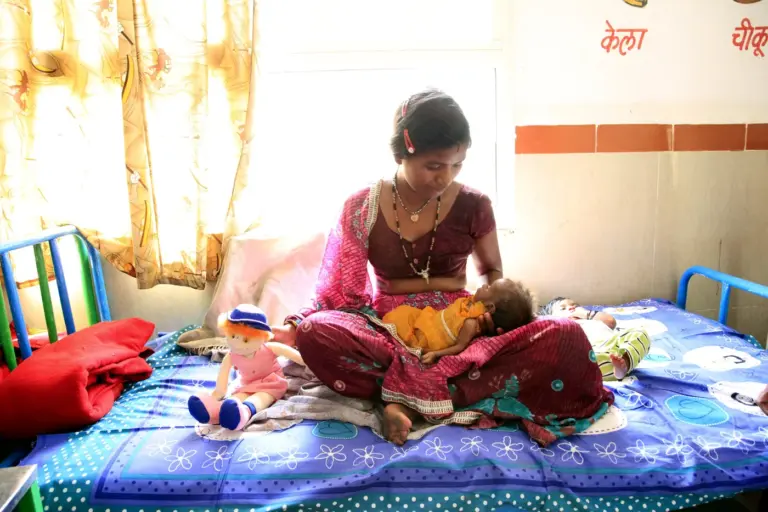
So where does India sit? Uncomfortably in the middle of every trend that drives this crisis, and largely without a policy to name it. India is urbanising fast, its joint families are dissolving into nuclear and single-person households, and its young people — the demographic the whole country bets its future on — are among the loneliest measured anywhere, with the Meta-Gallup survey placing India near the top of the global loneliness table. The youth mental-health picture is grim: rising anxiety, exam pressure, joblessness despite degrees, hours lost to screens, and a thin, overstretched system of care to catch anyone who falls. Loneliness is both a cause and a symptom of that wider distress.
At the other end of life sits the quieter Indian crisis — the elderly left behind. As adult children migrate to cities and abroad, a growing share of older Indians age alone, sometimes for the first time in a culture built on co-residence. The country’s missing eldercare system means there is little to replace the family that has moved away — few community supports, patchy pensions, a handful of old-age homes, and a deep stigma that keeps both loneliness and the institutions that might ease it in the shadows. The tragedy is sharpest where it should be least expected, in a society that long prided itself on the joint family as a social security system. That system is fraying faster than any replacement is being built.
States such as Kerala already preview the problem the rest of the country will meet — a large diaspora abroad, ageing parents in “migrant households” who have money sent home but no one present to share a meal or notice a fall. The emotional gap is not solved by a remittance. And the strain runs both ways across the generations: the same young people carrying record loneliness are also the ones expected to leave home for work, so the very mobility that builds the economy quietly dismantles the household that used to absorb life’s shocks. India is, in effect, urbanising and ageing at the same time, on a scale the world has never seen, and it is doing so before it has built the community institutions — the social prescribing, the senior clubs, the public spaces, the recognition in policy — that richer ageing societies are now scrambling to create.
India’s existing tools are aimed at mental illness, not at connection as such, and they are stretched thin. The National Mental Health Programme dates to 1982; its District Mental Health Programme tries to push care to the grassroots. The newer Tele-MANAS helpline, launched in 2022 as the digital arm of that programme, now runs a 24×7 service in 20 languages across most states and has fielded over two million calls — real progress, but a clinical response to what is partly a social problem. The Maintenance and Welfare of Parents and Senior Citizens Act of 2007 gives older people a legal claim to care, but a statute cannot manufacture companionship. What India lacks is a social-connection lens: a recognition, in policy and budget, that loneliness is a public-health and development issue in its own right. The WHO’s framing hands India a ready template — measure it, name it, and weave connection into urban design, ageing policy, schools, workplaces and primary care — before a young, fast-changing society pays the full health bill of growing apart.
For Your Mains Answer
This is a high-value topic for GS Paper 1, which covers Indian society — its salient features, the effects of urbanisation, the changing family structure, and the role of social-empowerment and population issues. It maps just as cleanly onto GS Paper 2 through health and the social-sector schemes meant to address it, and it offers a rich, humane theme for the Essay paper on connection, technology and the costs of modern life. The skill examiners reward here is the same one this article uses: define the concept precisely, prove it is a public-health issue with a few hard numbers, explain the drivers as a social transformation, and land it on India with a concrete way forward.
How to Build the Answer
Lead with the distinction — loneliness as the subjective feeling, social isolation as the objective lack — because it signals conceptual control. Then establish scale and stakes with the WHO frame: one in six affected, around 871,000 deaths a year, a mortality risk rivalling smoking. Move to drivers as a chain of social change: urbanisation, nuclear and single-person families, ageing, altered work, the digital paradox, the pandemic as accelerant. Survey responses — the UK and Japan loneliness ministers, social prescribing, the WHO Commission — to show solutions exist. Close on India: young and lonely at one end, elderly and isolated at the other, with Tele-MANAS and the senior-citizens law as partial tools and a social-connection lens as the gap. That arc — define, prove, explain, respond, localise — fits almost any framing of the question.
Common Mistakes to Avoid
Don’t treat loneliness and social isolation as synonyms; the distinction is the easiest mark on offer. Don’t moralise it as personal weakness — frame it as a social determinant of health shaped by how society is organised. Don’t blame technology alone; the digital paradox is one driver among many, and screens both cause and cure isolation. Don’t write as if loneliness is only an elderly problem — the young top the charts, and saying so shows you’ve read the current data. And don’t end with vague calls for “awareness”; name social prescribing, the WHO Commission and a social-connection lens as concrete levers.
A Compact Answer Spine
Loneliness (subjective feeling of a gap) ≠ social isolation (objective lack of contact); both threaten health → WHO 2025: 1 in 6 lonely, ~871,000 deaths a year, risk like smoking 15 cigarettes/day, raises early-death risk 60%+, linked to heart disease, stroke (~32%), dementia (~31%), depression → drivers: urbanisation, nuclear/single households, ageing, gig/remote work, digital paradox, COVID accelerant; young loneliest → responses: UK (2018) and Japan (2021) loneliness ministers, social prescribing, WHO Commission on Social Connection + Social Connection Index → India: ~43% report loneliness, lonely youth + isolated elderly, dissolving joint family, NMHP/Tele-MANAS + Senior Citizens Act 2007 as partial tools → way forward: a social-connection lens across health, ageing, urban design and schools.
Diagram or Flowchart Idea
Draw a simple two-circle contrast — “Loneliness (felt)” and “Social Isolation (counted)” with an overlap labelled “chronic, harmful” — beside a short cause-to-consequence arrow: drivers (urbanisation, nuclear family, ageing, digital paradox) → chronic loneliness → health toll (heart, brain, mind) → policy response (social prescribing, social-connection lens). The contrast plus the chain captures the whole answer at a glance.
A Balanced-Conclusion Line
A line that lands the marks: “The loneliness epidemic is the hidden cost of how a modern, urbanising society lives — and treating social connection as seriously as we treat sanitation or vaccination may be the most humane public-health investment India can make for both its young and its old.”
How to Use Data Without Cramming
You need only a handful of anchors, not a spreadsheet: 1 in 6 people affected, around 871,000 deaths a year, a 60 per cent higher risk of early death (like smoking 15 cigarettes daily), the young as the loneliest age group, and India near the top of the Meta-Gallup loneliness table at about 43 per cent. Attribute them plainly — “as the WHO Commission on Social Connection reported in 2025” — rather than scattering figures without a source.
Frequently Asked Questions
What is the difference between loneliness and social isolation?
Loneliness is subjective — the painful feeling that arises from a gap between the social connection you want and the connection you actually have, which you can feel even in a crowd. Social isolation is objective — the measurable lack of enough social contact and relationships. They often overlap, but a person can be isolated yet content, or surrounded by people yet deeply lonely. The distinction matters because isolation calls for more contact while loneliness calls for more meaningful contact.
Why does the WHO treat loneliness as a public-health crisis?
Because chronic loneliness measurably harms the body and shortens life. The WHO Commission on Social Connection reported in 2025 that about one in six people worldwide feel lonely and that weak social connection is linked to roughly 871,000 deaths a year. Lacking connection raises the risk of early death by more than 60 per cent — comparable to smoking 15 cigarettes a day — and is tied to higher rates of heart disease, stroke, dementia and depression. The World Health Assembly has since named social connection a global health priority.
Why are young people lonelier than the old?
Counter to the stereotype, surveys such as Meta-Gallup find adolescents and young adults report the highest loneliness of any age group, around 17 to 21 per cent. The likely reasons are heavy, comparison-driven social-media use replacing face-to-face contact, the pressures of study and unstable early careers, delayed family formation, and the lasting social scarring of the pandemic years that hit them at a formative age.
What is India doing about loneliness, and what is missing?
India’s tools are aimed at mental illness rather than connection as such — the National Mental Health Programme, its District Mental Health Programme, the Tele-MANAS 24×7 helpline launched in 2022, and the Maintenance and Welfare of Parents and Senior Citizens Act of 2007 for the elderly. These help, but a helpline is a clinical answer to a partly social problem. What India lacks is a dedicated social-connection lens — measuring loneliness and building connection into urban design, ageing policy, schools and primary care, as the WHO now urges.
Practice Questions
Prelims MCQs
- With reference to the WHO’s framing, which statement correctly distinguishes loneliness from social isolation?
(a) Loneliness is the objective lack of contact, while social isolation is the subjective feeling
(b) Loneliness is the subjective feeling of a gap in connection, while social isolation is the objective lack of contact
(c) Both terms mean exactly the same thing
(d) Loneliness applies only to the elderly and isolation only to the young
Answer: (b) Loneliness is subjective — the painful feeling of a gap between desired and actual connection; social isolation is the objective, measurable lack of sufficient social contact. - The Commission on Social Connection, which declared loneliness a global health priority, was established by which organisation?
(a) The United Nations Development Programme
(b) The World Bank
(c) The World Health Organization
(d) The International Labour Organization
Answer: (c) The WHO set up the Commission on Social Connection in late 2023; its 2025 flagship report linked weak social connection to about 871,000 deaths a year. - According to the WHO Commission, lacking social connection raises the risk of premature death by an amount commonly compared to which behaviour?
(a) Drinking two cups of coffee a day
(b) Smoking up to 15 cigarettes a day
(c) Skipping breakfast
(d) Walking 10,000 steps a day
Answer: (b) Lacking social connection raises early-death risk by more than 60 per cent, a hazard researchers compare to smoking up to 15 cigarettes a day. - Which country became the first in the world to appoint a Minister for Loneliness and publish a national loneliness strategy?
(a) Japan, in 2021
(b) The United Kingdom, in 2018
(c) India, in 2022
(d) The United States, in 2020
Answer: (b) Building on the Jo Cox Commission, the United Kingdom appointed the first Minister for Loneliness and published a loneliness strategy in 2018; Japan followed in 2021. - Which of the following is the digital-era programme that serves as the tele-mental-health arm of India’s National Mental Health Programme?
(a) Ayushman Bharat Digital Mission
(b) Tele-MANAS
(c) eSanjeevani
(d) PM-JAY
Answer: (b) Tele-MANAS, launched in 2022, runs a 24×7 tele-mental-health helpline in 20 languages and is the digital component of the National Mental Health Programme.
Mains Practice Questions
- Distinguish between loneliness and social isolation, and examine why the World Health Organization now treats weak social connection as a public-health crisis rather than a private matter. (10 marks, 150 words)
- “We are more connected than ever and lonelier than ever.” Analyse the drivers of the loneliness epidemic in contemporary societies, with special reference to urbanisation, the changing family and the digital paradox. (15 marks, 250 words)
- The loneliness epidemic is often described as a problem of the old, yet the data point to the young. Critically examine the prevalence, causes and consequences of loneliness among India’s youth. (15 marks, 250 words)
- Discuss how the breakdown of the joint family and rapid urbanisation have reshaped the social-support architecture for India’s elderly, and suggest measures to address the resulting isolation. (15 marks, 250 words)
- Evaluate the policy responses to loneliness adopted globally — from loneliness ministers and social prescribing to the WHO Commission on Social Connection — and assess what a “social-connection lens” would mean for India’s health, ageing and urban policy. (15 marks, 250 words)
Tell Google you want more of this.
Add Anantam IAS as a preferred sourceOne tap, and this site shows up more often in your own Top Stories, AI Overviews and AI Mode. Remove it any time.