
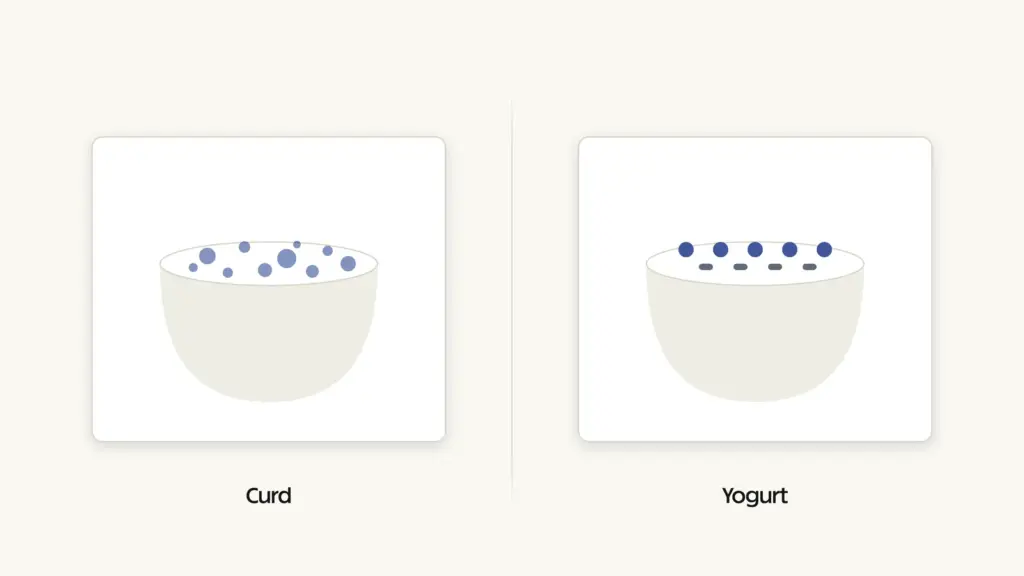
Curd and yogurt are both milk fermented by lactic acid bacteria, and in everyday Indian speech the words are used interchangeably. In food law they are not the same. Under India’s food standards, dahi (curd) is defined simply by fermentation with lactic acid bacteria, while yoghurt must be made with a specific symbiotic pair — *Streptococcus thermophilus* and *Lactobacillus delbrueckii* subsp. *bulgaricus*. Curd is the open, house-to-house version; yogurt is the standardised, laboratory-defined one. The practical differences in texture, tartness and shelf life all follow from that single distinction.
What is happening in both
Milk contains lactose, the milk sugar, and casein, its main protein. Lactic acid bacteria consume lactose and excrete lactic acid. As acid accumulates, the pH falls, and at about pH 4.6 the casein micelles lose their electrical repulsion and clump together into a soft, continuous gel. That is the “setting” you see. Whey — the watery fraction — is trapped inside the gel, which is why fresh dahi looks solid and then weeps liquid when disturbed.
Fermentation also does useful secondary work: it breaks down part of the lactose, produces flavour compounds such as diacetyl and acetaldehyde, drops the pH low enough to suppress spoilage organisms, and makes some minerals more available.
Both curd and yogurt run this same process. What separates them is which bacteria are doing it, and how tightly the conditions are controlled.
Curd vs yogurt: the comparison
| Point of comparison | Curd (Dahi) | Yogurt (Yoghurt) |
|---|---|---|
| Definition in Indian food law | Fermented milk characterised by lactic acid bacteria — the group is not specified | Fermented milk made with symbiotic cultures of Streptococcus thermophilus and Lactobacillus delbrueckii subsp. bulgaricus |
| Culture used | Mixed, often undefined; a spoon of the previous day’s dahi carries whatever strains it holds | Standardised commercial starter with a fixed pair of species |
| Method of inoculation | Back-slopping — adding a little old curd to warm milk | Adding a measured, laboratory-propagated culture to pasteurised milk |
| Incubation | Ambient warmth, roughly 30–40 °C, often overnight; time varies with the weather | Held at about 42–45 °C for a controlled period until a target pH is reached |
| Consistency of the result | Varies batch to batch and house to house | Highly repeatable — the point of the standardisation |
| Typical texture | Softer set, often looser, with visible whey separation | Firmer, smoother, thicker body |
| Typical taste | Mildly sour, changing sharply with how long it sits | Cleaner, more consistent tang |
| Minimum milk fat under Indian standards | Plain dahi must match the milk it is made from | Not less than 3.0% and not more than 15% (for full-fat yoghurt and flavoured dahi) |
| Minimum titratable acidity | 0.45% as lactic acid (general fermented-milk rule) | 0.6% as lactic acid |
| Minimum milk protein | 2.9% | 2.9% |
| Live culture count required | Starter organisms viable and abundant, not less than 10⁷ cfu/g | Same requirement — not less than 10⁷ cfu/g |
| Commercial availability | Both loose and packaged | Almost entirely packaged, usually flavoured or set in cups |
| Usual culinary use | Raita, kadhi, lassi, chaas, marinades, everyday accompaniment | Eaten as a dessert or breakfast item, often sweetened or fruited |
What Indian food law actually says
The relevant provision is the Standard for Fermented Milk Products in the Food Safety and Standards (Food Products Standards and Food Additives) Regulations. It lists fermented milks by the starter culture that characterises them, per the FSSAI dairy products standards.pdf):
- Dahi — lactic acid bacteria
- Yoghurt — symbiotic cultures of *Streptococcus thermophilus* and *Lactobacillus delbrueckii* subsp. *bulgaricus*
- Alternate Culture Yoghurt — cultures of *Streptococcus thermophilus* and *Lactobacillus* species
- Acidophilus milk — *Lactobacillus acidophilus*
Other harmless microorganisms may also be added alongside these. A few further rules are worth knowing:
- The starter organisms must be viable, active and abundant in the product right up to the date of minimum durability, and must total not less than 10⁷ cfu per gram. Where a manufacturer names an additional organism on the label and makes a claim about it, that one must be present at not less than 10⁶ cfu/g. If the product has been heat-treated after fermentation, these live-culture requirements no longer apply — which is exactly why a long-shelf-life fermented milk drink may contain no live bacteria at all.
- The raw milk must be heat treated — pasteurised, ultra-pasteurised, sterilised, UHT-treated or boiled — before fermentation.
- Whey removal after fermentation is not permitted, except for concentrated fermented milks. Straining dahi to make chakka, and then shrikhand, is covered separately.
- Flavoured dahi may be sold only in pre-packaged form.
- Under an amendment that came into force on 1 August 2023, the word “(Curd)” was dropped from the dahi entry in the culture table, tightening the terminology.
The compositional standards themselves distinguish the two products cleanly. Plain dahi has to carry the same minimum milk fat and solids-not-fat as the milk it was made from. Yoghurt and flavoured dahi have their own table: milk fat not less than 3.0% and not more than 15%, solids-not-fat at least 8.5%, milk protein at least 2.9%, and titratable acidity at least 0.6% as lactic acid. Partly skimmed versions sit between 0.5% and 3.0% fat; skimmed versions are capped at 0.5%.
The probiotic question
This is where marketing runs ahead of microbiology. A live culture is not automatically a probiotic. A probiotic is defined by demonstrated benefit at an adequate dose — the organism has to survive stomach acid and bile, reach the intestine alive, and do something measurable there.
The two organisms that define yoghurt, *S. thermophilus* and *L. bulgaricus*, are excellent at fermenting milk but are not strong gut colonisers. Products that make a genuine probiotic claim usually add other organisms — strains of *Lactobacillus acidophilus*, *Lactobacillus rhamnosus* or *Bifidobacterium* — on top of the yoghurt culture. Indian regulation reflects this: where probiotics are used in dairy products, the Indian Council of Medical Research guidelines for the evaluation of probiotics in food have to be followed, and a labelled organism carrying a claim has to be present at the specified minimum count. Product standards, labelling rules and the list of permitted additives are all published by the Food Safety and Standards Authority of India.
Home-set dahi, meanwhile, contains a genuinely mixed and undocumented population. It may well contain organisms with useful properties; it has simply never been characterised, which is a different thing from being inferior.
Nutrition: less separates them than you would think
Per 100 grams, plain full-fat curd and plain full-fat yogurt made from the same milk are nutritionally close. Both carry the milk’s protein, calcium, phosphorus, riboflavin and vitamin B12. Both have less lactose than the milk they came from, because the bacteria have eaten some of it — which is why many people who react badly to milk tolerate dahi comfortably.
Real nutritional differences come from three things that have nothing to do with the curd-versus-yogurt distinction:
- The milk used. Full-fat, toned, double-toned and skimmed milk give very different fat and calorie figures.
- Added sugar. Flavoured and fruit yogurts often carry substantial added sugar. Plain dahi carries none.
- Straining. Greek-style yogurt and hung curd have had whey drained off, which concentrates protein and reduces lactose per gram. Note that under Indian standards this straining moves the product into the concentrated fermented milk category rather than plain yoghurt.
If you compare a plain unsweetened yogurt with plain dahi, you are comparing near-equals. If you compare a fruit yogurt cup with home-set dahi, you are mostly comparing sugar.
Common confusions
“Curd is Indian, yogurt is foreign.” Not quite. Fermented milk is ancient across Central Asia, West Asia, the Balkans and the subcontinent. What is Western is not the food but the *standardisation* — the defined two-strain culture and the controlled incubation that made industrial production possible.
“Curd means the same thing in every cuisine.” It does not, and this causes real confusion. In Indian English, curd means dahi, a fermented milk. In Western food science, “curd” means the solid casein mass separated during cheesemaking — as in curds and whey — which is produced by adding rennet or acid, not by fermenting with a starter culture. Paneer is closer to that second sense than dahi is.
“Yogurt is always healthier than curd.” There is no such rule. Both must meet minimum protein and live-culture requirements. A sweetened flavoured yogurt can carry far more sugar than plain home-set dahi.
“All yogurt has live bacteria.” Not necessarily. If a fermented milk product has been heat-treated after fermentation to extend its shelf life, the live-culture requirement does not apply to it. Long-life fermented drinks sitting unrefrigerated on a shelf are the usual case.
“Bacteria multiply by mitosis.” They do not. Lactic acid bacteria are prokaryotes and divide by binary fission — no spindle, no chromosomal condensation, no nuclear membrane to break down. Their whole cell architecture differs from the eukaryotic pattern set out in the difference between plant cell and animal cell, and their division has none of the machinery described in the difference between mitosis and meiosis. That is exactly why a starter culture can double in twenty minutes and turn a pot of milk in a few hours.
Frequently Asked Questions
Is curd the same as yogurt?
In everyday Indian usage, yes. In food regulation, no. Dahi is defined by fermentation with lactic acid bacteria generally, while yoghurt requires the specific symbiotic pair of *Streptococcus thermophilus* and *Lactobacillus delbrueckii* subsp. *bulgaricus*.
Which is thicker, curd or yogurt?
Commercial yogurt is usually firmer and smoother, because the culture, the temperature and the incubation time are all controlled and because milk solids are often added. Home-set dahi is generally softer and more prone to whey separation.
Does curd have probiotics?
It contains live lactic acid bacteria, but “probiotic” is a stricter claim requiring documented strains and demonstrated benefit. Home-set dahi has a mixed, uncharacterised population. Products making a probiotic claim in India must follow the ICMR guidelines for evaluation of probiotics in food.
Can lactose-intolerant people eat curd or yogurt?
Many can tolerate both better than milk, because fermentation consumes part of the lactose and the live bacteria contribute lactase activity. Tolerance is individual, so start small.
Why does my dahi turn sour by evening?
Because fermentation continues as long as the culture is warm and has lactose left. Once the set is firm, refrigerate it. Cold slows the bacteria sharply and holds the sourness roughly where it is.
What is the minimum fat content for yogurt in India?
Full-fat yoghurt and flavoured dahi must contain not less than 3.0% and not more than 15% milk fat, with solids-not-fat of at least 8.5% and milk protein of at least 2.9%. Partly skimmed and skimmed versions have their own lower fat limits.
Is hung curd the same as Greek yogurt?
They are made the same way — by draining whey from set curd or yogurt — and are nutritionally similar, with more protein per gram and less lactose. Under Indian standards, straining moves the product into the concentrated fermented milk category, of which chakka is the named example.
Practice Questions
1. Under Indian food standards, yoghurt is characterised by fermentation with:
a) Lactic acid bacteria in general
b) *Streptococcus thermophilus* and *Lactobacillus delbrueckii* subsp. *bulgaricus*
c) *Lactobacillus acidophilus* alone
d) *Saccharomyces cerevisiae*
Answer: b) *Streptococcus thermophilus* and *Lactobacillus delbrueckii* subsp. *bulgaricus*
2. Milk sets into curd because falling pH causes:
a) Lactose to crystallise
b) Milk fat to solidify
c) Casein to coagulate near its isoelectric point
d) Whey proteins to denature and evaporate
Answer: c) Casein to coagulate near its isoelectric point
3. The minimum count of starter microorganisms required in a fermented milk product up to the date of minimum durability is:
a) 10³ cfu/g
b) 10⁵ cfu/g
c) 10⁷ cfu/g
d) 10¹⁰ cfu/g
Answer: c) 10⁷ cfu/g
4. Which statement about lactic acid bacteria is correct?
a) They are eukaryotes that divide by mitosis
b) They are prokaryotes that divide by binary fission
c) They are fungi that reproduce by budding
d) They are viruses that replicate inside milk cells
Answer: b) They are prokaryotes that divide by binary fission
5. Fermented dahi and yogurt are often better tolerated than milk by lactose-intolerant individuals because:
a) Fermentation removes all the calcium
b) Fermentation converts casein into fat
c) Part of the lactose is consumed during fermentation and the live cultures contribute lactase activity
d) The pH rises, neutralising lactose
Answer: c) Part of the lactose is consumed during fermentation and the live cultures contribute lactase activity
Mains-style questions
- Distinguish between curd and yogurt with reference to the starter cultures used, the process conditions and the compositional standards laid down in Indian food regulations.
- Explain the biochemistry of milk fermentation, and account for the changes in texture, flavour and keeping quality that follow.
- “A live culture is not the same as a probiotic.” Examine this statement in the light of the regulatory requirements for probiotic claims in food.
- Discuss how standardisation of starter cultures enabled the industrial production of fermented milk, and assess what is gained and what is lost relative to traditional back-slopping.
- Traditional fermented foods form a significant part of the Indian diet. Analyse their nutritional and food-safety significance, and the role of food standards in regulating them.
Tell Google you want more of this.
Add Anantam IAS as a preferred sourceOne tap, and this site shows up more often in your own Top Stories, AI Overviews and AI Mode. Remove it any time.