For two decades we’ve been told India is young, and we built our whole sense of the future around it. The demographic dividend, the median age of 28, the workforce that would carry the country. All true. But sitting quietly inside that story is a second one we’ve barely started to read. India is also ageing, fast, and it’s ageing without the one thing every other ageing society built first: a system to care for the old. The young India is real. So is the old India arriving right behind it. And right now only one of them has a plan.
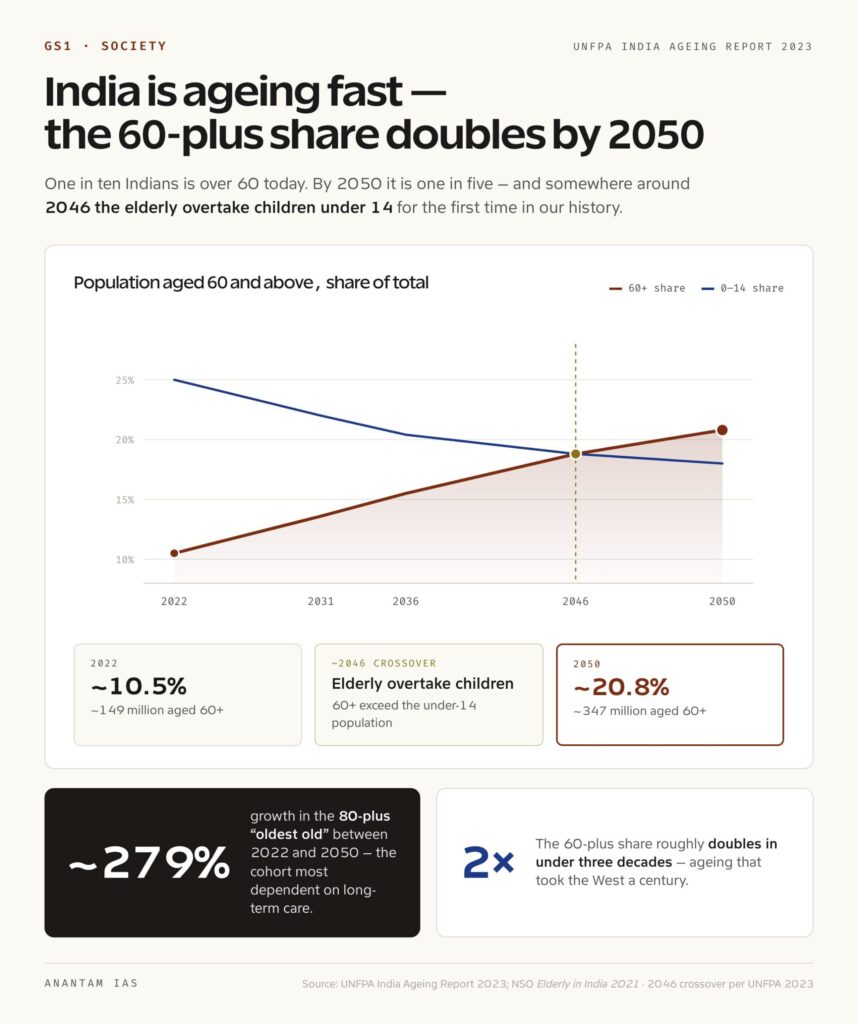
Here are the two numbers that should reframe the whole conversation. India’s population aged 60 and above will roughly double from about 10.5 percent in 2022, around 149 million people, to about 20.8 percent by 2050, around 347 million, according to the UNFPA India Ageing Report 2023. And by about 2046, India’s elderly will outnumber its children under 14, a crossover with no precedent in our history. So the question isn’t whether India will grow old. It’s whether anyone will be there to catch the people who do.
The Issue, Framed
The debate here isn’t whether India is ageing. The data settles that. The real debate is whether the family, plus the schemes already on the books, can carry the weight, or whether the country needs to build a care system it has never had.
Let’s fix the vocabulary first, because most of the confusion around this topic comes from people using big phrases loosely. The old-age dependency ratio is the number of people aged 60 and above for every 100 people of working age, 15 to 59. It tells you how many older people the working population has to support. In India it’s climbed from about 10.9 in 1961 to roughly 15.7 by 2021, per the NSO’s Elderly in India 2021 report. So the load on each worker is rising, steadily, year after year.
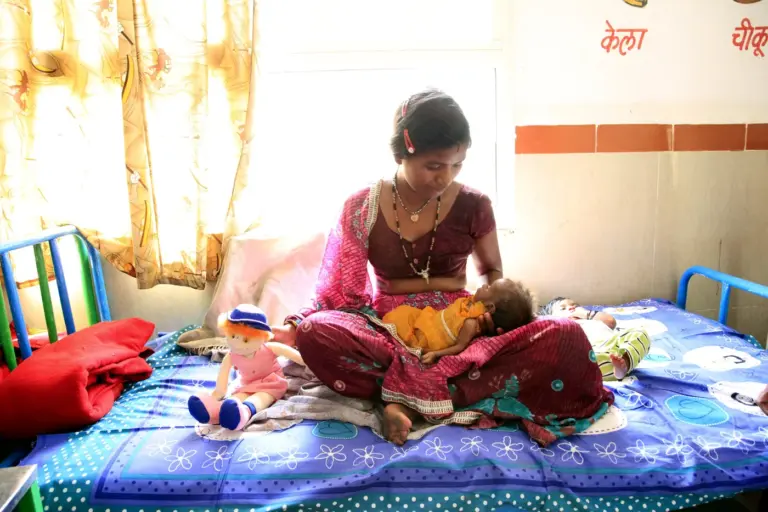
Then there’s the shape of who’s ageing. UNFPA frames India’s ageing through two structural features. The feminisation of ageing means women make up a growing majority of the old, because they live longer, around 52 percent of the elderly are women per NSO 2021, and a huge share of them end up widowed and without income of their own. The ruralisation of ageing means most older Indians, about 71 percent, live in villages, often left behind as the young migrate out for work. So India’s typical elderly person isn’t an urban retiree with a pension. She’s a rural widow with neither.
And the missing piece has a name too. Long-term care, or LTC, is sustained help with daily living for people who can’t fully manage on their own, whether at home, in day-care, or in a residential facility. It’s nursing, physiotherapy, assistance with bathing and eating, dementia support, palliative care near the end. It is exactly what an ageing society needs most. And in India it barely exists outside what families improvise on their own.
So the frame is this. The numbers are demographic certainty. The care infrastructure is almost entirely absent. The argument is over who’s supposed to fill that gap, and whether the answer we’ve leaned on, the family, can still hold.
What the Data Says
Start with the speed, because that’s what makes India’s case different. Most rich countries aged slowly, over a century or more, with time to build pensions and care homes along the way. India is doing it in decades. Between 2000 and 2022 the elderly population grew by 103 percent while the total population grew 34 percent, and from 2022 to 2050 the elderly are projected to grow another 134 percent against just 18 percent overall, per UNFPA 2023. So the old aren’t just becoming more numerous. They’re becoming numerous faster than the country can absorb.
The part that worries care planners most is hidden inside that curve. The 80-plus group, the oldest old, is projected to grow about 279 percent between 2022 and 2050. That’s the cohort least able to live independently and most dependent on long-term care. So the fastest-growing slice of the elderly is precisely the slice that needs a care system India hasn’t built.
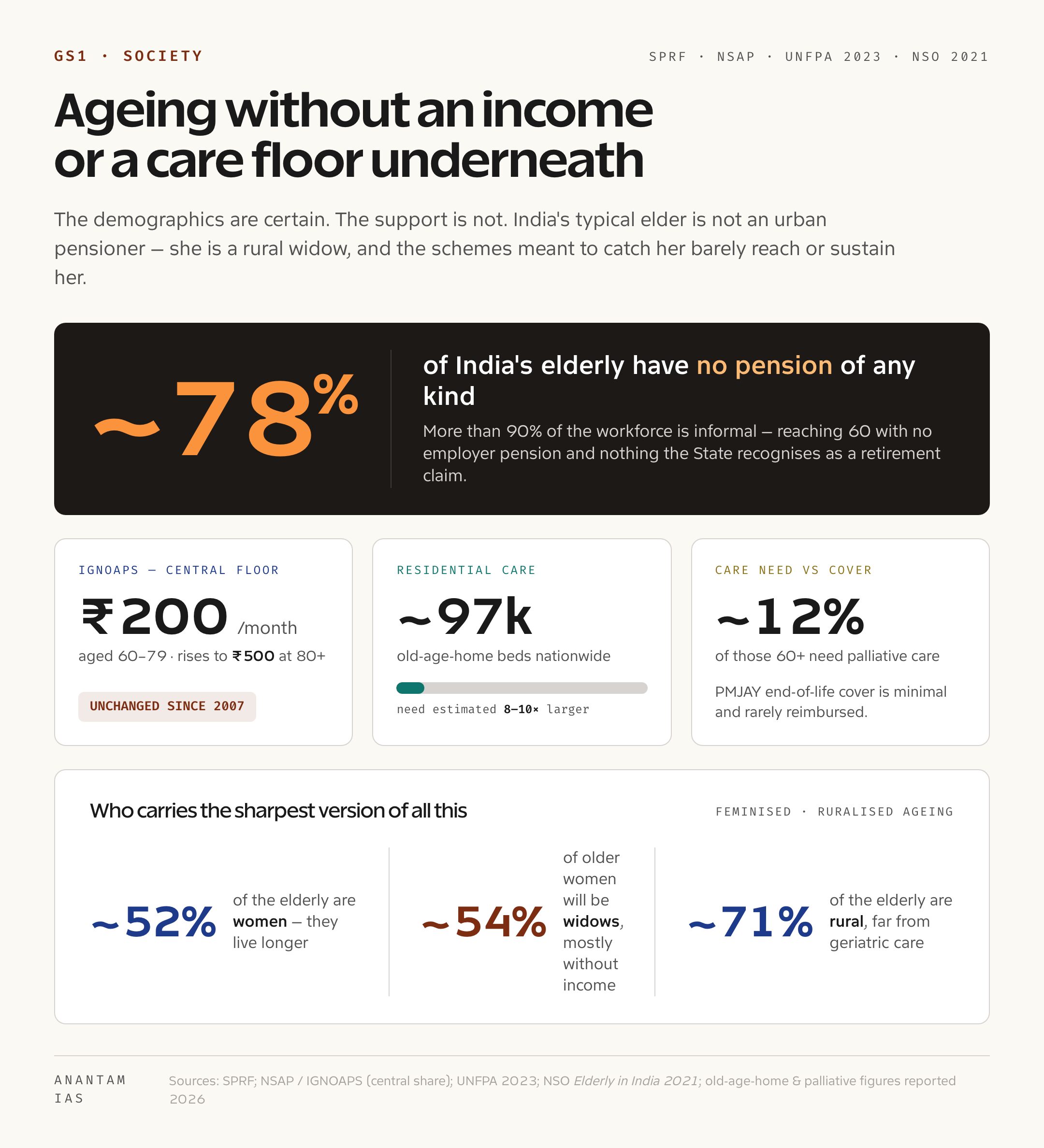
Now follow the money, because care without income is a crisis on its own. Roughly 78 percent of India’s elderly live with no pension coverage of any kind, per the Social and Political Research Foundation. That isn’t an accident. More than 90 percent of India’s workforce is informal, the unorganised sector with no employer pension and no formal retirement benefit, so most people reach 60 with nothing the State recognises as a claim. And the scheme meant to catch them, the Indira Gandhi National Old Age Pension Scheme, IGNOAPS, pays a central contribution of just 200 rupees a month for poor people aged 60 to 79, rising to 500 rupees at 80. Read that twice. The central floor has not been revised since 2007.
One honest caveat, because attribution matters here. That 200 rupees is the central share. Most states top it up, so an actual pensioner often receives somewhere between 1,000 and 3,000 rupees once the state adds its part. But the Union floor sitting frozen for nearly two decades is the critique that holds, and it’s the number that tells you how seriously the centre has treated old-age income.
Then the health load. Per the Longitudinal Ageing Study in India, LASI Wave 1, India’s first nationally representative survey on ageing, run by IIPS in 2017-18, about 75 percent of older Indians live with at least one chronic disease, around 24 percent need help with at least one Activity of Daily Living like bathing or dressing, and roughly one in three shows depressive symptoms. So the demand for sustained care isn’t a future projection. It’s already here, in the bodies of people who are already old.
And who carries the sharpest version of all this? Women and rural elders. Only about 10 to 11 percent of elderly women are economically independent, against roughly 48 to 57 percent of elderly men. About 54 percent of older women will be widows, mostly with no income of their own. Layer the rural 71 percent on top, far from any geriatric clinic, and you get the precise overlap UNFPA warned about: care need that is feminised, ruralised, and poorest exactly where support is thinnest.
The Case For
The case that India doesn’t urgently need a tax-funded care state is genuinely arguable, and a lazy answer would pretend otherwise. So let’s state it at full strength.
The family is still doing the work. Roughly four in five elderly Indians still live with their families, and only about one in five live alone or with a spouse only, per UNFPA’s findings. In a country that’s 71 percent rural elderly, the multi-generational household is still the default, not the exception. So the argument runs: India’s eldercare system already exists. It’s the family, and it has carried this load for centuries without a ministry telling it to.
And the law already backs that family up. The Maintenance and Welfare of Parents and Senior Citizens Act, 2007 makes caring for parents and senior citizens a statutory duty, not just a moral one. Children and heirs can be ordered by a Maintenance Tribunal to pay up to 10,000 rupees a month, with cases meant to be decided in 90 days. So there’s already a legal backstop, one arguably better suited to Indian society than importing an expensive Western-style care system.
The schemes aren’t nothing, either. The National Programme for Health Care of the Elderly, NPHCE, launched in 2010, now reaches around 713 districts with geriatric services and a network of Regional Geriatric Centres. The National Social Assistance Programme reaches about 33.5 million beneficiaries across old-age, widow, and disability pensions. Ayushman Bharat extends health cover in principle to many poor seniors, and there’s an Elderline helpline, the SAGE portal, Rashtriya Vayoshri Yojana for assistive devices, and contributory options like the Atal Pension Yojana. So on paper, health, income, and welfare are all addressed.
There’s even a fiscal-prudence case. India’s median age is still around 28, with roughly 10 working-age people per senior today. Building a full universal pension and long-term-care system now, the argument goes, could pre-commit fiscal space India will need far more acutely after 2040, when the dependency math turns hard. So why spend big before the crunch?
It’s a coherent case. Family norms, a maintenance law, a stack of schemes, a young population to wait it out. Take it seriously, then look at what it walks past.
The Case Against
Here’s what that case misses. Every pillar it leans on is already cracking, and the data shows the cracks widening exactly as the need rises. A care system isn’t judged by what exists on paper. It’s judged by whether it reaches the rural widow with no pension and a body that’s failing. On that test, India’s eldercare is mostly missing.
Start with the family pillar, because it’s the load-bearing one. Smaller families, urban migration, and the spread of nuclear households are thinning the joint family precisely when ageing peaks. And the strain shows. On LASI, at least 5 percent of elderly reported being ill-treated, with verbal and emotional abuse and neglect the most common forms. Treat that 5 percent as a floor, not the real level, because the abuser is usually family and under-reporting is heavy; NGO surveys put it far higher. So the safety net we’re counting on is fraying at the very moment we need it to hold.
The pension pillar barely holds weight at all. Roughly 78 percent of the elderly have no pension, the IGNOAPS central floor sits frozen at 200 rupees since 2007, and the scheme built to bring informal workers into a pension, PM-SYM, had enrolled under 1 percent of the unorganised workforce by 2023-24. So the idea that “schemes already span income” collapses the moment you ask how many people they actually reach, and at what amount.
The health pillar runs straight into capacity. About 75 percent of the elderly carry a chronic disease and roughly 48 percent report a limitation in Instrumental Activities of Daily Living, the harder tasks like managing money or medication. But India has a severe shortage of geriatricians and almost no organised palliative care. A 2024 estimate found about 12 percent of those 60-plus have palliative-care needs, rising to around 16 percent in Uttar Pradesh and Bihar, yet end-of-life cover under PMJAY is minimal and rarely reimbursed. So the disease is here, and the care to manage it isn’t.
And then the piece that’s flatly absent: long-term care infrastructure. India has no dedicated national regulator for residential care homes, the sector runs largely unregulated and unorganised, and total old-age-home capacity is around 97,000 residents against a need estimated at 8 to 10 times larger. Home-based nursing, physiotherapy, and equipment are mostly unregulated and self-financed. So the families being asked to carry care have almost nothing professional to lean on when the care gets medical and hard.
Pull it together and one phrase from the analysis literature captures it. India risks growing “old before rich.” Per ORF analysis, India enters mass ageing at roughly a quarter of the per-capita income China had at the same stage, with working-age people per senior projected to fall from about 10 today toward 4.6 by 2050. Treat those income comparisons as analysis, not official data. But the warning stands: the window to build is open now, and it’s closing.
The Deeper Structural Read
Step back from the schemes and the real fault line shows up. India’s eldercare problem isn’t a missing scheme. It’s a missing category. The State has never treated old-age care as a public good the way it treats, say, school education or maternal health. Care has been assumed to be private, a family matter, off the policy ledger. So when the family weakens, there’s no institution waiting to take over, because the country never built the institution in the first place.
That assumption made sense in a younger, more rural, joint-family India. It doesn’t survive contact with the demographics. When the 80-plus cohort grows 279 percent and the young migrate to cities, “the family will handle it” stops being a policy and becomes a hope. The structural read is that India is trying to run a 2050 demographic on a 1950 social contract, where the old are cared for invisibly, by women, inside the home, for free.
Which brings us to the part that should bother you most as a future administrator. The cost of India’s missing care system isn’t unpaid. It’s paid, in full, by women, twice over. Once as the elderly widows who outlive their husbands with no income, and again as the daughters and daughters-in-law who provide the unpaid care that substitutes for the absent system. NITI Aayog’s own 2024 paper makes this explicit, calling for recognising care work and care workers, “especially for women, who continue to bear most of the burden of care.” So the “free” family care that the optimistic case celebrates isn’t free. It’s subsidised by women’s unpaid labour and lost earnings.
There’s a fiscal trap underneath, too, and it cuts against the “wait until 2040” argument. Pension and care systems take 15 to 20 years to mature, because they depend on enrolment, contributions, trained workforces, and physical infrastructure that can’t be conjured overnight. So if India waits until the dependency math turns hard around 2040, it’ll be starting a 20-year project at the exact moment it can least afford to. The young India that exists today is the demographic space to build the care system. Waste that space, and the old India arrives to nothing.
And here’s the federal layer. Pensions, health, and welfare are split across the centre and the states, IGNOAPS floors set in Delhi, top-ups and old-age homes run by states, with wide variation in who gets what. South India is ageing first, on track for one in five people aged 60-plus by 2036, while the north stays younger longer. So a single national template won’t fit. The deeper read is that India needs not one care scheme but a care architecture, federal, gendered, and built before the curve peaks, not after.
What Should Be Done
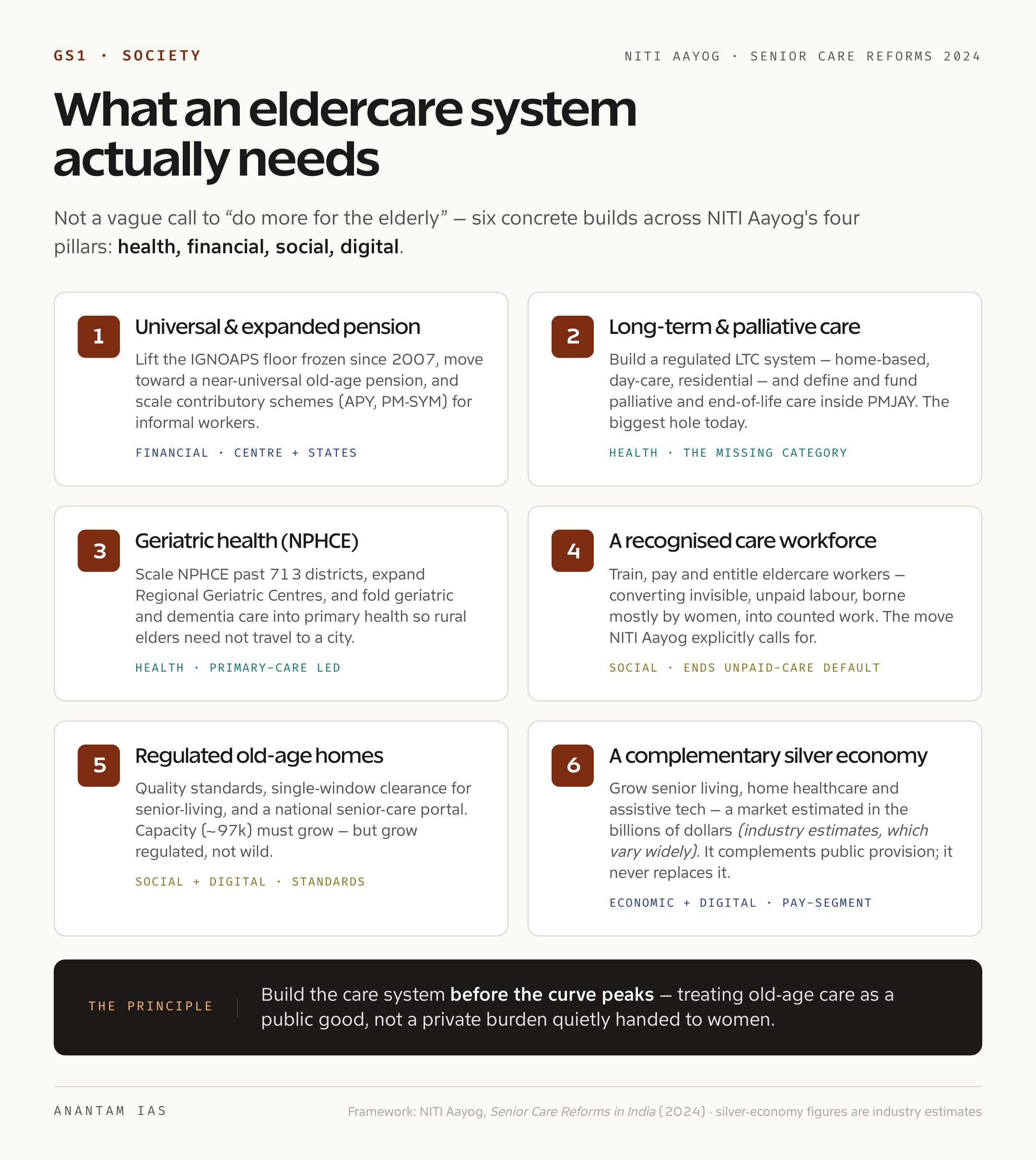
So what does an actual eldercare system look like? Not a vague call to “do more for the elderly,” but a set of moves you could hand a policymaker tomorrow. NITI Aayog’s 2024 paper, Senior Care Reforms in India, already organises the work under four pillars, health, social, economic, and digital. Build on that spine.
- Lift the pension floor and widen the net. Raise the IGNOAPS central contribution that’s sat at 200 rupees since 2007, move toward a near-universal non-contributory old-age pension for the poorest, and scale contributory schemes for informal workers, who are over 90 percent of the workforce. The NITI paper itself floats reverse-mortgage products and mandatory savings for the “affording segment.” A pension that hasn’t moved in 18 years isn’t a safety net. It’s a relic. Start at India’s social security net for unorganised workers to see why the informal-sector gap drives the whole problem.
- Build long-term and palliative care as public infrastructure. Create a regulated LTC system spanning home-based care, day-care, and residential care, and define and fund palliative and end-of-life care inside PMJAY so the roughly 12 percent of seniors who need it can actually get it. This is the single biggest hole, because it’s the category that simply doesn’t exist today.
- Scale geriatric health beyond a pilot. Take NPHCE past its current 713 districts, expand the Regional Geriatric Centres, and fold geriatric and dementia care into primary health so a rural elder doesn’t have to travel to a city for basic age-related treatment. Pair it with health literacy for both seniors and the family members caring for them.
- Recognise, train, and pay the care workforce. A care system runs on care workers, and right now most of that work is unpaid and female. Build a trained, paid eldercare workforce with real wages and entitlements, which both improves care quality and converts invisible unpaid labour into recognised, counted work, the move NITI Aayog explicitly calls for.
- Regulate old-age homes and senior living. Set a participative regulatory framework with quality standards, single-window clearance for senior-living projects, and a national senior-care portal so families can actually find and trust the services that exist. With capacity at about 97,000 against an 8-to-10-times shortfall, the sector has to grow, but it has to grow regulated, not wild.
- Treat the silver economy as an ally, not a substitute. Senior living, home healthcare, and assistive technology are a real and growing market, with industry estimates putting senior living alone in the billions of dollars by 2030. Use tax and GST reforms and digital inclusion to grow it. But the market serves those who can pay, so it complements public provision for the poor; it never replaces it.
Every one of these strengthens the country, not just its elders. A society that builds care before the crisis is a society that decided its old people are a public responsibility, not a private burden quietly handed to women. That’s the whole point of building it.
For Your Mains Answer
This is a clean GS1 topic that rewards a candidate who can hold demographics and dignity in the same frame. It sits squarely in society and population, and it links outward to welfare and the economy.
GS paper mapping: GS1: population and associated issues, social empowerment, role of women, salient features of Indian society, and effects of globalisation on the family. Cross-cutting into GS2 (welfare schemes, vulnerable sections) and GS3 (economy of ageing).
Likely question frames:
- “India is ageing before it has built the institutions to care for the aged.” Examine this statement in light of recent demographic data and policy responses.
- The ageing of India’s population is feminised and ruralised. Discuss the implications for welfare policy.
- Critically analyse whether the family-based eldercare model can survive India’s demographic transition.
Quotable data points:
- 60-plus share roughly doubles from about 10.5 percent (about 149 million) in 2022 to about 20.8 percent (about 347 million) by 2050.
- Elderly to overtake children under 14 by about 2046, a first in Indian history.
- The 80-plus “oldest old” grow about 279 percent between 2022 and 2050.
- About 78 percent of the elderly have no pension; the IGNOAPS central floor is 200 rupees a month, frozen since 2007.
- About 75 percent of older Indians have a chronic disease; around 24 percent need help with daily activities; one in three shows depressive symptoms.
- About 71 percent of the elderly are rural and about 52 percent are women; around 54 percent of older women will be widows.
- Old-age-home capacity is about 97,000, against a need 8 to 10 times larger.
Keywords to use: old-age dependency ratio, feminisation of ageing, ruralisation of ageing, long-term care, oldest old, pension coverage gap, informal-sector workers, care workforce, silver economy, old before rich.
Syllabus linkages: population and associated issues, social empowerment and welfare of vulnerable sections, role of women and unpaid care work, decline of the joint family, urbanisation and rural out-migration.
Balanced conclusion line: India’s youth is real, but so is the old India arriving behind it; the test of this generation isn’t whether it enjoyed the demographic dividend, but whether it used that window to build the care system the next generation of elders will need.
How to Build the Answer
Open with the tension, not a definition. The strongest first line here pits the celebrated young India against the unprepared old India arriving behind it. That tells the examiner you’ve seen both halves of the demographic story. A definition of the old-age dependency ratio can follow in the second sentence. Lead with the idea; let the glossary trail it.
Bring data in early, but ration it. One strong opening body paragraph can carry three figures: the doubling to about 20.8 percent by 2050, the 2046 crossover, and the 78 percent with no pension. Then say what they prove. UPSC rewards the move from figure to inference, so the number is the anchor and the “this means” is the mark.
Steelman the other side before you knock it down. If your stance is that India needs a care system, first state honestly why the family-plus-schemes model has a real logic, co-residence, the 2007 Maintenance Act, a young median age. An answer that admits the counter-case reads balanced; one that ignores it reads like a slogan.
Group the way forward, don’t scatter it. Cluster the reforms under NITI Aayog’s four pillars, health, financial, social, digital, so the answer sounds like governance analysis rather than a wish list. Use the topic’s own vocabulary, feminisation of ageing, long-term care, care workforce, to signal command of the subject.
Close on the syllabus link and on judgment, not summary. The last line should connect ageing to women, to the family, and to the window the demographic dividend gives India to act. The reliable pattern is “the goal is not X alone, but X with Y,” which lets you pair demographic growth with dignified care.
Common Mistakes to Avoid
- Don’t confuse this with the demographic dividend. That’s the working-age story. This is the old-age care story. Mixing them muddies both.
- Don’t present 200 rupees as the total pension. It’s the central floor; states top it up. Note the distinction and you sound precise rather than alarmist.
- Don’t go one-sided. The family-based model has a genuine cultural and fiscal logic. Give it two or three honest lines before arguing it’s eroding.
- Don’t end on a slogan. Close with an implementable principle or a value, the window to build, the gendered cost, not a flourish.
- Don’t forget who pays. Name the rural widow and the unpaid daughter-in-law. UPSC rewards answers that say who bears the cost.
A Compact Answer Spine
- Introduction: Open with the young-India-versus-ageing-India tension in one line; define the old-age dependency ratio in the next.
- Evidence: Use two or three attributed figures, the doubling by 2050, the 2046 crossover, the 78 percent pension gap, and tie each to an implication.
- Arguments: The case that family plus schemes suffice, then the case that the system is missing. Keep both fair.
- Structural diagnosis: Care has never been treated as a public good; its cost falls on women, twice over.
- Way forward: Group reforms under NITI Aayog’s four pillars, each with a clear actor, centre, state, health system, market.
- Conclusion: Adapt the balanced conclusion line to the exact wording of the question.
Diagram or Flowchart Idea
For a 15-marker, draw one causal chain rather than a decorative cluster. The cleanest here: rapid ageing (60-plus doubling, 80-plus surging) plus a shrinking joint family and out-migration, leading to rising care need, meeting a missing care system (no LTC, 78 percent without pension), with the burden landing on rural elderly women. The examiner reads that logic in five seconds.
For a 10-marker, skip the diagram unless it’s genuinely simple. A two-column table, “Need rising” against “System missing,” with a row each for income, health, and care, does more work and is faster to evaluate under time pressure.
Ethics and Governance Angle
Add one ethical line even in a society-focused answer. Ageing isn’t only a demographic statistic. It’s a question of who a society chooses to make visible and who it leaves to fend alone. Here the concrete person is the rural widow with no income and a failing body, and the unpaid daughter caring for her. Naming them sharpens the answer.
Then convert empathy into design. Don’t just say “protect the elderly.” Say how: lift the frozen pension floor, build regulated long-term care, fund palliative care in PMJAY, recognise and pay the care workforce. That’s the move from moral language to administrative maturity.
A sentence pattern that travels well: “The duty is real, but discharging it through women’s unpaid labour is not a policy, it’s a default.” It names the value and the failure in one line, which is exactly what a balanced answer wants.
How to Use Data Without Sounding Mechanical
Use fewer numbers than you know. Three well-explained figures beat ten scattered ones. Lead with one big number, the doubling to about 20.8 percent by 2050, use a second for the crossover, 2046, and a third for the gap, 78 percent with no pension. One scale figure, one turning point, one failure gap is usually enough.
Never leave a statistic standing alone. Follow it with “this means” or “the policy implication is.” That tiny move turns a fact sheet into analysis. In Mains, facts are raw material; judgment is the finished answer.
Finish by asking one question: can a tired examiner follow this in a single pass? If it needs rereading, simplify. Short introduction, data early, two sides marked cleanly, a grouped way forward. Clarity isn’t a lower standard than depth. For UPSC, clarity is how depth becomes visible. And when you cite an estimate, say so, attributing the silver-economy or “old before rich” figures as analysis rather than government data is itself a mark of judgment.
FAQ
What does “feminisation and ruralisation of ageing” mean?
It’s how UNFPA describes the shape of India’s elderly population. Feminisation means women are a growing majority of the old because they live longer, around 52 percent of the elderly, and many end up widowed with no income of their own. Ruralisation means most older Indians, about 71 percent, live in villages, often left behind as the young migrate to cities. Together they concentrate care need where support is thinnest.
Why is the 200-rupee old-age pension so heavily criticised?
The 200 rupees a month under IGNOAPS, rising to 500 at age 80, is the central government’s contribution for poor pensioners, and it hasn’t been revised since 2007. States usually top it up, so an actual pensioner may receive more, but the frozen central floor signals how little the income side of eldercare has moved. With about 78 percent of the elderly holding no pension at all, the bigger problem is reach, not just amount.
What is long-term care, and why does India lack it?
Long-term care, or LTC, is sustained help with daily living for people who can’t fully manage on their own, from home nursing and physiotherapy to day-care, residential care, and palliative support. India lacks it because care was always assumed to be a family matter, never built as public infrastructure. There’s no dedicated national regulator for care homes, capacity sits around 97,000 against a need many times larger, and palliative care is barely covered under PMJAY.
What is NPHCE, and is it enough?
The National Programme for Health Care of the Elderly, NPHCE, launched in 2010 to provide geriatric health services, and it now reaches around 713 districts with Regional Geriatric Centres. It’s a genuine start, but it’s far from enough: India still has a severe shortage of geriatricians, weak palliative care, and almost no organised long-term care, which is why NITI Aayog’s 2024 paper called for scaling geriatric health well beyond the current footprint.
Tell Google you want more of this.
Add Anantam IAS as a preferred sourceOne tap, and this site shows up more often in your own Top Stories, AI Overviews and AI Mode. Remove it any time.