Somewhere in the dry tables of the United Nations population data sits one of the most extraordinary facts about our species: a child born today can reasonably expect to live longer than any human generation in history, and a meaningful share of children born in rich countries this decade will see their hundredth birthday. India’s own average life expectancy has climbed from barely 32 years at Independence to roughly 72 years now — more than double a human lifetime added in three generations. We tend to file this under “good news” and move on. But economists and gerontologists have started to notice that adding decades to the average life quietly rewrites almost everything else: how long we study, when we work, how we save, what we buy, and how a country pays for its old age. That rewiring, taken together, is what people now call the longevity economy.
And it lands at a pointed moment for India. We still talk about ourselves as the world’s youngest large nation, riding a demographic dividend. Both things are true at once — India is young today and ageing fast, with the share of people over 60 set to roughly double from about 10 per cent in 2020 to nearly 20 per cent, some 320 million people, by 2050. So a UPSC aspirant who only knows the “young India” story is reading half the page. The longevity economy is where demography, the economy, health policy and even ethics meet, and it rewards a candidate who can explain not just that we are living longer, but what living longer actually does to a society and its balance sheet.
What the Longevity Economy Actually Is
Start with the words, because the looseness around them is where most answers go wrong. The longevity economy is the whole web of economic activity — production, consumption, investment, work and policy — that is reshaped by the fact that people are living much longer lives. It is not a single industry. It is closer to what the digital economy was twenty years ago: a force that runs through every sector rather than sitting in one of them. The London Business School economist Andrew Scott, one of the field’s clearest voices, frames the core shift as a society moving from simply being an “ageing society” — older, and treating that as a burden — to becoming a “longevity society” that treats extra years of healthy life as an asset to be invested in. Estimates of the global market vary wildly precisely because the boundary is fuzzy, with narrower counts of longevity-specific products and therapies in the tens of billions of dollars and broader counts of the whole age-shaped economy running into the tens of trillions by 2030.
The engine underneath all of it is a single demographic fact with two faces. The first face is rising life expectancy: more people reaching old age, and more years lived once there. The second, less obvious face is the changing shape of the population pyramid — fewer births and longer lives together mean the share of older people climbs everywhere, not just in the rich world. Japan, much of Europe and China are already deep into this; India, Indonesia and Brazil are entering it. So the longevity economy is global, but it arrives in countries at very different income levels, which is exactly why India’s version of it will not look like Japan’s.
Where it gets interesting — and examinable — is the claim that longer lives are not just a cost to be managed but an opportunity to be captured. In a June 2025 essay for the International Monetary Fund’s Finance & Development magazine, Scott and the global-health expert Peter Piot argued for a “longevity dividend”: longer, healthier and more productive lives that, handled well, add to growth rather than draining it. They cite evidence from the United Kingdom that cutting the incidence of six major chronic diseases by a fifth could lift GDP by around 1 per cent within five years, mainly by keeping people healthy enough to keep working. That is the optimistic pole of this debate. The pessimistic pole — pensions, healthcare bills, a shrinking workforce — is just as real, and a good answer holds both.

Lifespan Is Not Healthspan: The Gap at the Heart of It
Here is the distinction that the whole topic turns on, and the one most candidates miss. Lifespan is how long you live. Healthspan is how long you live in good health, free of serious disease and disability. They are not the same number, and the difference between them is where both the human tragedy and the economic action sit.
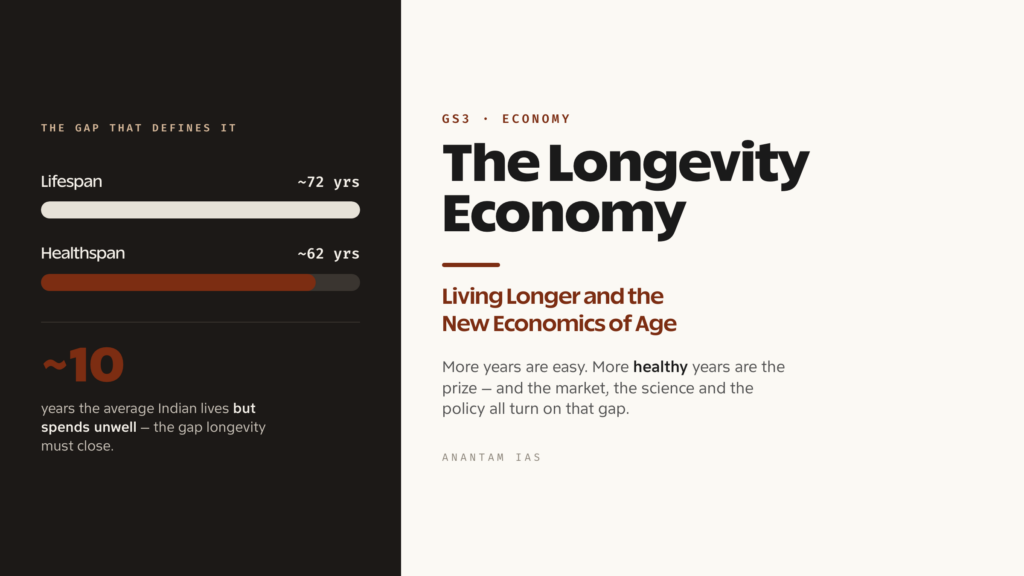
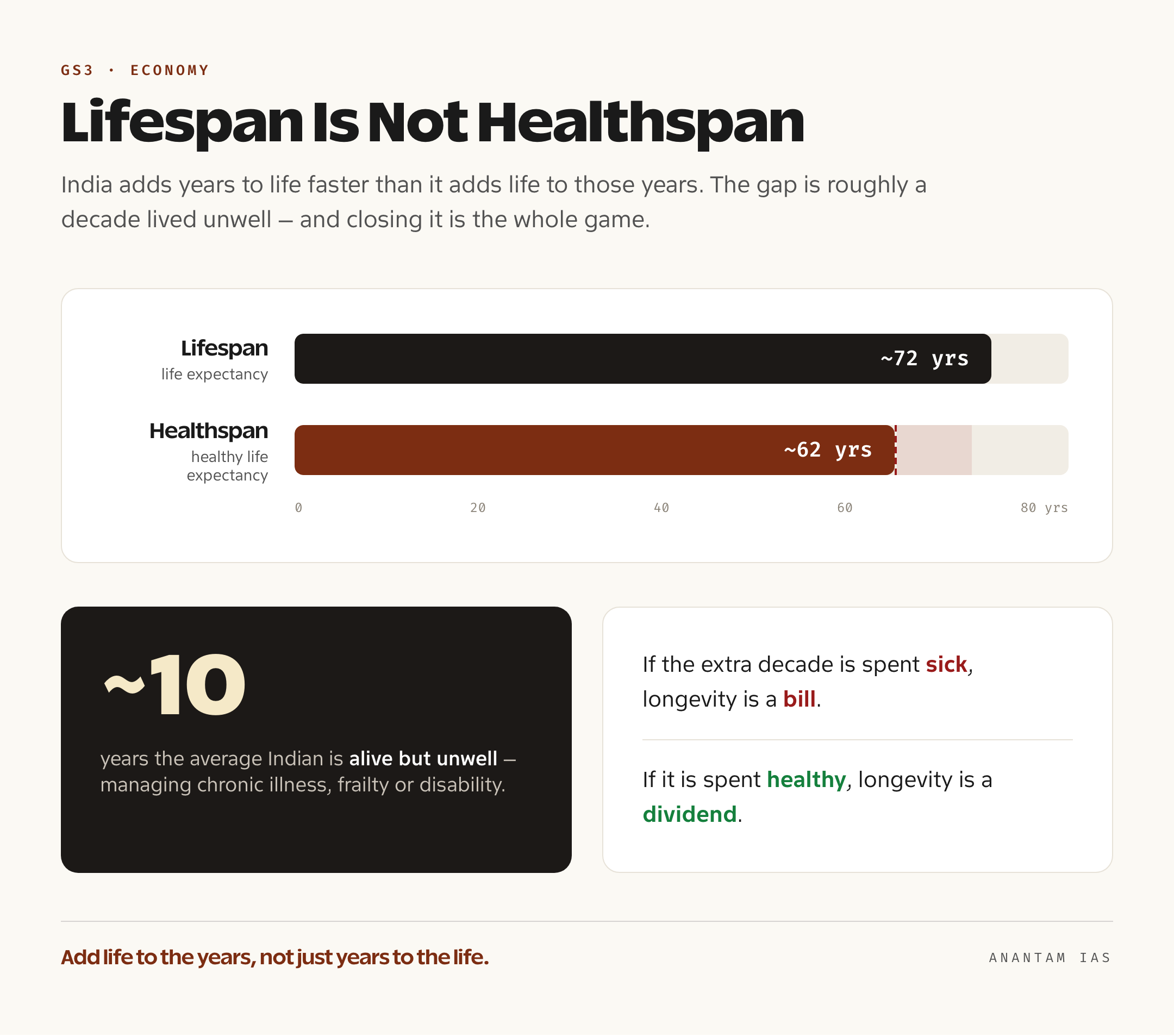
The figures for India are blunt. As of 2025, average life expectancy at birth is around 72 years. But India’s healthy life expectancy — the World Health Organization’s measure of years lived in full health, sometimes called HALE — is far lower, in the region of 62 to 63 years. That leaves a gap of roughly a decade in which the average Indian is alive but unwell, managing chronic illness, frailty or disability. Studies tracking this gap find it has actually widened to over ten years, and that it is larger for women, who live longer but spend more of those extra years in poor health. So we have done something remarkable in adding years to life; we have done much less in adding life to those years. The 2024 Economic Survey put a sharp point on the cause, attributing well over half of India’s health burden to unhealthy diets — a reminder that much of the healthspan gap is driven by preventable lifestyle disease, not just old age.
This gap is the single most important idea to carry out of this article, because it reframes the entire policy question. If the extra decade of life is spent sick, longevity is mostly a bill — for hospitals, carers, pensions and lost work. If that same decade can be spent healthy and active, longevity becomes a dividend — more working years, more spending, more contribution. The whole battle of the longevity economy is the battle to close the gap between lifespan and healthspan, to “compress morbidity” into the very end of life rather than letting it stretch across a decade. Everything else — the science, the technology, the redesign of careers — is in service of that one goal.
Why It Is Not the Same as the Silver Economy
This is the trap, so let’s defuse it directly. The silver economy and the longevity economy sound interchangeable, and many write-ups use them as if they were. They are not, and the difference is precisely the kind of conceptual clarity that separates a sharp answer from a vague one.
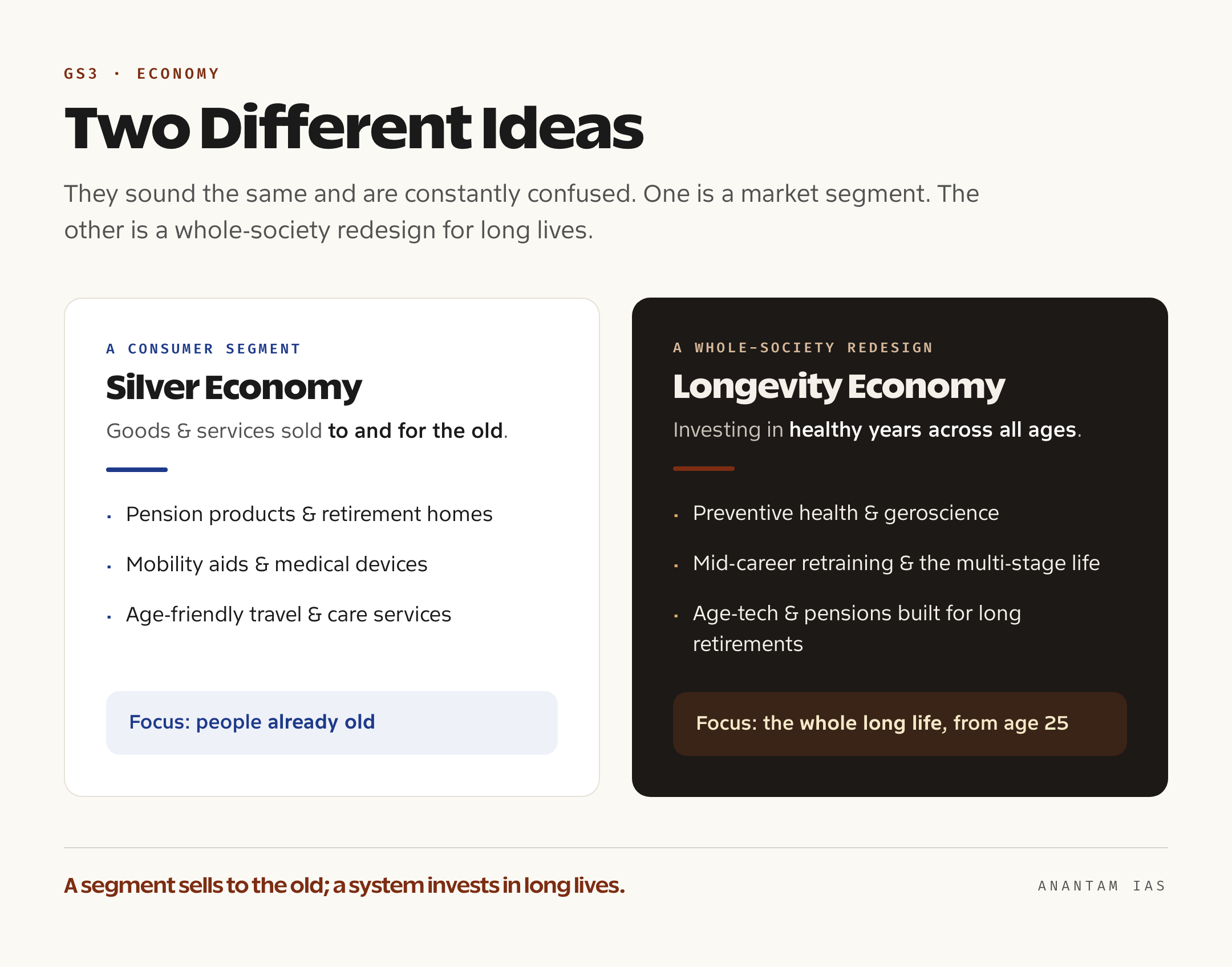
The silver economy is about a market: the goods and services bought by and for older people — pension products, retirement homes, mobility aids, medical devices, age-friendly travel, and so on. It treats the elderly as a distinct consumer segment to be served. That market is real and growing, and we have written about it separately in our explainer on the silver economy in India. But it is, by definition, about old people. Andrew Scott’s pointed criticism is that too much corporate thinking about ageing stops here — that it reduces a profound shift to “adult diapers and cruise ships”, a niche market at the far end of life.
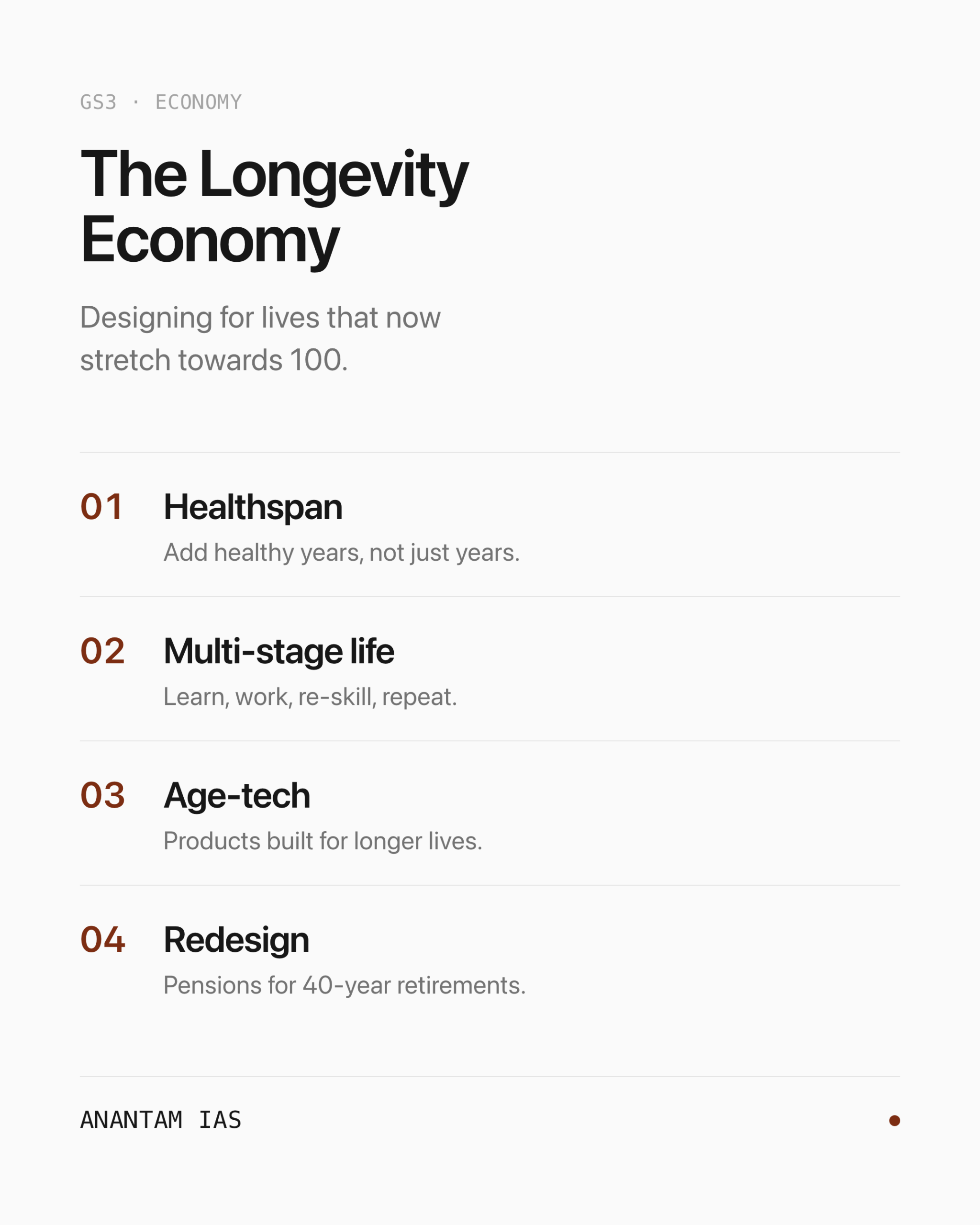
The longevity economy is wider in two ways. First, it is about all ages, not just the old. If you are going to live to 90 or 100, the decisions that shape those final decades are made at 25, 40 and 55 — how you invest in your health, skills and savings across a whole long life. So the longevity economy includes a 30-year-old’s preventive health checks, a 50-year-old retraining for a second career, and a pension system redesigned for forty-year retirements, not just a 75-year-old’s wheelchair. Second, it is about investing in extra healthy years as a productive asset, rather than simply selling things to people who already have them. The silver economy asks, “What can we sell to the old?” The longevity economy asks, “How do we redesign a whole society so that longer lives make everyone richer, healthier and more useful for longer?” One is a segment; the other is a system. Hold that line in an answer and you have already out-thought most of the room.
The Science and the Technology: Geroscience and Age-Tech
Two engines are driving the longevity economy from the supply side, and both are moving fast enough to be examinable in their own right. The first is geroscience — the branch of biology that treats ageing itself, rather than any single disease, as the thing to slow down. Its central insight is that the major killers of old age — heart disease, cancer, dementia, diabetes — share common biological roots, the so-called hallmarks of ageing, a set of cellular processes such as cellular senescence (cells that stop dividing but linger and inflame surrounding tissue), genomic instability, mitochondrial decline and chronic low-grade inflammation. The bet of geroscience is that if you could target these shared mechanisms, you might delay many age-related diseases at once and extend healthspan, not just lifespan.
This is no longer pure theory. Researchers are studying repurposed drugs such as metformin and rapamycin and a class of compounds called senolytics that clear out worn-out “senescent” cells, with early human trials in the mid-2020s showing tentative signs that low doses can improve markers of cardiovascular health in older adults. The science is genuinely promising and genuinely unproven at the same time — and an aspirant should resist both the hype that says ageing is about to be “cured” and the cynicism that dismisses it entirely. The honest framing is that geroscience is an emerging field with real momentum and large uncertainty, and that the global anti-ageing biotech market is growing quickly on the strength of that promise.
The second engine is age-tech — the technologies that help people live well across a long life. This runs from wearables and remote health monitoring that catch disease early, to AI-assisted diagnostics, to assistive robotics and fall-detection systems for the very old, to fintech built for forty-year retirements. India is unusually well placed on parts of this, because the same digital public infrastructure that powers payments and identity could, in principle, carry preventive health and pension services to hundreds of millions cheaply. The point to grasp is that the longevity economy is being built on the supply side as much as the demand side: science is trying to extend the healthy years, and technology is trying to make those years liveable and affordable at scale.
Redesigning Education, Work and Retirement — and the Risks
If lives are getting much longer, the old shape of a life no longer fits, and this is where the economics turns personal. For a century, the standard life ran in three blocks: you studied, then you worked, then you retired — education, work, retirement, in that fixed order. That model was designed for lives of 65 or 70 years. Stretch the life to 90 or 100 and it breaks. A single burst of education at the start cannot carry skills across a 60-year career in a world where technology rewrites jobs every decade. A retirement designed to last ten years cannot stretch to thirty-five without bankrupting either the saver or the state.
The economists Lynda Gratton and Andrew Scott captured the alternative in their influential book The 100-Year Life, arguing for a shift from the rigid three-stage life to a flexible “multi-stage” one. In a multi-stage life, people cycle through education, work and breaks more than once — retraining in mid-career, taking sabbaticals, starting second and third careers, blending part-time work into later life rather than stopping dead at 60. Gratton and Scott also stress that a long life depends on building not just money but “intangible assets”: productive assets like skills and reputation, vitality assets like health and relationships, and transformational assets like the capacity to reinvent yourself. The longevity economy, on this view, is as much about how individuals and institutions reorganise the life course as about any gadget or drug.
But longer lives also carry hard risks, and a balanced answer must name them. The first is the inequality of longevity. Extra years are not shared equally — in India, life expectancy for the richest fifth of households runs several years above the poorest fifth, and the healthy years are even more unevenly spread. A longevity economy built only for those who can afford private health, retraining and savings would widen an already deep divide, turning long life into a privilege rather than a right. The second is pension and fiscal sustainability. India’s pension system is thin — pension assets are a fraction of GDP, only a small slice of the workforce has any formal pension, and the old-age dependency ratio is set to climb sharply toward 2050. The government’s Unified Pension Scheme, effective from April 2025, tries to give central employees a more assured, inflation-linked income, but it touches only a sliver of a workforce that is overwhelmingly informal. The third is the care deficit — a society that lives longer needs carers, geriatric medicine and eldercare infrastructure that India has barely begun to build, a gap we have examined in our piece on India’s missing eldercare system. The longevity economy, in other words, is an opportunity wrapped around a warning: handled well, longer lives enrich a country; handled badly, they deepen its inequalities and strain its finances.
For Your Mains Answer
This is a versatile topic that lands across GS Paper 1 (population and associated issues, social empowerment, ageing as a social change), GS Paper 2 (welfare schemes, health, issues relating to the vulnerable) and especially GS Paper 3 (the Indian economy, mobilisation of resources, growth and development). It also gives the Essay paper a rich, current frame for themes on ageing, the meaning of a long life, and human capital. The examiner’s reward here goes to the candidate who can do two things: separate lifespan from healthspan cleanly, and separate the longevity economy from the silver economy clearly. Get those two distinctions right and the rest of the answer almost writes itself.
How to Build the Answer
Move in a chain from idea to evidence to policy. Open by defining the longevity economy as the economy reshaped by longer lives, then introduce the lifespan-versus-healthspan gap with India’s numbers (about 72 years of life, about 62 of health). Use that gap to show why longevity can be either a dividend or a bill. Then distinguish it from the silver economy (all ages and investment, not just the elderly market). Bring in the two supply-side engines — geroscience and age-tech — and the redesign of the life course (the multi-stage life from The 100-Year Life). Close on India: the twin reality of a young-but-ageing nation, and the three risks — inequality of longevity, pension sustainability, and the care deficit — before a balanced verdict.
Common Mistakes to Avoid
Don’t treat “longevity economy” and “silver economy” as synonyms — the distinction is the whole point. Don’t confuse lifespan with healthspan; quoting that India lives to 72 without noting it stays healthy only to about 62 misses the core idea. Don’t present India as only young — flag that it is young and ageing fast at once. Don’t oversell geroscience as a cure for ageing; frame it as promising but unproven. And don’t forget the equity angle — a longevity economy that only the rich can access is itself a major exam-worthy criticism.
A Compact Answer Spine
Longer lives reshape the whole economy = the longevity economy → key idea: lifespan (≈72 yrs in India) ≠ healthspan (≈62 yrs), a ~10-year gap → close the gap and longevity is a dividend; leave it open and it’s a bill → it is broader than the silver economy: all ages + investment, not just selling to the old → supply-side engines: geroscience (target ageing itself) + age-tech → redesign the life course: from the three-stage to the multi-stage “100-year life” → India: young but ageing fast (60+ to ≈20% by 2050) → risks: inequality of longevity, thin pensions, care deficit → verdict: an opportunity that demands deliberate, equitable policy.
Diagram or Flowchart Idea
Draw two horizontal bars stacked: a long “lifespan” bar to 72, and a shorter “healthspan” bar to 62, with the gap between them shaded and labelled “years lived in ill health”. Beside it, a simple two-column box contrasting the silver economy (serves the old) with the longevity economy (invests across all ages). These two visuals carry the answer’s core distinctions at a glance.
A Balanced-Conclusion Line
A line that lands the marks: “The real prize of a longer life is not more years of old age but more years of health and purpose — so India’s task is to turn rising lifespans into rising healthspans, and to make that longevity dividend reach the poor as surely as the rich, rather than letting long life become one more inequality.”
How to Use Data Without Cramming
You need only a handful of anchors: about 72 years (India’s life expectancy) against about 62 (healthy life expectancy), a gap of roughly a decade; the share of those over 60 doubling to nearly 20 per cent (around 320 million) by 2050; and one framing fact — Scott and Piot’s “longevity dividend” in the IMF’s 2025 essay, with chronic-disease reduction lifting GDP. Drop those into the right sentences and attribute them plainly, rather than scattering statistics.
Frequently Asked Questions
What is the longevity economy in simple terms?
It is the whole sweep of economic activity that changes because people are living much longer lives — not a single industry but a force running through health, work, finance, technology and policy. It covers everything from preventive healthcare and age-friendly technology to retraining for second careers and redesigning pensions for much longer retirements. The core idea, as economist Andrew Scott puts it, is treating extra years of healthy life as an asset to invest in, not just a cost to manage.
How is the longevity economy different from the silver economy?
The silver economy is a market — the goods and services sold to and for older people, like retirement homes, pension products and mobility aids. The longevity economy is broader: it spans all ages, because the decisions that shape a long life are made decades before old age, and it focuses on investing in extra healthy years as a productive asset rather than just selling to the elderly. In short, the silver economy is a consumer segment; the longevity economy is a whole-society redesign.
What is the difference between lifespan and healthspan, and why does it matter?
Lifespan is how long you live; healthspan is how long you live in good health, free of serious disease and disability. They differ sharply — in India, average life expectancy is around 72 years but healthy life expectancy is only about 62, leaving roughly a decade lived in ill health. The gap matters because if those extra years are spent sick, longevity is mostly a financial burden, whereas if they are healthy, it becomes a dividend. Closing the lifespan-healthspan gap is the central goal of the longevity economy.
Why does the longevity economy matter for India when India is still young?
Because India is young and ageing fast at the same time. We still enjoy a demographic dividend, but the share of people over 60 is set to nearly double to about 20 per cent — roughly 320 million people — by 2050, while pensions remain thin and eldercare barely exists. Planning for longer lives now, rather than waiting for the country to grow old, is what lets India capture a longevity dividend instead of being caught unprepared by an ageing one.
Practice Questions
Prelims MCQs
- With reference to the terms used in the study of ageing populations, consider the following:
(a) Lifespan and healthspan mean the same thing
(b) Healthspan refers to the years a person lives in good health, free of serious disease or disability
(c) Healthspan is always greater than lifespan
(d) Healthspan measures only the years spent in retirement
Answer: (b) Healthspan is the period lived in good health; it is typically shorter than lifespan, and the gap between them is the years lived in ill health. - The concept of the “longevity dividend,” recently discussed in an IMF Finance & Development essay, refers to which of the following?
(a) The interest earned on pension fund investments
(b) The economic gains from longer, healthier and more productive lives
(c) A government bonus paid to citizens over 60
(d) The fall in life expectancy during economic recessions
Answer: (b) The longevity dividend describes the growth and welfare gains that longer, healthier lives can generate if societies invest in healthy ageing. - Which of the following best distinguishes the “longevity economy” from the “silver economy”?
(a) The longevity economy concerns only people above 60
(b) The silver economy spans all ages while the longevity economy serves only the elderly
(c) The longevity economy spans all ages and treats healthy years as an investment, while the silver economy is the market of goods and services for older people
(d) There is no difference between the two
Answer: (c) The silver economy is the elderly consumer market; the longevity economy is broader, covering all ages and the investment in healthy years. - “Geroscience,” in the context of ageing research, is best described as:
(a) The study of government schemes for senior citizens
(b) The biology that targets the ageing process itself rather than any single disease
(c) The economics of pension fund management
(d) The branch of medicine dealing only with bone disorders
Answer: (b) Geroscience treats ageing itself as a target, on the view that many age-related diseases share common biological roots, the hallmarks of ageing. - According to United Nations projections, the share of India’s population aged 60 and above is expected to reach approximately what level by 2050?
(a) About 5 per cent
(b) About 10 per cent
(c) About 20 per cent
(d) About 35 per cent
Answer: (c) The share of those aged 60 and above is projected to roughly double from about 10 per cent in 2020 to nearly 20 per cent — around 320 million people — by 2050.
Mains Practice Questions
- Distinguish between “lifespan” and “healthspan.” Why is closing the gap between them central to turning a longer-living population into an economic asset rather than a fiscal burden? (15 marks, 250 words)
- “The longevity economy is broader than the silver economy.” Critically examine this statement with reference to the changing economics of ageing. (15 marks, 250 words)
- India is often described as a young nation, yet it is ageing rapidly. Discuss the policy challenges this dual reality poses for the economy, with particular reference to pensions, healthcare and the care economy. (15 marks, 250 words)
- Examine the role of geroscience and age-technology in extending healthy years. What opportunities and risks do they present for a country like India? (10 marks, 150 words)
- “Longer lives can deepen inequality as easily as they can create wealth.” In the light of this statement, evaluate how India can ensure that a longevity dividend is shared equitably across social and economic groups. (15 marks, 250 words)
Tell Google you want more of this.
Add Anantam IAS as a preferred sourceOne tap, and this site shows up more often in your own Top Stories, AI Overviews and AI Mode. Remove it any time.