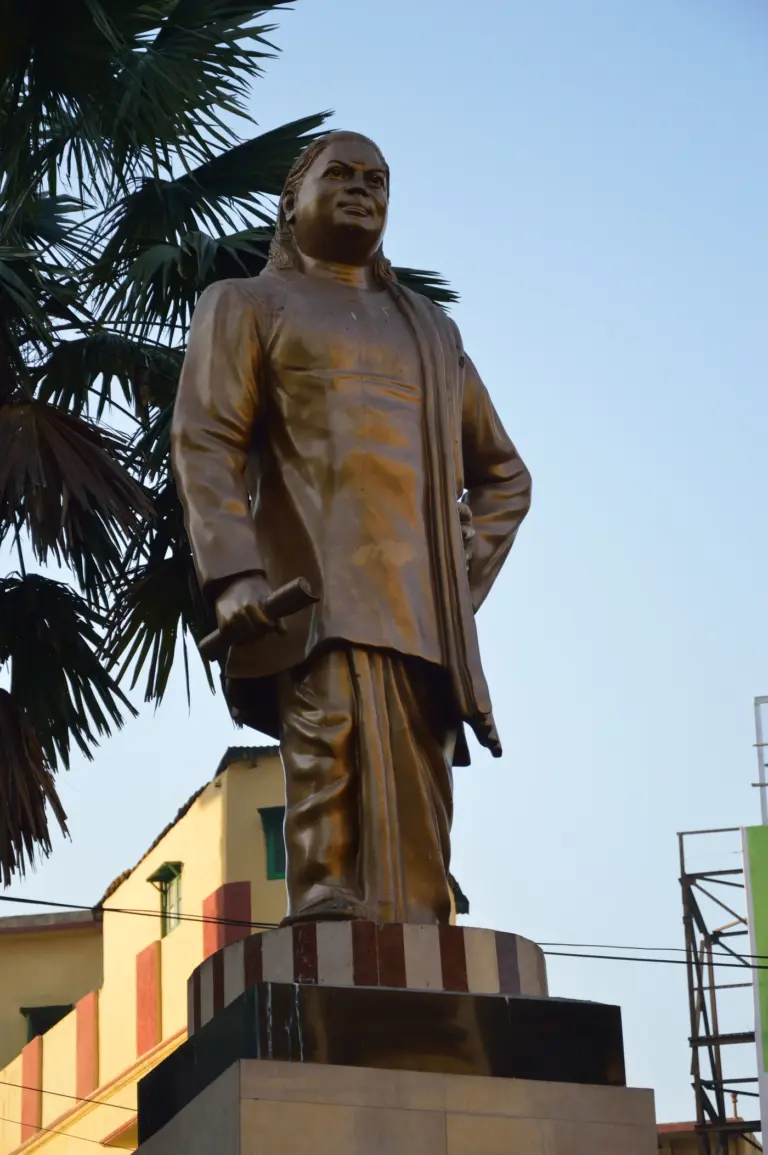
Bhikaji Rustom Cama (1861–1936), widely known as Madam Cama, was one of the most fearless women in India’s freedom struggle and the first Indian to unfurl a version of the Indian national flag on foreign soil — at the International Socialist Conference in Stuttgart, Germany, on 22 August 1907. Born into a wealthy Parsi family in Bombay, she gave up a comfortable life to live three decades in exile, editing a revolutionary journal, smuggling literature into India, and speaking for self-rule at a time when most Indian women were legally invisible in public politics. For UPSC, her life sits at the intersection of Modern Indian History, Indian Society, and the history of women’s participation in the freedom movement.
Early Life and Marriage
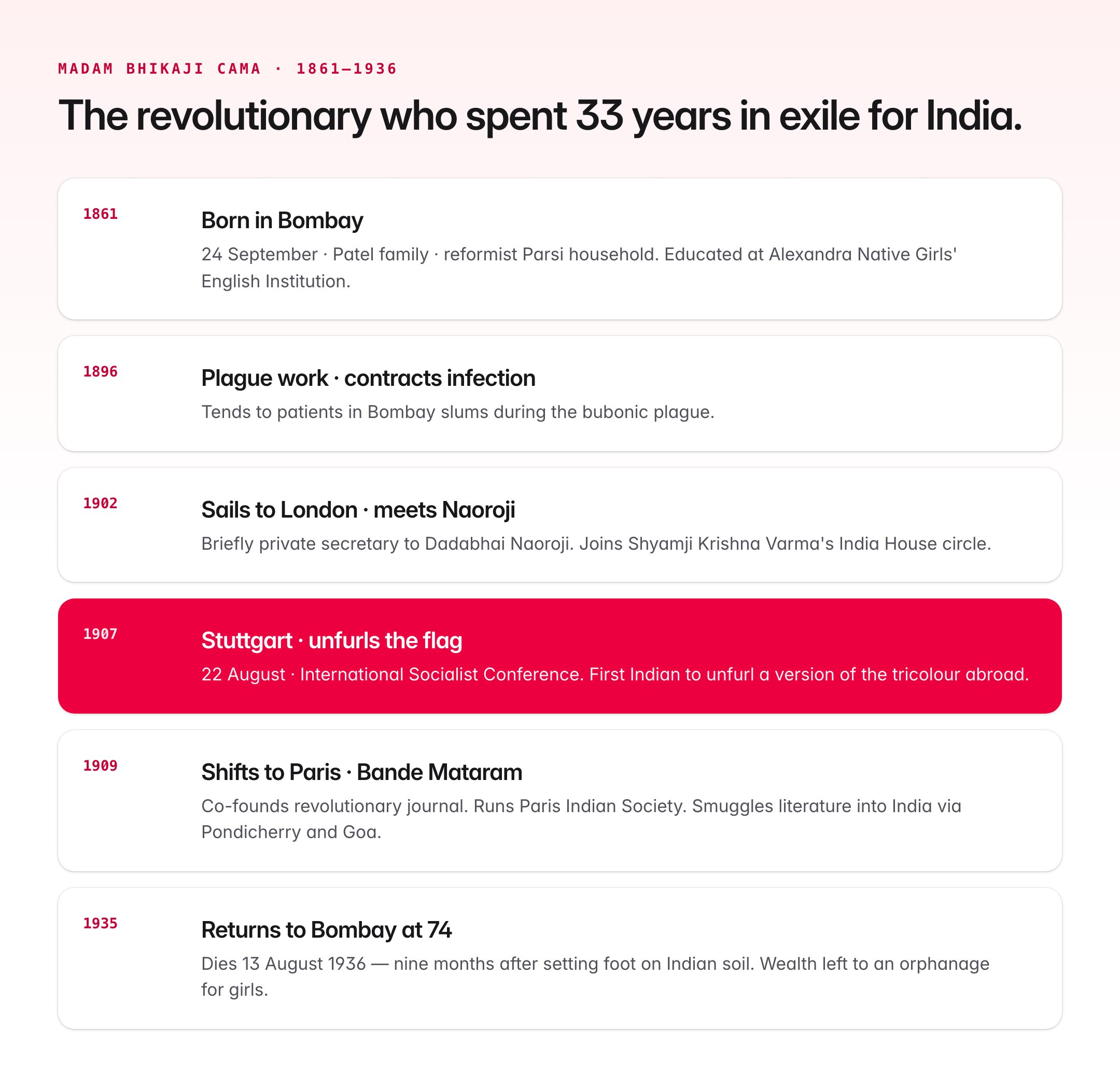
Bhikaji was born on 24 September 1861 into the Patel family of Bombay — a prosperous, reformist Parsi household. She was educated at Alexandra Native Girls' English Institution, one of the early English-language schools for Indian girls. She married Rustom Cama, a pro-British barrister and son of K. R. Cama. The marriage was unhappy from the start — Bhikaji's nationalist sympathies clashed with her husband's Anglophile views — and the couple separated within a few years, though they never divorced.
The Plague Commission and Departure from India
In 1896, Bombay was ravaged by the bubonic plague. Bhikaji joined one of the teams tending to patients in the slums and contracted the infection herself. After partial recovery in 1902, she was advised to travel abroad for medical treatment. This departure — ostensibly medical — became permanent political exile. She reached London in 1902, and her life's trajectory changed within weeks.
Meeting Dadabhai Naoroji and Shyamji Krishna Varma
In London, Cama became close to Dadabhai Naoroji, the “Grand Old Man of India,” and briefly served as his private secretary. She also joined the circle of Shyamji Krishna Varma, founder of India House (Highgate, London) and the Indian Home Rule Society (1905). It was in this milieu that she transitioned from reformist to revolutionary nationalist. British intelligence marked her file by 1906. When authorities began pressuring her to sign a loyalty oath or return home, she refused and shifted to Paris in 1909 — which would be her base for the rest of her exile.
The Stuttgart Flag, 22 August 1907
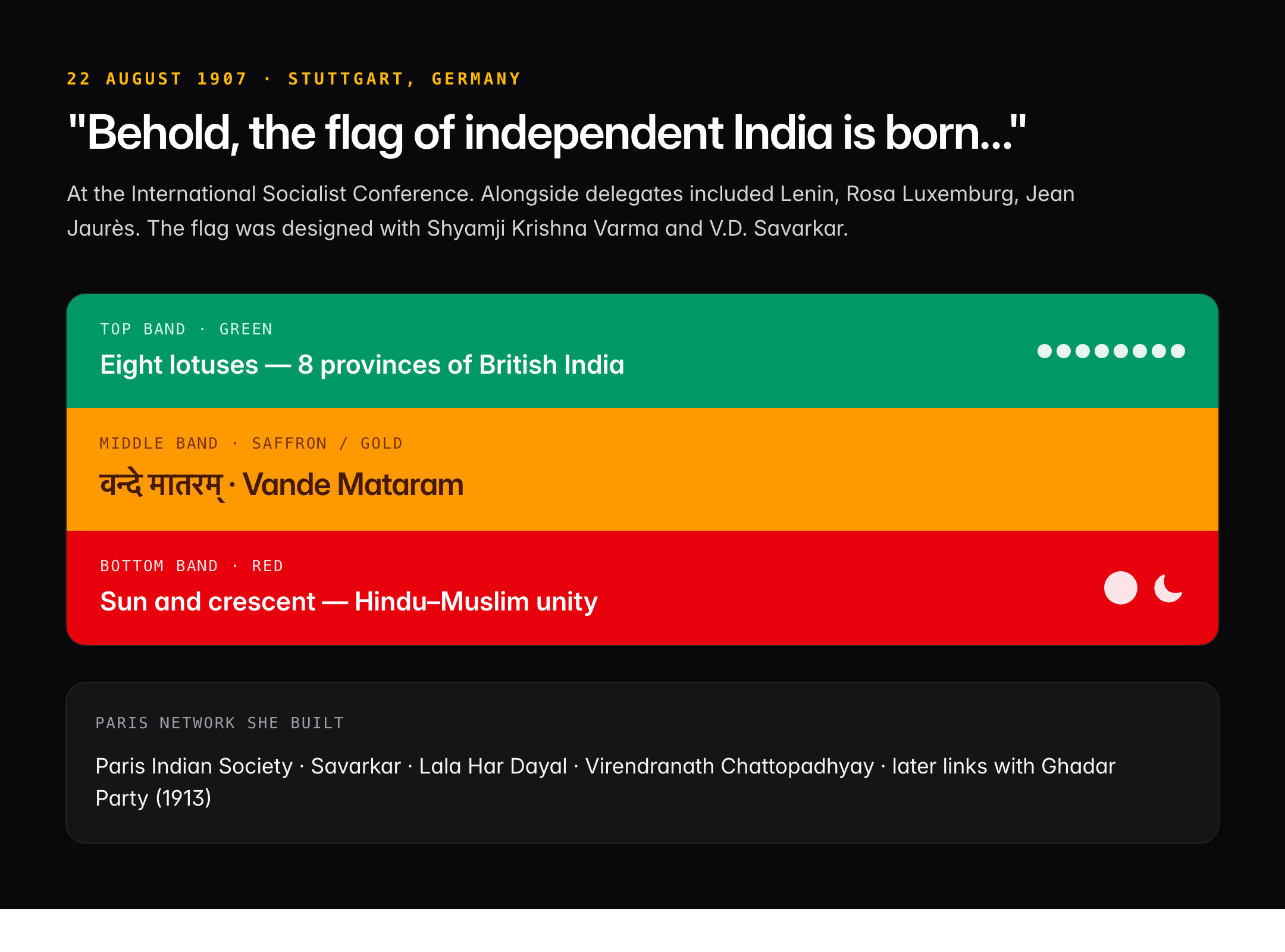
The defining moment of Bhikaji Cama's life came at the International Socialist Conference held in Stuttgart, Germany, from 18 to 24 August 1907 — a gathering that included Lenin, Rosa Luxemburg, Jean Jaurès, and delegates from every major socialist movement in Europe. Cama was one of the Indian representatives.
On 22 August 1907, she unfurled a flag she had designed with Shyamji Krishna Varma and Vinayak Damodar Savarkar — a tricolour with green, saffron (then gold), and red horizontal bands, bearing:
- Eight lotuses on the top (green) band — for the eight provinces of British India.
- “Vande Mataram“ in Devanagari across the middle (saffron) band.
- A crescent and a sun on the bottom (red) band.
Holding the flag aloft, she declared: "Behold, the flag of independent India is born… I appeal to lovers of freedom all over the world to support this flag."
This is historically recognised as the first version of an Indian national flag unfurled on foreign soil. Though not the tricolour adopted in 1947, it is a direct ancestor of the present flag and the earliest symbol of an independent Indian political identity in international forums.
| Flag design element | Meaning |
|---|---|
| Green band (top) | Islam |
| Saffron/gold band (middle) | Hinduism, Buddhism |
| Red band (bottom) | Strength, courage |
| Eight lotuses | Eight provinces of British India |
| Vande Mataram | National aspiration |
| Sun and crescent | Hindu–Muslim unity |
Paris, the Bande Mataram Journal, and Revolutionary Network
From Paris, Cama co-founded and edited the monthly revolutionary journal Bande Mataram in 1909 (same name but distinct from Aurobindo's Calcutta paper). Later she also brought out Madan's Talwar (1909) — named in memory of Madan Lal Dhingra, executed after his assassination of Sir Curzon Wyllie. These journals carried anti-colonial essays, poems, and instructions for Indians abroad, and were smuggled into India through the French colony of Pondicherry and the Portuguese colony of Goa, bypassing the British Indian Post Office.
She ran the Paris Indian Society (an extension of India House after British crackdown), hosting revolutionaries including Savarkar, Lala Har Dayal, Virendranath Chattopadhyay, and later links with the Ghadar Party (1913) in San Francisco. British diplomatic pressure forced France to confine her movements during the First World War.
Years of Exile and Return
During World War I, Cama was interned in Vichy and later in Bordeaux for her anti-British speeches. She refused repeated British offers to return home in exchange for political inactivity. Only in 1935, aged 74 and seriously ill, did she sign a written assurance and return to Bombay. She died on 13 August 1936, just nine months after setting foot on Indian soil after 33 years.
She left most of her wealth to an orphanage for girls and to Avabai Petit Orphanage — a reflection of her lifelong feminist concerns.
Women in the Freedom Struggle: Cama's Place
Bhikaji Cama stands in a line of pioneering women revolutionaries often under-represented in textbook histories.
| Woman | Role | Era |
|---|---|---|
| Rani Lakshmibai | Armed resistance, 1857 | Mid-19th c. |
| Savitribai Phule | Education, social reform | Mid-19th c. |
| Bhikaji Cama | Revolutionary exile, international platform | 1902–1936 |
| Sarojini Naidu | Congress leader, Nightingale of India | 1910s–1940s |
| Annie Besant | Home Rule League, Congress President 1917 | 1910s |
| Kamala Chattopadhyay | All India Women's Conference | 1920s–40s |
| Aruna Asaf Ali | Quit India, 1942 flag-raising at Gowalia Tank | 1942 |
| Usha Mehta | Secret Congress Radio, 1942 | 1942 |
Cama is unique for sustained international revolutionary work — operating outside the Congress mainstream and outside Gandhian non-violence, aligning the Indian struggle with global socialism and pan-Asian nationalism.
Legacy and Commemoration
- Bhikaiji Cama Place, a major commercial district in South Delhi, is named after her.
- INS Bhikaji Cama, a coast guard ship, bears her name.
- Postage stamps were issued by India Post in 1962 (birth centenary) and 2012.
- Her speech at Stuttgart is etched on the Flag Foundation of India memorial in Pune.
UPSC Relevance
Madam Bhikaji Cama is a recurring Prelims and Mains name. For Prelims, remember: birth 24 September 1861, Stuttgart flag on 22 August 1907 at the International Socialist Conference, journals Bande Mataram and Madan’s Talwar, base in Paris after 1909, association with Dadabhai Naoroji, Shyamji Krishna Varma, Savarkar, and the India House / Paris Indian Society network. A typical MCQ asks to match the year of the Stuttgart flag or the name of her journal. For GS Paper I (Modern History), she fits into the chapter on Revolutionary Nationalism and Indian Revolutionaries Abroad alongside Ghadar Party, Berlin Committee, India House. For GS Paper I (Indian Society) and women’s role in the national movement, she is a premium example of a woman operating in the global revolutionary sphere — not merely Gandhian satyagraha. In Essay, quote her Stuttgart declaration for themes on “patriotism”, “identity abroad”, or “women who moved history”. Pair her with Sarojini Naidu, Aruna Asaf Ali, Usha Mehta for a cross-era narrative. Her life also illustrates how colonial exile networks laid groundwork for later formal movements — a sophistication examiners reward.
Tell Google you want more of this.
Add Anantam IAS as a preferred sourceOne tap, and this site shows up more often in your own Top Stories, AI Overviews and AI Mode. Remove it any time.