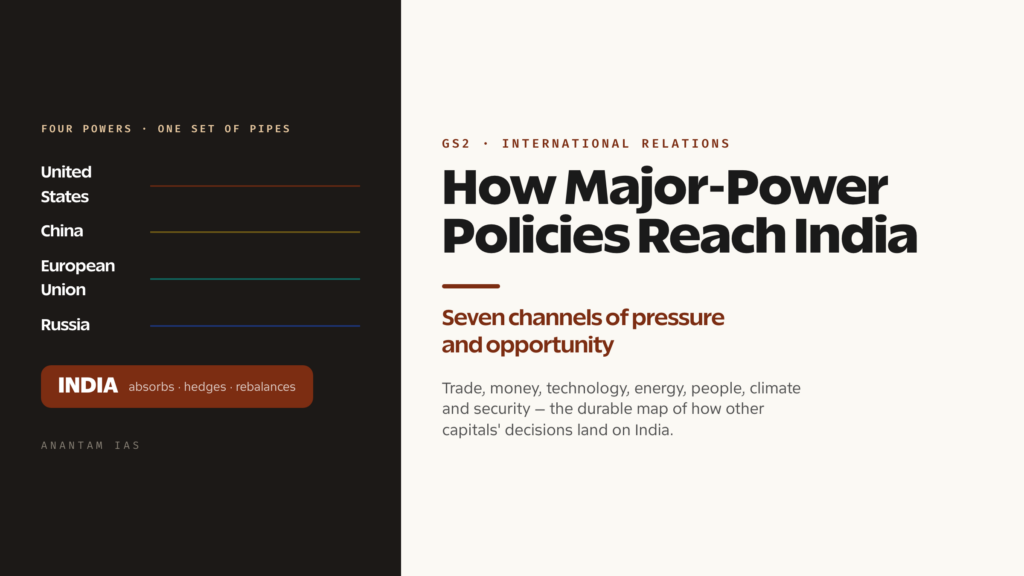
In February 2026, a single handshake in Washington showed how tightly India’s fortunes are now tied to choices made in other capitals. Months earlier, the United States had stacked tariffs on Indian goods up to a punishing 50 per cent — half of it a straight penalty for India buying Russian oil. Then, after long negotiation, President Trump and Prime Minister Modi announced a deal that cut the reciprocal rate to 18 per cent, with India agreeing to wind down its Russian crude purchases and signal large purchases of American goods. A tariff line set in one country had reshaped exporters’ order books, an oil-buying decision and a chunk of India’s foreign policy in a single stroke. That is the syllabus theme in one episode: the policies and politics of other powers, developed and developing alike, land squarely on India’s interests.
And this is not a story of news headlines so much as a story of plumbing — the fixed channels through which any major power’s decisions flow into the Indian economy, security and diplomacy. A US interest-rate move, a Chinese export curb, a European carbon rule, a Russian war: each travels down a predictable pipe and shows up as a rupee level, a factory order, a visa queue or a border posture. For a UPSC aspirant, the trick is not to memorise the latest tariff number — those change — but to hold the map of channels in your head, so that whatever the next shock is, you can place it instantly and explain how India absorbs or deflects it.
The Channels Through Which Major-Power Policy Reaches India
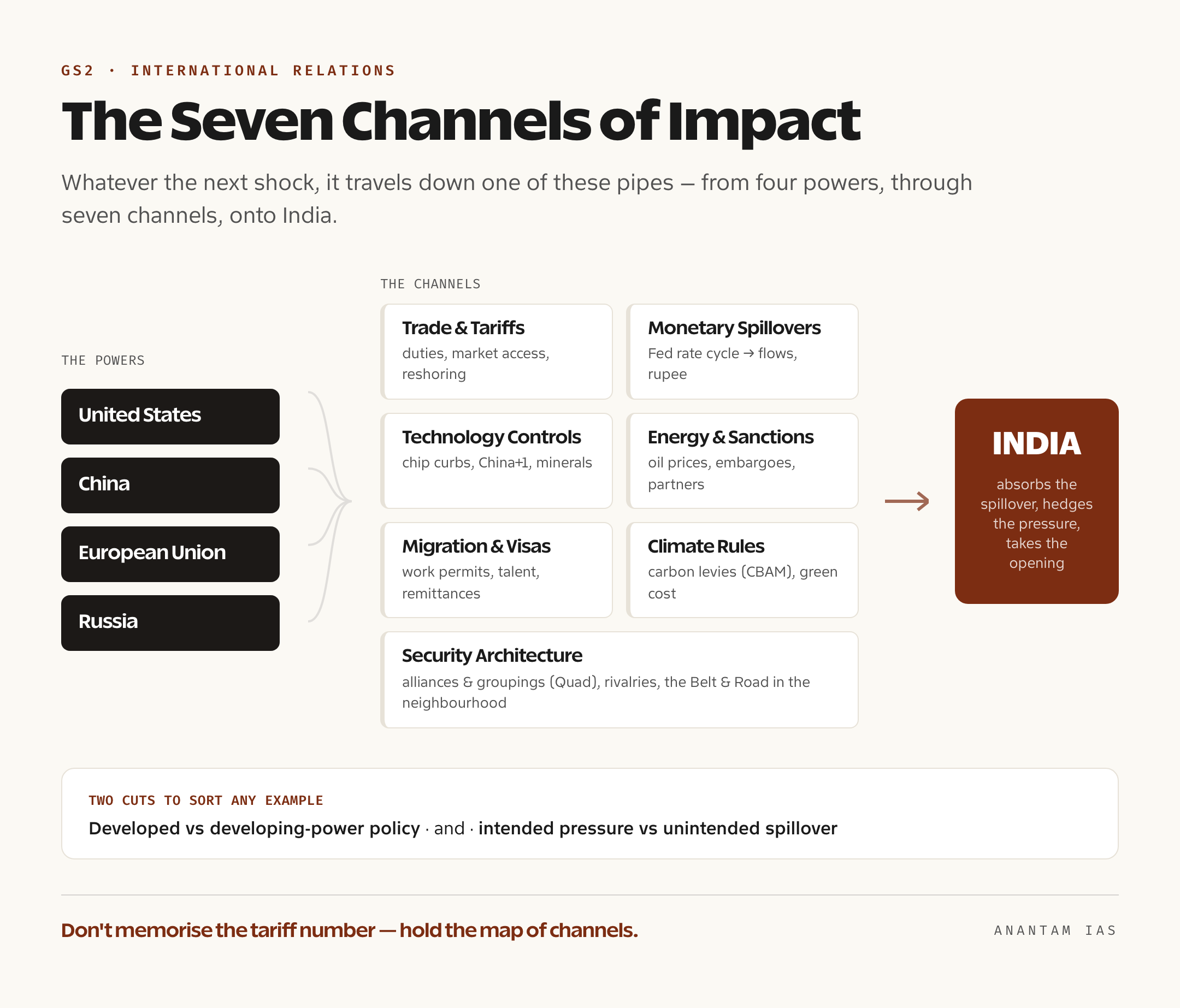
Start with the framework, because it is what makes this topic durable rather than a running ticker of events. The policies of major powers reach India through roughly seven channels, and almost every development you will read about slots into one of them. Trade and tariffs come first — the rules other countries set on what they will buy from India and on what terms, from outright duties to non-tariff barriers. Then monetary-policy spillovers: when the US Federal Reserve moves its interest rate, it moves global capital, and that tide lifts or drains Indian markets and the rupee whether or not New Delhi has done anything. Third is technology controls — export curbs, chip rules and the scramble to redraw supply chains away from China. Fourth, energy and sanctions, where the price India pays for oil and the partners it can buy from are shaped by wars and embargoes far from its shores.
The remaining three are just as real. Migration and visa policy decide whether Indian talent and the remittances it sends home can move freely. Climate and trade-linked environmental rules, like Europe’s new carbon border levy, quietly turn green ambition into a cost on Indian exports. And the security architecture — the alliances, groupings and rivalries that other powers build — sets the strategic weather in India’s neighbourhood and oceans. Two big distinctions run across all seven. The first is between developed-country policy (US monetary and trade decisions, EU regulations) and developing or rival-power policy (China’s industrial and border posture, Russia’s wartime dependence on Indian buyers). The second is between intended pressure aimed straight at India, like the oil-linked tariff, and unintended spillover that hits India simply because it is plugged into the same global system, like a Fed rate cycle. Keep both distinctions handy — they let you sort any example in seconds.
Trade, Tariffs and the New Geoeconomics of Reshoring
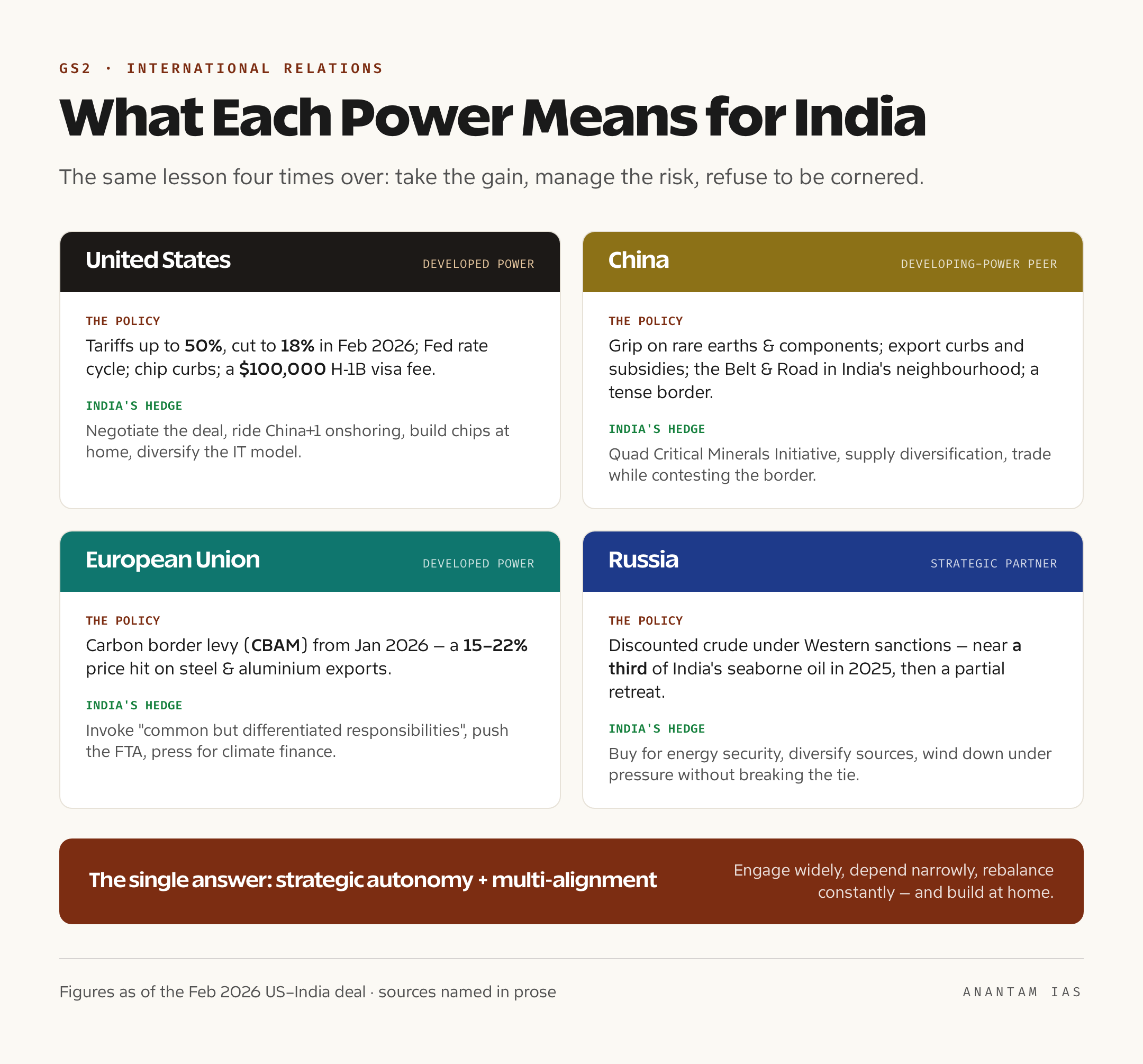
Trade is where great-power policy bites first and most visibly, and the past two years have been a live demonstration. When the second Trump administration rolled out “reciprocal” tariffs in 2025 and then layered an extra 25 per cent on India as a penalty for its Russian-oil purchases, the combined 50 per cent wall hit more than half of India’s roughly $87 billion of exports to the US — textiles, leather, gems and jewellery, engineering goods — while sparing pharmaceuticals and electronics. The February 2026 deal pared the reciprocal rate back to 18 per cent in exchange for India trimming Russian crude and opening its market to a long list of American industrial and farm goods, though sensitive sectors like dairy, rice and wheat were kept off the table. The episode is the cleanest example of intended pressure: a tariff used not just to protect American industry but as leverage over India’s energy and strategic choices.
But the same upheaval that threatens also rewards, and that is the deeper geoeconomic shift worth grasping. As Washington pushes “reshoring” (bringing manufacturing back to America) and “friend-shoring” (moving it to trusted partners), and as companies pursue a “China+1” strategy of adding a second base outside China, India has emerged as a prime alternative. The clearest proof is Apple: India’s iPhone exports went from near zero to around $50 billion over five years, and by 2025 smartphones had become India’s single largest export category, helped along by the Production-Linked Incentive scheme that offered cash subsidies for output. So a US policy aimed at reducing dependence on China became, almost as a side effect, a tailwind for Indian factories. The catch is that the very same warming of US-China relations that India cannot control could just as easily slow that flow — which is exactly why the channel cuts both ways, and why India’s answer has to be capability at home, not a bet on any one patron.
Money, Technology and Energy: The Spillover Channels
Now the channels that work quietly, without anyone naming India at all. Take monetary policy. When the US Federal Reserve raises interest rates, dollars become more attractive, so foreign portfolio investors pull money out of Indian stocks and bonds and the rupee weakens; when the Fed cuts, the tide reverses and capital flows back toward emerging markets like India. The Fed spent late 2025 easing, settling its policy rate near 3.5-3.75 per cent before pausing into 2026, and the effect was textbook — a softer dollar gives the rupee room to breathe and eases the pressure on the RBI. Because India imports most of its oil, a weaker rupee also feeds inflation, and analysts reckon roughly a 5 per cent rupee fall can add about 20 basis points to inflation. So a decision taken purely on American domestic grounds becomes an Indian inflation problem — the purest form of unintended spillover.
Technology is the second of these quiet channels, and it is increasingly the sharpest. Washington’s expanding export controls on advanced chips and chip-making tools are aimed at China, but they redraw the whole global supply chain, and India is positioning itself as a beneficiary. New Delhi rolled out semiconductor incentives worth roughly $15 billion, Micron’s assembly-and-test plant in Gujarat began operating in late 2025, and Tata Electronics’ fabrication unit at Dholera is targeting production around 2027. Here a developed power’s curbs on a rival create an opening for India — provided it can build the skills and ecosystem fast enough. Energy is the third. India buys most of its crude abroad, so when the US and EU sanctioned Russian oil after the 2022 invasion of Ukraine, India faced a hard choice and made a pragmatic one — it bought discounted Russian crude, which rose to roughly a third of its seaborne oil imports by 2025, until US tariffs and sanctions on Russian firms like Rosneft and Lukoil forced a partial retreat. As Indian officials put it, the energy security of 1.4 billion people is the priority, and diversification is the strategy. That single line captures how India treats every one of these channels: take the gains, manage the risks, refuse to be cornered.
A crucial reminder runs through all three of these channels — the powers shaping them are not only the developed West. China, a developing country by income but a great power by weight, sits inside every one of these pipes. Its dominance of the critical minerals and rare earths that go into chips, magnets and batteries gives Beijing a chokehold it has shown willingness to tighten, which is precisely why the technology channel cuts so deep for India. Its export curbs and industrial subsidies set the price and availability of the components Indian factories assemble. And its appetite for discounted Russian oil, as the largest single buyer, shapes the very market India trades in. So when the syllabus pairs “developed and developing countries,” it is pointing at exactly this — that a rising peer’s policy can press on India as hard as any decision out of Washington or Brussels, just through different valves.
Climate, Migration and the Security Architecture
The next set of channels shows how even non-trade policy travels. Europe’s Carbon Border Adjustment Mechanism, or CBAM — a levy on the carbon embedded in imports like steel, aluminium, cement and fertiliser — began charging on shipments from January 2026. Because Indian steel made in coal-fired blast furnaces emits around 2.6 tonnes of CO2 per tonne against roughly 1.4 in the EU, the carbon cost on Indian exports is heavy; the Global Trade Research Initiative estimates exporters may have to cut prices by 15-22 per cent to absorb it. India argues, with much of the developing world, that CBAM violates “common but differentiated responsibilities” — the principle that rich nations, having polluted longest, should carry a heavier load — and is pressing for climate finance and technology transfer rather than penalties. It is a textbook case of a developed-country regulation reaching deep into a developing economy through the trade pipe, dressed as environmental policy.
Migration is the human channel. When the US announced a $100,000 fee on new H-1B work visas in September 2025, it landed hardest on India, whose nationals took about 71 per cent of those visas; shares of Indian IT firms wobbled at the news, because the visa is the artery through which Indian engineering talent and a slice of its services exports flow. And the security architecture is the strategic channel — the groupings major powers build and the rivalries they run. The Quad (the US, Japan, Australia and India) gives India a platform to balance China’s assertiveness, and at their May 2026 meeting in New Delhi the four launched a Critical Minerals Initiative to cut dependence on Chinese supply and a maritime-surveillance effort for the Indo-Pacific. But the same grouping showed its limits when a leaders’ summit slipped amid US-India trade friction, and China’s Belt and Road Initiative — its programme of overseas ports and infrastructure — keeps tightening around India’s neighbourhood. So the security channel, like all the others, delivers both opportunity and pressure, and India has to read each one on its merits.
India’s Answer: Strategic Autonomy and Multi-Alignment
So how does a country hold its ground when seven different pipes are pumping other people’s decisions onto its soil? India’s answer has a name — strategic autonomy, the long-standing principle of keeping independent decision-making and avoiding rigid military alliances — and a method, multi-alignment. Multi-alignment means engaging many partners at once rather than picking a camp: deepening defence and technology ties with the US, buying oil and weapons from Russia, trading heavily with China while contesting it on the border, courting the EU on an FTA, and championing the Global South. As External Affairs Minister S. Jaishankar has framed it, India should reach out in as many directions as possible and maximise its gains. The point is to convert dependence on any single power into a spread of relationships that can be rebalanced as conditions change.
In practice this looks like disciplined hedging — engaging widely, depending narrowly, and constantly rebalancing. India takes the China+1 manufacturing tailwind while building chip capacity so it is not merely a passive beneficiary. It buys discounted Russian oil for energy security while diversifying suppliers and absorbing the US tariff cost rather than capitulating outright. It joins the Quad to balance China without signing up to an anti-China alliance that would forfeit its freedom of action. And it pushes self-reliance at home — Atmanirbhar Bharat, the PLI schemes, the semiconductor mission — because the surest insulation from another power’s policy is the capacity to make, fund and defend things yourself. The honest counter-argument, which a sharp answer should acknowledge, is that strategic autonomy gets harder in a sharpening US-China contest, where powers increasingly demand that India choose. India’s bet is that its sheer market size, talent and strategic location give it the leverage to keep saying “both, on my terms” — and the better it builds at home, the longer that bet holds.
For Your Mains Answer
This is a core theme for GS Paper 2, specifically the syllabus line on the effect of policies and politics of developed and developing countries on India’s interests, and it overlaps with bilateral and regional groupings, the Indian diaspora, and the international institutions India works through. It also feeds GS Paper 3 on the external sector and the economy, and it gives the Essay paper a rich, current canvas for themes of sovereignty, interdependence and self-reliance. The skill examiners reward here is structure: name the channel, give one current example, state the effect on India, and show India’s response — repeated cleanly across two or three channels beats a vague survey of world affairs.
How to Build the Answer
Lead with the framework, not the news. Open by classifying the channels — trade and tariffs, monetary spillovers, technology, energy and sanctions, migration, climate rules, security architecture — and the two distinctions (developed versus developing-power policy; intended pressure versus unintended spillover). Then pick two or three channels to develop with a current example each: the 2025-26 US tariff saga and the climbdown to 18 per cent for trade; the Fed cycle and the rupee for monetary spillover; CBAM for climate; the H-1B fee for migration. For each, run the same micro-arc — policy, channel, effect on India, India’s response. Close on strategic autonomy and multi-alignment as the unifying answer, and judge how sustainable it is.
Common Mistakes to Avoid
Don’t turn the answer into a news bulletin of the latest tariff figures — they date fast; lead with the durable channels instead. Don’t treat every effect as harmful: reshoring and China+1 are tailwinds, so show both the upside and the downside of the same policy. Don’t confuse strategic autonomy with non-alignment of the Cold-War kind — it is active engagement on India’s own terms, not standing aside. And don’t forget developing-power and rival-power policy: China’s border posture, BRI and export curbs belong in the answer just as much as US and EU decisions.
A Compact Answer Spine
Seven channels (trade · money · technology · energy · migration · climate · security) → two cuts: developed vs developing-power policy, intended pressure vs unintended spillover → trade: US tariffs up to 50% then cut to 18% (Feb 2026), plus China+1 reshoring tailwind → money: Fed cycle moves FPI and the rupee → tech: US chip curbs open a window, $15 bn semiconductor push → energy: Russian oil sanctions vs energy security → migration: $100,000 H-1B fee hits 71% Indian share → climate: EU CBAM from Jan 2026, 15-22% price hit → security: Quad balances China, BRI presses the neighbourhood → India’s answer: strategic autonomy + multi-alignment + Atmanirbhar self-reliance → verdict: hedging that works while India builds capacity, but harder as the US-China contest sharpens.
Diagram or Flowchart Idea
Draw four source boxes — US, China, EU, Russia — on the left, funnelling through a vertical stack of the seven channels in the middle, all arrows converging on a single “INDIA” box on the right, with a short “hedging / strategic autonomy” arrow looping back out. This one visual carries the entire framework and is quick to sketch in the margin before you write.
A Balanced-Conclusion Line
A line that lands the marks: “Major-power policy reaches India through fixed channels of trade, money, technology, energy, people, climate and security — so India’s task is not to escape the world’s plumbing but to manage it, converting dependence into a spread of partnerships through strategic autonomy, while building the domestic capacity that is the only lasting form of insulation.”
How to Use Data Without Cramming
You need only a handful of anchors: tariffs from 50 per cent down to 18 per cent (Feb 2026 deal), the $100,000 H-1B fee on a 71 per cent Indian share, CBAM’s 15-22 per cent price hit, Russian crude near a third of seaborne oil imports, and roughly $50 billion of iPhone exports for the China+1 story. Attribute them plainly — “as the February 2026 trade announcement showed” — and let one figure per channel do the work.
FAQ
What does “effect of policies of developed and developing countries on India’s interests” actually mean? It is a GS2 international-relations theme about how decisions taken by other powers — tariffs, interest rates, export controls, sanctions, visa rules, carbon levies, security alliances — flow into India’s economy, security and diplomacy. The useful way to study it is by channels: trade and tariffs, monetary-policy spillovers, technology controls, energy and sanctions, migration and visas, climate rules, and the security architecture. Almost every current event fits one of these pipes.
How did US tariff policy affect India in 2025-26? The US imposed reciprocal tariffs on India in 2025 and added a 25 per cent penalty for India’s Russian-oil purchases, pushing the wall up to 50 per cent and hitting more than half of India’s roughly $87 billion of exports to America. In February 2026 the two sides struck a deal cutting the reciprocal rate to 18 per cent, with India agreeing to wind down Russian crude purchases and open its market to a range of American goods. It is the clearest recent case of trade policy used as strategic leverage.
What is strategic autonomy and how does it differ from non-alignment? Strategic autonomy is India’s principle of keeping independent decision-making and avoiding binding military alliances, while multi-alignment is its method of engaging many partners at once. Unlike Cold-War non-alignment, which leaned toward staying out of blocs, strategic autonomy is active — India deepens ties with the US, Russia, the EU and the Global South simultaneously and rebalances as conditions shift, aiming to turn dependence on any one power into a manageable spread of relationships.
Is China’s policy part of this topic, or only the West’s? Both. The syllabus says developed and developing countries, so China and Russia belong squarely in the answer. China’s industrial and export policy shapes India’s supply chains and the China+1 opportunity, its Belt and Road Initiative presses on India’s neighbourhood, and its border posture drives India’s security choices. Russia’s wartime reliance on Indian oil buyers, in turn, hands India both cheap energy and a diplomatic headache with the West.
Practice Questions
Prelims MCQs
- The phrase “China+1 strategy,” often discussed in the context of India’s manufacturing, refers to which of the following?
(a) China’s policy of adding one more free-trade partner each year
(b) Global firms adding a manufacturing base outside China to reduce over-dependence on it
(c) A US scheme to tariff Chinese goods by an extra one per cent annually
(d) India’s plan to overtake China in GDP within one decade
Answer: (b) China+1 means companies keep China but add a second production base elsewhere, such as India or Vietnam, to diversify risk. - With reference to the European Union’s Carbon Border Adjustment Mechanism (CBAM), consider the following:
(a) It is a levy on the carbon embedded in imports such as steel, aluminium and cement
(b) It is a subsidy paid to EU exporters of green technology
(c) It is a ban on all imports from coal-dependent economies
(d) It applies only to imports from other developed countries
Answer: (a) CBAM puts a carbon cost on imports of specified carbon-intensive goods and began charging from January 2026, affecting Indian steel and aluminium. - When the US Federal Reserve cuts interest rates, the most likely immediate effect on India is:
(a) Foreign portfolio investment flows out of India and the rupee weakens
(b) Foreign portfolio investment flows toward India and the rupee finds relief
(c) India’s import bill automatically falls to zero
(d) The RBI is legally required to match the cut
Answer: (b) Lower US rates make dollar assets less attractive, so capital tends to flow back toward emerging markets like India, easing pressure on the rupee. - The Quad, in which India participates, comprises which set of countries?
(a) India, the US, the UK and France
(b) India, the US, Japan and Australia
(c) India, China, Russia and Brazil
(d) India, the US, Germany and South Korea
Answer: (b) The Quad is the United States, Japan, Australia and India; its 2026 agenda included a Critical Minerals Initiative to cut dependence on China. - In the context of Indian foreign policy, “multi-alignment” is best described as:
(a) Forming a single binding military alliance for collective defence
(b) Engaging multiple partners and coalitions simultaneously to maximise gains and preserve autonomy
(c) Refusing to engage with any major power until disputes are settled
(d) Aligning India’s currency with several reserve currencies at once
Answer: (b) Multi-alignment is the method behind strategic autonomy — engaging many powers at once and rebalancing rather than choosing a camp.
Mains Practice Questions
- “The policies of major powers reach India through fixed channels rather than random shocks.” Identify these channels and explain, with recent examples, how they affect India’s economic and strategic interests. (15 marks, 250 words)
- Examine how the trade and tariff policies of developed countries have affected India’s external sector in recent years. How should India respond to the use of tariffs as strategic leverage? (15 marks, 250 words)
- “Strategic autonomy is not non-alignment by another name.” In light of great-power competition, critically analyse India’s strategy of multi-alignment and assess its sustainability. (15 marks, 250 words)
- Discuss how the monetary policy of the United States transmits to the Indian economy. Why is this described as an unintended spillover rather than deliberate pressure? (10 marks, 150 words)
- The policies of both developed and developing major powers shape India’s interests. Evaluate this statement with reference to the United States, China, the European Union and Russia, and suggest how India can secure its long-term autonomy. (15 marks, 250 words)
Tell Google you want more of this.
Add Anantam IAS as a preferred sourceOne tap, and this site shows up more often in your own Top Stories, AI Overviews and AI Mode. Remove it any time.