Pashupatinath Temple in Kathmandu is the one Hindu shrine outside India that Indian syllabi treat as their own. It stands on the banks of the Bagmati River, it’s the holiest Shiva temple in Nepal, and it sits inside a UNESCO World Heritage Site that most students describe slightly wrong.
The usual slip is to call the temple itself a World Heritage Site. It isn’t, on its own. UNESCO lists the Kathmandu Valley as a single property made up of seven monument zones, and Pashupati is one of the seven. Get that framing right, and the rest of the topic, from tiered pagoda roofs to priests from South India, falls into place.
In short, the Pashupatinath temple is a Shiva shrine in the Newar pagoda style, with a Licchavi-era origin, a main structure rebuilt many times under later kings and a precinct managed since 1987 by a Nepali government trust. For India, it’s also a working piece of cultural diplomacy, which is why it appears in both art and culture and international relations notes.
Where Pashupatinath Stands
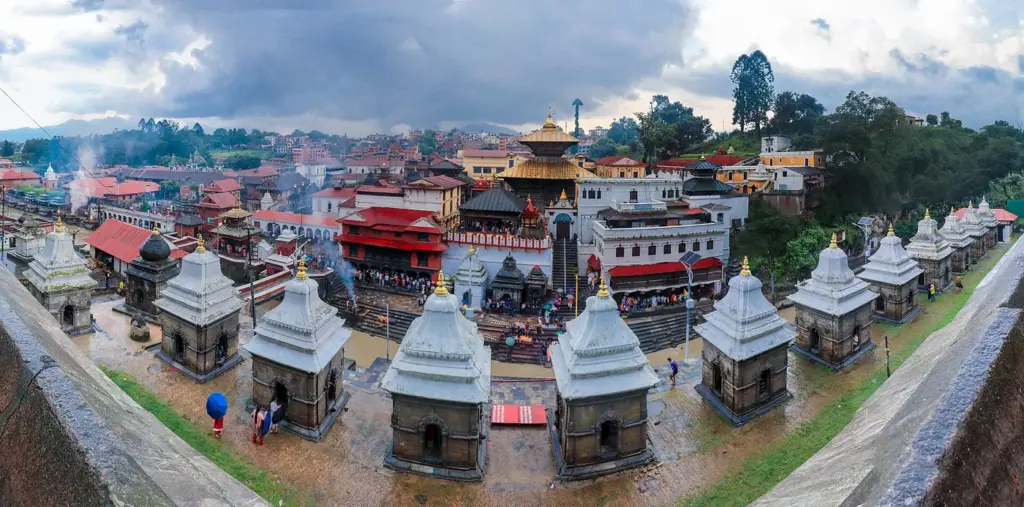
Pashupatinath stands on the Bagmati River in Kathmandu, at the heart of a large sacred zone that Nepal calls the Pashupati Area. According to the Pashupati Area Development Trust (PADT), that area covers about 264 hectares of temples, Buddhist viharas and stupas, ashrams and hermitages.
- The main temple is the centre of the complex, with smaller shrines, ghats and inscriptions spread along both banks of the river.
- The riverside ghats are also a cremation ground, which gives the site its particular association with death and liberation.
- By long-standing custom, the main temple courtyard is open only to Hindus, so most other visitors view the temple from across the river.
The deity is worshipped as a Shiva linga. PADT describes Pashupatinath as having five faces, named Tatpurusha, Aghora, Sadyojata, Vamadeva and Ishana. Think of it as a linga that carries faces on four sides with the fifth, Ishana, facing upward, so the god looks in every direction at once. The country context sits in the note on Nepal.
Origin and History
The Pashupatinath temple is older than any single building on the site. Its tradition runs back to the Puranas, its first structured temple dates to the Licchavi kings, and the building a pilgrim sees today is the product of repeated rebuilding under later kings.
- Puranic tradition: PADT traces the earliest references to the Skanda Purana. The legend tells of a cow that poured its milk on one spot in the forest, where the linga was found.
- Licchavi period (from about the 5th century CE): the Licchavi kings of the Kathmandu Valley built the first structured temple complex. PADT credits King Supushpa Deva with the original pagoda-style main temple.
- Medieval rebuilding: later rulers repaired and rebuilt the timber structure. An article in PADT’s own journal credits the medieval king Shivadeva with a rebuild, a golden roof and an offering of silver lotuses.
- Malla period (13th to 18th centuries): the Malla kings expanded the complex with subsidiary shrines, ghats and dharmashalas for pilgrims, and the temple became a pan-Hindu destination.
- The present two-tier form: a chronicle cited in the same journal credits it to Gangarani, queen of Shivasimha Malla, who is said to have reduced a three-tiered roof to two on the advice of the priest Swami Nityananda. Popular accounts often give 1692 for the present structure, but the trust’s own history doesn’t support that date, so don’t lean on it in an answer.
- 1979: the Kathmandu Valley, including Pashupati, was inscribed on the UNESCO World Heritage List.
- 2043 BS (1986-87): the Government of Nepal set up PADT as an autonomous trust with perpetual succession.
- 2015: the 7.8-magnitude Gorkha earthquake damaged many subsidiary shrines, but PADT records that the main temple withstood it.
That last point is worth a pause. A timber-and-brick temple that has been rebuilt many times came through one of the region’s worst earthquakes largely intact, while newer structures around it didn’t. It’s a reminder that “old” and “fragile” aren’t the same thing.
Architecture: The Pagoda Style Explained
Pashupatinath is built in the Newar pagoda style, the tiered-roof tradition of the Kathmandu Valley. That makes it different from the curvilinear towers of north India and the stepped towers of the south, and the difference is a favourite in matching questions.
The term needs translating. In the Nepali context, a “pagoda” is a square temple with roofs stacked one above another, each roof overhanging the one below and resting on carved timber struts. The walls are brick, the frame is wood and the roofs are finished in metal. It isn’t a Buddhist pagoda in the East Asian sense, even though the silhouettes look related.
- Roofs: two tiers, of copper and gold, as the trust’s own journal describes them.
- Pinnacle: a gold finial crowns the top.
- Doors: four main doors, all of silver.
- Sanctum: the linga with its five faces, at the heart of the square plan.
Placing Pashupatinath beside the two Indian styles shows where it fits:
| Feature | Newar pagoda (Pashupatinath) | Nagara (north India) | Dravida (south India) |
|---|---|---|---|
| Superstructure | Stacked, overhanging roofs | Curvilinear shikhara | Pyramidal, stepped vimana |
| Main materials | Brick walls, timber frame, metal roofing | Mostly stone | Mostly stone |
| Gateway emphasis | Four silver main doors | Entrance porches (mandapas) | Tall gopurams in the enclosure walls |
| Where to revise | This note | Nagara temple architecture | Dravidian temple architecture |
The wider framework is in the note on temple architecture in India. The one-line takeaway: Pashupatinath belongs to neither Indian style, and an answer that calls it Nagara loses the point of the question.
Religious Significance and the South Indian Priests
Pashupatinath is the most important Shiva shrine in Nepal and one of the holiest in the Hindu world. Two traditions give it that standing, and both tie it to India.
The name itself teaches a doctrine. Pashupati joins pashu (a creature, or a soul bound by ignorance) and pati (lord). PADT explains it this way: a person without wisdom is like a pashu, and surrendering to Pashupati is the way to liberation. So “Pashupatinath” isn’t “lord of cattle” in a pastoral sense. It’s “lord of bound souls”.
- Link with Kedarnath: according to PADT, the Shiva Purana regards Pashupatinath as the head of Kedareshwar, the deity of Kedarnath in Uttarakhand.
- Tamil devotional tradition: the temple is praised in the Tevaram, the Shaiva hymns of the Nayanar saints, which makes it one of the Paadal Petra Sthalams. The Bhakti movement note covers the Nayanars.
The priesthood is the detail examiners love. Daily worship at the main shrine is performed by the Bhattas, Brahmin priests drawn by tradition from South India, and the head priest, the Mool Bhatta, sits on the trust’s own governing board.
- The rule, as quoted in PADT’s journal, is that the priests of Pashupatinath must be married Brahmin householders from south of the Vindhyas: Karnataka, Maharashtra, Andhra and the Dravida country.
- Nepal’s chronicles, as cited in the same journal, credit King Yaksha Malla in the 15th century with arranging worship by South Indian Bhatta Brahmins after he took initiation from a Shankaracharya, a pontiff of the order traced to Adi Shankaracharya. The practice has continued since.
- The arrangement hasn’t always been comfortable inside Nepal. The same journal notes the local unease that followed disputes over appointing South Indian priests.
- The result is a Shiva temple in Kathmandu where the chief rituals are conducted by priests from South India, a living people-to-people link that no treaty created.
Maha Shivaratri is the temple’s biggest festival, and Teej draws large crowds of women devotees.
UNESCO Status: The Kathmandu Valley Property
Pashupati is one of seven monument zones in the Kathmandu Valley World Heritage Site, inscribed in 1979. UNESCO describes Pashupati specifically as “an extensive Hindu temple precinct”, which is why the whole zone, not just the main shrine, carries the listing.
- Inscribed: 1979, under cultural criteria (iii), (iv) and (vi).
- Size: a property of 167.37 ha with a buffer zone of 70.29 ha.
- Boundaries: a minor boundary modification accepted in 2006 set the seven monument zones.
- List of World Heritage in Danger: 2003 to 2007.
- Management: an Integrated Management Plan adopted in 2007, reviewed in five-year cycles.
- Continuing threat: UNESCO notes the property stays vulnerable to encroaching development, especially new infrastructure.
The seven zones mix palaces, Buddhist stupas and Hindu temples, and a Prelims question may ask you to spot the odd one out:
| Monument zone | Type | What UNESCO highlights |
|---|---|---|
| Hanuman Dhoka (Kathmandu) | Durbar square | Palace, temples and public space of the old city |
| Patan | Durbar square | Palace square of the second royal city |
| Bhaktapur | Durbar square | Palace square of the third royal city |
| Swayambhu | Buddhist ensemble | The oldest Buddhist monument (a stupa) in the valley |
| Bauddhanath | Buddhist ensemble | The largest stupa in Nepal |
| Pashupati | Hindu ensemble | An extensive Hindu temple precinct |
| Changu Narayan | Hindu ensemble | A temple complex with one of the valley’s earliest inscriptions, from the 5th century AD |
Notice what isn’t on the list. Lumbini, the Buddha’s birthplace, is a separate World Heritage Site in southern Nepal, not part of the Kathmandu Valley property. That’s the trap option in most questions. For comparison with Indian sites and the way UNESCO criteria work, see UNESCO World Heritage Sites in India.
Pashupatinath and India-Nepal Cultural Ties
Pashupatinath is India’s most visible religious bridge to Nepal. It shows up in Indian diplomacy because the ties are real, and because pilgrims from India make up a large share of its visitors.
The clearest recent example is a building pilgrims actually use. On 31 August 2018, Prime Ministers Narendra Modi and K.P. Sharma Oli inaugurated the Nepal-Bharat Maitri Pashupati Dharmashala.
- It’s a 400-bed pilgrim rest house in the Pashupati temple area.
- It was built on 10,625 sq m of land owned by PADT, under Indian grant assistance of about NPR 220 million (roughly INR 14 crore).
- It has three storeys and a floor area of about 6,100 sq m, with rooms, a dining hall, a library and a multi-purpose hall.
- Construction began in September 2016, and the finished building was handed over to PADT to run.
At the inauguration, Modi framed the temple as part of a chain of shared shrines, linking Somnath and Kashi Vishwanath to Pashupatinath, and Janakpur to Ayodhya. He also noted that the Tevaram hymns had carried the temple’s stories to Tamil Nadu for more than 1,500 years. The speech was diplomacy, but the facts it drew on are verifiable: the Kedarnath link and the Tamil hymns.
Here’s the honest limit. Shared faith builds goodwill, and a dharmashala is the kind of project that earns it. It doesn’t settle hard questions like the boundary at Kalapani and Lipulekh, which remains a live dispute. The balanced view, and the one that scores in Mains, is that cultural ties are the floor of the relationship, not its ceiling. The political side is covered in India-Nepal relations and the current affairs note on a new phase in India-Nepal relations.
Pashupatinath Temple at a Glance
| Item | Fact |
|---|---|
| Location | Banks of the Bagmati River, Kathmandu, Nepal |
| Deity | Shiva as Pashupati, worshipped as a linga with five faces |
| Style | Newar pagoda: two-tier roof of copper and gold, gold pinnacle |
| Doors | Four silver main doors |
| Earliest structured temple | Licchavi period; original pagoda credited to Supushpa Deva |
| Present form | Rebuilt under later kings; a chronicle credits the two-tier roof to Queen Gangarani |
| Pashupati Area | About 264 hectares |
| UNESCO | Part of the Kathmandu Valley WHS (1979), one of seven monument zones |
| Danger list | 2003 to 2007 |
| Managing body | Pashupati Area Development Trust, 2043 BS (1986-87) |
| Priests | Bhattas, Brahmins drawn by tradition from South India; the head priest is the Mool Bhatta |
| India link | Nepal-Bharat Maitri Pashupati Dharmashala, 400 beds, inaugurated 31 August 2018 |
How the Pashupatinath Temple Is Tested
Pashupatinath is tested in two ways: as a heritage fact in Prelims and as an example in Mains answers on culture and diplomacy.
For Prelims, the questions cluster around a small set of facts:
- The river: Bagmati, not the Koshi or Gandak.
- The listing: part of the Kathmandu Valley property, not a standalone site, and Lumbini isn’t in the same property.
- The style: Newar pagoda, not Nagara.
- The priests: South Indian Bhattas, a custom the chronicles trace to Yaksha Malla.
- The danger-list years: 2003 to 2007.
For Mains, Pashupatinath works as evidence in answers on soft power, heritage conservation at living religious sites, and India’s neighbourhood policy. One strong paragraph pairs the dharmashala with the South Indian priesthood, then adds the limit: faith-based goodwill doesn’t resolve boundary disputes.
The revision method is a contrast table. Put Pashupatinath beside one Nagara temple and one Dravida temple, and fill in roof, material, gateway and patron. Five minutes on that table will cover most of the questions this topic can generate.
The Verdict
The Pashupatinath temple is best learned as one piece of a larger heritage system, not as a standalone shrine. Read it through the UNESCO listing first, because that’s where the factual traps sit, and then through its Indian connections, because that’s where the analytical marks sit.
The detail to carry into any answer is the priesthood. A Shiva temple in Kathmandu, served by priests from South India, praised in Tamil hymns and tied by tradition to Kedarnath, is a better argument for shared civilisation than any speech could make.
Frequently Asked Questions
Where is the Pashupatinath Temple located?
The Pashupatinath Temple stands on the banks of the Bagmati River in Kathmandu, Nepal. It is the centre of the Pashupati Area, a sacred zone of about 264 hectares with temples, stupas, ashrams and ghats.
Is Pashupatinath a UNESCO World Heritage Site?
Pashupati is one of the seven monument zones of the Kathmandu Valley World Heritage Site, inscribed in 1979. UNESCO lists the valley as one property, so the temple precinct is protected as part of that listing rather than as a separate site.
What architectural style is the Pashupatinath Temple?
It is built in the Newar pagoda style of the Kathmandu Valley, with a two-tier roof of copper and gold, a gold pinnacle and four silver main doors. It belongs to neither the Nagara nor the Dravida style of Indian temples.
Why are the priests of Pashupatinath from South India?
By a centuries-old custom, the chief priests, called Bhattas, are Brahmins from South India. A rule quoted in the Pashupati Area Development Trust’s journal says the priests must be married Brahmin householders from south of the Vindhyas, and Nepal’s chronicles credit King Yaksha Malla in the 15th century with starting the practice. The head priest is the Mool Bhatta.
Who manages the Pashupatinath Temple?
The Pashupati Area Development Trust (PADT), set up by the Government of Nepal in 2043 BS (1986-87), manages, conserves and develops the temple and the surrounding Pashupati Area. Nepal’s Prime Minister is its patron and the Minister of Culture, Tourism and Civil Aviation is its president.
What is the Nepal-Bharat Maitri Pashupati Dharmashala?
It is a 400-bed pilgrim rest house in the Pashupati temple area, built with Indian grant assistance of about NPR 220 million on land owned by PADT. Prime Ministers Narendra Modi and K.P. Sharma Oli inaugurated it on 31 August 2018.
Was the Pashupatinath Temple damaged in the 2015 earthquake?
The main temple withstood the 7.8-magnitude Gorkha earthquake of 2015, but many subsidiary shrines in the complex needed full rebuilding, which PADT carried out through a restoration programme.
Practice Questions
Prelims MCQs
Q1. The Pashupatinath Temple in Kathmandu stands on the banks of which river?
(a) Koshi
(b) Gandak
(c) Bagmati
(d) Karnali
Answer: (c) The temple and the wider Pashupati Area lie along the Bagmati River in Kathmandu.
Q2. Which one of the following is NOT among the seven monument zones of the Kathmandu Valley World Heritage Site?
(a) Swayambhu
(b) Changu Narayan
(c) Lumbini
(d) Bauddhanath
Answer: (c) Lumbini is a separate World Heritage Site; the seven zones are Hanuman Dhoka, Patan, Bhaktapur, Swayambhu, Bauddhanath, Pashupati and Changu Narayan.
Q3. The architectural style of the main Pashupatinath temple is best described as:
(a) Nagara with a curvilinear shikhara
(b) Dravida with tall gopurams
(c) Newar pagoda with tiered roofs
(d) Vesara with a stellate plan
Answer: (c) The temple has a two-tier roof of copper and gold in the Nepali pagoda tradition.
Q4. By tradition, the chief priests (Bhattas) of the Pashupatinath Temple are drawn from:
(a) Newar Buddhist families of the Kathmandu Valley
(b) Brahmin families of South India
(c) Maithil Brahmins of Janakpur
(d) Kashmiri Pandit families
Answer: (b) A rule quoted in PADT’s journal requires Brahmins from south of the Vindhyas; Nepal’s chronicles trace the custom to King Yaksha Malla in the 15th century.
Q5. Consider the following statements about the Kathmandu Valley World Heritage Site: 1. It was inscribed in 1979. 2. It was on the List of World Heritage in Danger from 2003 to 2007. 3. It is inscribed under natural criteria. Which of the statements given above are correct?
(a) 1 only
(b) 1 and 2 only
(c) 2 and 3 only
(d) 1, 2 and 3
Answer: (b) It is a cultural property inscribed under criteria (iii), (iv) and (vi); statements 1 and 2 are correct.
Mains Questions
- Shared religious heritage such as Pashupatinath has long anchored India-Nepal relations. Discuss its role and its limits as an instrument of India’s neighbourhood policy. (15 marks, 250 words)
- Compare the Newar pagoda style of the Kathmandu Valley with the Nagara and Dravida styles of Indian temple architecture. (10 marks, 150 words)
- What lessons does the Kathmandu Valley’s experience on the List of World Heritage in Danger offer for managing living religious heritage sites in India? (15 marks, 250 words)
- Cultural diplomacy builds goodwill but cannot by itself resolve boundary disputes. Examine this statement in the context of India-Nepal relations. (15 marks, 250 words)
- Explain how cross-border pilgrimage sites such as Pashupatinath and Kailash Mansarovar function as sources of soft power for India. (10 marks, 150 words)
Tell Google you want more of this.
Add Anantam IAS as a preferred sourceOne tap, and this site shows up more often in your own Top Stories, AI Overviews and AI Mode. Remove it any time.