A few years ago, a degree certificate was a finish line. You studied for three or four years, framed the paper, and it told employers — for decades — what you could do. That settlement is quietly breaking. The skills an engineer or analyst learned in college now go stale faster than the loan that paid for them, and a growing share of work asks for tools that didn’t exist when the degree was awarded. Into that gap has walked a small, awkward word that UPSC aspirants are starting to meet in editorials and committee reports alike: the microcredential — a short, focused certificate that verifies one specific skill rather than a whole field, earned in weeks instead of years, and stacked onto whatever you already hold.
This isn’t a fad imported from Silicon Valley. It sits at the centre of a much larger argument about the future of work, about whether education should be a single event early in life or a habit that runs through it, and — for India especially — about whether the largest young workforce in human history can be kept employable as the ground shifts beneath it. For a UPSC candidate, microcredentials are a clean way into GS2 governance and social-sector themes (education, skilling, equity) that also touches GS3’s economy and the essay paper’s questions about technology and human capital. The trick is to understand both the global logic and the specific Indian architecture being built to answer it.
Why the Old Model Is Cracking: The Shrinking Half-Life of Skills
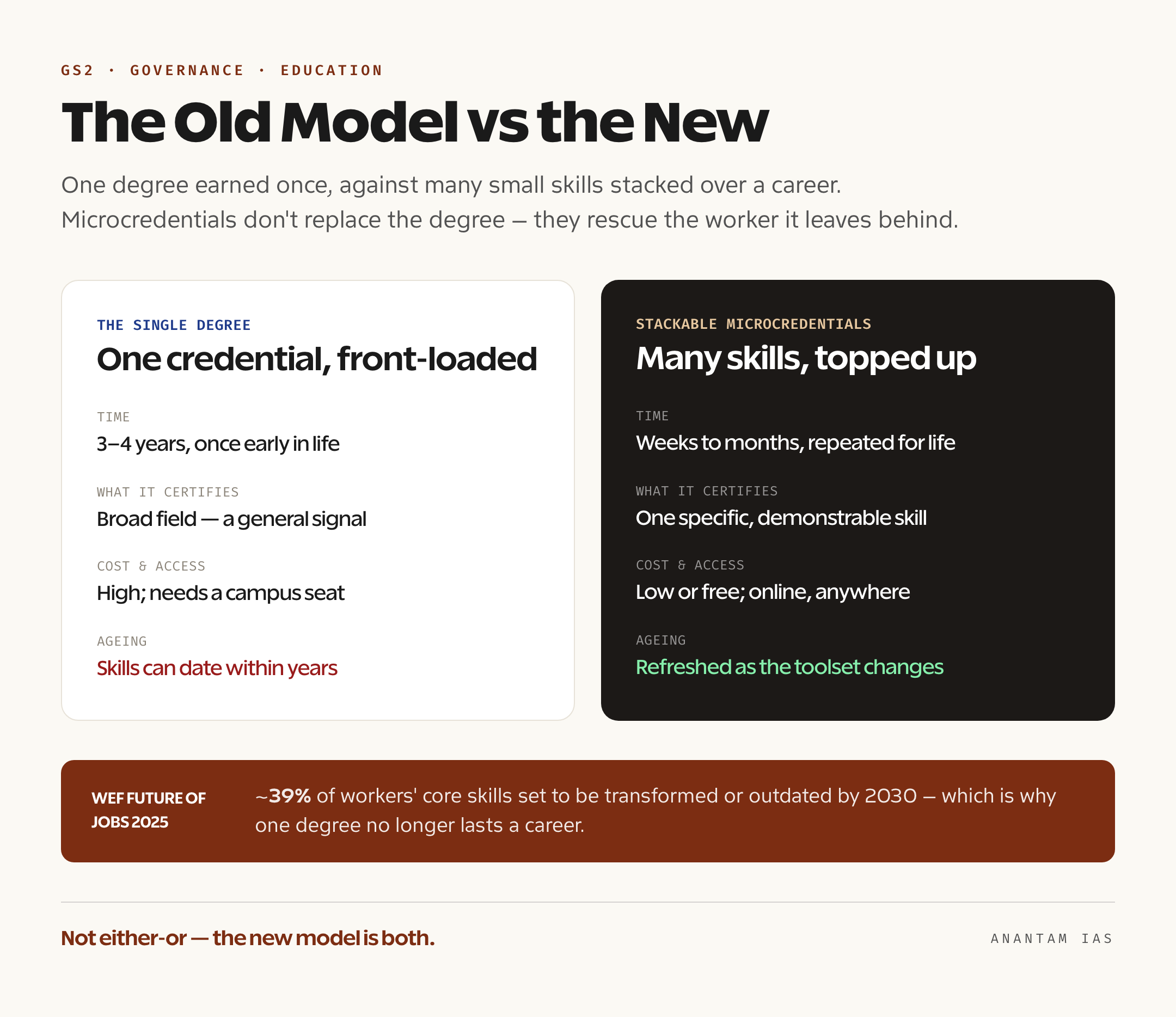
Start with the force driving everything else: the “half-life” of a skill — the time it takes for half of what you know to become obsolete — is collapsing. In fast-moving fields like data, cloud computing and artificial intelligence, a four-year degree finished five years ago may no longer describe what you can actually do today, while a recent, verified short course in the current toolset often does. The World Economic Forum’s 2025 Future of Jobs report put hard numbers on the anxiety: it estimated that around 39 per cent of workers’ core skills will be transformed or outdated between 2025 and 2030, that 63 per cent of employers already see skills gaps as the single biggest barrier to transforming their businesses, and that a majority of the global workforce will need some retraining by the end of the decade. When the WEF surveyed earlier, it framed the same point as a generational disruption — automation and AI reshaping which tasks humans are paid for, faster than the formal education system can re-tool.
The second force is the way hiring itself is changing. For most of the last century, the degree was a proxy — a rough signal that someone was trainable, disciplined and broadly capable. But a proxy is a blunt instrument. It can’t tell an employer whether a candidate can actually run a particular analytics pipeline or secure a particular kind of network. So a shift the recruiters now call “skills-based hiring” has been gathering pace: companies care more about what you can demonstrably do than where you studied. In that world, a credential that names a precise, tested skill is worth more than a generic qualification. Industry surveys reflect the swing — a large majority of employers say they would rather hire a candidate who holds a relevant skill certificate, and many say they’d offer a higher starting salary to someone carrying a recognised, credit-bearing one, especially in AI-adjacent roles.
Put those two forces together — skills decaying fast, and employers hiring against skills rather than diplomas — and you get the case for lifelong reskilling. It’s part of a wider loosening of the old link between a credential and a career, the same shift behind what some now call the no-collar economy, where what you can do matters more than the collar — or the diploma — you wear. The idea that you “finish” your education at twenty-two and coast on it is becoming a luxury few careers can afford. Learning has to become something you top up across a working life, in small, frequent doses, the way you’d service a vehicle rather than buy a new one. The microcredential is simply the unit that makes that economically possible: small enough to fit around a job, cheap enough to repeat, and specific enough to be worth something the moment you earn it.
What Microcredentials Actually Are: Formats, Stacking and the Skilling Ladder
So what does this unit look like in practice? A microcredential is any short, focused certification that verifies a specific competency — typically takes weeks to a few months, not years, and is built around a demonstrable skill rather than a broad subject. The family is wide. At one end sit MOOCs and online courses — the massive open online courses run on platforms that let anyone enrol. Then come “nano-degrees” and bootcamp certificates, more intensive sprints aimed at a job role. There are digital badges — small, verifiable tokens that prove you completed a module, often issued under shared technical standards like the Open Badges format so they can travel across platforms and be checked by an employer. And there are the big industry certificates: Google’s Career Certificates in fields like data analytics and IT support, Amazon Web Services and Microsoft cloud certifications, and similar programmes from firms whose tools people actually use at work. Because the company that builds the technology also issues the credential, employers trust that it maps to a real skill.
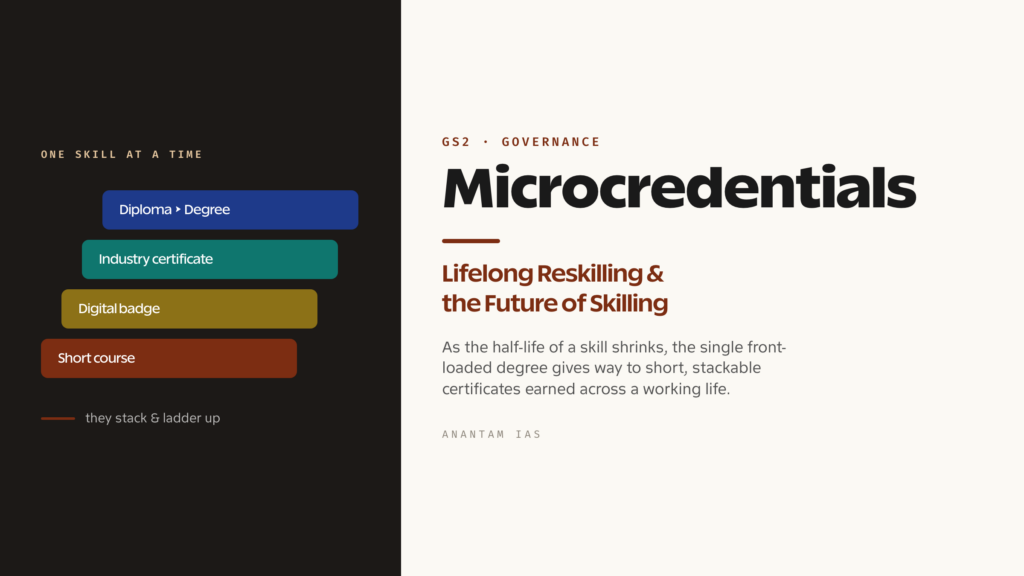
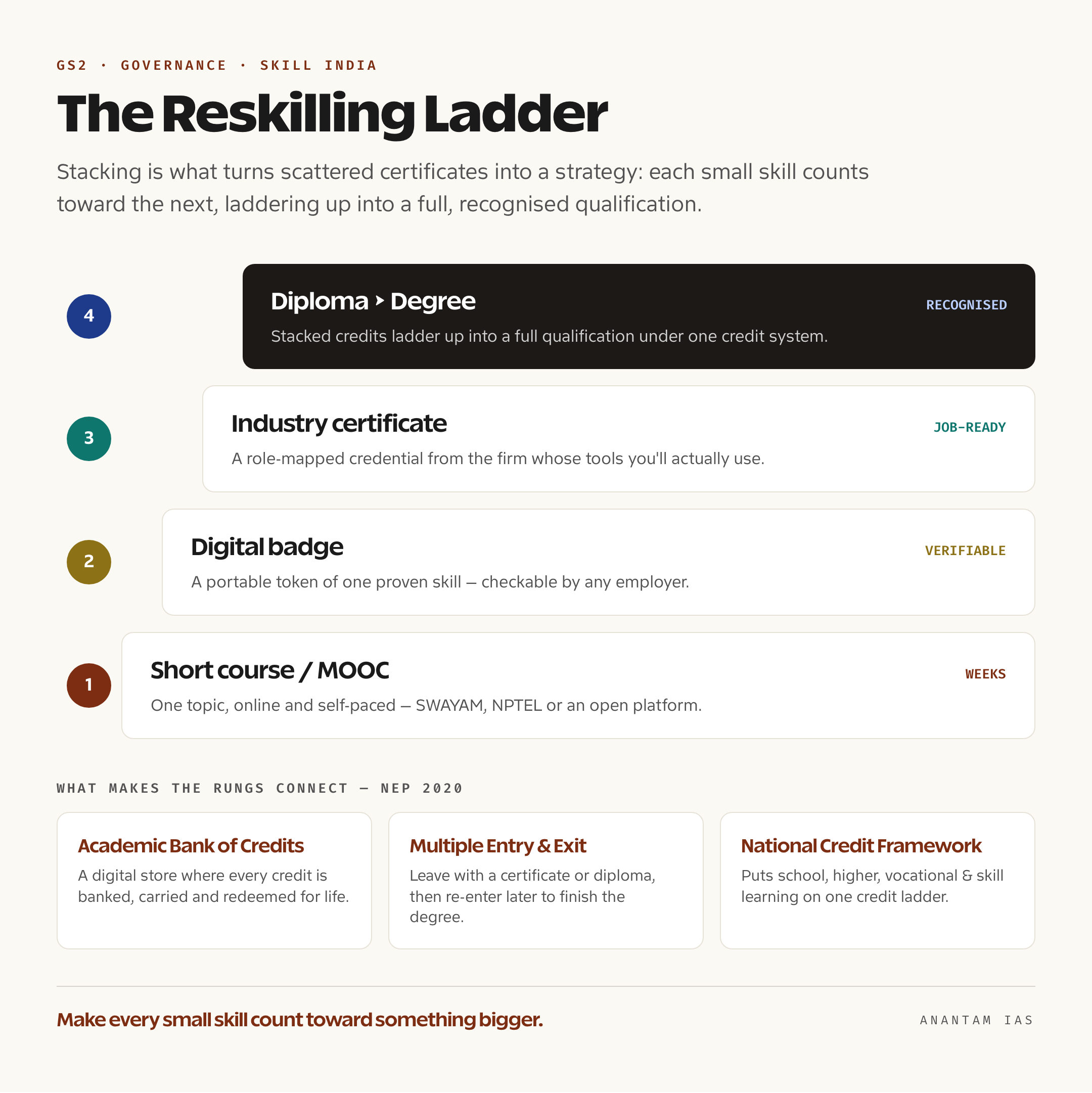
The feature that turns a pile of certificates into a strategy is stacking. A stackable credential is one you can collect over time so that each adds to the last, and — crucially — several can “ladder” upward into a larger qualification. Earn a short course here, a badge there, a certificate next year, and a well-designed system lets them accumulate into something a university or employer recognises as a full diploma or even part of a degree. This is the bridge that keeps microcredentials from being mere scattered souvenirs: instead of choosing either a quick certificate or a long degree, a learner can start small, get hired, and keep building toward the bigger qualification without ever leaving the workforce. That laddering logic — many small wins compounding into a recognised whole — is exactly what India’s new credit architecture is trying to formalise.
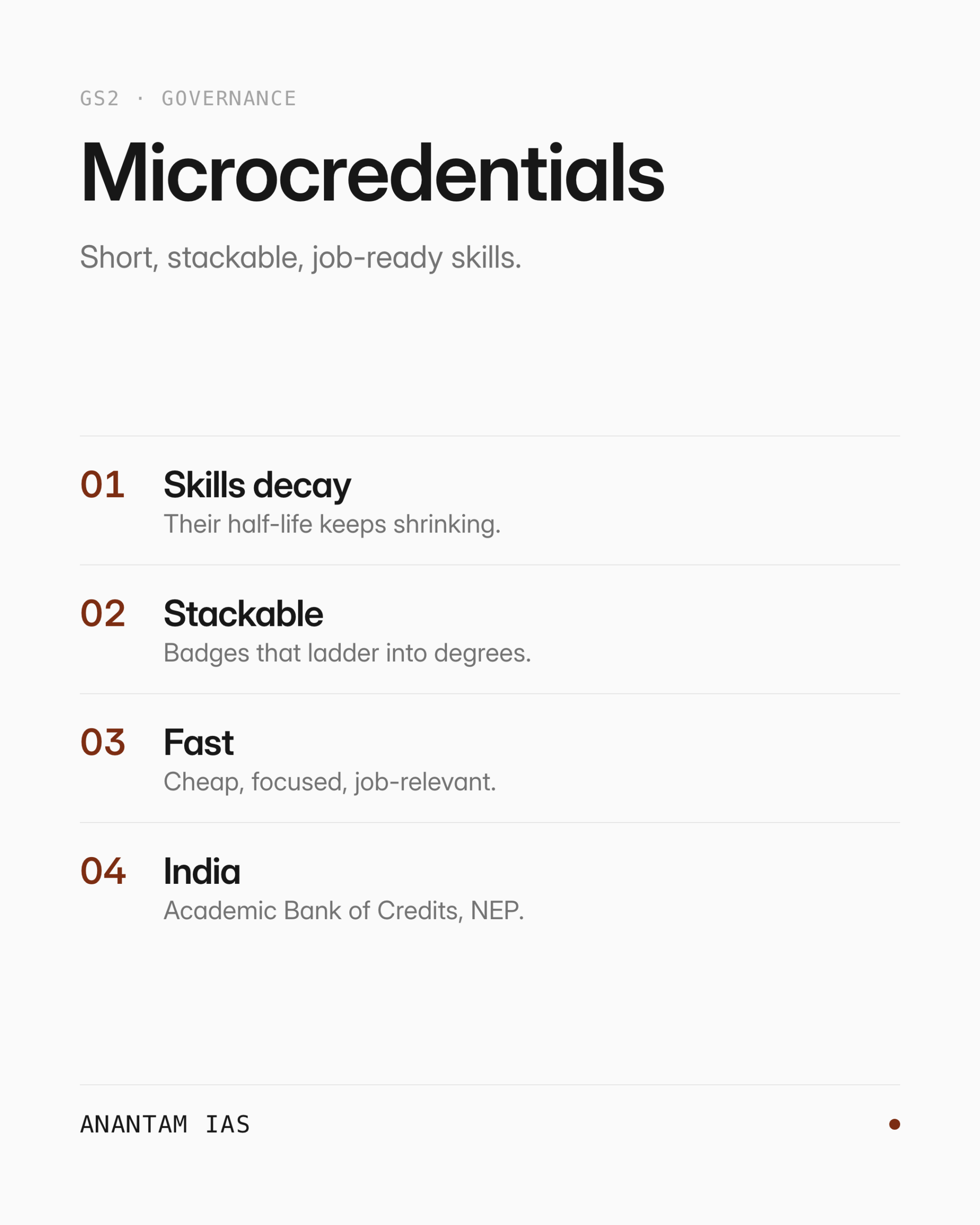
The appeal, especially in a country with millions of young people and limited campus seats, is easy to state. Microcredentials are fast, so a worker can respond to a new demand in months. They’re affordable, often a fraction of a degree’s cost and sometimes free. They’re job-relevant, because they’re designed around what employers ask for now. And they’re accessible — delivered online, they reach a learner in a small town who could never move to a metro for a three-year programme. For the aspirant, that four-word summary — fast, affordable, relevant, accessible — is the core “benefits” point worth memorising.
The Risks: Quality, Credential Inflation and the Digital Divide
For all the enthusiasm, a credential is only as good as the trust behind it, and that’s where the problems start. The first is quality and recognition. Anyone can issue a certificate; very few of them are independently checked. A badge from a serious technology firm or a top institute means a great deal, but the market is crowded with thin courses whose “credentials” prove little. Without standards — a common way to measure what a credential is worth and to map it onto the wider qualification system — employers can’t easily compare two certificates, and learners can’t be sure the time and money they’ve spent will be honoured. Standardisation, in other words, is the precondition for the whole model to work, and it’s the hardest part to get right.
The second risk is credential inflation. If everyone is collecting badges, the signalling power of any single one falls — much as a degree that everyone holds stops distinguishing anyone. There’s a real danger of a treadmill in which workers keep paying for more certificates simply to stay where they are, while the labour market’s bar quietly rises. That turns lifelong learning from an opportunity into an obligation, a cost shifted from employers and the state onto the individual worker. A good answer acknowledges this: microcredentials can democratise skills, but they can also commodify learning and offload the burden of staying employable onto those least able to bear it.
And the third — the one that matters most for India — is equity and the digital divide. The promise of online microcredentials is access; the catch is that access depends on a device, a stable connection, digital literacy and often English. A young person in a connected city with a smartphone and data can stack credentials freely. A young person in a village with patchy network, no personal device, and a regional-language education starts far behind and may fall further. So the same tool that can widen opportunity can also deepen the gap between the already-advantaged and the rest, unless the state deliberately bridges it. Any policy answer on skilling in India has to carry this caveat, because the technology is neutral but its benefits are not evenly distributed.
India’s Answer: Skill India, NEP 2020 and the Credit Architecture
India has more reason than almost any country to take this seriously, and the reason has a name: the demographic dividend. India has one of the youngest populations on earth, with a median age around the late twenties and a working-age share that will keep rising for years. That bulge of young people is an asset only if they’re employable — otherwise it becomes a liability, a generation underused. And the warning signs are real: India’s own skills reports have long flagged that only around half of graduates are assessed as job-ready. Reskilling at scale isn’t a nice-to-have for India; it’s the difference between the dividend paying out and the window closing.
The government’s main vehicle is the Skill India Mission, run by the Ministry of Skill Development and Entrepreneurship, which in 2025 marked ten years of operation. The Cabinet has continued and restructured it as a single Skill India Programme with an outlay of about ₹8,800 crore through 2025-26, folding three flagships into one: the Pradhan Mantri Kaushal Vikas Yojana (PMKVY) for short-term skilling, the National Apprenticeship Promotion Scheme (PM-NAPS) for on-the-job training, and the Jan Shikshan Sansthan scheme for community-based skilling. The Ministry reports more than two crore beneficiaries across these flagships, and tellingly, it has added hundreds of new courses in AI, cybersecurity, drones, 5G and green hydrogen — an explicit bet on future-of-work skills rather than yesterday’s trades. Apprenticeships are a particular focus, because earning a stipend while learning on a real shop floor is reskilling that doesn’t ask a poor family to choose between income and education.
The deeper structural reform, though, comes from the National Education Policy 2020, which is quietly building exactly the laddering machinery that stacking needs. Three pieces fit together. The first is the Academic Bank of Credits (ABC) — a digital account where a student’s credits, from any recognised course, are deposited and stored, so they can be accumulated, carried across institutions and redeemed later. The second is multiple entry and multiple exit, which lets a learner leave a programme with a certificate after one year, a diploma after two, or a full degree after three or four, and re-enter later to continue — abolishing the all-or-nothing logic of the old degree. The third is the National Credit Framework (NCrF), which for the first time tries to put school, higher, vocational and skill learning on a single credit ladder, so that a Skill India certificate and a university course can be measured in the same currency and stacked together. Alongside these, the SWAYAM and NPTEL platforms — government-run MOOCs offering thousands of free courses, the latter built by the IITs and IISc — let students earn up to 40 per cent of a programme’s credits online, the closest thing India yet has to a public microcredential system. The architecture, in short, is to make every small skill count toward something bigger, and to bank it in a name the learner carries for life.
The honest assessment is that the design is ahead of the delivery. The credit framework and the Academic Bank of Credits are genuinely ambitious — arguably world-leading in intent — but uptake has been slow: many universities have been hesitant to recognise online credits, and student take-up of the SWAYAM credit-transfer route has stayed in the low double digits where it has started at all. So the future-of-work case for India isn’t about whether to reskill — the demographic clock makes that non-negotiable — but about execution: standardising what credentials are worth, bridging the digital divide so rural and regional-language learners aren’t left out, and getting employers and universities to actually trust and accept the stacked credentials the system is now able to issue.
For Your Mains Answer
This is a versatile GS Paper 2 topic, sitting squarely in the social-sector portion of the syllabus — issues relating to the development and management of the social sector involving education, human resources, and government policies. It also reaches into GS Paper 3 wherever a question frames skilling as employment, human capital, or the economy’s growth engine, and it’s a rich, current example for the Essay paper on education, technology and the future of work. The skill examiners reward is to pair the global logic (shrinking skill half-lives, skills-based hiring) with the specific Indian scaffolding (Skill India, NEP’s ABC and NCrF) and a balanced verdict on whether the design is delivering.
How to Build the Answer
Open with the driver, not the tool — define why the old single-degree model is breaking (skills decaying fast, AI reshaping work, employers hiring on skills not diplomas). Then define the microcredential and its core feature, stacking, in a line each. Move to benefits (fast, affordable, relevant, accessible) and immediately balance them with risks (quality and recognition, credential inflation, the digital divide). Then land on India: the demographic-dividend imperative, Skill India as the delivery arm, and NEP 2020’s Academic Bank of Credits, multiple entry-exit and the National Credit Framework as the laddering machinery. Close by judging the gap between an ambitious design and slow delivery. That arc — driver, definition, benefits, risks, India’s architecture, verdict — fits almost any skilling or future-of-work question.
Common Mistakes to Avoid
Don’t treat microcredentials as just “online courses” — the examinable point is stacking and laddering into recognised qualifications, not the delivery medium. Don’t present them as an unmixed good; the credential-inflation and digital-divide critiques are what lift an answer from descriptive to analytical. Don’t confuse the schemes: Skill India (under MSDE) is the skilling-delivery mission, while the Academic Bank of Credits and the National Credit Framework (under NEP/Ministry of Education) are the credit-banking and laddering reforms — name them correctly. And don’t claim India’s system is fully working; the honest, mark-earning line is that the design is ambitious but uptake is still low.
A Compact Answer Spine
Shrinking skill half-life + AI reshaping work + skills-based hiring → the single-degree model breaks → microcredentials = short, focused, verifiable certificates → stackable credentials ladder into full qualifications → benefits: fast, affordable, job-relevant, accessible → risks: quality/recognition, credential inflation, digital divide/equity → India’s imperative: demographic dividend, ~half of graduates job-ready → delivery: Skill India Programme (~₹8,800 cr, PMKVY + apprenticeships) → laddering: NEP 2020’s Academic Bank of Credits + multiple entry-exit + National Credit Framework + SWAYAM/NPTEL → verdict: ambitious design, slow delivery; fix standardisation, equity and employer trust.
Diagram or Flowchart Idea
Draw a simple ladder: small rungs at the bottom labelled “short course / badge / industry certificate” that stack upward into a higher rung labelled “diploma → degree,” with a side-box naming the enablers — Academic Bank of Credits, multiple entry-exit, National Credit Framework. Beside it, a two-column “degree vs microcredentials” contrast. A visual like this shows both the unit and the system at a glance and is quick to sketch.
A Balanced-Conclusion Line
A line that lands the marks: “Microcredentials won’t replace the degree so much as rescue the worker the degree leaves behind — but for India they will only pay off if the credit ladder NEP 2020 has designed is matched by the standards, the digital access and the employer trust that make every small skill genuinely count.”
How to Use Data Without Cramming
You need only a handful of anchors, not a report. Use the WEF’s “around 39 per cent of core skills transformed or outdated by 2030” for the driver, “Skill India Programme, about ₹8,800 crore, over two crore beneficiaries” for the delivery, “up to 40 per cent of credits online via SWAYAM/NPTEL” for the architecture, and “roughly half of Indian graduates assessed as job-ready” for the imperative. Attribute them plainly — “as the WEF’s Future of Jobs report noted,” “under the restructured Skill India Programme” — rather than scattering figures loose.
Frequently Asked Questions
What exactly is a microcredential, and how is it different from a degree?
A microcredential is a short, focused certification — usually weeks to a few months — that verifies one specific, demonstrable skill, such as data analytics or cloud security, rather than a whole field of study. A degree certifies broad knowledge over three or four years and acts as a general signal of ability; a microcredential names a precise competency and can be earned quickly, cheaply and online. The two aren’t rivals so much as complements: microcredentials let workers top up skills across a career, and well-designed ones can “stack” and ladder up into a full diploma or degree.
Why are microcredentials becoming so important now?
Because the half-life of skills is shrinking. Fields like AI, data and cloud computing change so fast that knowledge from a degree finished a few years ago can be outdated, while employers increasingly hire on what a candidate can demonstrably do — “skills-based hiring” — rather than on where they studied. The World Economic Forum’s 2025 Future of Jobs report estimated that around 39 per cent of workers’ core skills will be transformed or outdated by 2030, which makes continuous reskilling a necessity rather than a choice.
What is India doing to build a microcredential system?
Two things working together. The Skill India Programme, run by the Ministry of Skill Development and Entrepreneurship with an outlay of about ₹8,800 crore through 2025-26, delivers short-term skilling (PMKVY), apprenticeships (PM-NAPS) and community skilling, and has added hundreds of courses in AI, cybersecurity, drones and green hydrogen. Separately, NEP 2020 is building the laddering machinery — the Academic Bank of Credits to store credits digitally, multiple entry and exit so learners can leave and rejoin with certificates and diplomas, and the National Credit Framework to put school, higher, vocational and skill learning on one credit ladder, with SWAYAM and NPTEL letting students earn up to 40 per cent of credits online.
What are the main risks of relying on microcredentials?
Three. Quality and recognition — anyone can issue a certificate, so without standards employers can’t tell a serious credential from a thin one. Credential inflation — if everyone collects badges, each one signals less, and workers can end up on a treadmill of paying for more just to stay in place. And the digital divide — because most microcredentials are delivered online, they favour learners with devices, connectivity, digital literacy and often English, and can widen the gap with rural and regional-language learners unless the state deliberately bridges it.
Practice Questions
Prelims MCQs
- The Academic Bank of Credits (ABC), associated with skilling and education reform in India, is best described as which of the following?
(a) A government bank that lends money to students for vocational courses
(b) A digital store where a student’s earned credits are deposited, accumulated and redeemed across institutions
(c) A scheme that pays stipends to apprentices during on-the-job training
(d) A regulator that fixes the fees of online certificate courses
Answer: (b) The ABC, introduced under NEP 2020, is a digital account that lets students accumulate and transfer credits across courses and institutions. - The “multiple entry and multiple exit” provision under NEP 2020 allows a learner to do which of the following?
(a) Enrol in several universities at the same time for the same degree
(b) Leave a programme with a certificate, diploma or degree depending on years completed, and re-enter later
(c) Convert any microcredential automatically into a postgraduate degree
(d) Skip all examinations if online courses are completed
Answer: (b) Multiple entry-exit lets a student exit with a certificate after one year, a diploma after two, or a degree after three or four, and rejoin later. - Under the UGC’s framework for online learning, students can earn up to what share of a programme’s credits through platforms like SWAYAM and NPTEL?
(a) 10 per cent
(b) 25 per cent
(c) 40 per cent
(d) 100 per cent
Answer: (c) The framework permits students to earn up to 40 per cent of a programme’s total credits through approved online courses on SWAYAM and NPTEL. - The restructured Skill India Programme combines which set of schemes under a single central sector scheme?
(a) PMKVY, PM-NAPS and the Jan Shikshan Sansthan scheme
(b) PMKVY, MGNREGA and the Mid-Day Meal scheme
(c) Atal Innovation Mission, PMKVY and Startup India
(d) PM-NAPS, Ayushman Bharat and Skill India Digital
Answer: (a) The Skill India Programme folds the Pradhan Mantri Kaushal Vikas Yojana, the National Apprenticeship Promotion Scheme and the Jan Shikshan Sansthan scheme into one composite scheme. - The concept of the shrinking “half-life of skills,” central to the case for lifelong reskilling, refers to which of the following?
(a) The falling cost of online certificate courses over time
(b) The shortening period in which half of a person’s skills become outdated
(c) The decline in the number of years a degree takes to complete
(d) The reduction in working-age population in an ageing society
Answer: (b) A shrinking skill half-life means knowledge becomes obsolete faster, so workers must keep retraining across their careers.
Mains Practice Questions
- “The single, front-loaded degree is giving way to lifelong, stackable learning.” Examine the drivers behind the rise of microcredentials and assess their implications for India’s education and employment system. (15 marks, 250 words)
- Discuss how the Academic Bank of Credits, multiple entry-exit, and the National Credit Framework under NEP 2020 together create an architecture for stackable credentials in India. What challenges limit their uptake? (15 marks, 250 words)
- Microcredentials promise to democratise skills but risk commodifying learning. Critically analyse the benefits and risks of a microcredential-led skilling model for a country like India. (15 marks, 250 words)
- “India’s demographic dividend is an asset only if its young workforce stays employable.” In this context, evaluate the role of the Skill India Mission in reskilling India’s youth for the future of work. (10 marks, 150 words)
- The digital divide threatens to turn an instrument of access into one of exclusion. Discuss how the design of India’s online skilling and credentialing system can be made more equitable. (15 marks, 250 words)
Tell Google you want more of this.
Add Anantam IAS as a preferred sourceOne tap, and this site shows up more often in your own Top Stories, AI Overviews and AI Mode. Remove it any time.