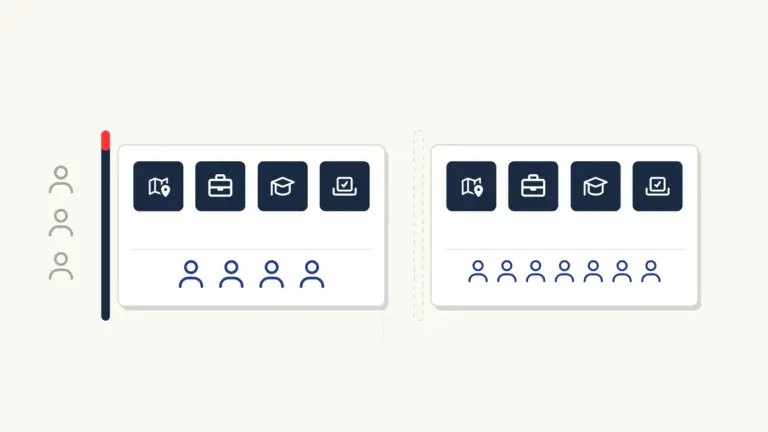
Mission Karmayogi — officially the National Programme for Civil Services Capacity Building (NPCSCB) — was launched by the Union Cabinet in September 2020 as the largest single effort to reform how Indian civil servants are trained, evaluated and deployed. It marks a shift from a "rules-based" to a "roles-based" human resource paradigm, where every civil service position is calibrated to a framework of roles, activities and competencies (FRACs).
For UPSC aspirants, Mission Karmayogi is a core GS II theme on administrative reform, with close links to the 2nd ARC's recommendations on capacity building.
The objective
Mission Karmayogi aims to:
- Improve government's human resource management practices.
- Augment the capacity of civil servants using state-of-the-art infrastructure.
- Prepare the Indian civil servant for the future — creative, constructive, imaginative, innovative, proactive, professional, progressive, energetic, enabling, transparent and technology-enabled.
- Empower civil servants with specific role-competencies for efficient, high-quality service delivery.
The six pillars of Mission Karmayogi
1. Policy Framework
- Guiding principles and vision for civil services capacity building.
- Alignment with national priorities and SDGs.
2. Institutional Framework
- New architecture comprising PMHRC, Cabinet Secretariat Coordination Unit, Capacity Building Commission, SPV, and Programme Management Unit.
3. Competency Framework
- FRACs — Framework of Roles, Activities and Competencies for each civil service position.
- Behavioural, Functional and Domain competencies mapped to roles.
4. Digital Learning Framework — iGOT Karmayogi
- Integrated Government Online Training platform.
- Online courses in multiple languages.
- Anytime, anywhere learning model.
5. Electronic Human Resource Management System (e-HRMS)
- Digitisation of service records, transfers, postings, promotions.
- Performance management integrated with competency assessments.
6. Monitoring and Evaluation Framework
- Data-driven assessment of capacity-building outcomes.
- Feedback loops for continuous improvement.
Institutional framework approved
Prime Minister's Public Human Resource Council (PMHRC)
- Chaired by the Prime Minister.
- Drives strategic direction of civil service reforms and capacity building.
- Members include select Union Ministers, CMs, thought leaders and experts.
Cabinet Secretariat Coordination Unit
- Monitors implementation.
- Aligns stakeholders (ministries, training institutions).
- Provides mechanism for overseeing Annual Capacity Building Plans.
Capacity Building Commission (CBC)
An autonomous body with extensive functions:
- Functional supervision over central training institutions.
- Assist PMHRC in preparing and approving Annual Capacity Building Plans.
- Create shared learning resources — internal and external faculty and resource centres.
- Coordinate and supervise the implementation of Capacity Building Plans with stakeholder Departments.
- Recommend on standardisation of training — pedagogy, methodology.
- Norms for common mid-career training across all civil services.
- Policy interventions on HR Management and Capacity Building.
Special Purpose Vehicle (SPV)
- Autonomous company under the Companies Act, 2013.
- Owns and operates all digital assets created for capacity building, including the iGOT-Karmayogi platform.
Programme Management Unit (PMU)
- Provides programme management and support services to the nodal Department of Personnel and Training (DoPT).
iGOT-Karmayogi Platform
- Provides effective digital e-learning material for civil servants.
- Training at various academies is restructured to include optimum use of iGOT's digital platform.
- Content covers behavioural, functional and domain skills.
- Courses in English, Hindi and regional languages.
- Continuous learning — no time boundaries; officers can revisit content.
How Mission Karmayogi benefits civil servants
- Rules-based to Roles-based HR Management: Aligns work assignments to competencies and role requirements.
- Framework of Roles, Activities and Competencies (FRACs): Every position mapped to a defined set of required competencies.
- Continuous capacity building — officers can strengthen their behavioural, functional and domain competencies throughout their careers.
- Personalised learning paths — based on current role and future career aspirations.
- Cross-sectoral learning — exposure to good practices across ministries and states.
Principles for Effective Governance for SDG
The United Nations Committee of Experts on Public Administration (UN CEPA) has developed principles that countries must embrace for SDG achievement. The World Bank defines governance as the traditions and institutions by which authority is exercised in a country, including:
- The process by which governments are selected, monitored and replaced.
- The capacity of the government to effectively formulate and implement sound policies.
- Respect of citizens and the State for the institutions that govern economic and social interactions.
Mission Karmayogi operationalises these principles in the Indian context through three clusters:
1. Effectiveness
The capacity to realise organisational or individual objectives. Effectiveness requires competence, sensitivity and responsiveness.
| Principle | Rationale | Tools |
|---|---|---|
| Competence | Institutions need sufficient expertise, resources, tools | Professional public sector workforce; strategic HRM; leadership training; performance management; financial control; e-government |
| Sound policymaking | Public policies must be coherent and evidence-based | Strategic planning; Regulatory Impact Analysis; coherent policymaking; statistical systems; monitoring and evaluation; science-policy interface |
| Collaboration | Institutions must work together and with non-State actors | Risk management; data sharing; centre-of-government coordination; multi-stakeholder partnerships |
2. Accountability
Officials must answer to stakeholders, act on criticisms and accept responsibility.
| Principle | Rationale | Tools |
|---|---|---|
| Integrity | Civil servants must discharge duties honestly | Anti-corruption policies; codes of conduct; competitive procurement; whistleblower protection; fair remuneration |
| Transparency | Enable public scrutiny through openness | Proactive disclosure; budgetary transparency; open data; beneficial ownership registries; lobby registries |
| Independent oversight | Oversight agencies must act professionally | Independent regulators; judicial review; independent audit; respect for legality |
3. Inclusiveness
| Principle | Rationale | Tools |
|---|---|---|
| Leaving no one behind | All humans should fulfil their potential | Equitable fiscal policy; social equity; data disaggregation; systematic follow-up |
| Non-discrimination | Equal access to public service | Workforce diversity; non-discrimination in service delivery; multilingual delivery; accessibility standards; universal birth registration; gender-responsive budgeting |
| Participation | Significant political groups must influence policy | Free and fair elections; public consultations; multi-stakeholder forums; participatory budgeting; community-driven development |
| Subsidiarity | Central authorities should do only what cannot be done locally | Fiscal federalism; rural and urban governance; municipal and local finance; multi-level governance |
| Intergenerational equity | Balance short and long-term needs | Sustainable development impact assessment; long-term debt management; spatial planning; ecosystem management |
Latest developments (2024-26)
- Capacity Building Commission is operational with multiple commissioners; oversight of 70+ Central Training Institutes.
- iGOT-Karmayogi platform has reached over 1 crore registered users across Central and State services.
- Mission Karmayogi Pran Shakti Abhiyan — outreach initiatives to ministries.
- Competency frameworks have been rolled out for several services including the Indian Railway Services.
- e-HRMS integration with Karmayogi Bharat SPV is progressively digitising service records.
- Updated context: The platform now includes AI-based learning recommendation systems, and content in multiple Indian languages. Several state governments — Gujarat, Karnataka, Madhya Pradesh — have signed MoUs to extend Karmayogi to state civil services.
Challenges
- Content quality and localisation — bulk of content is still Central; state and district-level training content is being built.
- Integration with training institutions — Central and State training bodies have their own content and pedagogies.
- Incentivising participation — busy field officers often deprioritise e-learning.
- Performance linkage — learning completion should feed into APR and promotions.
- Digital divide — officers in remote areas face connectivity issues.
UPSC relevance
For Prelims, remember:
- Mission Karmayogi launched 2020; aimed at civil services capacity building.
- Six pillars: Policy, Institutional, Competency, Digital Learning, e-HRMS, Monitoring.
- Capacity Building Commission.
- iGOT-Karmayogi platform.
- PMHRC chaired by the Prime Minister.
- FRACs — Framework of Roles, Activities and Competencies.
For Mains (GS II):
- Discuss Mission Karmayogi and its potential to transform the Indian civil service.
- Evaluate the "rules-based to roles-based" shift in HRM.
- How does Mission Karmayogi operationalise the 2nd ARC recommendations on capacity building?
In essays, Mission Karmayogi is a good illustration of the shift from hierarchical bureaucracy to a learning, agile, outcome-focused administrative state — a theme with strong connections to governance, ethics and public administration reform.
Tell Google you want more of this.
Add Anantam IAS as a preferred sourceOne tap, and this site shows up more often in your own Top Stories, AI Overviews and AI Mode. Remove it any time.