The Moidams of the Tai-Ahom kingdom at Charaideo in Upper Assam were inscribed in July 2024 as India’s 43rd UNESCO World Heritage Site — the first cultural site from Northeast India to receive the honour. Moidams are pyramidal, mound-shaped royal burials built by the Ahom rulers who governed the Brahmaputra valley for nearly six centuries between 1228 and 1826. Spread across a 95-hectare protected zone near Sivasagar, Charaideo’s Moidams contain the funerary remains of Ahom kings, queens and nobles, including the dynasty’s founder Sukapha (Chao Lung Siu-Ka-Pha). UNESCO’s inscription placed the Moidams of the Tai-Ahom alongside the Egyptian pyramids and the Chinese mausoleums as outstanding global examples of pyramidal royal funerary architecture.
The Moidams of the Tai-Ahom kingdom are a unique blend of indigenous Tai mound-burial traditions, animist beliefs about the afterlife, and later Hindu Vaishnav influences. They are also a useful UPSC topic for both Prelims (cultural facts, World Heritage Sites) and Mains (Ancient and Medieval India, Northeast India’s distinct historical trajectory).
Location and Setting
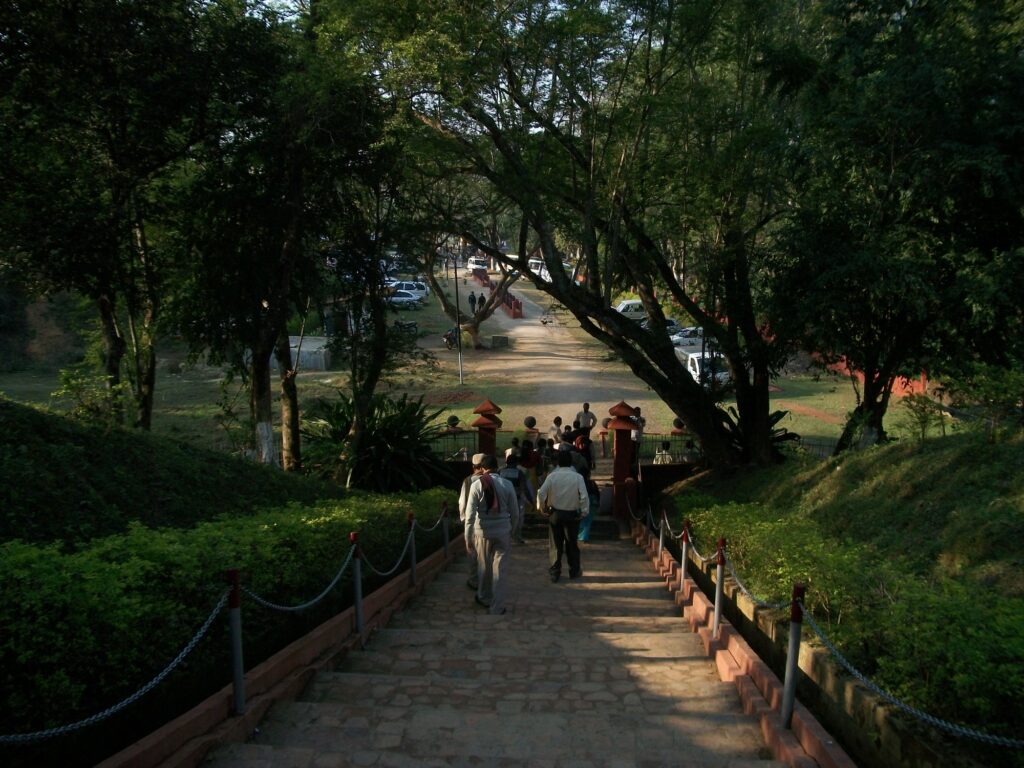
Charaideo lies in the Charaideo district of Upper Assam, about 28 km east of Sivasagar town and roughly 360 km east of Guwahati. The cluster of moidams sits on gently rolling terrain at the foothills of the Patkai range, near the border with Nagaland. The Brahmaputra valley around Charaideo is rich in alluvial farmland — exactly the kind of country the Ahoms preferred for capitals.
Topography
The protected area covers about 95 hectares and contains 90 visible moidams, of which 30 are royal (containing kings and queens). Many smaller mounds were destroyed or eroded over centuries.
The Tai-Ahom Kingdom
The Ahom kingdom was founded in 1228 by Sukapha, a Tai prince who crossed the Patkai range from Mong Mao (in present-day Yunnan-Myanmar borderland) with about 9,000 followers. Sukapha’s descendants ruled the Brahmaputra valley for nearly 600 years — one of the longest dynastic continuities in Indian history — until British annexation in 1826 under the Treaty of Yandabo that ended the First Anglo-Burmese War.
Sukapha and the Founding
Sukapha founded the first Ahom capital at Charaideo in 1253. The location’s significance is exactly why Charaideo became the dynastic burial ground even after later kings moved the political capital to Garhgaon, Rangpur and Jorhat.
Ahom Achievements
- Defended Assam against 17 Mughal invasions; their general Lachit Borphukan famously defeated Aurangzeb’s forces at the Battle of Saraighat (1671) on the Brahmaputra
- Built the Paik system — universal labour conscription that mobilised the entire male population for state service
- Maintained the Buranji tradition — chronicles in Ahom and Assamese that are among the most reliable medieval historical sources from anywhere in India
- Engineered embankments, tanks, roads and large monuments
Conversion and Assimilation
Initially animists practising Tai religion with its own pantheon, the Ahoms gradually assimilated into the Brahmaputra valley’s Hindu-Vaishnav culture during the 17th and 18th centuries — but never lost their distinct Tai identity, language, script and ritual practices, which still survive in pockets.
What is a Moidam
A moidam is a pyramidal earthen mound built over a vaulted brick chamber that holds the body of an Ahom royal along with grave goods — gold ornaments, ceremonial weapons, royal regalia, food, even retainers in earlier centuries. The structure combines a hemispherical or pyramidal earthen tumulus on top, a brick burial chamber inside, an octagonal boundary wall around the base, and a sacred gateway.
Components of a Moidam
- Tok — the underground vaulted brick chamber containing the body and grave goods
- Garbh-griha — the inner sanctum within the chamber
- Mound — the conical earthen tumulus that covers the chamber and gives the moidam its visual form
- Chow-chali — an entrance pavilion sometimes built at the base of the mound
- Octagonal wall — surrounds the entire structure and demarcates the sacred enclosure
Construction
Moidams were built rapidly after a royal death. Earth was piled over a brick chamber, faced with sun-dried and later kiln-fired bricks, and topped with a small shrine. Some of the larger moidams reach 30 metres in height.
Royal Grave Goods and Suttee-like Practices
Earlier Ahom moidams sometimes contained living retainers, queens, attendants, horses, elephants and gold ornaments, buried with the king. This practice was abolished by King Rudra Singha (r. 1696-1714) and the later Vaishnav-influenced rulers, after which only inanimate grave goods were placed.
Significance and OUV
UNESCO recognised the Moidams of the Tai-Ahom kingdom under Criteria (iii), (iv) and (vi) for “Outstanding Universal Value” because they represent:
- An exceptional six-century tradition of pyramidal royal funerary architecture
- A distinctive Tai cultural heritage that survived in isolation in the Brahmaputra valley
- The cosmological and animist worldview of the early Ahoms preserved in spatial and architectural form
- A living tradition — the descendants of the Ahom royal family still perform annual Me-Dam-Me-Phi ancestor-worship rituals at Charaideo
Comparison with Other Pyramidal Funerary Sites
| Site | Civilisation | Period | UNESCO |
|---|---|---|---|
| Giza Pyramids | Egyptian | 2600-2500 BCE | 1979 |
| Teotihuacan | Mesoamerican | 1-450 CE | 1987 |
| Imperial Tombs (Ming-Qing) | Chinese | 1368-1912 | 2000 |
| Moidams of Tai-Ahom | Tai-Ahom | 1228-1826 | 2024 |
The Moidams are the most recent (and youngest) of the major pyramidal funerary traditions to enter the World Heritage List.
Threats and Conservation
Encroachment
Some moidams outside the core protected zone were levelled by farmers in earlier decades. The 2024 inscription has tightened legal protection.
Vegetation
Tropical vegetation aggressively colonises the mounds; without periodic clearance the bricks are dislodged by roots.
Climate
Heavy monsoon rainfall erodes the earthen mounds. Drainage and minimal-intervention conservation are now in force.
The Archaeological Survey of India (ASI) and the Assam State Archaeology Department jointly manage the site under the buffer-zone framework agreed with UNESCO. A central Site Management Plan was finalised in 2023, two years ahead of the inscription decision.
India’s UNESCO World Heritage List
With the Moidams’ inscription, India now has 43 UNESCO World Heritage Sites — 35 cultural, 7 natural, and 1 mixed (Khangchendzonga). India is fifth in the world by number of inscriptions, after Italy, China, Germany, France and Spain. Recent additions include:
- Santiniketan (West Bengal) — 2023
- Sacred Ensembles of the Hoysalas — 2023
- Moidams of the Tai-Ahom (Assam) — 2024
For broader cultural context see our notes on the Ajanta caves and the Bhakti movement.
Living Tradition: Me-Dam-Me-Phi
Every 31 January, Ahom community organisations perform Me-Dam-Me-Phi — a festival to honour ancestors — at Charaideo and across Upper Assam. Rituals include offering rice, fish, betel and animal sacrifices (traditionally) to the spirits of departed kings and ancestors. The festival is one of the strongest pieces of evidence that the Tai-Ahom religion is a living tradition.
Frequently Asked Questions
What are the Moidams of the Tai-Ahom kingdom?
The Moidams are pyramidal royal burial mounds built by the Ahom rulers of Assam between 1228 and 1826. They consist of an underground brick chamber covered by a conical earthen mound and surrounded by an octagonal wall.
Where are the Moidams located?
The Moidams are at Charaideo in Upper Assam’s Charaideo district, about 28 km from Sivasagar town and 360 km east of Guwahati.
When were the Moidams of the Tai-Ahom inscribed by UNESCO?
The Moidams of the Tai-Ahom kingdom were inscribed at the 46th session of the UNESCO World Heritage Committee in New Delhi in July 2024 as India’s 43rd World Heritage Site.
Who founded the Ahom kingdom?
Sukapha (Chao Lung Siu-Ka-Pha), a Tai prince from the Mong Mao region, founded the Ahom kingdom in 1228 and established the first capital at Charaideo in 1253.
What is unique about the Moidams of the Tai-Ahom?
They represent a six-century pyramidal royal funerary tradition that combines indigenous Tai animism, later Hindu-Vaishnav influence, and is still a living cultural tradition through Me-Dam-Me-Phi rituals.
How many UNESCO World Heritage Sites does India have?
India has 43 UNESCO World Heritage Sites (as of 2025) — 35 cultural, 7 natural, and 1 mixed.
Who was Lachit Borphukan?
Lachit Borphukan was the Ahom general who defeated the Mughals at the Battle of Saraighat in 1671, halting Aurangzeb’s last serious push into the Brahmaputra valley.
What is Me-Dam-Me-Phi?
Me-Dam-Me-Phi is the Tai-Ahom ancestor-worship festival held annually on 31 January at Charaideo and across Upper Assam. It is the living ritual face of the Moidam tradition.
Tell Google you want more of this.
Add Anantam IAS as a preferred sourceOne tap, and this site shows up more often in your own Top Stories, AI Overviews and AI Mode. Remove it any time.