The Bhakti movement reshaped Indian religious life over roughly a thousand years. Beginning in the Tamil country around the sixth century with the Alvars and Nayanars, the Bhakti movement moved northward in waves and reached its fullest flowering between the fourteenth and seventeenth centuries in the Hindi heartland, Maharashtra, Bengal, Gujarat, and Punjab. It rejected priestly mediation, used regional languages instead of Sanskrit, opened devotional space to women and lower castes, and produced a literature of hymns, dohas, and abhangas that still shapes how most Hindus pray.
The Bhakti movement was not a single church or organised sect. It was a long current of personal devotion — bhakti meaning loving surrender to a chosen deity — that ran across different regions, languages, and theological positions. Some saints sang of god with form (Saguna), addressing Rama or Krishna as a real beloved. Others insisted god was without form (Nirguna), beyond all images. Both streams shared the same enemy: the ritual machinery of caste-bound brahmanism that kept ordinary people out of the temple.
This article reads the Bhakti movement with a UPSC History and Art-and-Culture lens. It traces the Tamil origins, the northward transmission through Ramananda’s disciples, the Saguna and Nirguna branches, the regional saints of Maharashtra and Bengal, the impact on language and social reform, and the parallels with the Sufi movement that ran alongside it.
Origins: Alvars and Nayanars in Tamil Country
The earliest Bhakti movement emerged in the Tamil region between the sixth and ninth centuries. Two streams of poet-saints flourished — the Alvars who worshipped Vishnu and the Nayanars who worshipped Shiva. The Alvars produced the Divya Prabandham, four thousand verses later canonised as a Tamil Veda. The Nayanars composed the hymns gathered in the Tevaram. There were twelve principal Alvars including Nammalvar and Andal — Andal being the only woman in the group, and the only female devotional poet to be enshrined in a major temple. There were sixty-three Nayanars including Appar, Sambandar, and Sundarar.
These saints walked from shrine to shrine, sang in Tamil rather than Sanskrit, came from every caste including untouchable communities, and addressed god in the intimate voice of a lover, a parent, or a friend. The Pallava and later Chola kings patronised the movement, built temples that became performance spaces for these hymns, and let the Alvar-Nayanar tradition shape south Indian temple culture permanently. In the eleventh and twelfth centuries the philosopher Ramanuja (traditionally dated 1017 to 1137) systematised this devotional theology as Vishishtadvaita — qualified non-dualism — providing the Bhakti movement with its first rigorous philosophical defence.
The Northward Spread
The Bhakti movement reached north India by a slow transmission that ran through Karnataka and Maharashtra. The Virashaiva or Lingayat tradition led by Basavanna in twelfth-century Karnataka rejected caste and temple ritual outright, producing the Kannada vachana literature. In Maharashtra the Varkari tradition centred on Pandharpur produced Jnaneshwar (Jnaneshwari, 1290), Namdev, Eknath, and Tukaram — saints who sang in Marathi abhangas.
The decisive northern figure was Ramananda in fifteenth-century Banaras. Ramananda accepted disciples from every caste and is credited with twelve principal followers including Kabir the weaver, Raidas the leather-worker, Sena the barber, Dhanna the farmer, Pipa the Rajput, and Sadhana the butcher. This deliberate cross-caste discipleship became the template for the entire north Indian Bhakti movement. Ramananda himself remained Saguna — devoted to Rama with form — but several of his disciples moved into Nirguna territory.
Saguna Bhakti: Devotion to God with Form
The Saguna stream of the Bhakti movement addressed god as a concrete personal presence — usually Rama or Krishna — and worshipped through image, story, and song. Its three towering figures in the north were Tulsidas, Surdas, and Meerabai.
Tulsidas
Goswami Tulsidas (c. 1532–1623) composed the Ramcharitmanas in Awadhi between 1574 and 1577. The Manas retells the Rama story in seven kandas modeled on Valmiki but recast as a manual of devotion accessible to anyone who could listen. Tulsidas also wrote the Vinaya Patrika, the Kavitavali, and the Hanuman Chalisa, which remains the most recited Hindu prayer in north India. By rendering Rama in Awadhi rather than Sanskrit, Tulsidas put the Ramayana within reach of farmers and weavers.
Surdas
Surdas (c. 1478–1583) was a blind saint of the Vallabha sampradaya in Braj. His Sursagar contains lakhs of pads on Krishna — the infant Krishna stealing butter, the youth playing the flute, the lover of the gopis. Surdas perfected the vatsalya bhava, parental devotion, and the madhurya bhava, the love of beloved for lover. His Braj Bhasha verses became the standard for Krishna devotion across north India.
Meerabai
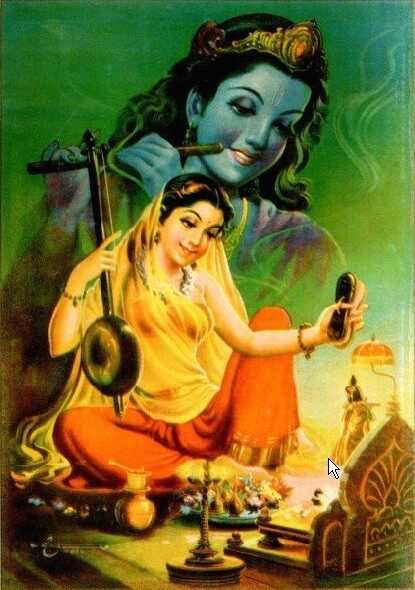
Meerabai (c. 1498–1547) was a Rajput princess of Merta who took Krishna as her divine husband and abandoned palace life for a wandering bhakti. Her padas, sung in Rajasthani and Brajbhasha, frame Krishna as her giridhar nagar — the holder of Mount Govardhan. Meera’s refusal of widow-remarriage norms, her open singing in public, and her rejection of the Mewar royal household made her the most defiant female voice in the Bhakti movement.
Nirguna Bhakti: Devotion to God without Form
The Nirguna stream rejected image worship, denied the relevance of caste and creed, and described god in negative terms — niranjan, nirakar, beyond all attributes. Its principal voices were Kabir, Guru Nanak, Dadu Dayal, and Raidas.
Kabir (c. 1440–1518), a Banaras weaver of Muslim background and Hindu discipleship, composed dohas and sakhis that ridiculed both temple priest and qazi. His verses survive in the Bijak, the Adi Granth, and the Kabir Granthavali. Guru Nanak (1469–1539) founded what became Sikhism on a Nirguna base, teaching one formless god, equal langar, and the three householder pillars of honest work, remembrance, and sharing. Dadu Dayal (1544–1603) in Rajasthan founded the Dadu Panth and continued Kabir’s syncretic line. Raidas (c. 1450–1520), a leather-worker disciple of Ramananda, wrote padas later canonised in the Adi Granth.
The Nirguna saints were structurally hostile to both Hindu and Muslim establishments. They borrowed the Sufi vocabulary of the inner heart, used the Hindu language of the satguru, and refused to belong fully to either tradition. This is why their followings often crystallised into new panths — Kabir Panth, Dadu Panth, Sikh Panth — rather than reforming the existing fold.
Regional Bhakti Traditions
Beyond the north Indian core, the Bhakti movement took strong regional shapes.
In Bengal, Chaitanya Mahaprabhu (1486–1533) launched the Gaudiya Vaishnava movement around ecstatic kirtan and the worship of Radha-Krishna. His followers — the six Goswamis of Vrindavan — built the theological infrastructure for what became the modern Krishna-consciousness world.
In Assam, Sankaradeva (1449–1568) founded the Ekasarana Dharma, a monotheistic Vaishnavism centred on Krishna, and produced the borgeet genre and the satra institution.
In Gujarat, Narsinh Mehta (1414–1481) wrote Vaishnava pads in Gujarati. His Vaishnav Jan To became Gandhi’s favourite bhajan.
In Maharashtra the Varkari saints — Jnaneshwar, Namdev, Eknath, Tukaram — sustained an unbroken tradition for four centuries, with the annual pilgrimage to Pandharpur still drawing lakhs.
In Kashmir, Lal Ded (Lalleshwari, fourteenth century) produced Shaivite vakhs that crossed easily into Sufi vocabulary.
Impact on Language and Literature
The Bhakti movement was the single most powerful force in the formation of modern Indian languages. Sanskrit had monopolised religious expression for a millennium. The Bhakti saints broke that monopoly. Tulsidas legitimised Awadhi, Surdas legitimised Braj, Meera legitimised Rajasthani, Tukaram legitimised Marathi, Chaitanya legitimised Bengali, Narsinh Mehta legitimised Gujarati, and Nanak legitimised Punjabi. Many of today’s Indian classical languages acquired their devotional core through Bhakti texts.
The literary forms invented or perfected by the Bhakti movement — doha, sakhi, pada, abhanga, bhajan, kirtan, vachana, borgeet — are still the living idiom of north and central Indian devotion. The Ramcharitmanas remains the most recited Hindi-belt text. The Sursagar shapes Krishna iconography. The Tukaram gatha is the everyday prayer of Maharashtra.
Social Reform and the Caste Question
The Bhakti movement was not a modern reform movement and should not be retrofitted as one. But its social effects were real. By admitting low-caste disciples — Kabir the Julaha, Raidas the Chamar, Sena the Nai, Dhanna the Jat — and by treating their utterances as sacred, the Bhakti saints created a parallel devotional space outside Brahminical control. By writing in vernaculars, they handed scripture to the unlettered. By centring on bhakti rather than karmakanda, they made caste-purity irrelevant to salvation.
Women too found access. Andal, Akka Mahadevi, Lal Ded, Meerabai, Bahinabai, Janabai, Mirabai — the Bhakti movement is the only premodern Indian tradition that produced a substantial body of female devotional poetry. None of this dismantled caste — that work would wait for the nineteenth and twentieth centuries — but it loosened the structure enough that lower-caste and female voices entered the canon and stayed there.
Bhakti and Sufi Parallels
The Bhakti movement and the Sufi movement ran in parallel across the same centuries and across the same north Indian geography. Both stressed personal love of god over external ritual. Both used regional languages — Sufis used Hindavi, Punjabi, Bengali. Both produced hagiographic literature. Both built shared shrines and shared audiences. Kabir explicitly draws on both Sant and Sufi vocabulary. Guru Nanak engages directly with Muslim interlocutors at Mecca. Dara Shukoh, the Mughal prince, translated the Upanishads under this synthesis.
This does not mean the two movements were the same. Sufis remained within Islam and within the silsila structure. Bhakti saints worked outside any single institutional fold. But the social space they opened — vernacular, personal, devotional, anti-clerical — was shared, and the encounter shaped Indian religious sensibility down to the present.
Decline and Legacy
The Bhakti movement did not die. It dispersed into the everyday religious life of India. The temple kirtan, the village bhajan mandali, the harikatha, the Pandharpur wari, the Vrindavan parikrama, the Sikh kirtan — these are the institutional afterlife of the medieval Bhakti movement. Modern reform movements from the Brahmo Samaj to Gandhi’s bhajan-centred ashrams drew on Bhakti vocabulary. The constitutional right to freedom of religion inherits, in part, the Bhakti insistence that god is accessible to every person regardless of caste, gender, or learning.
The Bhakti movement is, in this sense, the single most important religious development in the second millennium of Indian history.
Frequently Asked Questions
What is the Bhakti movement?
The Bhakti movement is a medieval Indian religious current that emphasised personal devotion to a chosen deity over priestly ritual. It ran from roughly the sixth century in the Tamil country to the seventeenth century in north India, producing saint-poets who composed in regional languages and admitted disciples across caste.
Who started the Bhakti movement?
The Bhakti movement is not traced to a single founder. Its earliest organised expression was the Alvars (Vishnu devotees) and Nayanars (Shiva devotees) of the Tamil country between the sixth and ninth centuries. Ramananda in fifteenth-century Banaras is credited with carrying it across north India.
What is the difference between Saguna and Nirguna Bhakti?
Saguna Bhakti worships god with form — Rama, Krishna, the deity in an image or temple. Tulsidas, Surdas, and Meerabai are Saguna saints. Nirguna Bhakti worships a formless, attributeless god, rejects image worship, and is often hostile to both temple and mosque. Kabir, Guru Nanak, and Dadu are Nirguna saints.
Who were the major saints of the Bhakti movement?
Major Bhakti movement saints include Andal and Nammalvar in Tamil Nadu, Basavanna in Karnataka, Jnaneshwar and Tukaram in Maharashtra, Ramananda, Kabir, Tulsidas, Surdas, Meerabai, and Raidas in north India, Chaitanya in Bengal, Sankaradeva in Assam, and Narsinh Mehta in Gujarat.
How did the Bhakti movement affect Indian languages?
The Bhakti movement was the principal force behind the literary formation of modern Indian languages. By writing devotional poetry in Awadhi, Braj, Marathi, Bengali, Gujarati, Punjabi, Kannada, and Tamil rather than Sanskrit, Bhakti saints gave these languages a high literary tradition that they have kept ever since.
What is the relationship between the Bhakti and Sufi movements?
The Bhakti movement and the Sufi movement ran in parallel across medieval India. Both emphasised personal love of god, used regional languages, and crossed religious boundaries. Saints like Kabir borrowed openly from both. Their parallel growth shaped a shared north Indian devotional sensibility, though Sufis remained within Islam and Bhakti saints often founded new panths.
Did the Bhakti movement reform caste?
The Bhakti movement did not abolish caste, but it loosened brahmanical monopoly over scripture and devotion. By admitting low-caste disciples, treating their compositions as sacred, and bypassing Sanskrit, Bhakti saints created a parallel devotional space where caste hierarchy carried less weight. Real legal-political caste reform came only with modern movements.
Why is the Bhakti movement important for UPSC?
The Bhakti movement is core to UPSC GS-I Art and Culture and Medieval History. Questions cover the Alvars-Nayanars, regional saints, Saguna-Nirguna split, language impact, social reform debates, and parallels with the Sufi movement. It also links to Indian society syllabus on caste, gender, and religious diversity.
Tell Google you want more of this.
Add Anantam IAS as a preferred sourceOne tap, and this site shows up more often in your own Top Stories, AI Overviews and AI Mode. Remove it any time.