Nagara shikhara early examples mark the moment when the curvilinear, beehive-shaped temple tower — the defining silhouette of north Indian Hindu architecture — first emerges as a coherent form. The Dashavatara temple at Deogarh in Uttar Pradesh, dated to the early sixth century CE, is the canonical first Nagara temple with a true shikhara, while the brick Bhitargaon temple in Kanpur district, the Mahua temple in Madhya Pradesh, and the Mundeshwari shrine in Bihar represent the experimental phase that led to it. Together these monuments show how the flat-roofed Gupta sanctuary of the 4th–5th centuries CE grew upward to become the soaring temple of the post-Gupta age.
For UPSC aspirants, Nagara shikhara early examples are central to Indian art and culture in Prelims, and to GS-I questions on temple architecture, regional schools and Gupta-period art. This article walks through the architectural definition of Nagara, the experimental brick and stone shrines that preceded Deogarh, and the diagnostic features that mark the first true shikharas.
Quick Facts on Early Nagara Temples
- Period: Late Gupta and post-Gupta, c. 450–650 CE
- Defining feature: Curvilinear shikhara over the garbhagriha
- First true Nagara shikhara: Dashavatara temple, Deogarh (early 6th c.)
- Brick precursor: Bhitargaon temple (c. 5th c.), Kanpur Dehat district, UP
- Stone precursors: Mahua temple (Shivpuri, MP); Mundeshwari (Kaimur, Bihar)
- Plan introduced at Deogarh: Panchayatana (main shrine + four corner sub-shrines)
- Shikhara type: Latina (single curved tower with central spine)
- Crowning element: Amalaka (notched stone disc) topped by kalasha
What Defines a Nagara Temple
The Nagara style, named in the Shilpa-shastras alongside its southern counterpart Dravida and the hybrid Vesara, is characterised by:
- A square garbhagriha (sanctum)
- A curvilinear shikhara that rises in a smooth parabolic curve
- An amalaka (notched stone disc) and kalasha (pot finial) at the top
- Vertical bands or rathas projecting from the centre of each face
- A mandapa in front, often pillared
- A high adhishthana (plinth)
- The whole temple raised on a jagati platform
The earliest temples in northern India — at Sanchi (Temple 17), Tigawa, Eran and Udayagiri — are simple flat-roofed cubical shrines. They have square sanctums and pillared porches but no shikhara. Nagara shikhara early examples are the buildings where this flat roof grows into a tower.
From Flat-Roof to Tower
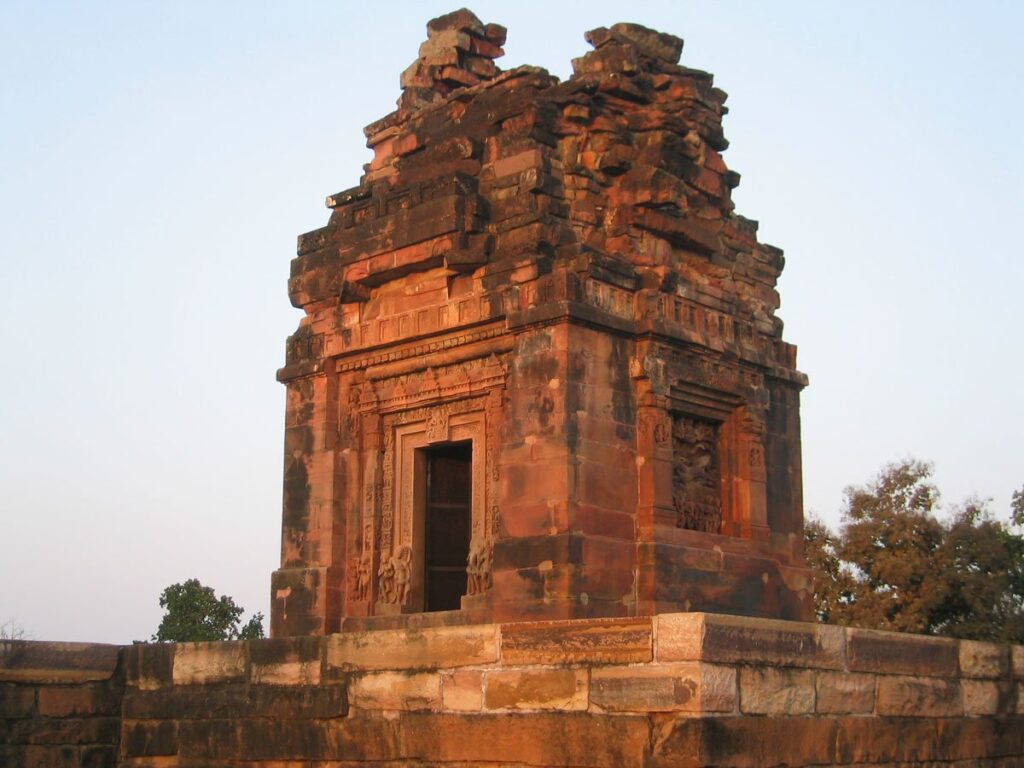
The transition is not abrupt. The 5th-century brick shrine at Bhitargaon already has a tall tower, though its precise original profile is debated. Stone experiments at Mahua and Mundeshwari follow. By the early 6th century, the Dashavatara temple at Deogarh stands as a fully realised early Nagara shikhara, even though only its lower stages survive.
Bhitargaon: The Brick Precursor
The Bhitargaon temple in Kanpur Dehat district (Uttar Pradesh) is the tallest surviving brick temple of the Gupta period. Built in the late 5th century, it consists of a square sanctum on a high terraced platform, with a tall tower above. The tower is steeply pyramidal and may anticipate the curvilinear shikhara.
Bhitargaon’s significance for Nagara shikhara early examples is threefold:
- It is one of the earliest surviving towered Hindu shrines in north India
- It demonstrates that brick architecture was a serious medium before stone took over
- Its terracotta sculptural panels depicting Vishnu, Shiva and river goddesses establish the iconographic programme later carried into stone temples
Why Brick Matters
The Gangetic plain lacks the easily quarried sandstone of central India, so early builders used kiln-fired bricks. Bhitargaon shows that brick could be moulded into tall, decorated forms — but brick is poorly suited to the heavy ribbed amalaka and projecting rathas of the mature Nagara shikhara. The shift to stone in the post-Gupta period made the full Nagara form possible.
Mahua and Mundeshwari: Stone Experiments
The Mahua temple in Shivpuri district of Madhya Pradesh, dated to around 600 CE, is a small but complete Pratihara-period shrine that shows an early curvilinear superstructure in stone. Its shikhara, though modest, has the unmistakable inward curve and the amalaka finial of the Nagara style.
The Mundeshwari temple at Ramgarh in Bihar’s Kaimur district, dated to the late 6th or early 7th century, is octagonal in plan — an unusual experiment — but its sculpture and proportions clearly anticipate developed Nagara. Some scholars treat it as a transitional monument between flat-roofed Gupta shrines and full Nagara temples.
These two structures matter because they are complete or near-complete early stone shrines, allowing us to read the full vertical programme that is missing from Bhitargaon and damaged at Deogarh.
Deogarh Dashavatara Temple: The Canonical First Nagara
The Dashavatara temple at Deogarh in Lalitpur district, Uttar Pradesh, dated to around 500–525 CE, is the most celebrated of Nagara shikhara early examples. It stands on a high jagati platform, with a square sanctum and, originally, a curvilinear shikhara rising above. The shikhara is partially preserved — enough to confirm it was the earliest standing latina form.
Three features make Deogarh foundational:
1. The Panchayatana Plan
Deogarh introduces the panchayatana layout — a main shrine with four subsidiary shrines at the corners of the jagati. This becomes a recurring template for later Nagara temples, including Khajuraho.
2. The Latina Shikhara
The shikhara at Deogarh is of the latina type — a single, unbroken curvilinear tower with a vertical central spine (latina meaning “creeper-like”). This is the parent form from which the multi-spired sekhari and the clustered bhumija sub-types later evolve at Khajuraho and central India.
3. The Narrative Panels
The plinth of Deogarh carries three masterpiece narrative panels: Anantashayi Vishnu (Vishnu reclining on Sheshanaga), Gajendra Moksha (the salvation of the elephant), and Nara-Narayana. These sculptural panels set the standard for Gupta classicism and show how iconography matured alongside architecture.
Diagnostic Features of Early Nagara Shikharas
To identify early Nagara shikhara examples in UPSC questions, look for:
- Curvilinear, not pyramidal, profile — the silhouette curves inward toward the top
- Latina (single-spined) tower — multi-spired sekhari and clustered bhumija are later developments
- Amalaka — large notched disc near the apex
- Kalasha — pot finial above the amalaka
- Three to five projecting rathas on each face (trivanga or panchavanga)
- No vimana-pyramid with stepped storeys (that is Dravida)
- Square sanctum with single doorway
- Garbhagriha without circumambulatory passage in the earliest examples
How Early Nagara Differs from Mature Nagara
Early examples are modest in height, latina in type, single-spined, with little surface ornament beyond doorway sculpture. Mature Nagara temples at Khajuraho, Bhubaneswar and Modhera are multi-spired, densely sculptured, and stand on elaborate jagatis with multiple mandapas. The progression from Deogarh to the Lakshmana temple at Khajuraho is a six-century journey from prototype to perfection.
Regional Spread of Early Nagara
Although Deogarh is in the central Ganga basin, early Nagara shikhara examples spread across north and central India:
- Madhya Pradesh: Mahua, Sanchi, Tigawa, Eran (earliest experiments)
- Uttar Pradesh: Deogarh, Bhitargaon
- Bihar: Mundeshwari, Nalanda shrines
- Rajasthan: Charchoma, Tala (early experiments in stone)
- Odisha: Parasurameshvara at Bhubaneswar (mid-7th c.) marks the eastern Nagara stream
Each region eventually developed its sub-style: central Indian Khajuraho-Bundelkhand, eastern Kalinga (Odisha), western Solanki (Gujarat), and Pratihara-Pala sub-traditions.
Significance for UPSC
Nagara shikhara early examples appear repeatedly in UPSC contexts because they:
- Establish the Hindu temple type for the entire north Indian tradition
- Mark the transition from late Gupta to post-Gupta art
- Introduce the panchayatana plan and latina tower
- Show the shift from brick to stone as the dominant medium
- Anchor the classicism of Gupta art in standing monuments
Frequently Asked Questions
What is a Nagara shikhara?
A Nagara shikhara is the curvilinear, beehive-shaped temple tower of north Indian Hindu architecture, distinguished from the pyramidal Dravida vimana of the south and the hybrid Vesara of the Deccan. It rises over the garbhagriha in a smooth inward curve, topped by an amalaka and kalasha.
Which is the earliest Nagara temple with a true shikhara?
The Dashavatara temple at Deogarh (Lalitpur district, Uttar Pradesh), built around 500–525 CE in the late Gupta period, is widely regarded as the earliest standing temple with a true Nagara latina shikhara.
What is the Bhitargaon temple known for?
Bhitargaon, in Kanpur Dehat district of Uttar Pradesh, is the tallest surviving brick Hindu temple from the Gupta period. Its tall pyramidal tower and terracotta panels of Vishnu and river goddesses make it the most important brick precursor of Nagara shikhara.
What is the panchayatana plan?
The panchayatana is a temple plan with one main shrine in the centre of a raised platform and four subsidiary shrines at the four corners. Deogarh is the earliest known example, and the form became standard in mature Nagara temples.
What is a latina shikhara?
A latina shikhara is the simplest type of Nagara tower — a single, unbroken curvilinear tower with a vertical central spine. Later multi-spired sekhari and clustered bhumija types evolved from it. Deogarh’s tower is latina.
Why are Mahua and Mundeshwari important?
The Mahua temple in Madhya Pradesh and the Mundeshwari shrine in Bihar are early post-Gupta stone temples whose complete or near-complete superstructures preserve the curvilinear Nagara profile, filling the gap between Bhitargaon’s brick prototype and the developed Deogarh form.
What sculptures decorate the Dashavatara temple at Deogarh?
Three plinth panels are world-famous: Anantashayi Vishnu (Vishnu reclining on the serpent Shesha), Gajendra Moksha (the elephant’s salvation), and Nara-Narayana. They are masterpieces of Gupta classical sculpture.
How do early Nagara temples differ from mature Khajuraho temples?
Early examples like Deogarh are small, latina-type, single-spined, on modest jagatis with limited ornament. Mature Khajuraho temples are tall, sekhari-type, multi-spired, on elaborate platforms with dense sculptural friezes, multiple mandapas, and a far more developed iconographic programme.
Tell Google you want more of this.
Add Anantam IAS as a preferred sourceOne tap, and this site shows up more often in your own Top Stories, AI Overviews and AI Mode. Remove it any time.