Disclosure: this guide contains Amazon affiliate links. As an Amazon Associate, Anantam IAS earns from qualifying purchases — at no extra cost to you.
The Nitin Singhania economy book can become another unfinished source if you start with policy names before understanding money, income and prices. I’d use it as your main economy reference only if you need a structured text and are ready to practice alongside it. If your existing book already helps you explain these concepts, keep that book and repair the gaps.
For an owner, the useful goal is smaller than “finish everything”: turn each topic into an explanation, a question you can answer and an update you can check. Start with the concept chapters, then connect them to policy. The inflation exercise below gives you a model to repeat.
Identify Your Copy
The relevant economy title is Courseware on Indian Economy by Nitin Singhania. It is separate from his art and culture book. McGraw Hill’s listing identifies:
- 7th edition, published April 27, 2026.
- ISBN 9789364449724 for the English title discussed here.
- A contents list that includes national income, banking, inflation, public finance and the external sector.
The publisher advertises videos, computer-based practice and an eBook. Treat these as advertised extras: check activation requirements, validity and whether a used copy’s access has already been redeemed before buying. Reading this guide doesn’t require digital access.
If you need a new copy, compare the ISBN with the English courseware listing on Amazon. A familiar author’s name alone won’t identify the edition or language.
Decide Whether It Fits
Keep this as your main text if you can follow a short section and explain its mechanism without copying the sentences. Buy it when you need a main reference and its sample language suits you. Skip an additional economy book when your main difficulty is insufficient recall or question practice.
- New to economics: begin with basic concepts and national income. If terms keep stopping you, revisit a foundation explanation before adding more material.
- Already using another reference: use our economy book selection guide to decide whether replacement solves a real gap.
- Using Ramesh Singh: keep your existing notes and use the Ramesh Singh reading guide before rebuilding your entire source list.
A broad contents list gives you places to look. It doesn’t establish that you can solve unfamiliar statements or write a reasoned GS3 answer.
Build A Concept-To-Policy Map
Read prerequisite topics before you collect policy examples. The numbers below refer to the publisher’s seventh-edition contents; use the topic names if you own another edition. The study tasks are suggested exercises, not descriptions of the book’s questions.
| Reading cluster | Chapters in this edition | Output from your session |
|---|---|---|
| Income and development | 1-3 | Explain why rising output doesn’t by itself prove better health or education |
| Money, banking and prices | 4, 5 and 9 | Draw a credit-to-spending chain and calculate an inflation example |
| Taxes and public finance | 10-11 | Separate government borrowing from revenue receipts |
| Agriculture and food | 16-20 | Trace one supply problem from production to household prices |
| External sector | 31-33 | Separate trade flows, financial flows and exchange-rate changes |
| Development applications | 35-40 | Link a policy proposal to its benefit, cost and implementation limit |
Don’t make a second copy of the chapter. Write the missing connection. For example, after banking, ask how costlier credit might change a business’s investment decision. After food management, ask why a supply disruption can raise prices even when household demand hasn’t increased.
Make An Inflation Revision Card
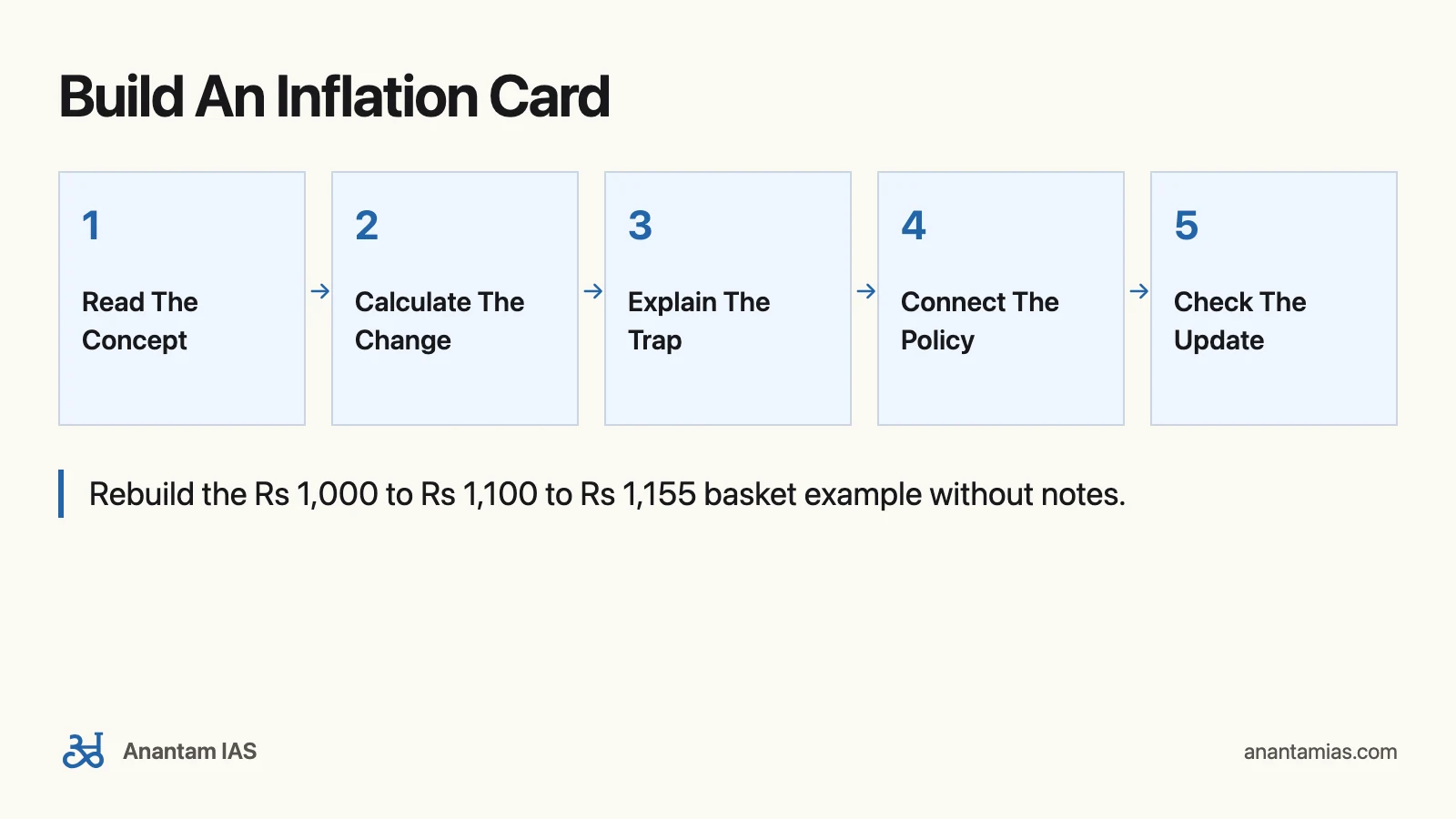
An inflation card should distinguish a price level from its rate of change. This is an original practice example, using an invented basket. It isn’t a UPSC PYQ or a reconstruction of India’s CPI.
Assume the same fixed basket costs Rs 1,000 in Year A, Rs 1,100 in Year B and Rs 1,155 in Year C. We keep the basket and quantities unchanged so we can isolate price changes.
- From A to B, the increase is Rs 100. Inflation = 100 / 1,000 x 100 = 10%.
- From B to C, the increase is Rs 55. Inflation = 55 / 1,100 x 100 = 5%.
- Inflation has fallen by 5 percentage points. The basket still costs Rs 55 more than in B.
- This is disinflation: prices are rising more slowly. Deflation would require a fall in the general price level.
The likely mistake is “inflation fell, so the basket became cheaper.” Our calculation shows exactly why that fails. Falling speed doesn’t mean you have reversed direction.
Now add a policy connection. A rise in the policy repo rate can make credit and spending less attractive through monetary transmission. It cannot directly produce an extra harvest after crop damage. The actual effect depends on the shock, bank pricing and borrowers’ responses. Use the RBI’s monetary policy explanation for the basic mechanism; check a current RBI statement separately for present rates and decisions.
Your card should contain:
- Definition: the rate of change in the price level.
- Calculation: 55 / 1,100 x 100 = 5%.
- Trap: lower inflation can coexist with higher prices.
- Application: separate a demand problem from a supply problem before choosing a policy explanation.
- Update field: index, period, release date and source for any real inflation figure you add.
Close the book and reproduce the reasoning. If you remember the answer but can’t explain the denominator, return to the example before doing more questions.
Use A Flexible Study Routine
A session should end with something you can retrieve tomorrow. Choose its size according to the time and background you actually have.
| Available time | Suggested session |
|---|---|
| 25 minutes | Read one small concept, explain it aloud and write one trap |
| 50 minutes | Add a worked example and a few relevant practice questions |
| 90 minutes | Add a verified official update and a short analytical paragraph |
For each cluster, use three passes: understand the mechanism, solve questions without the page open, then repair the errors. Extend a difficult cluster instead of forcing every chapter into the same daily quota.
Keep current figures on a separate sheet. The book can explain the framework while the Union Budget documents supply dated fiscal material. Label a number as a Budget Estimate, Revised Estimate or actual wherever the source does. Updating a number doesn’t require rewriting the underlying definition.
Know When To Stop Adding Sources
The courseware’s breadth needs selective revision. Digital features don’t remove the need to explain concepts unaided, and printed data can age between editions. A chapter on an emerging topic also doesn’t substitute for a current official policy document.
Before you buy a second economy text, complete one inflation card and one public-finance card from the book you own. If you can explain both, spend the next session on application. If you can’t, repair that specific concept first.
Frequently Asked Questions
Which Nitin Singhania economy edition does this guide use?
It uses the publisher-listed seventh edition of Courseware on Indian Economy, ISBN 9789364449724. Check your copy before using its chapter numbers.
Should I replace my existing economy book?
Replace it only if you have a specific unresolved gap and the sample explanation suits you better. If recall or question practice is the problem, improve that first.
Do I need digital courseware for this reading plan?
No. The worked exercise and study routine use ordinary reading and recall. The publisher advertises digital extras; activation and access conditions should be checked for your copy.
Does falling inflation mean prices are falling?
No. In the invented example, inflation falls from 10% to 5% while the basket becomes more expensive. The general price level falls under deflation.
Can I use an older edition?
You can retain concepts you understand, but check policies, rules and dated figures separately. Use topic names because the seventh-edition chapter references may not match your copy.
Tell Google you want more of this.
Add Anantam IAS as a preferred sourceOne tap, and this site shows up more often in your own Top Stories, AI Overviews and AI Mode. Remove it any time.