Disclosure: this guide contains Amazon affiliate links. As an Amazon Associate, Anantam IAS earns from qualifying purchases — at no extra cost to you.
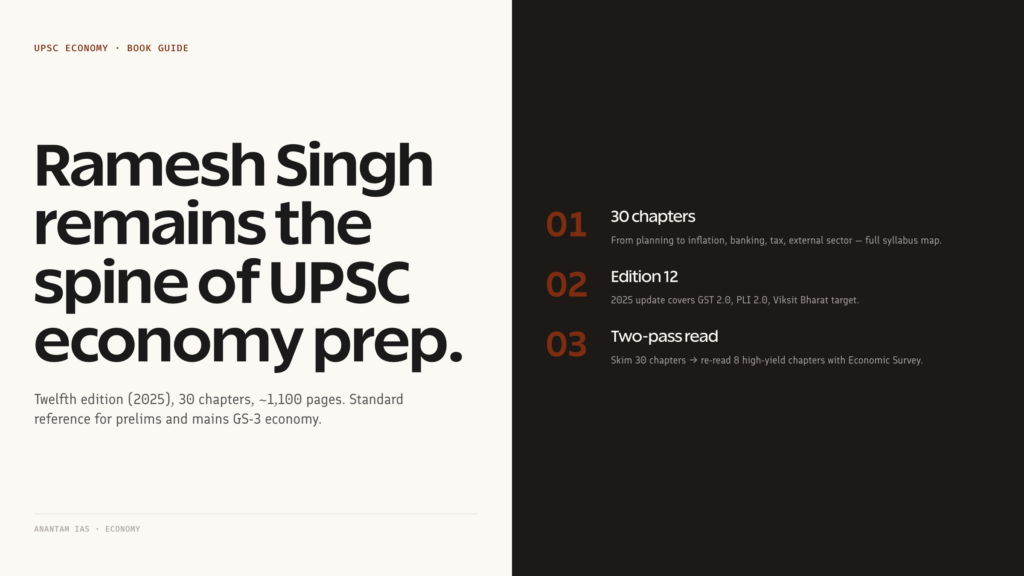
If you're starting Mains GS3 economy, Indian Economy by Ramesh Singh is the standard. Not Sanjeev Verma. Not Mishra & Puri. Not even NCERT — although NCERT remains the foundation. The 18th edition (2026-27) released in early 2026 is the current version, published by McGraw-Hill, and clocks in at roughly 850 pages. It's dense. It's repetitive in places. It updates every year with the latest Economic Survey and Union Budget. And honestly, no other Mains-targeted book covers public finance, banking, external sector, and inflation with this level of structured rigour. This explainer breaks down the chapters, the key concepts you must extract, and a tested 8-week reading strategy.
What is Indian Economy by Ramesh Singh?
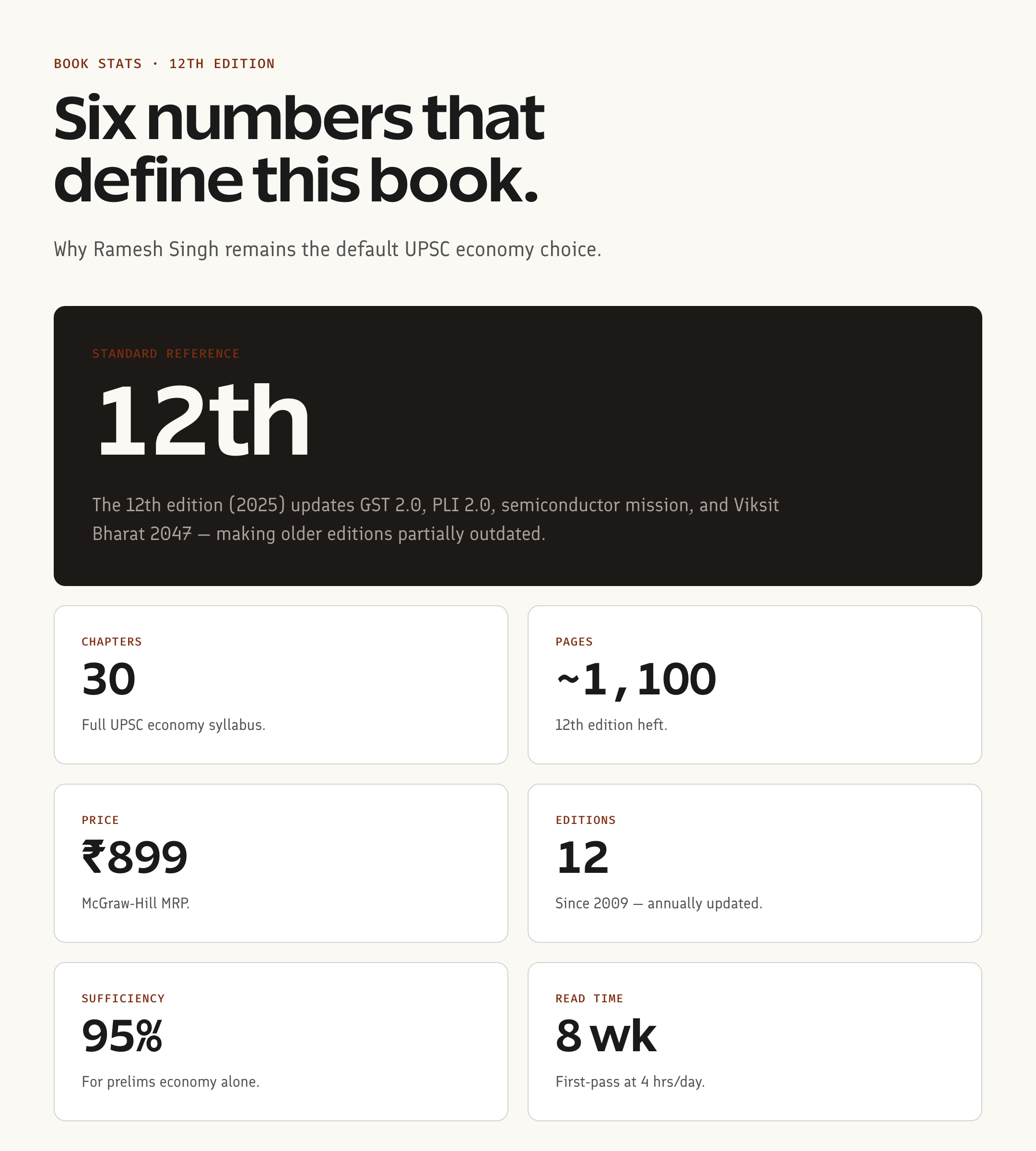
Indian Economy by Ramesh Singh is the standard reference book for UPSC Civil Services Examination Mains GS3 (economy) and Prelims (economy section). Published by McGraw-Hill Education, the 18th edition (2026-27) is the current version — updated with Economic Survey 2025-26, Union Budget 2026-27, and recent policy changes. It covers 21 chapters across roughly 850 pages, from National Income to Sustainability. Ramesh Singh is a Delhi-based economics educator with two decades of UPSC training experience.

Indian Economy — Ramesh Singh (18th Edition)
- McGraw Hill courseware edition, 624 pages
- Concept-first treatment of growth, banking, fiscal policy and external sector
- Includes Economic Survey and Union Budget coverage
- Latest edition — 18th edition (2026-27), released early 2026 — updated with Economic Survey 2025-26 and Union Budget 2026-27.
- Total chapters — 21 chapters, approximately 850 pages.
- Best use — UPSC Mains GS3 (Indian economy), Prelims economy MCQs, and as a reference for Economic Survey concepts.
Why Ramesh Singh became the standard
Look, the Mains GS3 syllabus on economy has roughly 20 sub-topics — growth, planning, inclusive growth, agriculture, industry, services, banking, public finance, inflation, fiscal federalism, external sector, GST, sustainability. Three sources cover all of them comprehensively: Mishra & Puri (academic), Datt & Sundharam (older standard), and Ramesh Singh (UPSC-focused).
Ramesh Singh wins on three counts:
- Annual updates — every edition incorporates the latest Survey and Budget.
- UPSC framing — concepts explained with Mains question structure in mind.
- PYQ alignment — recent PYQs are mapped to chapters in the 17th and 18th editions.
I'd hedge on one thing — Ramesh Singh is not a substitute for the Economic Survey. Read the book first to build conceptual scaffolding, then read Survey volumes for current data and policy nuance. Skipping Survey is a mistake every coaching student eventually pays for.
Chapter-by-chapter — what each chapter actually contains
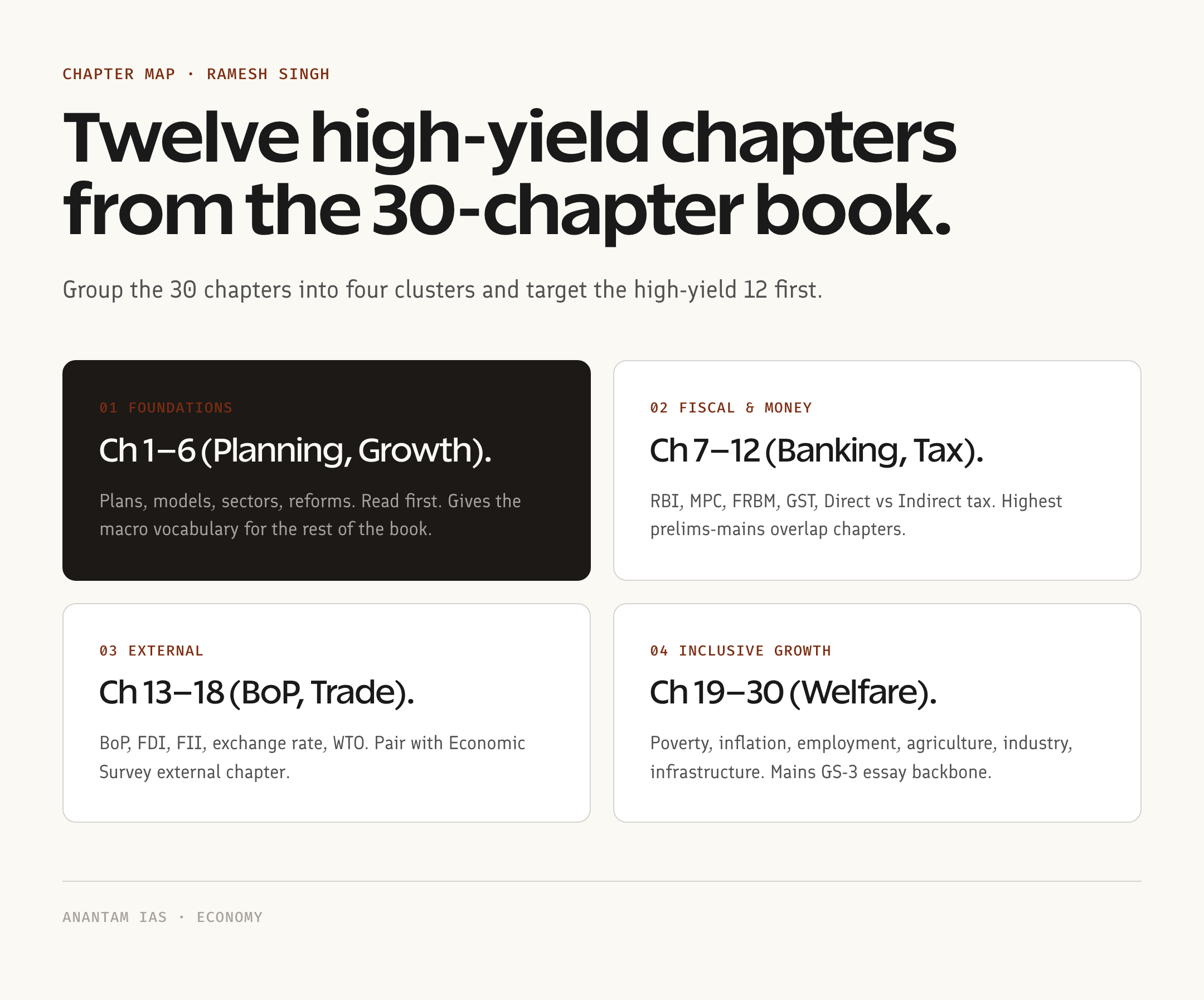
Here's the 18th edition chapter list with what you should extract from each.
Chapter 1 — Introduction to Economics. Microeconomics vs macroeconomics. Production, consumption, distribution. Market vs command economy. Skim if you've done Class 11 NCERT.
Chapter 2 — National Income. GDP, GNP, NNP, NDP, NI, Personal Income, Disposable Income. GVA, GVO. Base year, deflators, CPI, WPI. Read this chapter twice. Critical for Prelims and Mains.
Chapter 3 — Growth, Development and Happiness. Sen vs Bhagwati debate. HDI, GHI, GII, MPI, World Happiness Report. Inclusive growth definition. Sustainable Development Goals.
Chapter 4 — Evolution of the Indian Economy. Pre-1947, post-Independence model, License Raj, ISI strategy, 1980s reforms, 1991 LPG reforms. Foundation chapter. Read fully.
Chapter 5 — Economic Planning. Planning theory, types of planning, Indian planning models — Harrod-Domar, Mahalanobis, Sukhamoy Chakravarty, Gadgil. Memorise the models.
Chapter 6 — Planning in India. All twelve Five-Year Plans, targets, achievements. NITI Aayog framework. Read NITI Aayog for institutional details.
Chapter 7 — Economic Reforms. First-generation reforms (1991-2000), second-generation (2000-2014), third-generation (2014 onwards). PLI schemes, GST, IBC, labour codes, Atmanirbhar Bharat.
Chapter 8 — Inflation and Business Cycle. CPI, WPI, GDP deflator. Demand-pull, cost-push, structural inflation. RBI's flexible inflation targeting (4±2%). Phillips Curve. Read inflation for current 2026 data.
Chapter 9 — Agriculture and Food Management. Green Revolution, MSP, FCI, PDS, OWS, ONOR, FRP, PM-KISAN, eNAM, Pradhan Mantri Fasal Bima Yojana. Farmer protests, three farm laws (repealed 2021), MSP committee.
Chapter 10 — Industry and Infrastructure. Industrial Policy resolutions (1948, 1956, 1991), MSME definition, PLI schemes, Make in India, National Logistics Policy 2022, Gati Shakti.
Chapter 11 — Services Sector. IT-BPM, finance, tourism, gig economy, GIFT City, services trade balance. India captures 55% of global services outsourcing.
Chapter 12 — Indian Financial Market. Money market, capital market, primary vs secondary, SEBI, Stock Exchanges, derivatives, FPI/FDI distinction.
Chapter 13 — Banking in India. RBI structure, monetary policy tools (CRR, SLR, repo, reverse repo, MSF, OMO), MPC, bank nationalisation, NPA crisis, IBC, PSB privatisation.
Chapter 14 — Insurance in India. IRDAI, life vs general, FDI cap (now 100% for insurance from 2025-26), Pradhan Mantri Jeevan Jyoti Bima Yojana, Suraksha Bima Yojana, Atal Pension Yojana.
Chapter 15 — Security Market in India. SEBI, NSE/BSE, NIFTY/SENSEX, IPO/FPO, ESOP, derivatives, T+0 settlement, India INX in GIFT City.
Chapter 16 — External Sector in India. Balance of payments, exchange rate regimes, FDI, FPI, external commercial borrowings, FERA-FEMA transition, forex reserves.
Chapter 17 — International Economic Organisations and India. IMF, World Bank, WTO, ADB, NDB (BRICS), AIIB, G20, IMF Quota reform, India's role.
Chapter 18 — Tax Structure in India. Direct vs indirect, Income Tax slabs, Corporate tax (22%), GST (CGST, SGST, IGST), faceless assessment, Direct Tax Code drafts.
Chapter 19 — Public Finance in India. Fiscal deficit, revenue deficit, primary deficit, FRBM Act, fiscal federalism, Finance Commissions, GST Council.
Chapter 20 — Sustainability and Climate Change: India and the World. Paris Agreement, NDCs, COP outcomes, India's net-zero 2070 target, green budgeting, Mission LiFE, sovereign green bonds.
Chapter 21 — Miscellaneous. Black money, demonetisation, financial inclusion, JAM trinity, India Stack, digital economy, AI in economy, gig and platform workers… this chapter is where every "current affairs" topic eventually gets parked.
Key concepts you must extract — the 30-concept list
Don't read Ramesh Singh as a novel. Extract these 30 concepts and you've covered 80% of Mains GS3 economy.
- GDP, GNP, NNP, NDP, NI — definitions and differences
- GVA vs GDP at market prices
- Inflation indices — CPI, WPI, GDP deflator
- Phillips Curve, NAIRU
- Five-Year Plan models — Harrod-Domar, Mahalanobis
- NITI Aayog's three-tier framework
- LPG reforms — what L, P, G each did
- Goods and Services Tax — slabs, dual structure, council
- Insolvency and Bankruptcy Code — process, NCLT, IBBI
- Production-Linked Incentive schemes — 14 sectors
- Make in India and Atmanirbhar Bharat
- Monetary policy tools — repo, reverse repo, CRR, SLR, MSF
- Flexible inflation targeting — 4±2% band
- Open Market Operations and Liquidity Adjustment Facility
- Capital adequacy ratio (Basel III), NPA classification
- SEBI and stock market regulation
- Balance of payments structure — current, capital, errors
- FDI vs FPI distinction
- WTO disputes — TRIPS, agriculture, SCM
- Special Drawing Rights and IMF quotas
- Direct vs indirect taxes, tax buoyancy
- FRBM Act and fiscal glide path
- Finance Commission — vertical and horizontal devolution
- GST Council composition
- Doubling Farmers' Income strategy and CACP
- Gig economy and Code on Social Security 2020
- Climate finance — Adaptation Fund, GCF
- Sustainable Development Goals 2030
- Demographic dividend window — 2055
- India@2047 vision — $30 trillion target
How to read Ramesh Singh — the 8-week strategy
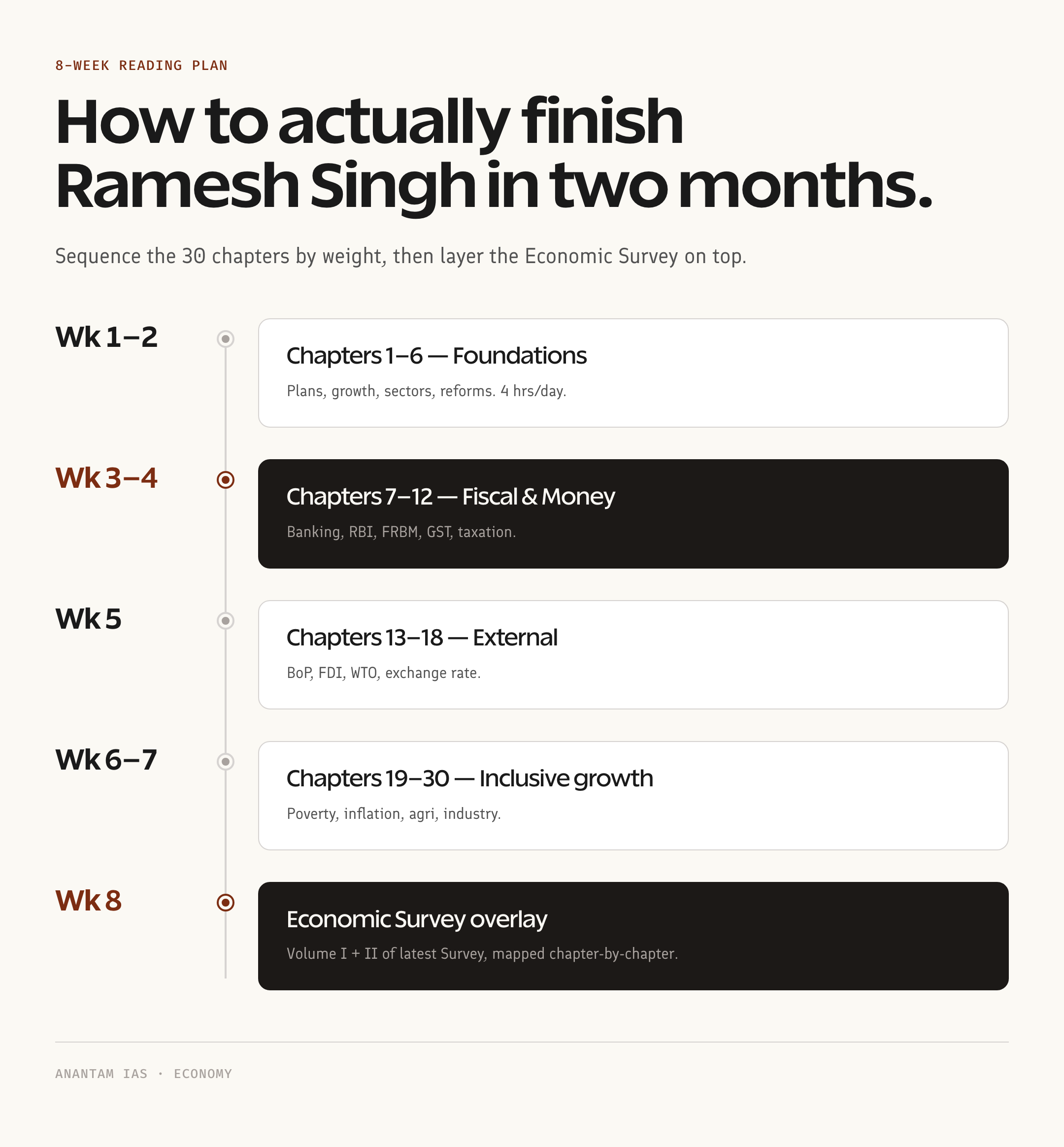
Don't read it cover-to-cover. Don't skim it either. Here's the schedule that actually works.
Week 1 — Foundation. Chapters 1, 2, 3. National Income concepts, growth/development distinction. 3 hours/day.
Week 2 — History and Planning. Chapters 4, 5, 6. Evolution of Indian economy, planning models, 12 FYPs, NITI Aayog. 3 hours/day.
Week 3 — Reforms and Inflation. Chapters 7, 8. LPG, reforms 2.0, 3.0. CPI/WPI, inflation targeting. 3 hours/day.
Week 4 — Sectors I. Chapters 9, 10. Agriculture and food, industry and infrastructure. 3 hours/day.
Week 5 — Sectors II + Finance. Chapter 11, 12, 13. Services, financial markets, banking. 3 hours/day.
Week 6 — Insurance + External. Chapters 14, 15, 16. Insurance, security market, external sector. 3 hours/day.
Week 7 — Tax and Public Finance. Chapters 17, 18, 19. International organisations, tax, fiscal. 3 hours/day.
Week 8 — Climate + Misc + Revision. Chapters 20, 21 + revise weak chapters. 3-4 hours/day.
Honestly, the trap is reading week 1 thoroughly and then losing momentum by week 4… happens to almost everyone. Set a hard "no skipping a week" rule and treat each chapter as a sprint, not a marathon.
Pair it with Economic Survey 2025-26 chapter-wise — read the Survey chapter after the corresponding Ramesh Singh chapter. That single move beats 80% of coaching students.
What to skip and what to add
Honestly, three chapters can be skimmed if you're tight on time:
- Chapter 1 (Introduction to Economics) — covered in Class 11 NCERT.
- Chapter 14 (Insurance) — Mains rarely touches this in depth.
- Chapter 15 (Security Market) — only key concepts (SEBI, T+0, GIFT City).
What you must add to Ramesh Singh:
- Economic Survey 2025-26 — both volumes, chapter-wise.
- Union Budget 2026-27 — speech + Annual Financial Statement.
- PIB Daily — for current schemes and data updates.
- NITI Aayog reports — gig economy, healthcare, demographic dividend.
- PRS India — Bill summaries (DPDP Act, Forest Conservation Amendment, etc.)
- Mrunal Patel video lectures — for budget and Survey decoding.
Why this book matters for UPSC
For Prelims, expect 4-6 questions per year directly from Ramesh Singh content — economic terminology, scheme details, policy facts.
For Mains GS3, the book provides the structural backbone for 50+ marks worth of answers — agriculture, industry, services, public finance, banking, external sector.
For Interview, the book provides factual confidence on macroeconomic indicators. PYQ board members frequently test inflation rates, fiscal deficit, GDP growth — all of which are in Ramesh Singh's Chapter 2 and Chapter 19.
Common misconceptions
Myth 1 — "Ramesh Singh alone is enough for Mains GS3." No. You also need NCERT Class 11 (foundation), Economic Survey (current), and selective newspapers (Indian Express, The Hindu). Ramesh Singh is necessary but not sufficient.
Myth 2 — "The latest edition is the 17th." As of early 2026, the 18th edition (2026-27) is the latest, released by McGraw-Hill in early 2026. The 17th (2025-26) is the previous edition.
Myth 3 — "Reading the PDF is the same as the print book." Reading flow matters. Print book + highlighter + margin notes works better for retention than PDF scrolling. If budget is tight, used 17th edition copies on OLX work fine — the core concepts haven't changed.
Myth 4 — "Mishra & Puri is better." Mishra & Puri is an academic textbook for economics graduates — heavier on theory, lighter on UPSC framing. For pure UPSC prep, Ramesh Singh wins… no contest at the UPSC level.
Well, one more — "I'll read both Sanjeev Verma and Ramesh Singh." Don't. Pick one as your primary. Use the other only to clarify a chapter you find unclear. Two parallel reads waste 200 hours a year.
How to revise Ramesh Singh in 30 minutes (revision pass)
After your full read, build:
- 30 concept flashcards (the list above).
- One-page macro snapshot with FY26 data — GDP, growth, inflation, fiscal deficit, CAD, forex, FDI.
- One-page table of 12 FYPs — period, theme, target, achievement.
- One-page reform timeline — 1991 → 2026, key milestones.
- PYQ map — last 10 years' GS3 economy questions mapped to Ramesh Singh chapters.
Revise these five sheets in 30 minutes once a week. That's the move.
Frequently Asked Questions
Which is the latest edition of Indian Economy by Ramesh Singh?
The 18th edition (2026-27) released by McGraw-Hill Education in early 2026 is the latest. It incorporates Economic Survey 2025-26 and Union Budget 2026-27.
How many chapters does Ramesh Singh's Indian Economy have?
21 chapters in the 18th edition, covering concepts, planning, reforms, sectors, banking, external sector, public finance, and sustainability across approximately 850 pages.
Is Ramesh Singh enough for UPSC Mains GS3?
No. Ramesh Singh is the backbone, but you also need NCERT Class 11 Indian Economic Development, Economic Survey 2025-26, Union Budget 2026-27, and current PIB releases.
How long does it take to read Indian Economy by Ramesh Singh?
About 8 weeks at 3 hours/day for a structured first read. Revision passes take 4-5 days each. Skim-and-extract pass takes 2 weeks.
What is the price of Indian Economy by Ramesh Singh?
The 18th edition (2026-27) retails at approximately ₹780-₹880 in print. McGraw-Hill also offers a courseware bundle with online video lectures and PYQs at higher pricing.
Where can I download Ramesh Singh Indian Economy PDF?
Authorised PDF is not freely available — McGraw-Hill sells it as a paid e-book on their portal. Free PDFs in circulation are typically older editions (15th, 16th) and may infringe copyright. For the latest content, buy the print or official courseware.
Should I read Ramesh Singh before or after the Economic Survey?
Read Ramesh Singh first to build conceptual scaffolding, then the Economic Survey for current data and policy nuance. Without the conceptual base, Economic Survey reads like a data dump. With it, the Survey snaps into place.
Tell Google you want more of this.
Add Anantam IAS as a preferred sourceOne tap, and this site shows up more often in your own Top Stories, AI Overviews and AI Mode. Remove it any time.