Disclosure: this guide contains Amazon affiliate links. As an Amazon Associate, Anantam IAS earns from qualifying purchases — at no extra cost to you.
The Vivek Singh economy book is useful only when reading turns into an explanation you can reproduce. If you keep confusing bank lending, money supply and policy rates, changing authors won’t automatically fix the confusion. I’d begin with a banking concept map and use Indian Economy as the reference for rebuilding it.
Keep the book if its explanations are understandable to you. Buy it if you need a main economy text and its sample pages suit your level. If you already have a workable main reference, spend your next session testing understanding before adding another book.
Check Edition And Language
Indian Economy by Vivek Singh is published by S Chand. The English publisher listing identifies the 10th edition, copyright 2026, with ISBN 9789373597003. Its contents include Fundamentals of Macroeconomics, two Money and Banking sections, Government Budgeting and Budget and Economic Survey.
A separate Hindi publisher listing identifies Bhartiya Arthvyavastha, also the 10th edition, with ISBN 9789373596273. Match the language and ISBN to your intended copy. Don’t assume that pagination or chapter references transfer between versions.
For a new English copy, check the verified Amazon listing. Economy MCQs 450 is a separate question-book listing; it shouldn’t be mistaken for the main text.
Choose One Main Reference
Use this guide to study a book you own or are considering as your main source. The economy book comparison handles the wider choice between authors. If you own Ramesh Singh, try the existing reading guide before abandoning it.
- Keep: the language works for you and your errors come from insufficient practice.
- Buy: you need a main text and can follow a sample explanation.
- Delay: several terms in each paragraph need a foundation lesson first.
- Skip the additional purchase: you are already revising another usable economy source.
Publisher descriptions can establish contents and format. They can’t establish which book will be easier for you personally. Try explaining one sample concept aloud before deciding.
Read In A Dependency Sequence
Start with macroeconomics, then money and banking, then budgeting. This makes later policy chapters easier to interpret because you already know the objects being changed. Use the topic names rather than a borrowed page-number schedule.
| Topic to locate | Study output | Check your understanding |
|---|---|---|
| Fundamentals of Macroeconomics | A nominal-versus-real output example | Can output value rise without output volume rising? |
| Money and Banking I and II | A policy-to-credit map | Can a policy rate change have uneven effects? |
| Government Budgeting | A receipts-and-expenditure sheet | Why is borrowing excluded from non-debt receipts? |
| Inclusive growth and subsidies | A benefit-and-cost explanation | Who benefits, who may be missed and who pays? |
| Agriculture and supply chains | A farm-to-market bottleneck map | Which constraint is price, storage or transport? |
| Budget and Economic Survey | A dated update sheet | Is the figure an estimate or an actual? |
You don’t need to finish all the application chapters before checking the foundation. If banking remains unclear, park that problem on your error sheet and repair it before using monetary policy in a Mains answer.
Work Through Banking Transmission
A repo-rate change can influence bank funding and lending decisions, but borrowers don’t all receive the same change immediately. The RBI’s monetary policy explanation gives the basic role of repo operations. Use it for concepts; get current rates from the latest official policy statement.
This original practice example simplifies loan pricing. It isn’t a UPSC question and it doesn’t describe a real bank product.
Suppose an imaginary bank prices a loan as benchmark rate plus a fixed spread:
- Benchmark: 6%.
- Spread: 3 percentage points.
- Initial lending rate: 6% + 3 percentage points = 9%.
- The benchmark falls to 5.75%, while the spread stays at 3 percentage points.
- At the next applicable reset, the model rate becomes 5.75% + 3 percentage points = 8.75%.
For a constant principal of Rs 1,00,000, ignoring repayments and compounding, annual simple interest changes from Rs 9,000 to Rs 8,750. The difference is Rs 250. This is an interest illustration, not an EMI calculation.
Now remove the assumptions one at a time:
- If the loan has a fixed rate, this reset rule doesn’t apply automatically.
- If a floating loan’s reset date hasn’t arrived, the change can appear later.
- If the spread changes, the final lending rate needn’t move by the full benchmark change.
- If a business expects weak sales, cheaper credit alone may not persuade it to expand.
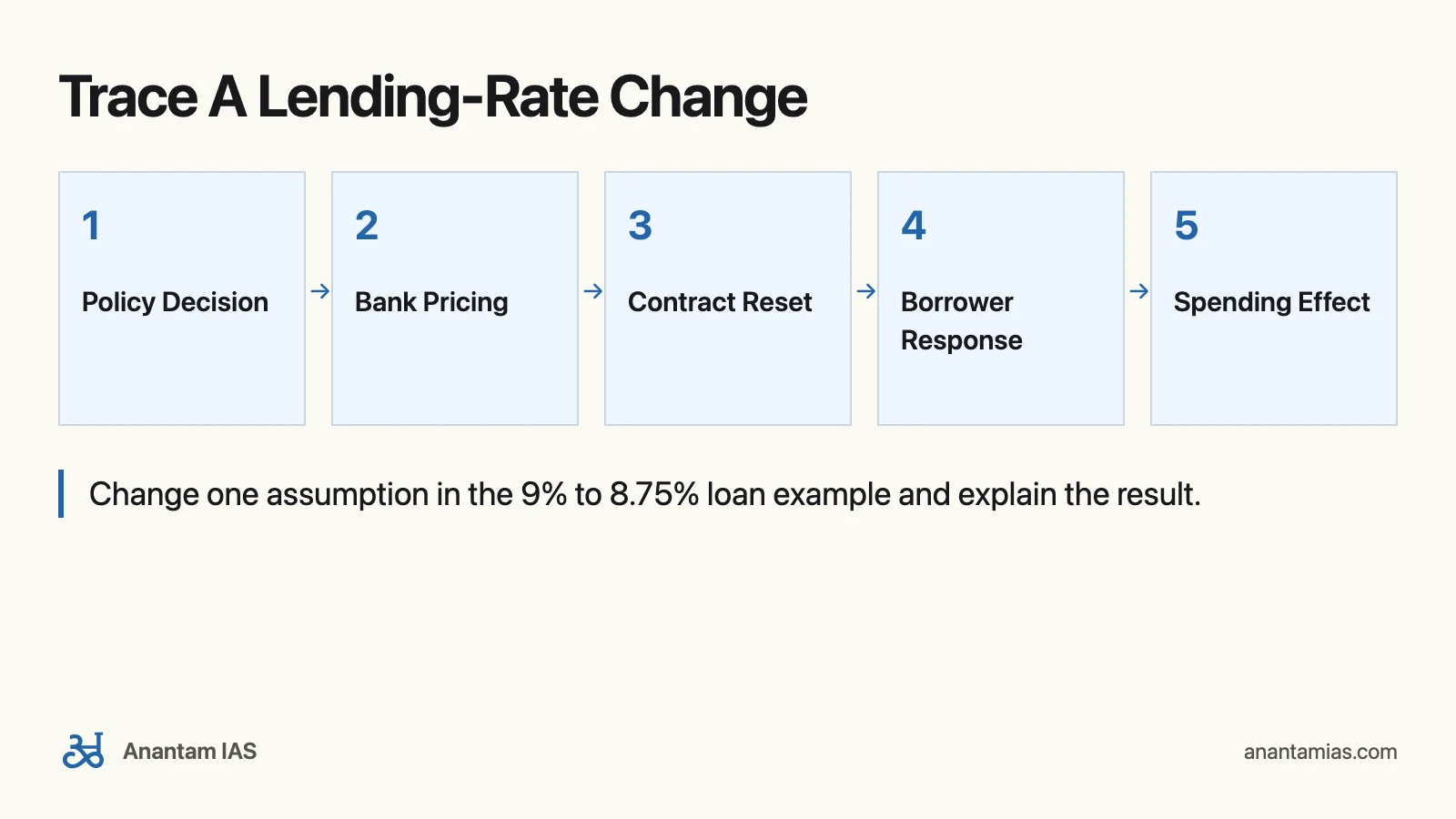
Our concept map becomes: policy decision, benchmark or funding conditions, bank loan pricing, borrower response, then spending and investment. Each arrow needs a condition. Avoid writing “repo falls, therefore every EMI immediately falls.” Real contracts and transmission channels matter.
For your notebook, write a short response to: “Why can monetary easing have a delayed or uneven effect?” Use the reset timing, pricing and borrower-demand conditions above. That’s already a stronger explanation than a chain of unexplained arrows.
Separate Static Concepts From Updates
A separate tracker prevents a changing number from swallowing your revision notes. A definition and the latest value have different jobs.
| Tracker field | What to write |
|---|---|
| Concept | Fiscal deficit, inflation or real GDP growth |
| Stable explanation | The definition and mechanism in your own words |
| Current value | Only the figure relevant to the period you are studying |
| Source and date | Official release and publication date |
| Status | Actual, provisional, revised or budget estimate as applicable |
| Question | What would this change imply, and what cannot be inferred? |
The Union Budget documents are the starting point for fiscal updates. For monetary decisions, use RBI. Don’t merge monthly inflation, quarterly growth and annual budget numbers as if they describe the same period.
Build A Flexible Reading Cycle
A 28-day cycle can organize your work if you have regular study time. It is a planning example, not a promise to complete the book or become exam-ready.
- Days 1-7: macroeconomics, money and banking; produce the banking map.
- Days 8-14: budgeting and government policy; solve one receipts exercise.
- Days 15-21: growth, agriculture, subsidies and infrastructure topics you need; write an application paragraph for each cluster.
- Days 22-28: revisit errors, attempt relevant questions and update selected figures.
With 30 minutes a day, use one small topic and extend the cycle. With 60 minutes, split reading and recall roughly equally. If your base is strong, start with questions and read the pages that repair mistakes. Keep a recovery session available; a missed day is a scheduling problem, not evidence that you need a new book.
Make The Book Earn Its Place
One reference still needs official updates and exam practice. The book’s coverage of other exams doesn’t mean every detail deserves equal UPSC revision time. Chapter familiarity also doesn’t guarantee that an unfamiliar statement will be easy.
Use the banking exercise as your first check. Rebuild it from memory, change one assumption and explain what follows. If you can do that, continue to the next cluster. If you can’t, the useful next purchase can wait.
Frequently Asked Questions
Which Vivek Singh Indian Economy edition is discussed?
The S Chand English tenth edition, ISBN 9789373597003. A separate Hindi tenth-edition listing has ISBN 9789373596273; match language and contents to your own copy.
Is Economy MCQs 450 the main textbook?
No. The Amazon source records list it separately from Indian Economy. Check the title and ISBN before buying a main reference.
Does a repo-rate cut immediately reduce every EMI?
No. Effects depend on the rate arrangement, benchmark, reset date and pricing conditions. The guide uses a simplified interest model, not an EMI calculation.
Is the 28-day cycle compulsory?
No. It is a planning example. Extend difficult clusters or use fewer topics per day according to your available time and foundation.
How should I update economic data?
Keep a separate tracker with the figure, period, official source, release date and estimate status. Preserve the stable concept explanation in your main notes.
Tell Google you want more of this.
Add Anantam IAS as a preferred sourceOne tap, and this site shows up more often in your own Top Stories, AI Overviews and AI Mode. Remove it any time.