Disclosure: this guide contains Amazon affiliate links. As an Amazon Associate, Anantam IAS earns from qualifying purchases — at no extra cost to you.
Sanjiv Verma Indian Economy is often searched as a beginner’s book, but owning it won’t resolve the gap between remembering a definition and using it. If fiscal deficit, revenue deficit and borrowing still blur together, I suggest starting with a small budget worksheet. It gives you a clear target for your next reading session.
Keep your existing copy when its explanations work for you, and update changing material separately. Buy a new copy when you need a main reference and have checked its language, edition and contents. If another economy book already serves that role, finish a concept-and-practice cycle before adding this one.
Confirm The Title And Revision
The title is The Indian Economy by Sanjiv Verma. “Sanjeev Verma” is a search spelling you may encounter; the publisher uses Sanjiv. Unique Publishers’ current listing identifies:
- The 15th revised edition.
- Revisions credited to Pavneet Singh and Trijya Garg.
- ISBN 9789366490021.
- A resource presented for UPSC and State Civil Services Prelims and Mains.
The credited revisers matter when comparing a recent copy with an older one. A reading plan written for an older edition may point you to different pages. Use the topic headings in your own contents list.
An Amazon listing for the English fifteenth edition names the revisers, but check the seller, cover and ISBN against the publisher before ordering. Marketplace author fields can be inconsistent.
Decide What You Need From It
Use this as an owner-focused concept guide. The economy book comparison is the place for the wider choice between authors, including whether your preparation actually needs another reference. If you are already studying Ramesh Singh, use the Ramesh Singh guide to improve that workflow first.
- Keep a copy you can read and explain from; age alone doesn’t erase every underlying concept.
- Check dated policies, data and institutional rules separately, especially in an older edition.
- Buy only after a sample section feels understandable and your current source has a specific unresolved gap.
- Avoid choosing solely because someone calls it “easy.” A familiar paragraph can still conceal an unfamiliar calculation.
I wouldn’t prescribe a page-by-page plan without your edition’s contents. The sequence below is a suggested way to locate and study concepts, not a claim about exact chapter order.
Build A Beginner Concept Ladder
Begin with output, money and government accounts before you try to analyze current economic policy. Each step should produce a small explanation you can use later.
| Concept to locate in your copy | Why it comes here | Your study task |
|---|---|---|
| National income and growth | Establish what output measures | Separate a price rise from an output increase |
| Money, banking and inflation | Explain credit and purchasing power | Draw a credit-to-spending chain with conditions |
| Government receipts and expenditure | Identify the budget’s components | Classify revenue receipts, non-debt capital receipts and borrowing |
| Deficits and debt | Compare flows with accumulated obligations | Calculate three deficits and state what each measures |
| External sector | Understand cross-border transactions | Distinguish exports, imports and financial flows |
| Policy applications | Put mechanisms into an answer | Give one likely benefit, one cost and one implementation condition |
The difficult part is usually choosing the right category before using a formula. Give that step time. You can revisit a definition without restarting the whole subject.
Solve A Budget Worksheet
Budget deficits measure different gaps, so one total can’t answer every question. The NCERT chapter on government budget explains the categories; the Economic Survey’s fiscal chapter also sets out the deficit relationships.
This original practice example uses an invented government budget. All figures are in Rs crore. They are not India’s actual budget figures or a UPSC PYQ.
| Item | Amount |
|---|---|
| Revenue receipts | 800 |
| Non-debt capital receipts | 50 |
| Revenue expenditure | 900 |
| Capital expenditure | 200 |
| Interest payments, included within revenue expenditure | 80 |
Start by identifying the receipts that don’t create new debt:
- Non-debt receipts = 800 + 50 = 850.
- Total expenditure = 900 + 200 = 1,100. The interest payment is already inside 900; don’t add it again.
- Fiscal deficit = 1,100 – 850 = 250.
- Revenue deficit = 900 – 800 = 100.
- Primary deficit = 250 – 80 = 170.
The fiscal deficit is the overall gap before financing it with borrowing and other debt sources. If you add borrowing to non-debt receipts before calculating the gap, you hide the borrowing requirement you are trying to measure. That’s the main trap in this exercise.
The revenue deficit compares revenue expenditure with revenue receipts. It tells us Rs 100 of that expenditure isn’t covered by those receipts. It doesn’t mean all revenue expenditure is wasteful: a teacher’s salary can be valuable even though it isn’t classified as capital expenditure.
The primary deficit removes interest payments from the fiscal deficit. Here, Rs 170 remains after excluding interest. It doesn’t remove those payments from the government’s real obligations.
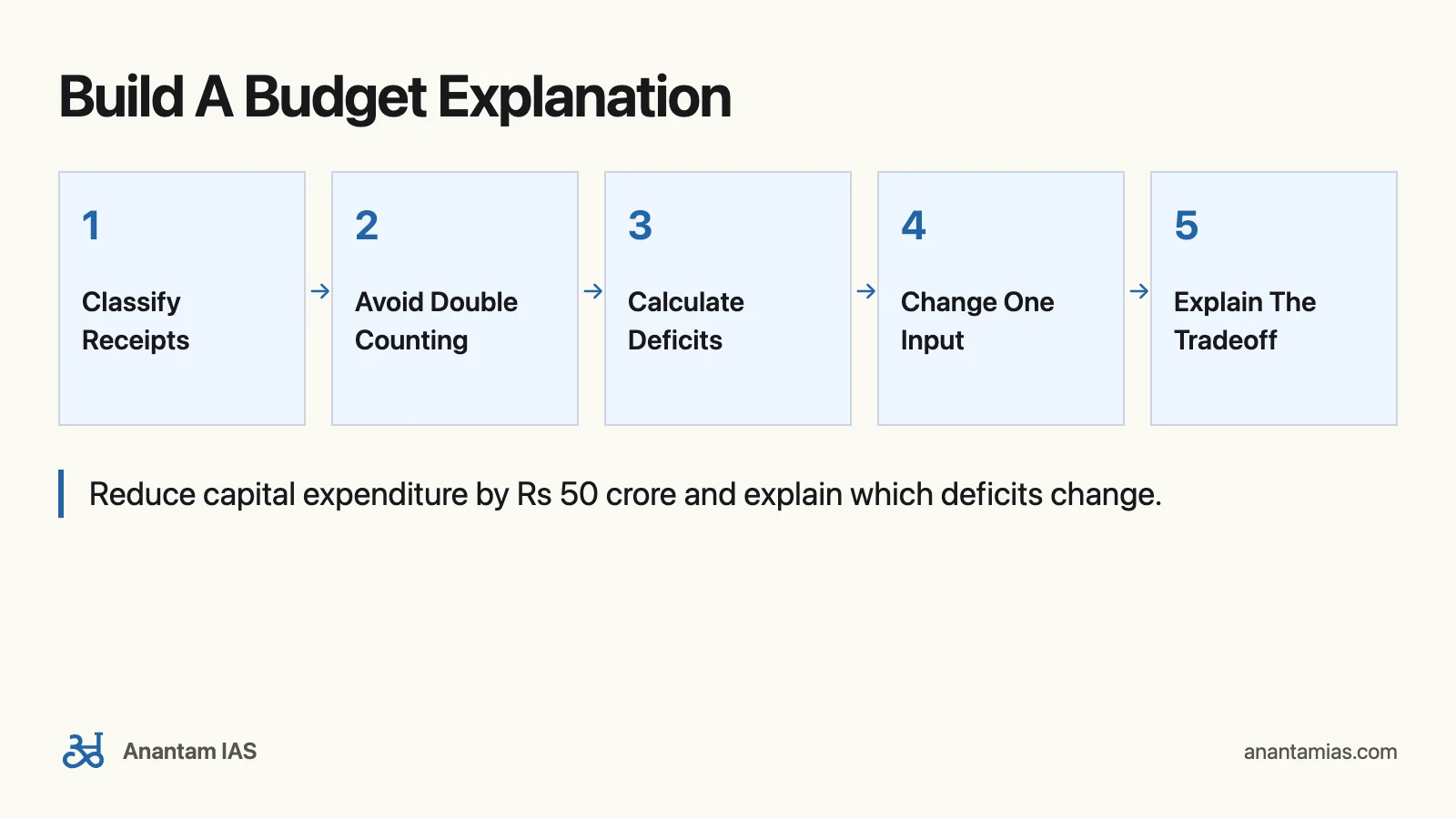
Change only capital expenditure from 200 to 150:
- Total expenditure becomes 1,050.
- Fiscal deficit becomes 1,050 – 850 = 200.
- Primary deficit becomes 200 – 80 = 120.
- Revenue deficit stays 100, because neither revenue receipts nor revenue expenditure changed.
Now you can explain why reducing capital expenditure can narrow the fiscal deficit without changing the revenue deficit. Whether that cut is desirable requires information about the project’s benefits and costs. A smaller deficit alone doesn’t settle the policy judgment.
Turn The Calculation Into An Answer
After the worksheet, write a short paragraph answering: “Does a lower fiscal deficit necessarily mean a better budget?” You don’t need a memorized essay.
- Begin with the condition: fiscal discipline matters, but the composition and effects of the adjustment matter too.
- Use the practice example: a capital-spending cut reduces the fiscal gap while the revenue gap stays unchanged.
- Add the tradeoff: canceling an unproductive project differs from delaying useful infrastructure.
- Finish with what you’d check: expenditure quality, revenue durability, debt costs and the economic context.
Keep the invented numbers labeled as an illustration. Don’t present them as evidence about the Union Budget.
Make The Routine Adjustable
A reading session should move from category to calculation to interpretation. Give yourself a repeatable unit instead of a finish-date promise.
| Your starting point | Suggested session |
|---|---|
| New to the topic, 30 minutes | One definition, one classification decision and a small calculation |
| Some foundation, 60 minutes | Read the relevant pages, reproduce the worksheet and answer a few questions |
| Revising, 90 minutes | Begin with questions, repair mistakes and write a short analytical answer |
Review the worksheet the next day without looking, then again after a few days. If the arithmetic is right but the categories are wrong, repair the classification. If both are right, vary one input and explain the consequence.
For live material, keep a dated update sheet. Use the Union Budget document collection to distinguish estimates from actuals and to check fiscal data. Don’t attach a real percentage-of-GDP figure to this worksheet without also supplying the matching GDP denominator.
Use Its Limits Sensibly
A book can organize concepts, but its printed updates can age and a publisher’s description can’t certify your understanding. Check that your edition covers the topic you need; don’t infer its depth or accuracy solely from a sales description. Your reading must still connect to official data and relevant exam practice.
Begin with the receipts classification today. If you can explain why borrowing is excluded and why interest isn’t counted twice, you have a useful foundation for the next budget chapter.
Frequently Asked Questions
Is the author Sanjiv or Sanjeev Verma?
Unique Publishers uses Sanjiv Verma. Sanjeev is a search spelling, not the verified author form used here.
Who revised the fifteenth edition?
The publisher credits Pavneet Singh and Trijya Garg for revisions to The Indian Economy, fifteenth edition, ISBN 9789366490021.
Should an older edition be discarded?
No automatic replacement is needed if its concepts work for you. Check dated policies, rules and figures, and use your edition’s topic headings rather than borrowed page numbers.
Why is borrowing excluded when calculating fiscal deficit?
Fiscal deficit measures expenditure above non-debt receipts before the gap is financed. Including borrowing in those receipts would conceal the borrowing requirement being measured.
Is a smaller fiscal deficit always better?
The composition and consequences of adjustment matter. In the invented worksheet, a capital-expenditure cut reduces fiscal deficit but leaves revenue deficit unchanged; its desirability needs more information.
Tell Google you want more of this.
Add Anantam IAS as a preferred sourceOne tap, and this site shows up more often in your own Top Stories, AI Overviews and AI Mode. Remove it any time.