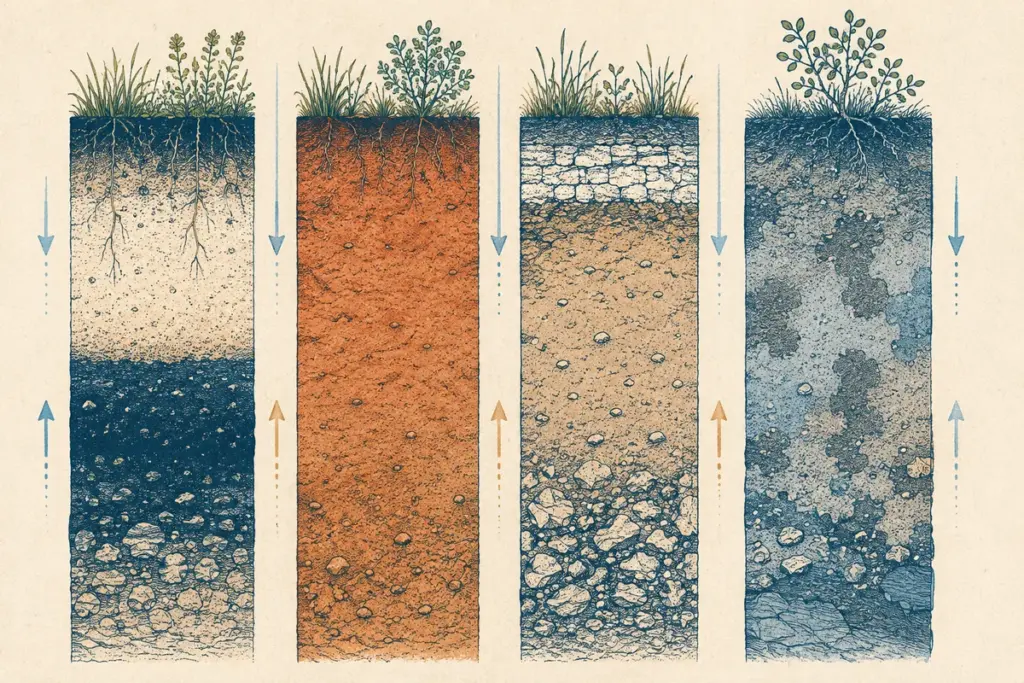
Pedogenic processes are what turn broken rock into soil with a profile. The horizons of a soil are not layers that were deposited; they are layers that were made, by water moving material up or down through the column and by organisms working on it. Which process dominates at a site is decided mainly by the balance between precipitation and evaporation, and that single relationship organises the whole world soil map.
The Two Universal Movements
Before the named processes, two movements underlie all of them.
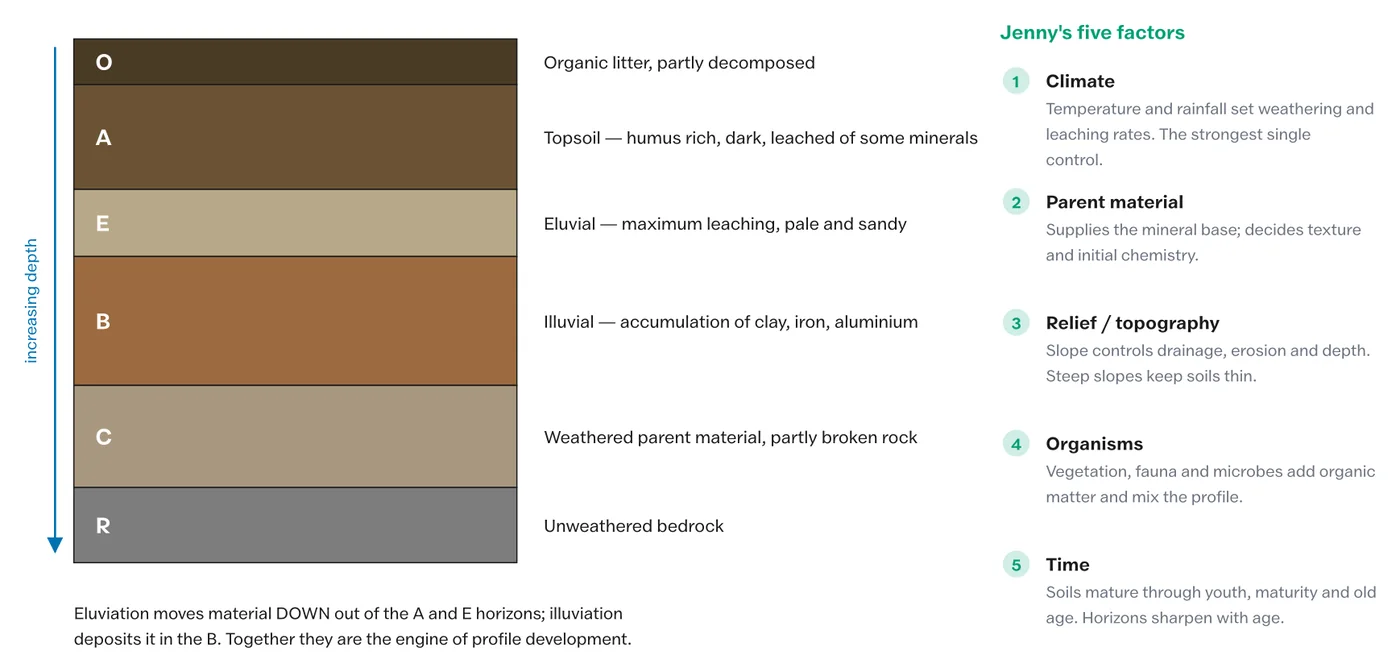
- Eluviation is the removal of material, in suspension or in solution, from a horizon. The zone it depletes is the E or A horizon.
- Illuviation is the deposition of that material lower down, building the B horizon.
The direction of net water movement decides everything that follows. Where precipitation exceeds evaporation, water moves down and the profile is leached. Where evaporation exceeds precipitation, water moves up and salts accumulate at or near the surface. Every named process below is a special case of one or the other.
The Five Named Processes
| Process | Climate | What moves | Result |
|---|---|---|---|
| Podzolisation | Cool, humid; acid coniferous litter | Iron and aluminium, chelated by organic acids | Bleached ash-grey E horizon over a dark accumulated B; strongly acid |
| Laterisation | Hot, seasonally wet tropics | Silica and bases removed; iron and aluminium left | Red residual soil rich in sesquioxides; hardens irreversibly on exposure |
| Calcification | Semi-arid grassland | Calcium carbonate, moved down then back up | Carbonate accumulation as a caliche or kankar horizon |
| Salinisation | Arid, or irrigated without drainage | Soluble salts brought up by capillary rise | White surface crust; reh, kallar and usar in Indian usage |
| Gleization | Waterlogged, oxygen-poor | Iron reduced to its ferrous form | Grey, blue or mottled horizons; peaty and marshy soils |
Podzolisation and Laterisation Compared
These two are the most confused pair, and the distinction is worth stating precisely because they are opposite in what they remove.
- Podzolisation removes iron and aluminium and leaves silica behind. The bleached horizon is silica-rich. The agent is organic acids from acid litter, which chelate the metals and carry them down.
- Laterisation removes silica and bases and leaves iron and aluminium behind. The residual soil is sesquioxide-rich and red. The agent is heavy leaching under high temperature.
They are therefore mirror images: one leaches the metals and keeps the silica, the other leaches the silica and keeps the metals. That is the whole difference, and it explains why podzols are grey and laterites red.
Podzolisation strips the metals. Laterisation strips the silica. Everything else about the two follows from that.
Laterite, and Why It Matters in India
Laterite deserves particular attention because it is widespread in India and behaves unlike other soils.
- It forms where a seasonally wet tropical climate alternates heavy leaching with a dry season, on the Western Ghats crest, parts of the Eastern Ghats, Meghalaya and the Kerala coast.
- It is poor for cereals, being low in nitrogen, phosphorus, potash and organic matter, but supports tea, coffee, cashew and rubber.
- It hardens irreversibly on exposure, which is why it has been cut into building blocks for centuries and why exposed laterite surfaces resist further cultivation.
Salinisation and the Cost of Irrigation Without Drainage
Salinisation is the process with the sharpest policy consequence, because it is largely made by people.
The mechanism is straightforward. Irrigation raises the water table. Where evaporation exceeds precipitation, capillary rise brings that water toward the surface and evaporation leaves its dissolved salts behind. Repeat annually and the upper profile accumulates salt to the point where crops fail.
This is the standard failure of large canal commands in arid and semi-arid regions, and it appears across parts of Punjab, Haryana, western Uttar Pradesh and Rajasthan’s Indira Gandhi command. The remedy is drainage rather than more water, which is politically harder because drainage produces no visible new command area.
Jenny’s Framework
Hans Jenny stated in 1941 that soil is a function of five factors, usually remembered as CLORPT: climate, organisms, relief, parent material and time.
- Climate dominates at the global scale, which is why the world soil map resembles the world climate map.
- Parent material dominates in young soils and where the rock is unusual, which is why the Deccan trap gives black soil regardless of the climate above it.
- Relief works through slope, aspect and drainage, and produces the catena, the sequence of related soils down a hillslope on the same parent material.
- Time decides which of the others shows. A young soil resembles its parent material; a mature soil resembles its climate.
Zonal, Intrazonal and Azonal
The older genetic classification groups soils by which factor won, and its terms remain in use.
- Zonal soils reflect climate, having had time to develop a full profile under it. Podzols, laterites and chernozems are zonal.
- Intrazonal soils reflect a local factor overriding climate, usually drainage or parent material. Saline, peaty and calcareous soils are intrazonal.
- Azonal soils are young and lack a developed profile: alluvial, regosol and lithosol.
The observation worth making is that India’s alluvial soils are azonal and are nonetheless the most agriculturally important soils in the country. Profile development and fertility are different things, and a soil can be undeveloped and rich at the same time.
What is the difference between eluviation and illuviation?
Eluviation is the removal of material in suspension or solution from a horizon, typically the A or E horizon. Illuviation is its deposition lower down, building the B horizon. The direction of net water movement through the profile decides which dominates.
What is podzolisation?
Soil formation under cool humid conditions with acid coniferous litter, in which organic acids chelate iron and aluminium and carry them downward, leaving a bleached ash-grey horizon over a dark accumulated layer. It removes the metals and leaves the silica.
How does laterisation differ from podzolisation?
They are mirror images. Podzolisation removes iron and aluminium and leaves silica, producing a grey horizon. Laterisation, under a hot seasonally wet tropical climate, removes silica and bases and leaves iron and aluminium, producing a red sesquioxide-rich soil.
Why does laterite harden on exposure?
Because it is rich in iron and aluminium oxides which dehydrate and cement irreversibly when exposed to air and alternating wet and dry conditions. This is why laterite has long been cut into building blocks, and why exposed laterite surfaces resist cultivation.
What causes salinisation in irrigated land?
Irrigation raises the water table; where evaporation exceeds precipitation, capillary rise brings that water toward the surface and evaporation leaves its dissolved salts behind. Repeated annually, salt accumulates in the upper profile until crops fail. The remedy is drainage, not more water.
What is a catena?
A sequence of related soils down a hillslope, developed on the same parent material but differing because drainage, erosion and deposition vary with slope position. It demonstrates the influence of relief in Jenny’s framework.
Why are India’s alluvial soils described as azonal?
Because they are young and have not developed a full profile through in-situ processes, having been laid down by rivers. They are nonetheless the most agriculturally important soils in the country, which shows that profile development and fertility are separate things.
Practice Questions
Prelims
1. Podzolisation results in the removal of
- (a) silica and bases
- (b) iron and aluminium
- (c) calcium carbonate
- (d) soluble salts
Answer: (b)
2. The accumulation of calcium carbonate in a semi-arid profile is called
- (a) laterisation
- (b) gleization
- (c) calcification
- (d) salinisation
Answer: (c)
3. Gleization occurs under conditions that are
- (a) hot and dry
- (b) cool and acid
- (c) waterlogged and oxygen-poor
- (d) saline and alkaline
Answer: (c)
4. Soils reflecting a local factor that overrides climate are classed as
- (a) zonal
- (b) intrazonal
- (c) azonal
- (d) polyzonal
Answer: (b)
5. In Jenny’s CLORPT relationship, the factor that dominates in young soils is
- (a) climate
- (b) organisms
- (c) parent material
- (d) time
Answer: (c)
Mains
- Distinguish between eluviation and illuviation, and explain what decides which dominates. (10 marks)
- Compare podzolisation and laterisation, and account for the difference in colour of the resulting soils. (15 marks)
- Explain the process of salinisation and its relationship to canal irrigation in north-western India. (15 marks)
- Discuss Jenny’s five factors of soil formation, indicating which dominates at which scale. (15 marks)
- “India’s most important soils are azonal.” Examine this statement and its implications for soil classification. (20 marks)
Tell Google you want more of this.
Add Anantam IAS as a preferred sourceOne tap, and this site shows up more often in your own Top Stories, AI Overviews and AI Mode. Remove it any time.