
The Panchayats (Extension to Scheduled Areas) Act, 1996 — universally called PESA — is the law that extends the 73rd Constitutional Amendment to Fifth Schedule tribal areas with significant modifications. It was enacted on 24 December 1996 to honour the constitutional promise of tribal self-rule rooted in custom, community and the Gram Sabha. PESA is widely described as the “constitution within the Constitution” for Adivasis, and yet, almost three decades after enactment, it remains one of the most under-implemented laws in independent India.
Constitutional Context
The 73rd Amendment (1992) created a three-tier panchayati raj framework across India. However, Article 243M(4)(b) explicitly barred its direct application to Fifth Schedule areas and excluded the Sixth Schedule states entirely, recognising that tribal institutions differ fundamentally from mainstream village governance. PESA was the promised framework to adapt — not impose — panchayati raj to tribal realities.
The Bhuria Committee (1994–95), chaired by Dileep Singh Bhuria, drafted the substantive recommendations that became PESA.
Coverage: Fifth Schedule States
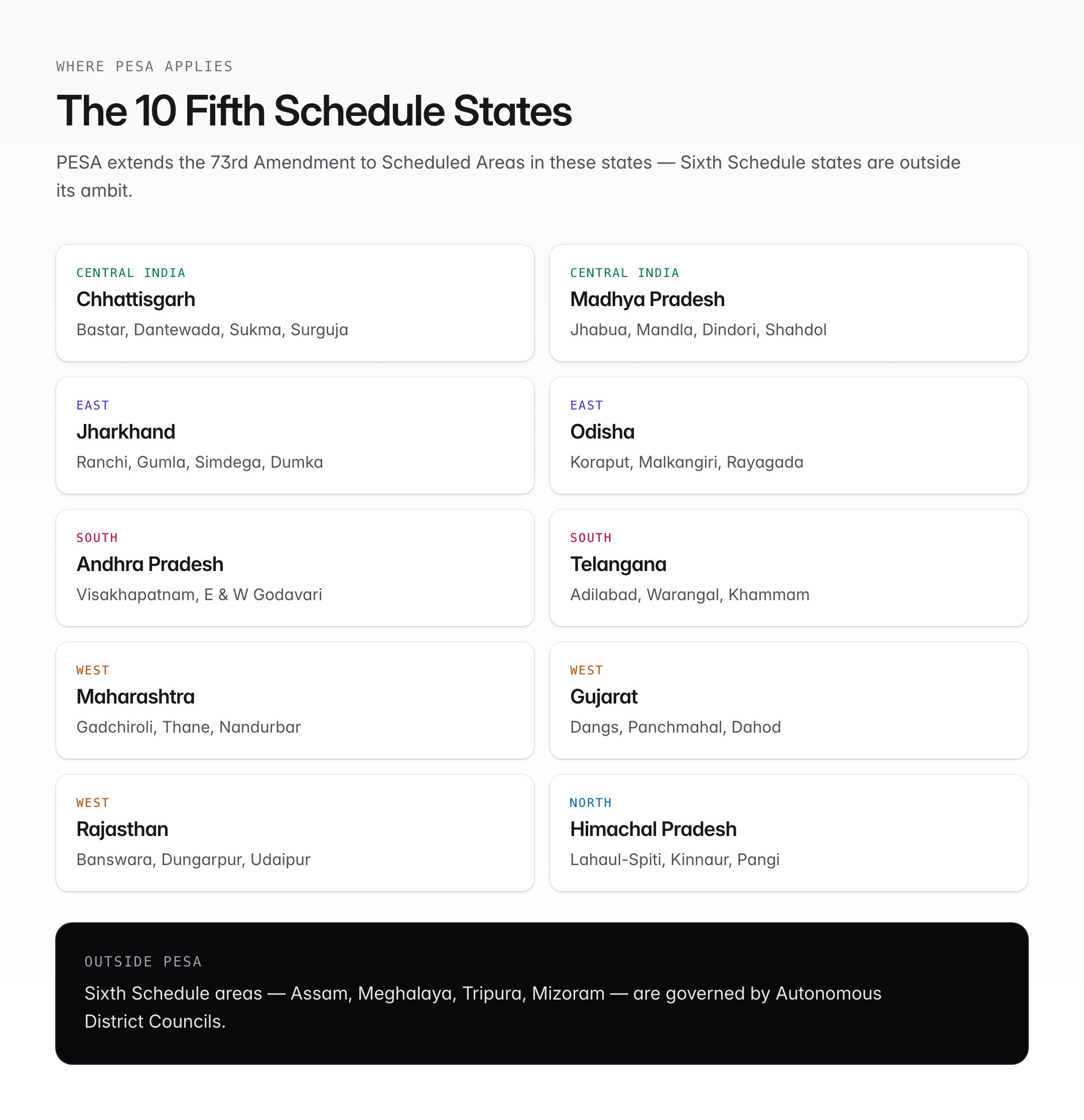
PESA applies to Scheduled Areas declared under the Fifth Schedule in 10 states:
| State | Tribal Districts with Scheduled Areas |
|---|---|
| Andhra Pradesh | Visakhapatnam, East Godavari, West Godavari and others |
| Telangana | Adilabad, Warangal, Khammam, Mahbubnagar |
| Chhattisgarh | Bastar, Dantewada, Sukma, Bijapur, Kanker, Surguja |
| Gujarat | Dangs, Panchmahal, Dahod, Vadodara parts |
| Himachal Pradesh | Lahaul-Spiti, Kinnaur, Pangi |
| Jharkhand | Ranchi, Gumla, Simdega, West Singhbhum, Dumka |
| Madhya Pradesh | Jhabua, Mandla, Dindori, Shahdol, Balaghat |
| Maharashtra | Gadchiroli, Thane, Nandurbar, Yavatmal |
| Odisha | Koraput, Malkangiri, Rayagada, Mayurbhanj, Sundergarh |
| Rajasthan | Banswara, Dungarpur, Udaipur, Pratapgarh parts |
The Sixth Schedule areas (Assam, Meghalaya, Tripura, Mizoram) are governed by Autonomous District Councils and fall outside PESA's ambit.
Core Features of PESA
PESA does not create new panchayats; it modifies how panchayats function in Scheduled Areas. Its core principles are:
- State legislation on panchayats in Scheduled Areas must be in consonance with customary law, social and religious practices, and traditional management practices of community resources.
- The Gram Sabha — not elected panchayats — is the primary unit of self-governance and the supreme decision-making body at village level.
- A village is defined in PESA terms: a habitation or group of habitations or a hamlet or group of hamlets comprising a community and managing its affairs in accordance with traditions and customs — not the revenue village.
- Reservations: the Chairperson of panchayats at all levels in Scheduled Areas shall be a Scheduled Tribe member; at least half the seats reserved for STs.
- No recall of ST-reserved seats via general recall provisions unless customary procedure is followed.
Specific Powers of the Gram Sabha under PESA
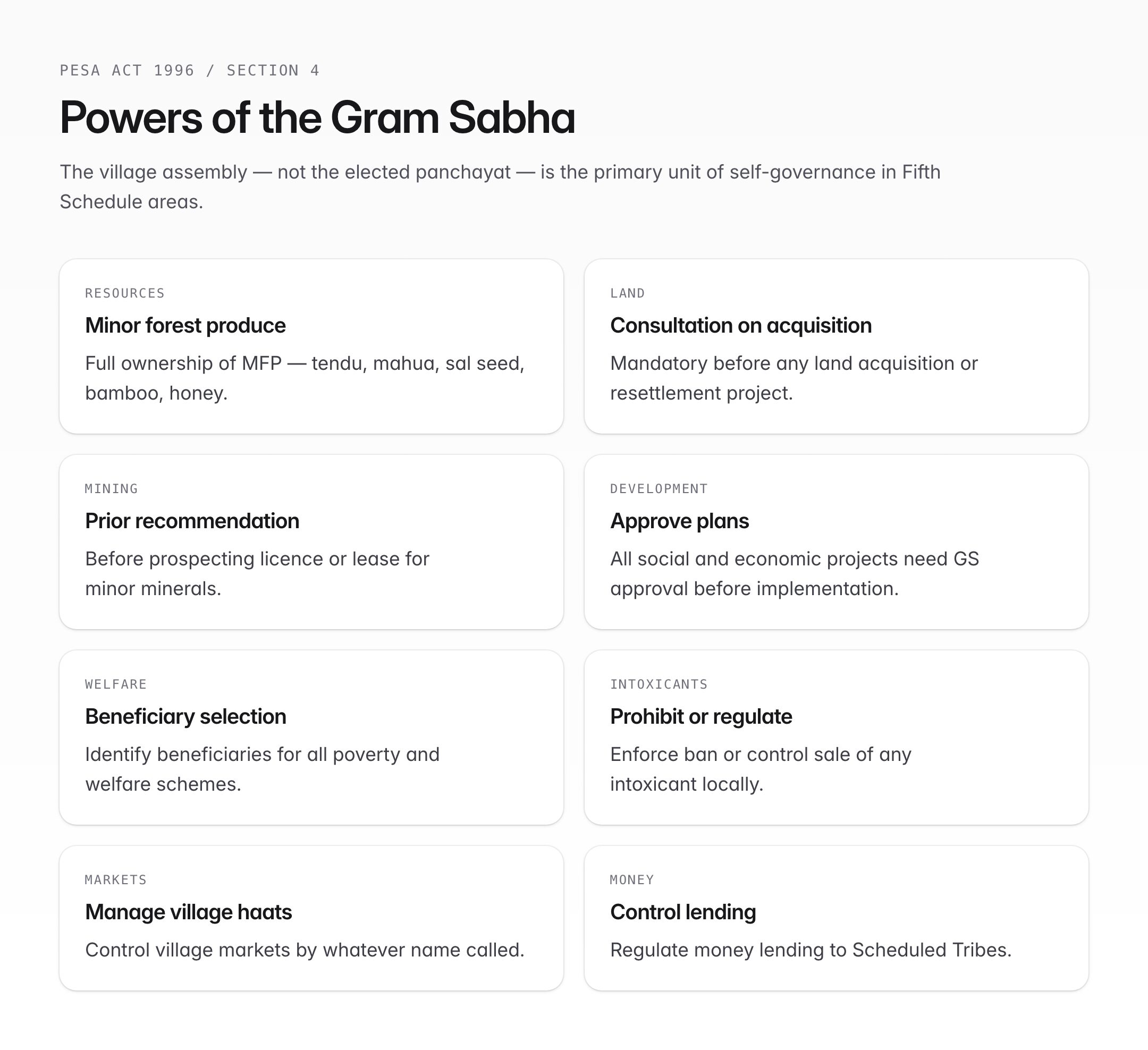
Section 4 of PESA gives Gram Sabhas remarkable — on paper — authority.
| Domain | Gram Sabha Power |
|---|---|
| Cultural identity | Safeguard and preserve traditions, customary law, community resources, customary dispute resolution |
| Development planning | Approve plans, programmes and projects for social and economic development before implementation |
| Beneficiary selection | Identify beneficiaries of poverty alleviation and other programmes |
| Utilisation certificates | Issue certification of utilisation of funds for all programmes |
| Land acquisition | Mandatory consultation before acquisition of land in Scheduled Areas for development projects and before resettlement |
| Mining | Prior recommendation of Gram Sabha (or appropriate panchayat) before grant of prospecting licence or mining lease for minor minerals |
| Minor minerals | Same for concessions to exploit minor minerals by auction |
| Minor forest produce | Ownership of MFP vested in the Gram Sabha |
| Intoxicants | Power to enforce prohibition or regulate/restrict sale and consumption of any intoxicant |
| Money lending | Power to control money lending to STs |
| Social sector | Control over institutions and functionaries in social sectors |
| Markets | Manage village markets by whatever name called |
| Tribal sub-plan | Control over local plans and resources under tribal sub-plans |
The Samatha judgment (Supreme Court, 1997) and later the Niyamgiri judgment (Orissa Mining Corporation vs Ministry of Environment & Forests, 2013) affirmed Gram Sabha's consent powers over land and mining, drawing directly on PESA's spirit.
Minor Forest Produce — The Economic Heart of PESA
PESA vests ownership of minor forest produce in the Gram Sabha. MFP includes tendu leaves, mahua flowers, sal seeds, bamboo (post-2011), chironji, lac, honey, gum, tamarind and other non-timber forest products. For millions of tribal households, MFP is the primary cash income. The Forest Rights Act, 2006 reinforced this by recognising community forest resource rights (Section 3(1)(i)) and codifying MFP ownership (Section 2(i), 3(1)(c)).
State PESA Rules — The Implementation Gap
Of the 10 Fifth Schedule states, only a few have notified PESA Rules:
| State | PESA Rules Year |
|---|---|
| Madhya Pradesh | 2022 |
| Chhattisgarh | Partial rules, 2022 |
| Rajasthan | 2011 |
| Andhra Pradesh | 2011 |
| Himachal Pradesh | 2014 |
| Maharashtra | 2014 (revised 2022) |
| Jharkhand | Draft, not notified |
| Odisha | Amendments to various laws; no consolidated rules |
| Telangana | Draft |
| Gujarat | Not notified |
Where rules exist, they frequently dilute PESA. For example, Madhya Pradesh Rules have been criticised for limiting Gram Sabha's consent over mining to "consultation" and retaining state override in "public interest." Studies by the Ministry of Panchayati Raj, National Commission for Scheduled Tribes and independent researchers (CSD, PRIA, Samarthan) consistently document:
- Mismatch between revenue villages and PESA villages.
- Meetings held without quorum; resolutions signed in offices, not habitations.
- Contractors manipulating MFP auctions despite Gram Sabha ownership.
- Forest and mining clearances granted without genuine consent.
- Absence of a dedicated monitoring or grievance mechanism.
PESA and Related Legislations
PESA does not operate in isolation. It interlocks with:
- Forest Rights Act, 2006 — community and individual forest rights.
- Land Acquisition, Rehabilitation and Resettlement Act (LARR), 2013 — Section 41 mandates Gram Sabha consent in Scheduled Areas.
- Fifth Schedule, Article 244(1) — Governor's special responsibility; Tribes Advisory Council.
- Article 275(1) — grants-in-aid for welfare of STs.
- Samatha v. State of AP (1997) — state-owned land in Scheduled Areas cannot be leased to non-tribals or private parties for mining.
Significance
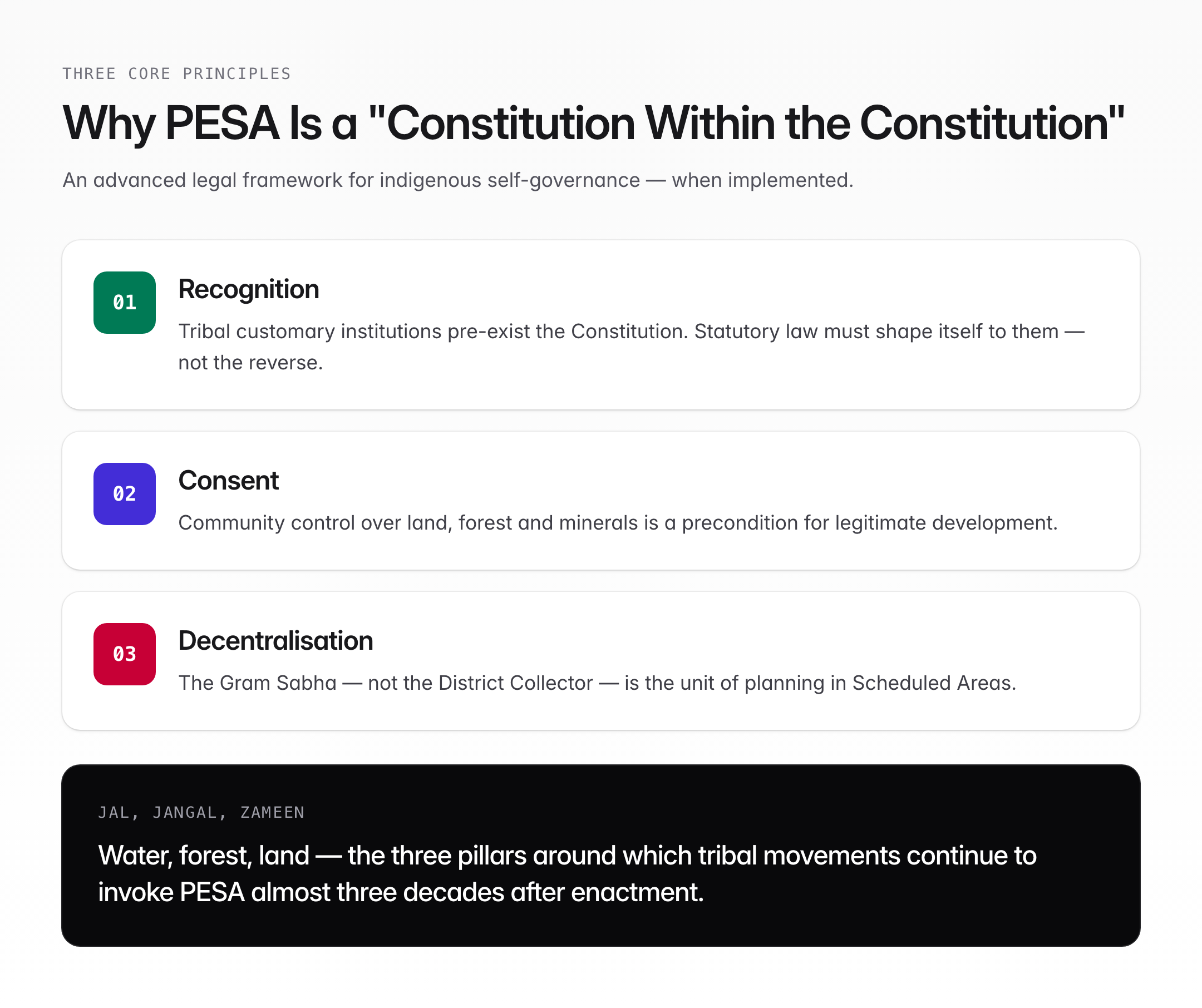
PESA is one of the world's most advanced legal frameworks for indigenous self-governance, anchored in three ideas:
- Recognition — tribal customary institutions pre-exist the Constitution and must shape, not conform to, statutory law.
- Consent — community control over land, forests and minerals is a precondition for legitimate development.
- Decentralisation — the Gram Sabha, not the District Collector, is the unit of planning.
When genuinely implemented — as in parts of Maharashtra's Gadchiroli (Mendha-Lekha, Lekha-Pipariya villages) — PESA has produced working models of community forest management and local economic sovereignty.
UPSC Relevance
Prelims: Year of enactment (1996), Schedule applicable (Fifth), states covered (10), powers listed in Section 4, difference from Sixth Schedule, relationship with 73rd Amendment, and key overlapping laws (FRA 2006, LARR 2013).
GS-II (Polity/Governance): PESA appears under "federalism," "devolution," "special provisions for STs," "local self-government" and "governance in tribal areas." Typical question: "PESA remains a paper tiger in most Scheduled Areas. Critically examine the reasons and suggest reforms."
GS-I (Society): Link to tribal identity, displacement, and cultural preservation.
GS-III (Environment/Internal Security): PESA is central to the Left-Wing Extremism (Naxalism) belt — the Red Corridor overlaps almost exactly with Scheduled Areas. Development deficits there are partly a PESA implementation failure.
Essay: Suitable for themes like "participatory democracy," "law and custom," "development and displacement."
Interview: Expect probing questions on Niyamgiri, Pathalgadi movement, Samatha judgment, and your view on whether PESA needs a central rule-making authority.
Study PESA as a live political-economy question: a law of extraordinary ambition, implementation that rarely matches its letter, and tribal movements that continue to invoke it to defend jal, jangal, zameen.
Tell Google you want more of this.
Add Anantam IAS as a preferred sourceOne tap, and this site shows up more often in your own Top Stories, AI Overviews and AI Mode. Remove it any time.