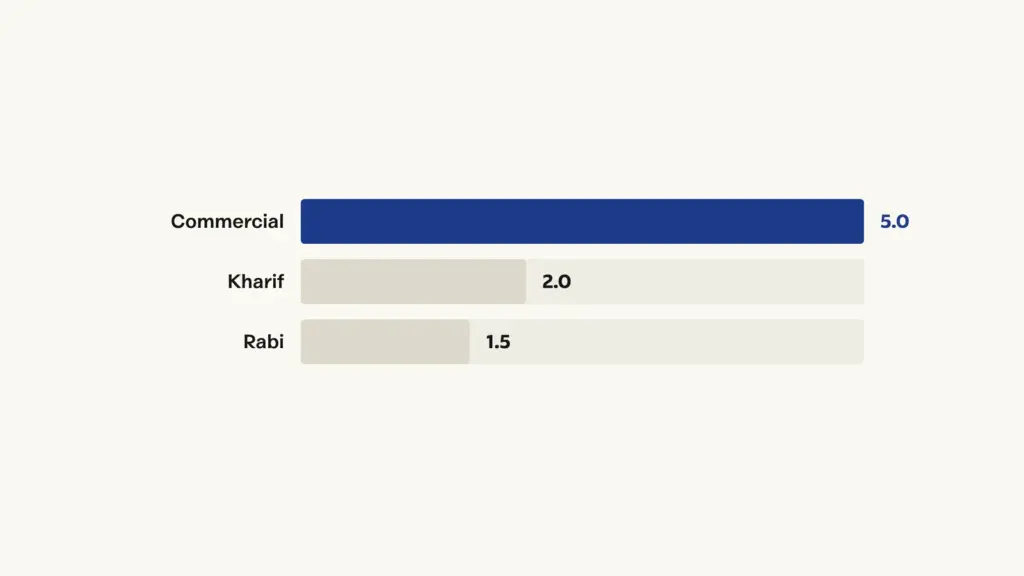
PM Fasal Bima Yojana (PMFBY) lets a farmer insure a season’s crop for a capped premium — 2% of the sum insured for Kharif crops, 1.5% for Rabi, and 5% for commercial and horticultural crops — with the rest of the actuarial premium paid by the central and state governments. You can enrol through your bank, a Common Service Centre, or directly on the National Crop Insurance Portal, pmfby.gov.in. This guide covers registration and login, the application routes, premium rates, the 72-hour crop-loss reporting rule, and how to track your application and claim. (Scheme background: our concept explainer on PMFBY covers its design, history, and performance debate; this page is the how-to.)
Who can apply
All farmers growing notified crops in notified areas can enrol — owners, tenants, and sharecroppers alike. Two things decide insurability:
- Notified crop, notified area. Each state notifies which crops are insurable in which districts/blocks for each season. If your crop-area combination is not notified, PMFBY cannot cover it that season.
- Insurable interest. You must actually be cultivating the crop. Tenants and sharecroppers apply with the land records plus their cultivation agreement or state-prescribed certificate.
Enrolment is voluntary for all farmers, including loanee farmers (those with a Kisan Credit Card or seasonal crop loan). Loanee farmers are enrolled by their bank by default in most states but may opt out by submitting a declaration to the bank before the state’s cut-off date.
Premium rates — what you actually pay
| Season / crop type | Farmer’s share of premium | Who pays the rest |
|---|---|---|
| Kharif food and oilseed crops | 2% of sum insured | Centre and state governments share the balance |
| Rabi food and oilseed crops | 1.5% of sum insured | Centre and state governments share the balance |
| Annual commercial and horticultural crops | 5% of sum insured | Centre and state governments share the balance |
These caps come from the scheme’s operational guidelines on the official portal. In practice: if the sum insured for paddy in your block is ₹50,000 per hectare, your Kharif premium is at most ₹1,000 per hectare, whatever the actuarial rate the insurer quoted. Sum insured per hectare is set district-by-district in the state notification; the portal’s Insurance Premium Calculator (on the pmfby.gov.in home page) shows the exact figure for your crop, season, and district before you commit.
Three ways to apply
1. Through your bank (loanee farmers). If you hold a KCC or crop loan, your bank branch handles enrolment against your sanctioned crop; the premium is debited from your account. Confirm before the cut-off date that the bank has recorded the correct crop and area — mismatch between sown crop and insured crop is a leading cause of rejected claims.
2. Through a CSC. Carry your documents to any Common Service Centre; the operator files the application on the portal and you pay the premium there. The service is free to the farmer apart from the premium itself. This is the least error-prone route if you are not comfortable with the portal.
3. Self-registration on pmfby.gov.in. The do-it-yourself route:
- Open pmfby.gov.in and click Farmer Corner — Apply for Crop Insurance Yourself.
- Choose Guest Farmer to create your account. Fill in your name (as per bank records), mobile number, age, category, and farmer type.
- Verify the OTP sent to your mobile; your farmer account is created.
- Login for Farmer with your mobile number and OTP thereafter.
- Fill the application: state, district, season, year, scheme (PMFBY), and crop.
- Enter land details — survey/khasra number, area to be insured.
- Enter bank account details (this is where any claim will be paid).
- Upload documents, preview, and submit.
- Pay the premium online. Save the application/receipt number — every later status check needs it.
Documents needed
- Aadhaar card (mandatory for enrolment)
- Bank passbook or a cancelled cheque (account in the farmer’s name)
- Land record: khasra/khatauni or record-of-rights extract
- Sowing certificate or self-declaration of sowing, as your state prescribes
- For tenants/sharecroppers: the cultivation agreement or state-prescribed certificate
- Mobile number for OTPs and claim alerts
Cut-off dates
Enrolment closes before the season peaks — typically 31 July for Kharif and 31 December for Rabi, though the binding date is whatever your state’s notification says for your crop, and states do occasionally extend it. Check the current season’s dates on the portal or with your bank/CSC early; applications after the cut-off are simply not accepted, and banks stop debiting loanee premiums after that date too.
Reporting crop loss — the 72-hour rule
For localised calamities (hailstorm, landslide, inundation, cloudburst, lightning-caused fire) and post-harvest losses (crop lying cut in the field damaged by cyclonic or unseasonal rain within 14 days of harvest), an individual farm-level claim exists only if you intimate the loss within 72 hours of the event. Late intimation is a standard ground for rejection, whatever the actual damage. Ways to report, per the scheme’s Krishi Rakshak helpline page:
- Call the toll-free Krishi Rakshak Portal and Helpline: 14447 — give your name, policy/application number, crop, and nature of damage; you get a ticket number by SMS.
- Report on the Crop Insurance app (Report Crop Loss, with a geo-tagged photo of the damaged field).
- Inform your bank branch, CSC, insurance company’s toll-free number, or the local agriculture department office — any of these counts as intimation.
After intimation, the insurer must appoint a loss assessor within about 48 hours; assessment and claim payment then follow the guideline timelines. Widespread losses (drought, flood affecting the whole notified area) do not need individual intimation — they are settled on area-yield data from crop-cutting experiments.
Checking application and claim status
- On pmfby.gov.in, open Application Status in the Farmer Corner.
- Enter your receipt/application number and the captcha.
- The screen shows the stage: submitted, approved by insurer, premium received, or claim calculated/paid.
Logged-in farmers see all their policies season-wise under their account. For a claim that seems stuck, call 14447 with your ticket or policy number, and escalate in writing to the District Level Grievance Committee through the district agriculture officer if it stays unresolved. Keep your premium receipt and intimation ticket number — they are your whole case file.
Common mistakes that sink claims
- Wrong crop recorded. If the bank insured wheat but you sowed mustard, the claim fails. Verify the crop entry at enrolment.
- Missed 72-hour window. Report first, document later. A phone call to 14447 on day one beats a perfect written complaint on day four.
- Bank-account mismatch. Claims are paid by DBT; the account must be active and Aadhaar-seeded, the same discipline that schemes like PM-Kisan demand.
- Uninsured area inflated. Insuring more area than the land record supports invites rejection at verification.
Frequently Asked Questions
What premium does a farmer pay under PM Fasal Bima Yojana?
At most 2% of the sum insured for Kharif food and oilseed crops, 1.5% for Rabi food and oilseed crops, and 5% for annual commercial and horticultural crops. The central and state governments pay the remaining premium.
Is PMFBY compulsory for farmers with a crop loan?
No. Enrolment has been voluntary for all farmers, including loanee farmers, since Kharif 2020. Banks enrol loanee farmers by default in most states, but you can opt out with a written declaration before the cut-off date.
How do I do PM Fasal Bima Yojana login?
On pmfby.gov.in, use Farmer Corner → Login for Farmer, and sign in with your registered mobile number and OTP. First-time users create an account through the Guest Farmer registration form.
What is the time limit to report crop loss?
72 hours from the event, for localised calamities and post-harvest losses. Report via the Krishi Rakshak helpline 14447, the Crop Insurance app, your bank, CSC, or the local agriculture office.
How is the claim amount paid?
Directly into the insured farmer’s bank account by DBT, after loss assessment (individual losses) or on area-yield shortfall calculated from crop-cutting experiments (widespread losses).
Can tenant farmers and sharecroppers get PMFBY cover?
Yes, in states where they are notified as eligible, with land records plus the prescribed cultivation agreement or certificate proving insurable interest in the crop.
Where do I check my PMFBY application status?
pmfby.gov.in → Application Status, using the receipt number from enrolment. Claim-stage queries can also be raised on the toll-free helpline 14447.
Tell Google you want more of this.
Add Anantam IAS as a preferred sourceOne tap, and this site shows up more often in your own Top Stories, AI Overviews and AI Mode. Remove it any time.