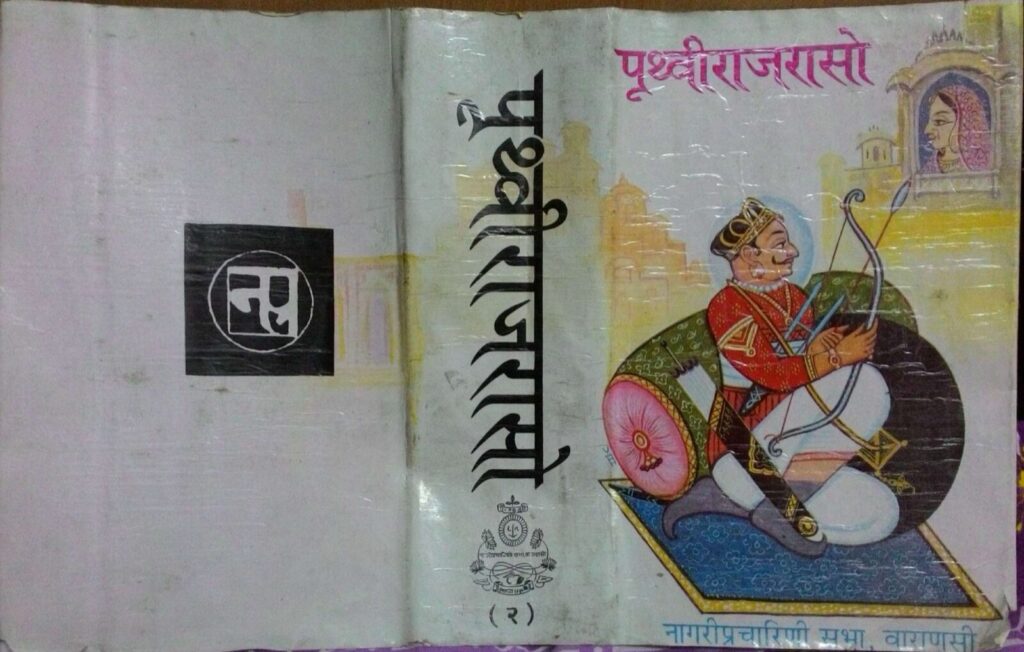
The Prithviraj Raso is one of those medieval texts that refuses to fit neatly into any single category. It’s an epic, it’s a panegyric, it’s a romance, it’s an attempted political history, and it’s also the subject of one of the longest-running authorship and dating debates in Indian literary scholarship. The Prithviraj Raso is traditionally attributed to Chand Bardai, the court poet of the twelfth-century Rajput ruler Prithviraj Chauhan III. Whether the version we have today is anything close to what Chand Bardai might have composed in the 1190s is a separate, much harder question.
For UPSC aspirants the Prithviraj Raso shows up in the cultural and medieval Indian history syllabus as a representative work of medieval Rajput court literature, often paired with later Rajput chronicles like the Padmavat of Malik Muhammad Jayasi. The Prithviraj Raso also matters because it shaped how generations of readers, performers, and later nationalist writers imagined Prithviraj Chauhan, the Second Battle of Tarain, and the broader idea of Rajput resistance.
This piece looks at the Prithviraj Raso on its own terms: what it is as a literary work, what we know about its language and structure, what the dating controversy involves, why Bharatendu Harishchandra got pulled into it, and what its value is as a historical source today.
Quick Facts at a Glance
- Work: Prithviraj Raso (also spelled Prithiraj Raso, Prithwiraja Raso)
- Traditional author: Chand Bardai, court poet of Prithviraj Chauhan III
- Patron-subject: Prithviraj Chauhan III, Chahamana ruler of Ajmer and Delhi (r. circa 1178-1192)
- Language: Brajbhasha, with Rajasthani influences (an early form of literary Hindi)
- Genre: Epic praise poem (charita / raso tradition)
- Earliest extant manuscript: Dated 1610 CE
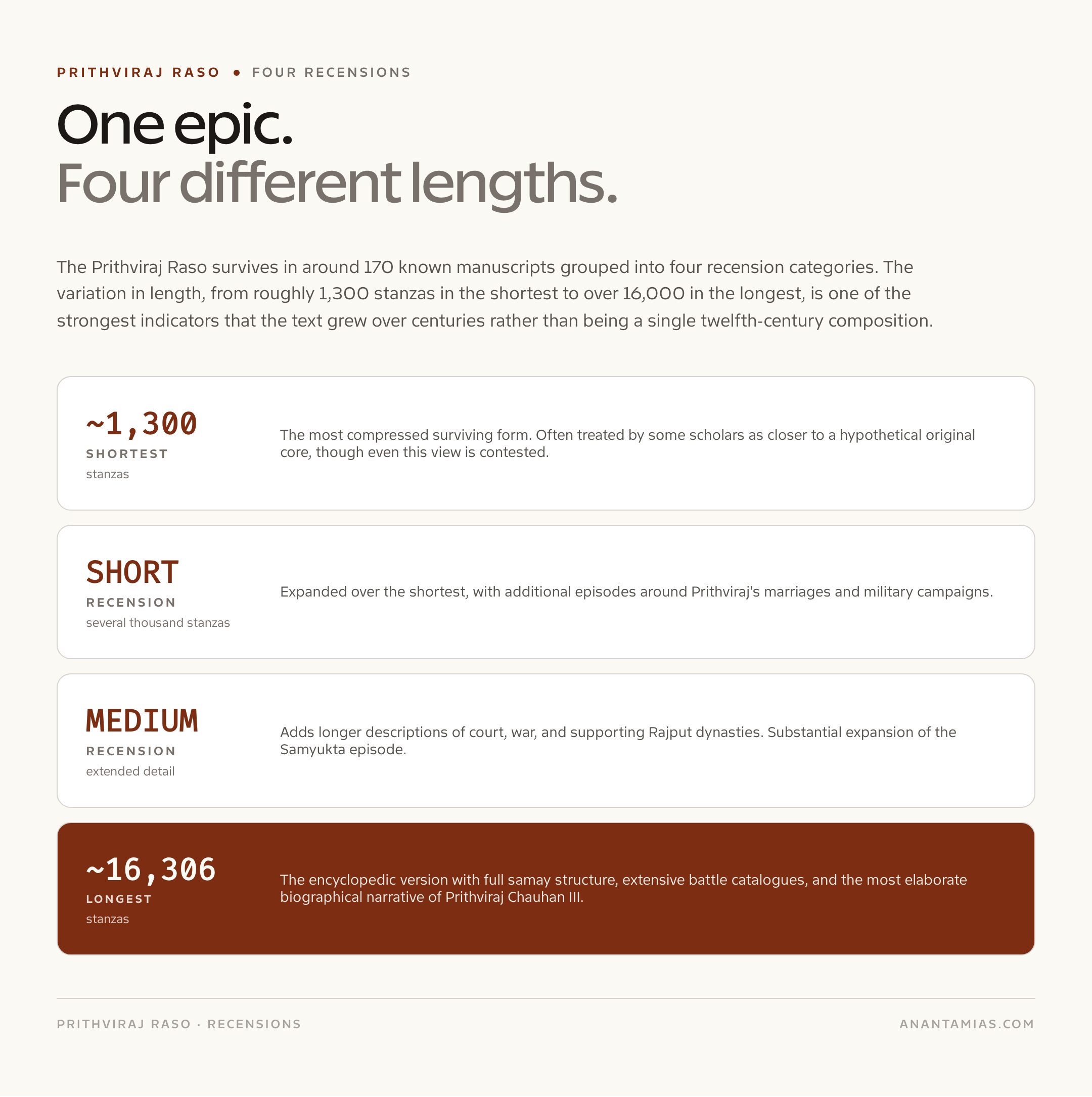
- Number of known manuscripts: Around 170, grouped into four recensions
- Length of longest recension: Around 16,306 stanzas
- Length of shortest recension: Around 1,300 stanzas
- Common metre: Six-line chappay, with other metres mixed in
- Modern scholarly consensus: Composite text with later layers, not historically reliable as written
Who Was Chand Bardai
Chand Bardai is one of the most famous names in early Hindi literary tradition, even though almost nothing about him is independently verifiable. The traditional account places him as the official court poet (rajkavi) of Prithviraj Chauhan III at Ajmer and later Delhi. Tradition says Chand Bardai accompanied Prithviraj Chauhan after the king’s defeat at the Second Battle of Tarain in 1192, and that the two perished together at Ghor. This narrative is itself part of the Prithviraj Raso and there’s no independent twelfth-century evidence for it.
What’s more solid is that the figure of Chand Bardai became central to medieval and early modern north Indian bardic culture. Wandering bards across Rajasthan and the Hindi belt invoked Chand Bardai as the founder of the raso tradition, the genre of heroic praise-poetry that documented Rajput dynastic memory. Whether or not the historical Chand Bardai wrote a single line of the Prithviraj Raso as we have it, his name became inseparable from the genre.
What the Prithviraj Raso Contains
The Prithviraj Raso narrates the life of Prithviraj Chauhan as a heroic epic. It moves through his ancestry, birth, education, military campaigns, marriages (including the elopement with Samyukta, daughter of Jaichand of Kannauj, which is one of the most retold episodes), confrontations with Muhammad Ghori, the Battles of Tarain, his blinding and captivity at Ghor, and the famous shabdabhedi (sound-piercing) archery feat in which he kills Ghori before himself dying.
Background and Historical Context
The Prithviraj Raso is structured into samay (sections or cantos), each devoted to an episode. Different recensions vary substantially in how many samay they contain and in which episodes get extended treatment. The longest recension is encyclopedic. The shortest reads almost as a compressed verse summary. This variation is itself one of the strongest indicators that the Prithviraj Raso was a living, expanding text reworked over centuries, not a frozen twelfth-century composition.
Language and Literary Form
The language of the Prithviraj Raso is conventionally described as an early form of Brajbhasha, the literary register of medieval north India that later became the vehicle of Krishna devotional poetry. The Prithviraj Raso also carries strong Rajasthani influences in vocabulary and idiom, which makes sense given its Rajput patronage context. Some passages drift toward Dingal, the bardic Rajasthani register, while others sit closer to standard Brajbhasha.
The dominant metre is the chappay, a six-line verse form that became the workhorse of Rajput heroic poetry. Other metres are interleaved, including doha, kavitta, and tomar. Stylistic features include the heavy use of similes drawn from war, hunting, court life, and natural imagery, and the deployment of long catalogues of warriors, weapons, and elephants in battle descriptions. The aesthetic is heroic-erotic (vir and shringar rasa), with vir dominant.
The Dating and Authorship Controversy
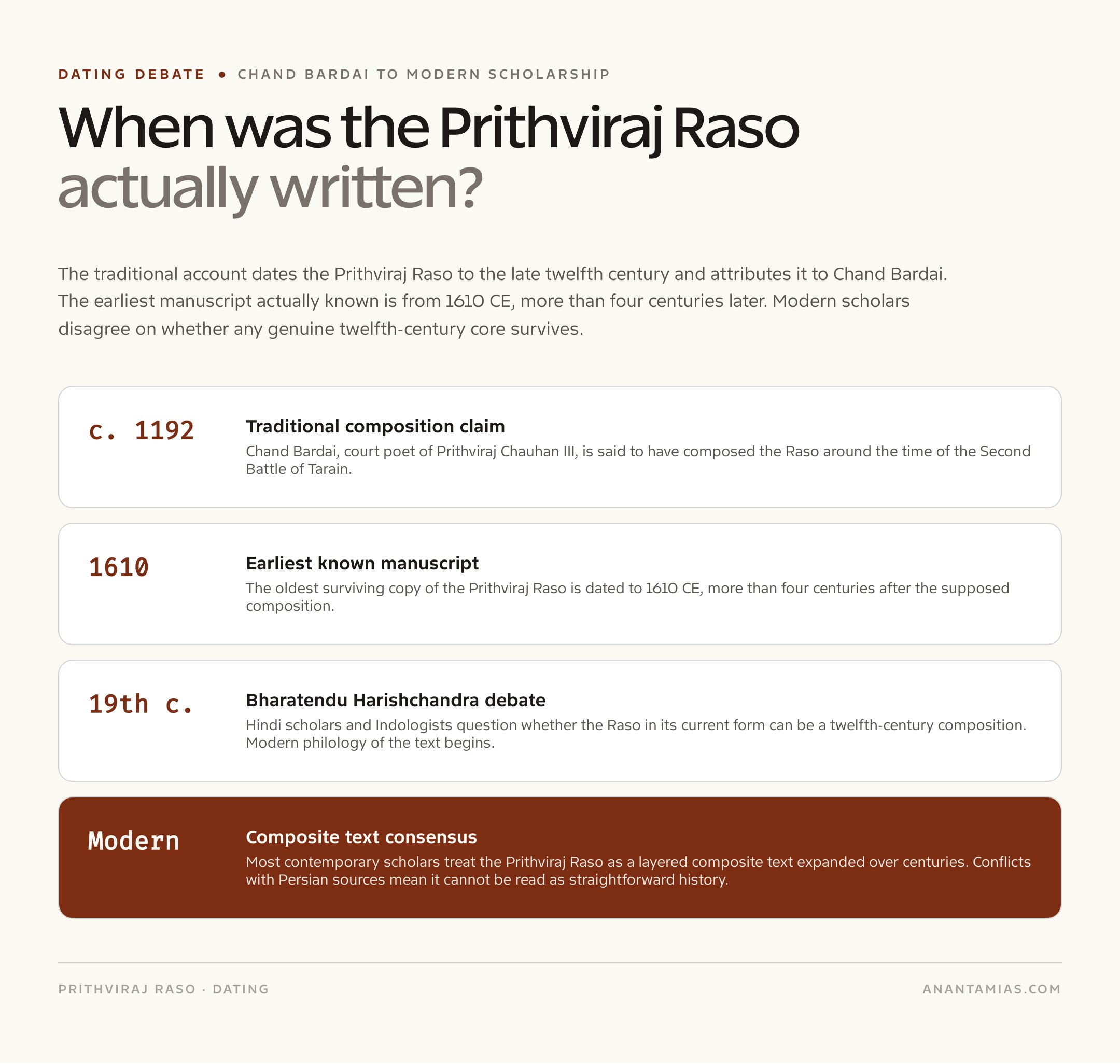
The Prithviraj Raso’s authorship and date have been debated for more than a century, and the question is not settled. The traditional view dates the text to the late twelfth century, attributing it to the historical Chand Bardai. The earliest manuscript actually known is from 1610 CE, which is more than four centuries after the supposed composition. Internal evidence is mixed.
Several markers point to a later date for the text as we have it. The Prithviraj Raso uses dating conventions (the so-called Anand Samvat) that don’t match the twelfth-century context. It refers to persons, places, and events that didn’t exist in the 1190s. Its language, while archaic in places, contains forms that linguists associate with later medieval Brajbhasha rather than twelfth-century Apabhramsha. These observations led nineteenth and twentieth century scholars to argue that the Prithviraj Raso, in its current form, was composed in the sixteenth century, possibly under Akbar, and projected backward.
A counter-position holds that a genuine twelfth-century core text by Chand Bardai existed and was progressively expanded and overwritten by later poets, with the resulting composite text bearing both very old and much later layers. The four recensions (shortest, short, medium, longest) are then read as evidence of this layered growth.
The Bharatendu Harishchandra Controversy
Bharatendu Harishchandra, the nineteenth-century Hindi writer often called the father of modern Hindi literature, took a strong interest in the Prithviraj Raso. In the 1870s and 1880s the question of whether the Prithviraj Raso was an authentic twelfth-century text became a live debate among Hindi scholars and Indologists. Bharatendu Harishchandra wrote on the subject and is associated with the position that the Prithviraj Raso, in the form then circulating, could not be a straightforward twelfth-century work.
This controversy is important for two reasons. First, it was one of the earliest sustained efforts at critical philology in modern Hindi scholarship, dragging the Prithviraj Raso out of the realm of bardic recitation into modern textual analysis. Second, it foreshadowed the broader debate about how to read medieval Indian texts: as transmitted historical records, as living literary traditions, or as some combination of both. The Prithviraj Raso debate has not closed, and modern scholars including Cynthia Talbot and Allison Busch have returned to it with fresh tools.
Historical Value of the Prithviraj Raso
Modern historians are clear that the Prithviraj Raso is not a reliable record of twelfth-century events. The basic facts of Prithviraj Chauhan’s biography in the Prithviraj Raso conflict with contemporary Persian and Sanskrit sources. The Second Battle of Tarain in the Prithviraj Raso doesn’t match Minhaj-i Siraj’s Tabaqat-i Nasiri or Hasan Nizami’s Taj-ul-Maasir. The famous Samyukta swayamvara elopement story has no twelfth-century corroboration. The shabdabhedi killing of Muhammad Ghori is not consistent with what we know about Ghori’s death in 1206 CE in Damyak.
That doesn’t make the Prithviraj Raso useless. As a literary artefact it preserves the texture of medieval Rajput court culture, the vocabulary of war and chivalry, the conventions of bardic praise, and the imaginative universe through which later north Indian audiences understood the figure of Prithviraj Chauhan. As a window onto how medieval and early modern audiences constructed political memory, the Prithviraj Raso is irreplaceable. It also reflects how the Rajput elite of the later medieval period wanted to remember its own past.
Prithviraj Raso and the Construction of National Memory
The Prithviraj Raso fed directly into the construction of Prithviraj Chauhan as a pan-north-Indian heroic figure during the nineteenth and twentieth centuries. Nationalist writers, popular novelists, and later film-makers drew on the Prithviraj Raso, sometimes uncritically, to build a story of Rajput resistance against external invasion. The selective borrowing was rarely accompanied by acknowledgement that the source text was composite, of disputed date, and historically unreliable.
This matters for UPSC because the syllabus asks aspirants to think critically about historiography, not just to memorize narratives. The Prithviraj Raso is a clean case study in how a literary text can be elevated into a quasi-historical authority over centuries, and how modern critical scholarship recovers a more careful picture.
Why the Prithviraj Raso Matters for UPSC
Three exam-relevant angles. First, as a representative work of medieval Hindi (Brajbhasha) literature and the raso genre, the Prithviraj Raso shows up in culture and literature questions. Second, as a case study in the difference between literary tradition and historical source, it’s a useful peg for historiography questions in mains. Third, as part of the broader cultural history of the Delhi Sultanate transition period and the Rajput response to incursions from the north-west, it complements direct study of the Battles of Tarain.
The Prithviraj Raso also pairs naturally with the broader Sahitya Akademi recognition of medieval Hindi literature and with the standard reading list around Bardic poetry of Rajasthan.
Conclusion
The Prithviraj Raso is best read as a layered medieval Hindi epic that grew over centuries, attributed to Chand Bardai but almost certainly written and rewritten by many hands, encoding the heroic memory of Prithviraj Chauhan rather than reporting his life as it happened. Its dating controversy, traceable through Bharatendu Harishchandra in the late nineteenth century and continuing into present-day scholarship, is one of the most instructive philological debates in Indian literary studies. For UPSC and for general readers interested in medieval north Indian culture, the Prithviraj Raso is essential not because it is true, but because of how powerfully it shaped the truths that later generations believed.
Frequently Asked Questions
Who wrote the Prithviraj Raso?
Traditionally the Prithviraj Raso is attributed to Chand Bardai, the court poet of Prithviraj Chauhan III, but most modern scholars believe the text as we have it is a composite work expanded and rewritten over several centuries.
In what language is the Prithviraj Raso composed?
The Prithviraj Raso is composed in Brajbhasha with strong Rajasthani influences, an early literary register of Hindi, with frequent use of the six-line chappay metre.
How long is the Prithviraj Raso?
The Prithviraj Raso exists in four recensions. The longest contains around 16,306 stanzas while the shortest comprises only about 1,300 stanzas.
Is the Prithviraj Raso historically reliable?
No. Modern scholarship treats the Prithviraj Raso as a literary epic rather than a historical record. Many of its specific claims conflict with contemporary Persian and Sanskrit sources.
What was Bharatendu Harishchandra’s role in the Prithviraj Raso debate?
Bharatendu Harishchandra in the nineteenth century was associated with the position that the Prithviraj Raso in its current form could not be a straightforward twelfth-century work, helping launch the modern philological debate over the text’s date and authorship.
Why is the Prithviraj Raso important if it is not historically accurate?
It preserves medieval Rajput court culture, the conventions of the raso genre, and the imaginative framework through which later north Indian audiences remembered Prithviraj Chauhan and the Battles of Tarain.
Tell Google you want more of this.
Add Anantam IAS as a preferred sourceOne tap, and this site shows up more often in your own Top Stories, AI Overviews and AI Mode. Remove it any time.