When Go First filed for insolvency in May 2023, foreign aircraft lessors discovered something unsettling about Indian law. Despite holding valid lease agreements, despite owning the aircraft on paper, and despite the airline owing them millions of dollars, they could not take their planes back. The National Company Law Tribunal had imposed a moratorium under Section 14 of the Insolvency and Bankruptcy Code, which freezes all recovery actions against the corporate debtor. Lessors arguing that the aircraft were not assets of the airline but property of the lessor were caught in months of litigation while their planes sat on Indian tarmac, depreciating, unmaintained, and unflyable.
The fallout was international. The Aviation Working Group, an industry body that monitors compliance with aviation finance treaties, downgraded India’s compliance rating with the Cape Town Convention. Lease rentals for Indian carriers rose. Major lessors began to demand higher security deposits and shorter contractual terms. India’s reputation as a reliable aviation jurisdiction took a measurable hit at exactly the moment when Indian airlines were placing some of the largest aircraft orders in commercial aviation history.
The Protection of Interests in Aircraft Objects Bill, 2025 is the legislative response. It implements the Cape Town Convention fully into Indian law, creates a clear repossession path for lessors, and resolves the conflict with the IBC moratorium. This guide explains what the bill does, why it matters, and how it fits into the broader architecture of Indian aviation finance.
Quick Facts on the Aircraft Objects Bill 2025
The Protection of Interests in Aircraft Objects Bill, 2025 implements the Cape Town Convention on International Interests in Mobile Equipment (2001) and its Aircraft Protocol fully into Indian domestic law. India acceded to the Cape Town Convention in 2008, but full statutory implementation was incomplete until this bill. The bill establishes the primacy of its provisions over conflicting laws, specifically the Insolvency and Bankruptcy Code, 2016 and the Companies Act, 2013, in matters relating to aircraft, aircraft engines, airframes, and helicopters. The Irrevocable De-registration and Export Request Authorization, or IDERA, is a pre-signed authorisation by the airline that allows the lessor, on default, to approach the Director General of Civil Aviation to deregister and export the aircraft within five working days, without court consent. The bill applies to airframes, aircraft engines, and helicopters of civil aviation use; it does not apply to military, customs, or police aircraft, which are classified as state aircraft. The Bill resolves the conflict that arose during the Go First insolvency, where the IBC moratorium prevented foreign lessors from repossessing their aircraft.
What the Aircraft Objects Bill Actually Does
The bill performs three connected legal operations. The first is to give Indian statutory force to the rights and remedies that the Cape Town Convention requires of contracting states. These include the lessor’s right to take possession of the aircraft, the right to sell or lease it, the right to collect income from it during enforcement, and the right to obtain interim relief from a court within strict timelines. Article XI of the Aircraft Protocol, which India had earlier opted into through Declaration A, sets a 60-day window within which a defaulting airline must either pay overdue amounts or surrender the aircraft. The bill brings this 60-day rule into Indian law as a matter of statutory right.
The second operation is to establish primacy. Section 238 of the Insolvency and Bankruptcy Code says that the IBC has overriding effect over other laws. The new bill carves out a specific exception. In matters relating to aircraft objects, the bill prevails over the IBC and over the Companies Act. This means the moratorium under Section 14 of the IBC, which would otherwise freeze all recovery actions against the corporate debtor, will not apply to lessor actions on aircraft. The Companies Act provisions on creditor actions during winding up are similarly subordinated.
The third operation is the IDERA mechanism. An IDERA is an authorisation that the airline signs at the time of leasing the aircraft, which the lessor can invoke if the airline defaults. Once invoked, the DGCA is required to deregister the aircraft from the Indian register and permit its export within five working days. The DGCA does not require court consent or judicial review at this stage. The lessor’s contractual right is converted into an administrative remedy executable on a fixed timeline.
Background and Historical Context
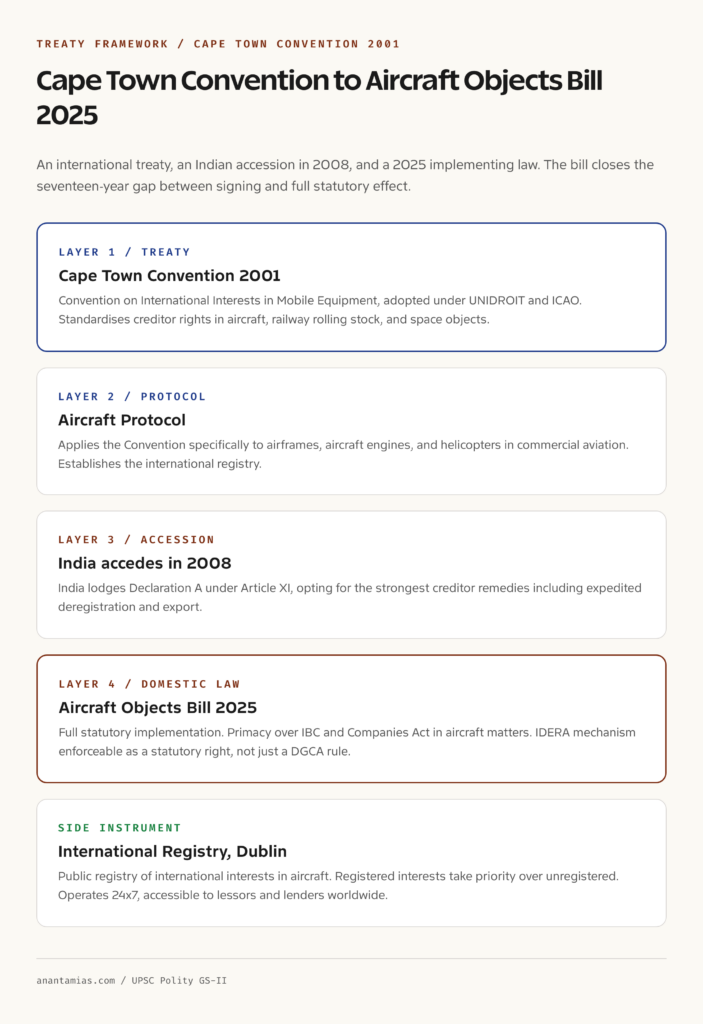
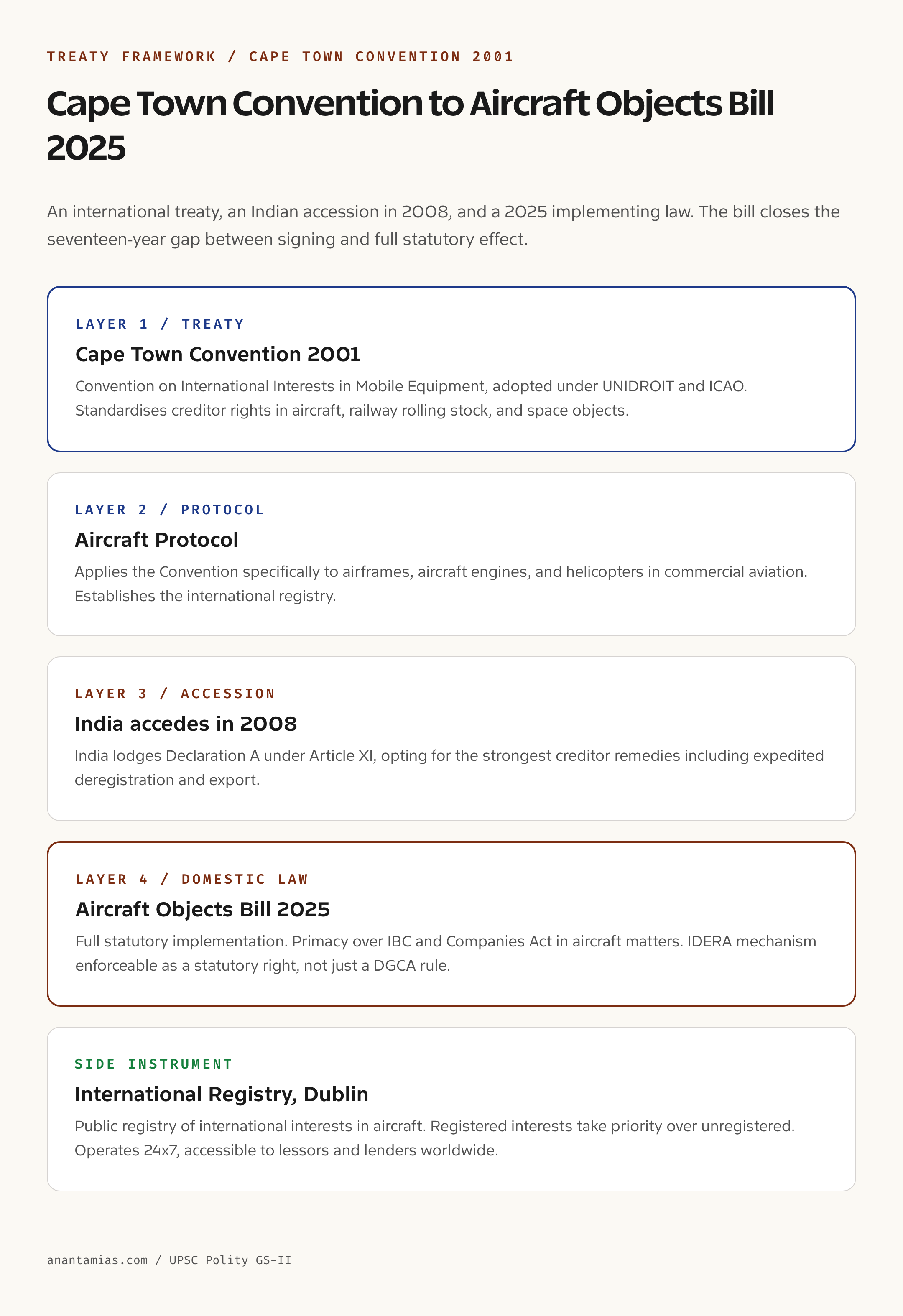
The Cape Town Convention on International Interests in Mobile Equipment was adopted in November 2001 under the auspices of UNIDROIT and the International Civil Aviation Organization. Its purpose was to standardise the law on creditor rights in mobile assets that move across borders, including aircraft, railway rolling stock, and space objects. The Aircraft Protocol, adopted simultaneously, applies these principles to airframes, aircraft engines, and helicopters in commercial aviation. The Convention created an international registry to record interests in these objects, providing public notice of who owns or has rights in any given aircraft.
India signed the Cape Town Convention in 2008 and lodged the various declarations that contracting states are required to make. However, the Convention requires implementing legislation to take full effect within domestic law. For nearly two decades, India operated with a partial framework. The DGCA’s Civil Aviation Requirements were updated to recognise IDERAs and to set a five-working-day timeline for deregistration. But these were administrative rules, not statutory rights. When they collided with the IBC moratorium during Go First, the administrative rule had to give way.
The Go First case, which began in May 2023, exposed every weakness of the partial framework. Lessors filed applications before the NCLT seeking lifting of the moratorium. The Resolution Professional argued that the aircraft were essential assets for any potential resolution and that the moratorium served the larger public interest of maintaining the airline as a going concern. The NCLT initially sided with the Resolution Professional. Lessors appealed to the National Company Law Appellate Tribunal and the Delhi High Court. While litigation continued, the aircraft sat on the ground. By the time the Delhi High Court ruled in favour of lessors and ordered deregistration, the planes had lost much of their commercial value. Some lessors took losses running into hundreds of millions of dollars.
The Aviation Working Group’s compliance ranking for India dropped sharply. India had been ranked among the top tier of compliant jurisdictions; it now slipped into the tier requiring caution. This translated directly into higher financing costs for Indian airlines. Industry estimates suggested that the basis-point increase on lease rentals could cost Indian carriers an additional $300 to $500 million annually, costs ultimately borne by passengers in higher fares.
The Cape Town Convention and India’s Declarations
The Cape Town Convention is structured around the concept of an “international interest,” which is created when a debtor agrees to grant or hold an interest in a uniquely identifiable mobile object. International interests, when registered on the international registry, take priority over unregistered interests. The Convention provides three default remedies on default: taking possession or control, selling or leasing, and collecting income. Contracting states can, by declaration, opt for stronger remedies including expedited de-registration and export.
India lodged Declaration A under Article XI of the Aircraft Protocol, which gives lessors the strongest available remedies, including the right to take possession of an aircraft, to deregister it from the national register, and to export it without further court consent on default. India also opted in to the speedy interim relief provisions under Article X. These declarations were lodged at the time of accession in 2008. The Aircraft Objects Bill 2025 brings these treaty obligations into binding domestic law.
India did not, however, lodge Declaration 39, which would have required courts to give effect to the Convention’s remedies notwithstanding the law of the contracting state on insolvency. Whether the bill compensates for this omission, by providing direct statutory primacy over the IBC, is now a question that future cases will test.
Why the Aircraft Objects Bill Matters
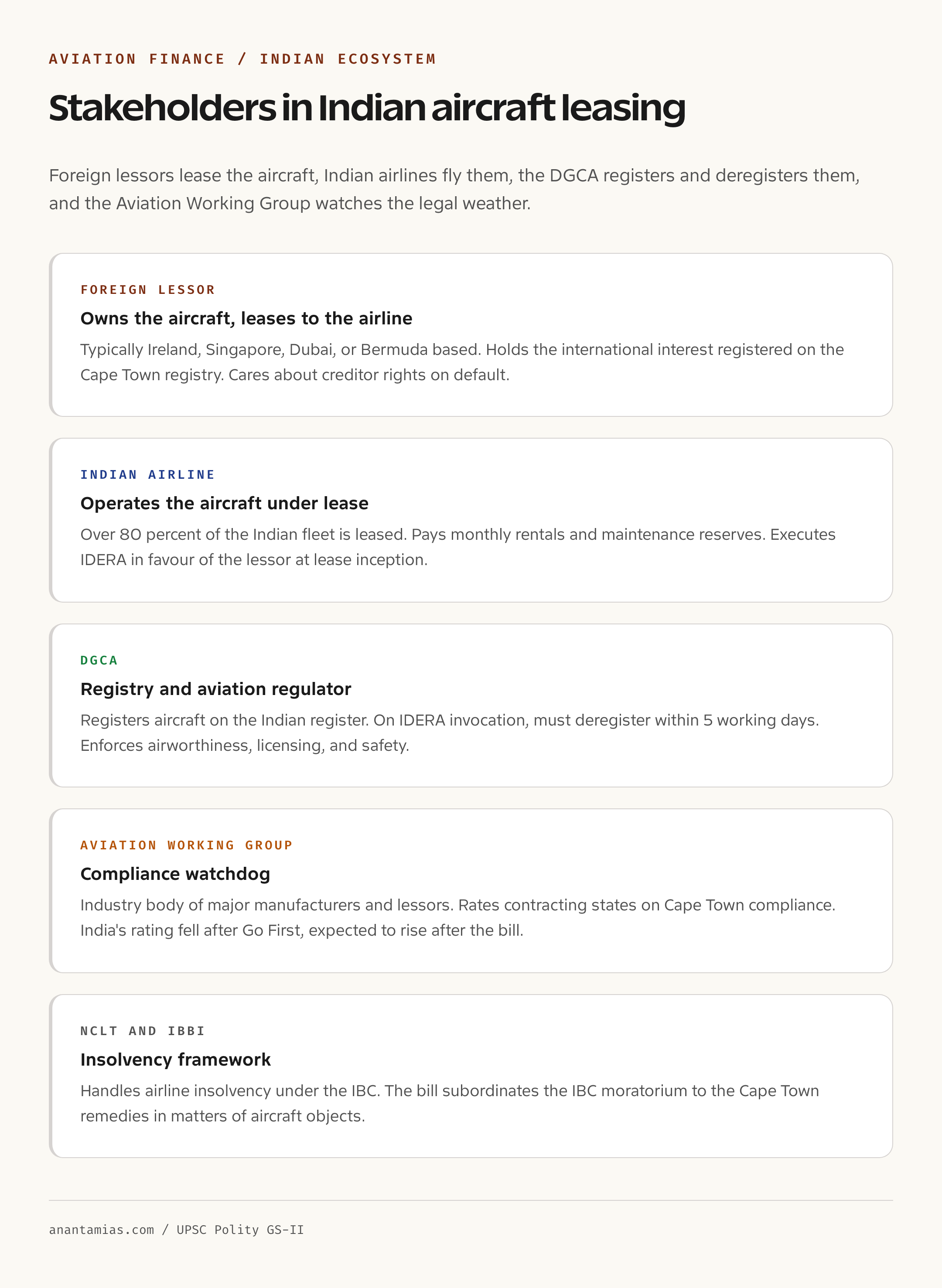
For Indian aviation, the bill is a structural reform of considerable economic weight. Indian carriers operate predominantly on lease arrangements rather than ownership; estimates put the share of leased aircraft in the Indian fleet at over 80%. The cost of lease finance is a major operational expense. By restoring lessor confidence, the bill should reduce lease rentals over time and allow Indian carriers to access lower-cost financing for fleet expansion. With aircraft orders from Indian airlines crossing 1,500 units in 2023 and 2024, even small basis-point reductions in financing cost translate into very large absolute savings.
For lessors, the bill restores the predictability of repossession. A lessor signing a lease with an Indian airline in 2025 can now structure the contract knowing that, on default, the IDERA mechanism will work as intended. This brings India in line with the major aircraft finance jurisdictions, including Ireland, Singapore, Dubai, and Bermuda, all of which have modern aviation finance frameworks.
For the constitutional and policy question of how India treats international treaties, the bill is also instructive. India’s constitutional doctrine on treaties requires implementing legislation for treaties to bind domestic courts. The 17-year gap between signing the Cape Town Convention and full implementation is illustrative of how often treaty obligations sit unenforced. The bill is one example of catching up on this implementation backlog.
Detailed Analysis: How IDERA Works in Practice
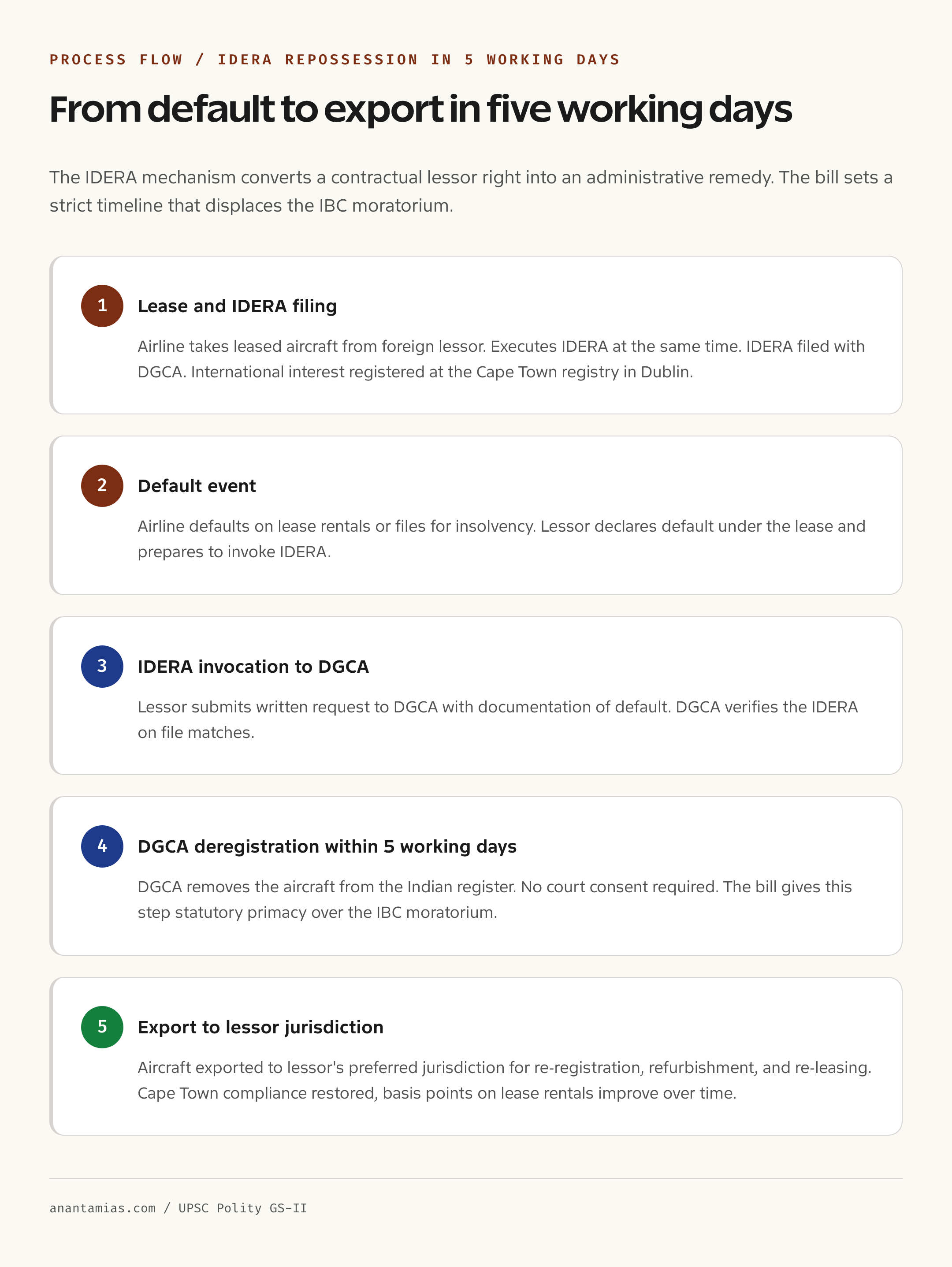
The IDERA mechanism is the operational heart of the bill. When an airline takes a leased aircraft, it executes an IDERA in favour of the lessor at the same time as the lease. The IDERA is filed with the DGCA. As long as the airline remains in compliance, the IDERA sits inert. If the airline defaults, the lessor can invoke the IDERA by submitting a written request to the DGCA, supported by documentation of default.
On invocation, the DGCA is statutorily required to deregister the aircraft within five working days. Deregistration removes the aircraft from the Indian national register, after which it cannot fly under the Indian flag. The lessor can then export the aircraft to its preferred jurisdiction, where it can be re-registered, refurbished, and re-leased. The five-day timeline is short by international standards and reflects the urgency required to preserve the value of the aircraft.
Crucially, the bill places the IDERA mechanism above the IBC moratorium. Even if the airline has filed for insolvency and a Resolution Professional is in charge of the corporate debtor, the IDERA holder can deregister and export the aircraft. The bill thus solves the central legal problem that Go First exposed: the conflict between contractual creditor rights and statutory insolvency moratoriums.
The bill provides for interim court relief if disputes arise about the validity of the default or the propriety of the IDERA invocation. Article X of the Aircraft Protocol requires courts to grant such relief expeditiously, typically within 10 to 30 days of application. The bill incorporates these timelines, ensuring that neither side can use court processes to drag out the dispute.
Comparative Perspective: India and the Cape Town Convention Club
India’s full implementation of the Cape Town Convention puts it in the company of jurisdictions that have built large aviation finance industries on the foundation of clear creditor rights. Ireland, with its Dublin-based fleet of leasing companies, is the global leader. Singapore, Dubai’s International Financial Centre, and Bermuda are major hubs. The United States has its own framework predating Cape Town, but provides comparable creditor protection through the Bankruptcy Code’s Section 1110, which gives a 60-day window similar to the Cape Town Convention’s.
The countries that have struggled with aviation finance are those where the Cape Town Convention is not implemented or where domestic insolvency law conflicts with it. Russia, Indonesia, and Argentina have all faced AWG downgrades in recent years for similar reasons. India’s experience between 2023 and 2025 was a brief but instructive episode in the same category. The bill aligns India with the Ireland-Singapore-Dubai cluster rather than the Russia-Indonesia cluster, with consequences that will play out in lease rentals for the next decade.
Challenges and Implementation Issues
Three challenges face the bill in practice. First, the constitutional question of legislative override. Section 238 of the IBC has been read by courts as a powerful overriding clause. The bill’s claim of primacy in matters of aircraft objects rests on the principle of generalia specialibus non derogant: a special law prevails over a general one in matters covered by the special law. This principle is well-established but is likely to be tested in litigation, particularly the first time a Resolution Professional argues that an aircraft is essential to a viable resolution plan.
Second, the position of secured creditors. Banks and financial institutions that have lent to Indian airlines often hold security interests, including hypothecation, over aircraft. The bill’s primacy over the IBC affects the lender’s position in the resolution waterfall. The interplay between Cape Town Convention rights of lessors and security interests of domestic lenders is not fully spelt out, and will need clarification through rules or judicial decisions.
Third, the institutional capacity at DGCA. The five-working-day window for deregistration assumes that the DGCA can process IDERA invocations within this timeline, including verifying the documentation, providing notice to relevant authorities, and updating the registry. Building and maintaining this administrative capacity, including 24×7 emergency processing for cases where multiple aircraft of a single airline default simultaneously, is an operational challenge.
A fourth concern, raised by some commentators, is the impact on labour. When an airline collapses and aircraft are repossessed, employees lose their jobs. The Cape Town Convention regime privileges creditor rights over the going-concern interest of the airline. The bill’s design reflects this priority. Whether the broader labour and consumer interests of Indian aviation are served by this priority is a policy question that the bill answers in favour of creditor predictability.
Prelims Pointers
The Cape Town Convention on International Interests in Mobile Equipment was adopted in 2001 in Cape Town, South Africa. India acceded to it in 2008. The Aircraft Protocol, adopted alongside the main Convention, governs airframes, aircraft engines, and helicopters. IDERA stands for Irrevocable De-registration and Export Request Authorization. The DGCA is required to deregister an aircraft within five working days of an IDERA invocation. The bill applies to civil aviation aircraft and helicopters; military, customs, and police aircraft are excluded as state aircraft. The bill provides primacy over the Insolvency and Bankruptcy Code, 2016 and the Companies Act, 2013 in matters of aircraft objects. The Aviation Working Group monitors compliance with the Cape Town Convention; India’s compliance rating fell after the Go First case in 2023 but is expected to recover with the bill’s enactment. India lodged Declaration A under Article XI of the Aircraft Protocol, opting for the strongest creditor remedies. Section 14 of the IBC imposes the moratorium that the bill displaces in aircraft matters.
Mains Practice Questions
The Protection of Interests in Aircraft Objects Bill, 2025 is a structural reform of Indian aviation finance. Discuss the key provisions of the bill and their implications for the Indian aviation sector. (15 marks, 250 words)
Examine the conflict between the Cape Town Convention obligations and the moratorium provisions of the Insolvency and Bankruptcy Code as exposed by the Go First case. How does the new bill resolve this conflict? (10 marks, 150 words)
Implementation of international treaties in India often suffers from a long delay between signing and statutory implementation. Critically discuss this challenge with reference to the Cape Town Convention. (15 marks, 250 words)
Way Forward
The bill’s success will depend on three factors over the next few years. First, the consistency of judicial interpretation. Courts must hold the line on the bill’s primacy over the IBC. Any erosion of this primacy through case-by-case carve-outs would re-introduce the uncertainty that Go First exposed. Second, the operational reliability of the DGCA in processing IDERA invocations within the five-day window. The DGCA will need to publish standard operating procedures, build the administrative capacity, and report on its performance. Third, the response of the Aviation Working Group and international lessors. A measurable upgrade in India’s compliance rating, and a corresponding reduction in lease rentals, will be the practical proof that the bill works.
Beyond the immediate aviation context, the bill is a model for treaty implementation. India has a long backlog of international treaties signed but only partially implemented. The bill shows that focused implementing legislation, drafted with attention to the conflicts with existing domestic law, can resolve these gaps. Other treaty obligations, in areas as diverse as data protection, climate finance, and cross-border insolvency, may follow a similar route.
For the larger Indian economy, predictability of creditor rights is one of the foundations of capital availability. The bill is one step in building that predictability. Combined with the IBC for insolvency, the SARFAESI Act for secured lending, and the proposed reforms to commercial dispute resolution, India’s commercial law framework is steadily evolving towards the global standard.
Frequently Asked Questions
What is the Protection of Interests in Aircraft Objects Bill 2025?
The bill is the legislation that fully implements the Cape Town Convention on International Interests in Mobile Equipment (2001) and its Aircraft Protocol into Indian domestic law. It creates clear statutory rights for aircraft lessors and resolves the conflict between treaty obligations and the IBC moratorium that emerged during the Go First insolvency.
What is the Cape Town Convention?
The Cape Town Convention on International Interests in Mobile Equipment is a 2001 international treaty under UNIDROIT and ICAO that standardises creditor rights in mobile assets that cross borders, including aircraft, railway rolling stock, and space objects. The Aircraft Protocol applies these principles specifically to civil aviation. India acceded to the Convention in 2008.
What is IDERA?
IDERA stands for Irrevocable De-registration and Export Request Authorization. It is a pre-signed authorisation that an airline executes in favour of an aircraft lessor at the time of leasing. If the airline defaults, the lessor can invoke the IDERA, and the DGCA is required to deregister the aircraft from the Indian register within five working days, allowing export to another jurisdiction.
What was the Go First case and why did it matter?
Go First Airlines filed for insolvency in May 2023. The NCLT imposed a moratorium under Section 14 of the IBC, which prevented foreign aircraft lessors from repossessing their aircraft despite valid lease agreements. The case exposed the conflict between Cape Town Convention obligations and Indian insolvency law, led to a downgrade in India’s compliance rating with the Aviation Working Group, and pushed up lease rentals for Indian carriers.
Does the bill apply to all aircraft?
The bill applies to airframes, aircraft engines, and helicopters used in civil aviation. It does not apply to state aircraft, which include military aircraft, customs aircraft, and police aircraft. This carve-out follows the Cape Town Convention itself, which is concerned with commercial aviation finance, not government-operated aviation.
How does the bill resolve the IBC conflict?
The bill establishes primacy of its provisions over the Insolvency and Bankruptcy Code, 2016 and the Companies Act, 2013, in matters relating to aircraft objects. This means the IBC moratorium under Section 14, which freezes all recovery actions against an insolvent corporate debtor, will not apply to lessor actions to repossess and export aircraft.
What is the Aviation Working Group?
The Aviation Working Group is an international industry body, formed by major aircraft manufacturers and lessors, that monitors and reports on contracting states’ compliance with the Cape Town Convention. Its compliance rating directly affects the lease rentals that lessors charge in different jurisdictions. India’s rating was downgraded after Go First and is expected to be upgraded after the bill’s enactment.
Why is the five-working-day deregistration timeline important?
The five-working-day timeline is short by international standards and reflects the urgency of preserving aircraft value. Aircraft are highly mobile assets that depreciate rapidly when grounded and require continuous maintenance. A long deregistration delay can translate into significant value loss for the lessor and affect the market for the aircraft on resale.
Tell Google you want more of this.
Add Anantam IAS as a preferred sourceOne tap, and this site shows up more often in your own Top Stories, AI Overviews and AI Mode. Remove it any time.