India is one of the most racially diverse populations in the world — the result of repeated waves of human migration over 65,000 years: the Out-of-Africa modern humans, Austro-Asiatic farmers from the East, Tibeto-Burman migrations from the Northeast, and steppe pastoralists from the West. The classical anthropological classification by B.S. Guha (1935) identified six racial elements in India; modern population genetics has reframed this as a mixture of Ancestral North Indian (ANI), Ancestral South Indian (ASI), Austro-Asiatic, and Tibeto-Burman ancestries.
For UPSC GS-I (Indian Society) and GS-II (vulnerable sections, racial discrimination), racial diversity is significant for two reasons: it shapes regional cultural identity, and it is the basis for racial discrimination — especially against Northeast Indians and Africans — which the state has tried to address through committees, advisories, and now a possible dedicated anti-racial-discrimination law.
This guide covers the conceptual basis, the classical and modern classifications, the Indian context, the legal-constitutional framework, key government interventions, and 2024-26 issues.
Defining Race and Racial Diversity
Race, in classical anthropology, is a population sharing distinct heritable physical traits — skin colour, hair texture, facial features, head shape. UNESCO's 1950 and 1967 statements on race held that biological races among humans, in any pure form, do not exist; differences are clinal and overlapping.
Racial diversity therefore refers to observed phenotypic and ancestral variation among groups — useful for anthropology, genetics, and forensic medicine, but not a license for hierarchy. The Indian Constitution's Article 15 prohibits discrimination on grounds of "religion, race, caste, sex, or place of birth."
Race vs. Ethnicity
- Race: Biological-phenotypic basis (skin, hair, features).
- Ethnicity: Shared culture, language, religion, history.
- Ancestry: Genetic-genealogical lineage.
UPSC answers should distinguish them carefully — most "racial" disputes in India are actually ethnic disputes coded as racial.
Sociological and Anthropological Lens
- Émile Durkheim: Group differentiation feeds organic solidarity but also generates "boundary maintenance".
- Max Weber: Status groups can be ethnic/racial — closed, monopolistic, ranked.
- Frantz Fanon: Race is a colonial construct — Black Skin, White Masks (1952).
- Stuart Hall: Race is "a floating signifier" — biologically thin, politically thick.
- Indian anthropologists: B.S. Guha (1935), Sarat Chandra Roy, Iravati Karve, K.S. Singh (People of India project, 1985-2002 — documented 4,635 communities).
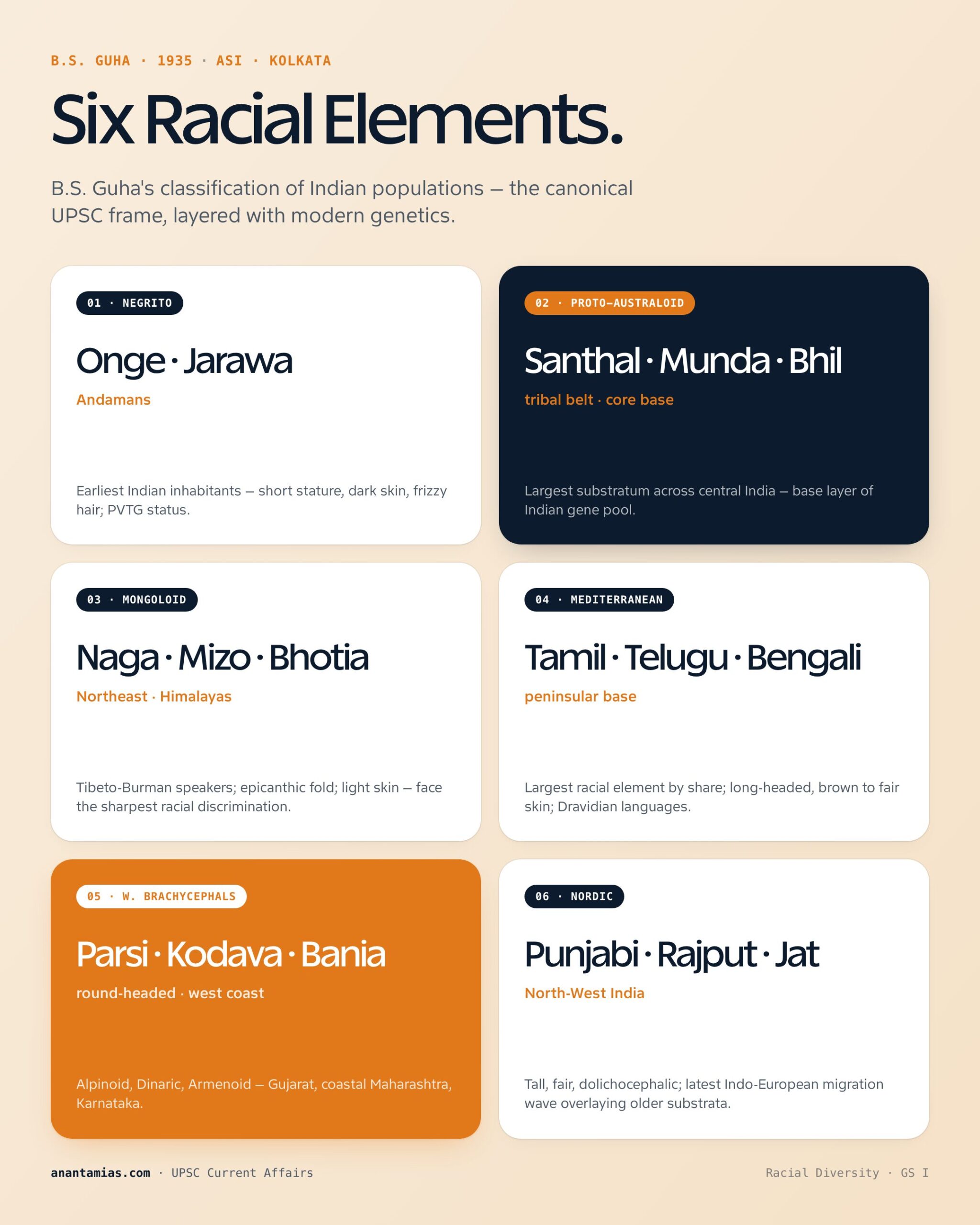
B.S. Guha's Classification (1935): Six Racial Elements
| Race | Distinct Traits | Region |
|---|---|---|
| Negrito | Short, dark, woolly hair | Andaman (Onge, Jarawa), Kerala hills (Kadar) |
| Proto-Australoid | Wavy hair, broad nose, dark complexion | Central, peninsular tribes — Munda, Santhal, Bhil |
| Mongoloid | Yellow skin, scanty body hair, epicanthic fold | Northeast, Ladakh, Himalayas |
| Mediterranean | Long head, narrow nose, brown skin | South India — Tamils, Telugu speakers |
| Western Brachycephal | Broad head | Coorgis, Parsis, Bengalis |
| Nordic | Tall, fair, long head | Indo-Gangetic plains |
Guha's classification is descriptive and now contested. Modern genetics has subsumed it.
Modern Population Genetics: ANI, ASI, AAA, ATB
Reich et al. (Nature, 2009), Moorjani et al. (2013), and the Indian Genome Variation Consortium (2008) show Indian populations are mixtures of:
| Ancestral Population | Source | Today |
|---|---|---|
| ANI (Ancestral North Indian) | West Eurasian, Iranian-related farmers + steppe pastoralists | North-Northwest India |
| ASI (Ancestral South Indian) | Indigenous South Asian hunter-gatherers | Tamil Nadu, Kerala, tribes |
| AAA (Austro-Asiatic) | Southeast Asian migrants ~4,000 BP | Munda, Khasi, Santhal |
| ATB (Ancient Tibeto-Burman) | East Asian migrations | Northeast, Himalayas |
| AHG (Andamanese) | Distinct early dispersal | Andaman Islands |
Genetic studies show endogamy is recent and strong — most jatis are reproductively isolated for ~1,000-2,000 years (Basu et al., PNAS 2016). This intensifies recessive disease risk and explains the persistence of phenotype clusters.
Racial Diversity Across Indian Regions
- Andaman & Nicobar: Negrito groups (Onge, Jarawa, Sentinelese, Great Andamanese) — oldest human lineages in India.
- Northeast: Tibeto-Burman speakers — Naga, Mizo, Manipuri, Khasi (Austro-Asiatic), Garo, Adi, Apatani.
- Central India: Proto-Australoid affinities — Gond, Bhil, Munda, Santhal.
- South India: Mediterranean and ASI — Tamil, Telugu, Malayali, Kannadiga.
- North-Northwest: Indo-Aryan, Western Brachycephal, Nordic affinities — Punjabi, Rajasthani, Kashmiri.
- West: Mixed populations — Marathi, Gujarati, Konkani, Sindhi, Parsi.
Northeast India: The Sharpest Edge of Racial Discrimination
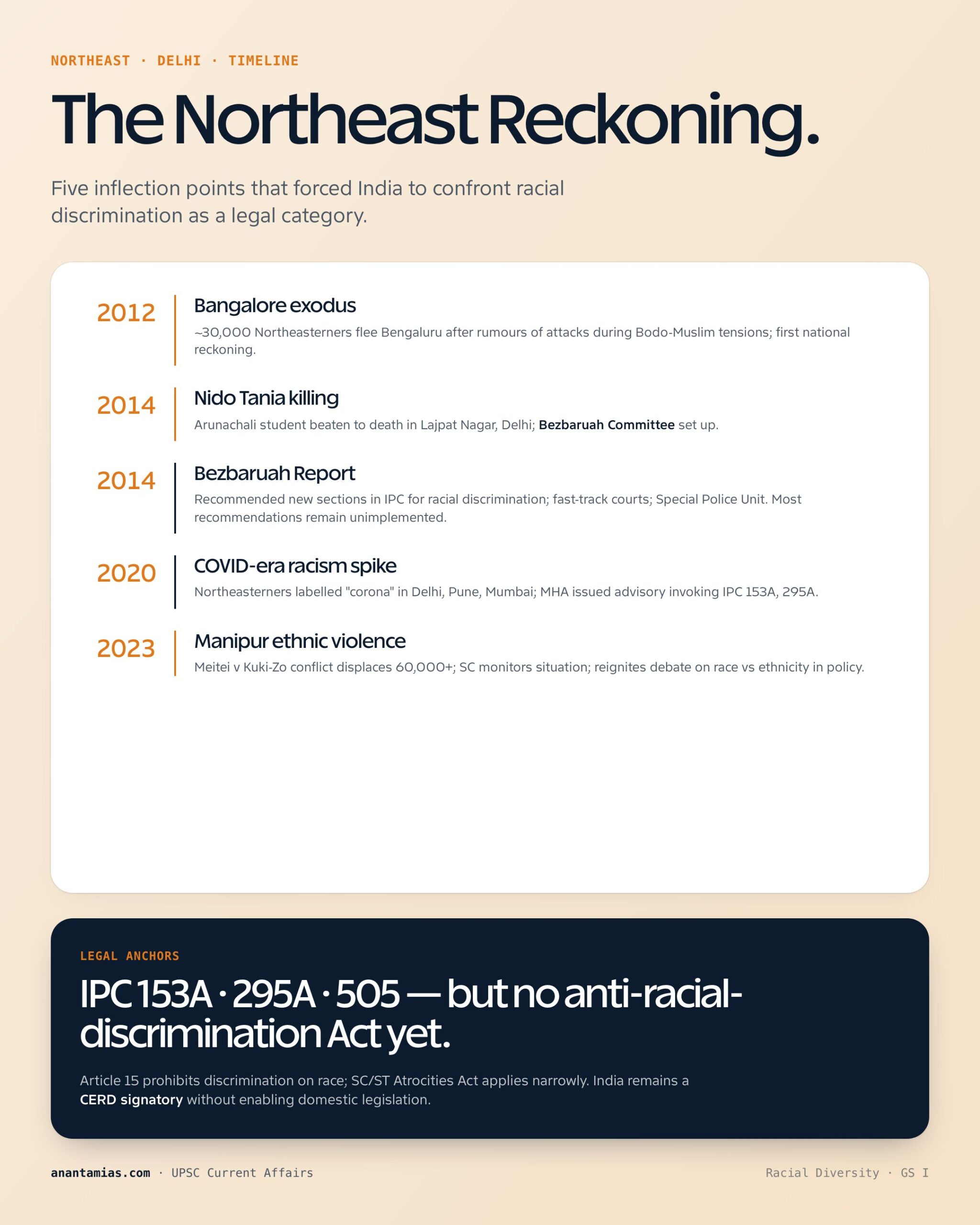
Northeast Indians, with distinct Mongoloid features, face systematic racial profiling, prejudice, and violence in metro India.
Key Incidents
- Nido Tania, an Arunachal Pradesh student, killed in Delhi (2014).
- COVID-19 era (2020): Northeast Indians spat at, called "Chinese", "corona", in multiple cities.
- Manipur 2023-24: Internal ethnic conflict between Meitei and Kuki-Zo communities killed 200+ and displaced 60,000+.
- 2024 Delhi survey by North East Support Centre and Helpline (NESCH): 86% of NE students reported facing racial slurs at least once.
Bezbaruah Committee (2014)
Constituted after Nido Tania's death; recommended:
- A specific anti-racial discrimination law with stringent penalties.
- Amendment to Section 153A IPC (now Section 196 BNS 2023) for racial offences.
- A special police unit in metros for NE persons.
- Awareness drives in schools, workplaces, police.
Government Response
- MHA Advisory (2014, reissued 2020) for stringent action against NE racial offences.
- NESCH as 24×7 helpline.
- Special Police Unit, Delhi — operational since 2014.
- Bharat Niwas (NE State Bhavans) as cultural anchors.
- Look East / Act East policy (since 1991/2014) — connects NE economically and culturally.
- PM-DevINE (2022) — ₹6,600 crore for NE infrastructure.
- NEP 2020 explicitly mentions reducing prejudice through curricular content.
African Migrants and Students
India has ~25,000-30,000 African students (MEA estimates). Multiple incidents — Bengaluru 2016 (Tanzanian student stripped), Greater Noida 2017 (Nigerian students attacked) — prompted MEA to issue advisories. The Indian Council for Cultural Relations (ICCR) runs sensitisation but anti-racism legislation specifically for foreigners is still pending.
Constitutional and Legal Framework
| Instrument | Provision |
|---|---|
| Article 14 | Equality before law |
| Article 15(1) | Prohibition of discrimination on grounds of race |
| Article 15(2) | No restriction on access to public places by race |
| Article 16 | Equality of opportunity in public employment |
| Article 21 | Right to life and dignity |
| BNS 2023, Sections 196-197 | Promoting enmity between groups (formerly IPC 153A, 153B) |
| BNS 2023, Section 79 | Word, gesture or act intended to insult modesty (replaces 509 IPC) |
| Information Technology Act 2000, Section 66A struck down (2015) but 74 BNS covers obscenity online | |
| SC/ST (POA) Act 1989 amended 2015 | Protects SC/STs (including NE STs) from atrocities |
A standalone anti-racial discrimination law has been on the agenda since the Bezbaruah Committee but is yet to be enacted (2026).
International Conventions
- UN International Convention on the Elimination of All Forms of Racial Discrimination (ICERD), 1965: India is a state party.
- Durban Declaration 2001: India's position — caste is not race; subject to internal jurisdiction.
- UN Special Rapporteur on Racism: Periodic reports include Indian context.
2024-26 Issues and Policy Debates
- Manipur conflict 2023-24: Highlighted ethnic-racial fault lines within Northeast itself; 220+ deaths, 60,000+ displaced; SC-monitored relief.
- Census 2027: Will provide updated tribal and linguistic data — racial composition is no longer enumerated separately.
- NEP 2020 implementation: Multilingual content, Northeast cultural modules.
- Hate speech surge during 2024 election cycle — RSF World Press Freedom Index ranked India 159/180.
- Citizenship Amendment Act 2024 (rules notified): Northeast states (esp. Assam, Tripura) have raised demographic-cultural concerns.
- Delhi 2024 survey (NESCH): 86% of NE students faced racial slurs.
- AI bias: Indian face-recognition datasets under-represent Mongoloid features — flagged by NIST 2023 report.
Sociological Perspectives
| Theorist | Concept | Application |
|---|---|---|
| B.S. Guha | Six racial elements | Classical typology of India |
| K.S. Singh | People of India | 4,635 communities documented |
| Andre Beteille | Race-caste distinction | Caste is not race; both axes of stratification |
| Stuart Hall | Race as floating signifier | Northeast Indians racialised in metros |
| Frantz Fanon | Colonised self | Internalised racism in postcolonial India |
| Sanjib Baruah | NE as "durable disorder" | State and racial governance in Northeast |
Government Initiatives
- Bezbaruah Committee implementation (partial).
- NESCH 24×7 helpline.
- Special Police Unit for NE in Delhi, Bengaluru.
- Look East / Act East + PM-DevINE.
- Eklavya Model Residential Schools for tribal/NE students.
- NEP 2020 anti-bias curriculum modules.
- Sangeet Natak Akademi, ICCR, Sahitya Akademi — racial-cultural inclusion.
Data Snapshot (2024-26)
| Indicator | Value | Source |
|---|---|---|
| Communal/racial incidents (NE in Delhi 2024) | 86% NE students faced slurs | NESCH 2024 |
| Manipur deaths | 220+ | MHA, 2024 |
| African students in India | ~25,000-30,000 | MEA |
| ST share | 8.6% | Census 2011 |
| PVTGs | 75 | MoTA |
| Documented communities | 4,635 | People of India project |
| Communal riot cases | 272 (2022) | NCRB |
| Press Freedom rank | 159/180 | RSF 2024 |
Challenges
- Cultural unfamiliarity between mainland and Northeast.
- Stereotyping in films, advertising, media.
- Inadequate legal recourse — no dedicated anti-race law.
- Internal racism — fair-skin bias, "matrimonial colourism".
- Endogamy and genetic disease burden — sickle cell, thalassemia.
- Police sensitisation gaps in metros.
- Online hate speech with weak takedown mechanisms.
Way Forward
- Enact a standalone Anti-Racial Discrimination Act (Bezbaruah recommendation).
- Strengthen Section 196-197 BNS enforcement on hate speech.
- Sensitisation curricula in police academies, schools, workplaces.
- Cultural integration: Ek Bharat Shreshtha Bharat scaled up; PM-DevINE infrastructure.
- Genetic counselling for endogamy-related disease in tribal/NE belts (e.g., National Sickle Cell Anaemia Elimination Mission, 2023, ₹1,500 crore).
- Media self-regulation on racial portrayal — Press Council, NBSA codes.
- Inclusive digital infrastructure — multilingual government portals, accessible identity documents.
Mains Hook
"Racial diversity is a fact of Indian biology and a project for Indian polity." Discuss the legal and policy framework to combat racial discrimination in India, with special reference to Northeast Indians. (GS-I, 250 words, 15 marks)
Prelims Pointers
- Six racial elements (Guha 1935): Negrito, Proto-Australoid, Mongoloid, Mediterranean, Western Brachycephal, Nordic.
- Negrito groups in Andaman: Onge, Jarawa, Sentinelese, Great Andamanese.
- ANI-ASI: Reich et al., Nature 2009.
- Bezbaruah Committee: 2014, anti-racial discrimination recommendations.
- NESCH: NE Support Centre and Helpline (Delhi).
- PM-DevINE: Launched 2022, ₹6,600 crore.
- ICERD: 1965 — India is signatory.
- Article 15(1): Prohibits race-based discrimination.
- National Sickle Cell Anaemia Elimination Mission: 2023, ₹1,500 crore.
- People of India project: K.S. Singh, ASI; documented 4,635 communities.
Racial diversity in India is at once biological richness, cultural depth, and political vulnerability. UPSC answers should braid all three threads — anthropology, genetics, and rights-based governance — to do justice to the topic.
Tell Google you want more of this.
Add Anantam IAS as a preferred sourceOne tap, and this site shows up more often in your own Top Stories, AI Overviews and AI Mode. Remove it any time.