The Supreme Court’s January 2025 ruling in Bernard Francis Joseph Vaz v. Government of Karnataka returns the right to property to the centre of constitutional debate. After four decades during which the right was treated as a residual constitutional right of secondary importance, the Court held in clear terms that “adequate compensation” is an inherent part of Article 300A. The state cannot deprive a person of property without paying fair value, and the procedural protections that surround the right are not optional but constitutionally mandated. The ruling also showcased the Court’s use of Article 142, the “complete justice” power, to shift the valuation date from the 2003 acquisition notification to 2019, which translated into substantially higher compensation for the landowners affected by the Bengaluru-Mysuru Infrastructure Corridor Project.
For UPSC aspirants, the ruling is a reset point on the property-rights question. It builds on the 2024 Kolkata Municipal Corporation v. Bimal Kumar Shah ruling, which articulated seven procedural rights under Article 300A, and consolidates them with a clear statement on substantive compensation. The case also offers a textbook illustration of how the Supreme Court uses Article 142 to deliver constitutional justice in fact patterns where statutory remedies have failed. This guide walks through the constitutional history of property rights in India, the 2025 ruling, the seven procedural rights, the LARR Act framework, and the prelims and mains pointers an aspirant should consolidate.
Quick Facts on the 2025 Property Ruling
The case is Bernard Francis Joseph Vaz v. Government of Karnataka. The Court held that adequate compensation is an inherent part of Article 300A of the Constitution. The trigger was a 22-year delay in paying compensation for land acquired for the Bengaluru-Mysuru Infrastructure Corridor Project, popularly called BMICP. The Court invoked Article 142 to shift the date for determining the market value of the land from the 2003 notification to 2019, accounting for inflation and delay. Article 300A is in Part XII of the Constitution and is a constitutional right and a human right, but not a fundamental right. The 44th Constitutional Amendment, 1978 repealed Article 19(1)(f) and Article 31, demoting property from a fundamental right to a constitutional right. The seven procedural rights under Article 300A were articulated in Kolkata Municipal Corporation v. Bimal Kumar Shah, 2024.
What Article 300A Says
Article 300A of the Constitution states: “No person shall be deprived of his property save by authority of law.” It is a single-sentence article placed in Part XII (Finance, Property, Contracts and Suits), inserted by the 44th Amendment Act, 1978. The textual brevity has been deceptive. Decades of judicial interpretation have read into Article 300A both substantive and procedural protections that go well beyond what the bare text suggests. The 2025 ruling crystallises this jurisprudence by holding that “authority of law” includes both procedural fairness and substantive compensation.
Background and Historical Context
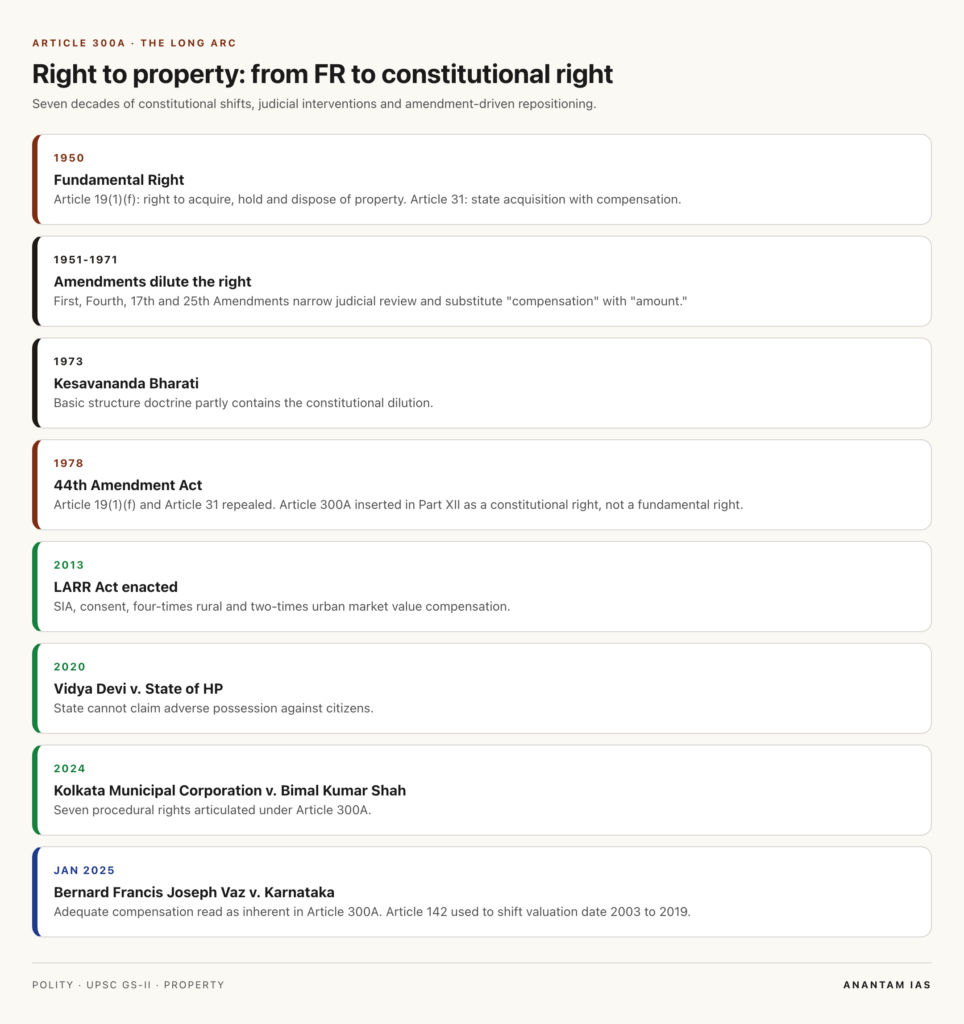
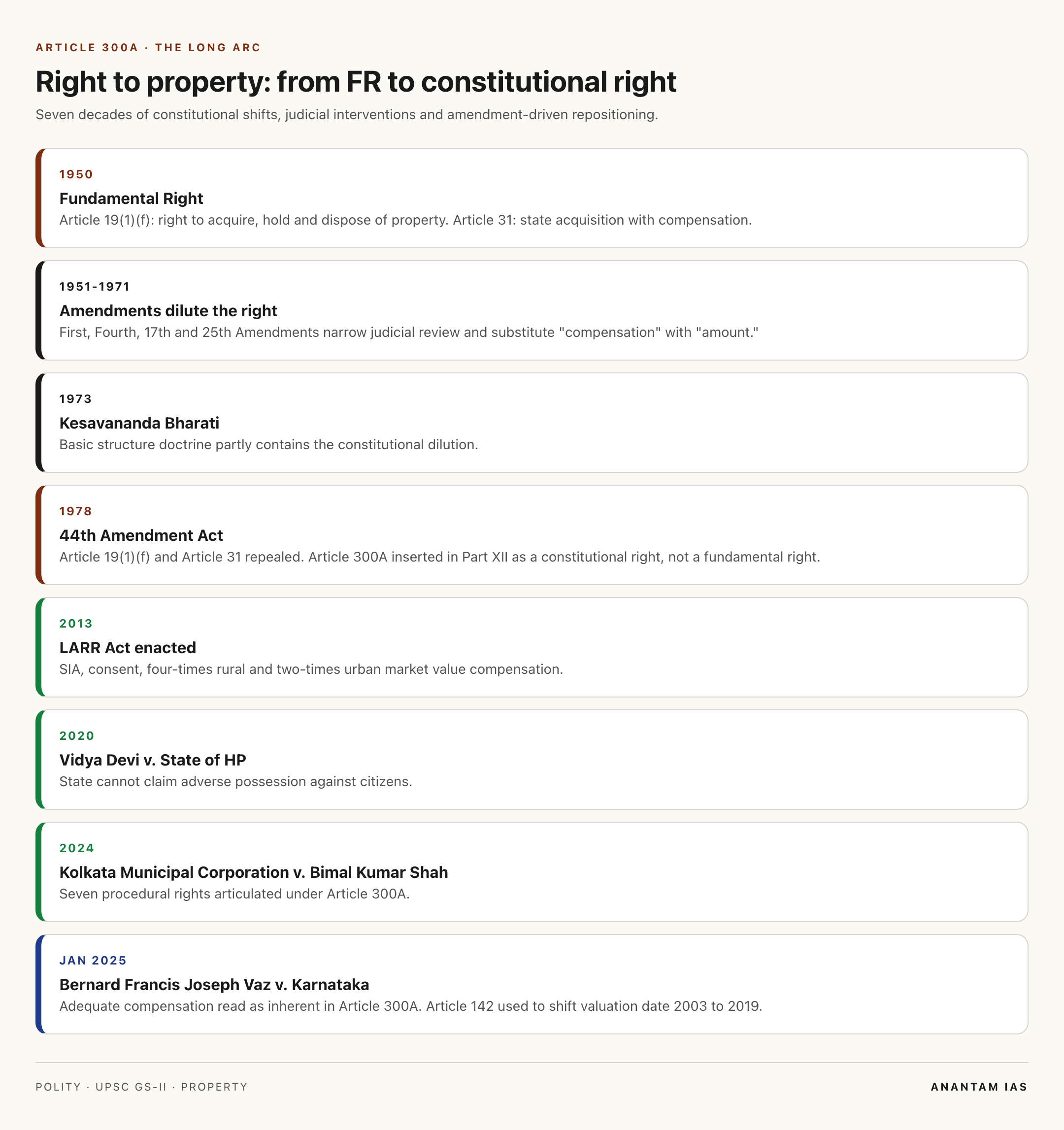
The constitutional history of the right to property is one of the most contested in independent India. As originally adopted in 1950, the Constitution placed the right to property in two locations. Article 19(1)(f) gave every citizen the right to acquire, hold and dispose of property, subject to reasonable restrictions. Article 31 prohibited the state from acquiring private property except for a public purpose and only after paying compensation. These provisions sat uncomfortably alongside the early socialist agenda of land reforms, abolition of zamindari and ceiling laws.
A long sequence of constitutional amendments followed, each attempting to insulate land-reform legislation from judicial review. The First, Fourth, Seventeenth and Twenty-Fifth Amendments progressively narrowed judicial review, moved land-reform laws into the Ninth Schedule, and substituted “compensation” with “amount” so that courts could not adjudicate adequacy. The Kesavananda Bharati ruling of 1973 partly contained this trajectory by establishing the basic structure doctrine. The 44th Amendment of 1978 took the next decisive step. It repealed Article 19(1)(f) and Article 31, removing property from the list of fundamental rights altogether, and inserted Article 300A in Part XII to retain the right as a constitutional right. The objective, in the Statement of Objects and Reasons, was to reduce litigation against land-reform legislation. For more on this constitutional shift, see our explainer on the 44th Amendment of the Indian Constitution.
The post-1978 trajectory has been one of judicial restoration. In a series of rulings, including Tukaram Kana Joshi v. MIDC, Vidya Devi v. State of Himachal Pradesh in 2020, and Kolkata Municipal Corporation v. Bimal Kumar Shah in 2024, the Court has read substantive and procedural content back into Article 300A. The 2025 Vaz ruling is the latest and most consequential step in this restoration.
The 2025 Ruling: Bernard Francis Joseph Vaz v. Karnataka
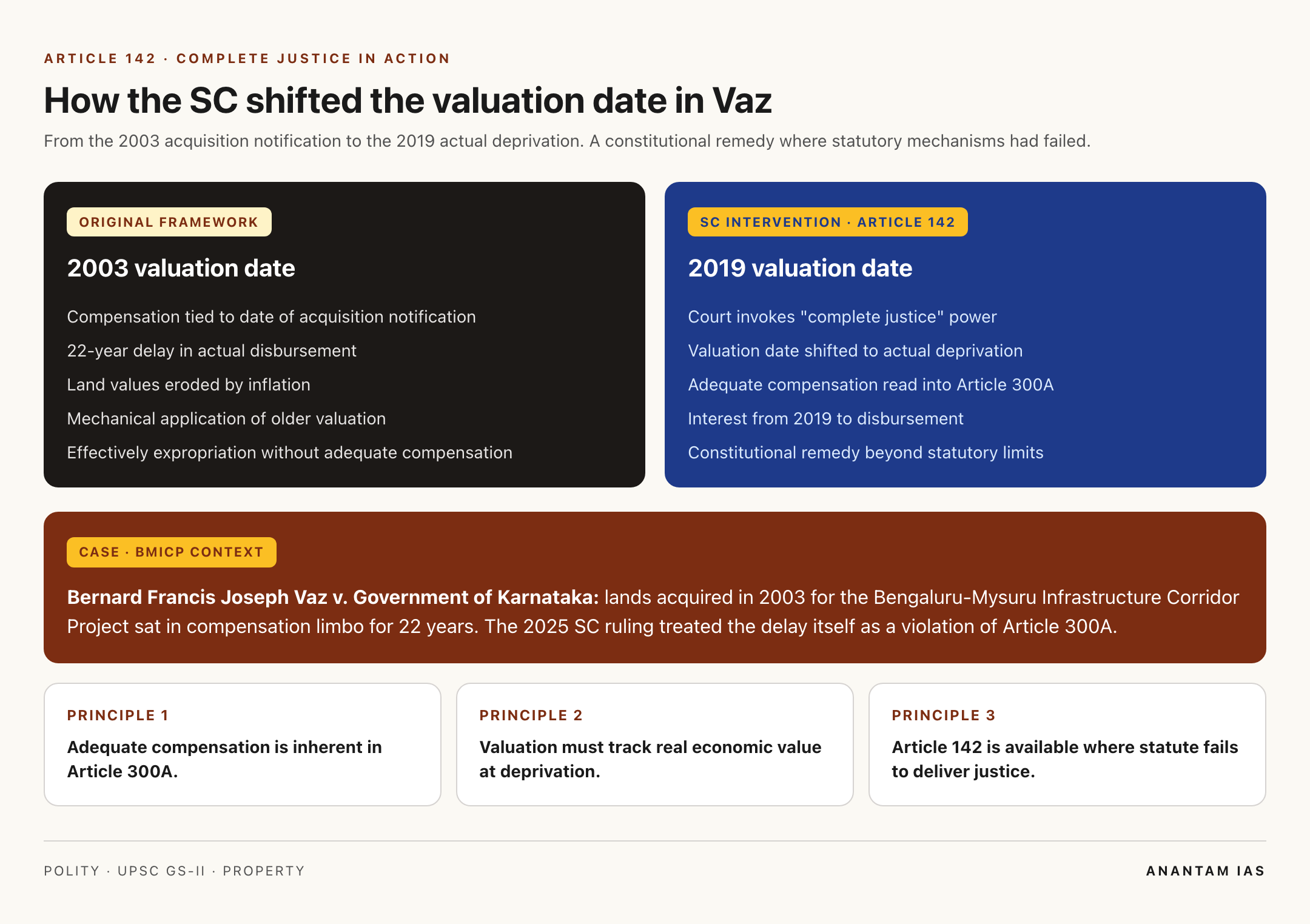
The fact pattern is straightforward and instructive. Lands belonging to the Vaz family in Karnataka were notified for acquisition in 2003 for the Bengaluru-Mysuru Infrastructure Corridor Project, a major highway and urban-development project. Compensation was determined on the basis of 2003 market values. Possession was taken, but actual disbursement of compensation was delayed for 22 years through procedural and litigation pendency. By the time the matter reached the Supreme Court, the 2003 compensation amount had become substantially eroded by inflation and the dramatic rise in land values in the corridor.
The Court held that Article 300A guarantees not only that property cannot be taken without authority of law but that the compensation paid must be adequate, having regard to the time of actual deprivation and the market value at that time. The Court held that the 22-year delay was an infringement of the right under Article 300A and that mechanical application of the 2003 valuation would amount to expropriation without adequate compensation. Invoking its Article 142 power to do “complete justice,” the Court directed that the market value be determined as of 2019, with appropriate interest from that date until actual disbursement. The ruling thus translated abstract constitutional doctrine into a concrete monetary remedy. Our Constitution of India explainer covers the broader constitutional setting in which Article 142 operates.
The 7 Procedural Rights Under Article 300A
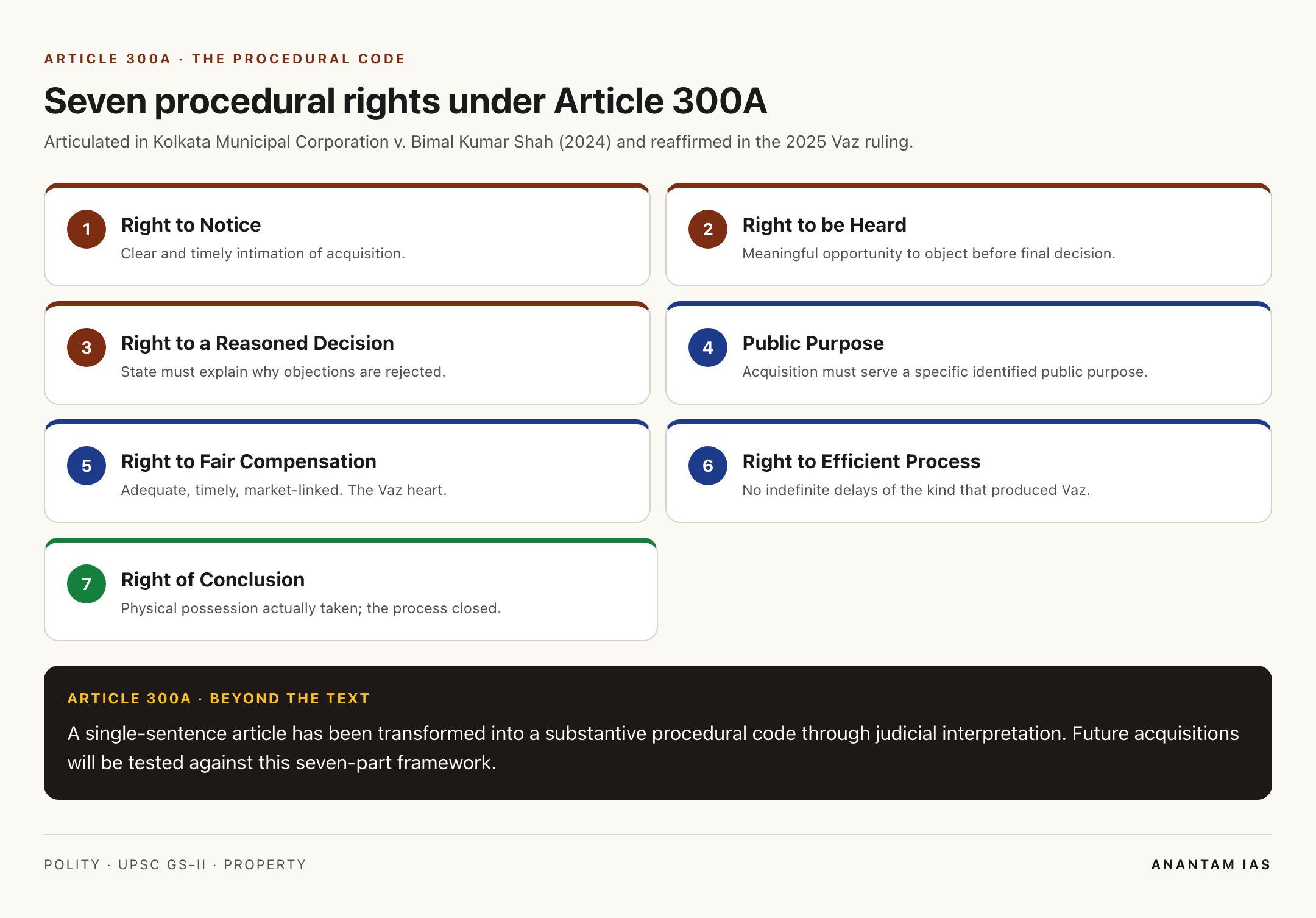
The 2024 Kolkata Municipal Corporation v. Bimal Kumar Shah ruling, reaffirmed and built upon in the 2025 Vaz judgment, identifies seven procedural rights that flow from Article 300A. These are not optional administrative niceties but constitutional pre-conditions for any acquisition of private property. The first is the right to notice, meaning clear and timely intimation that acquisition is being initiated, with sufficient detail to allow the affected person to respond. The second is the right to be heard, meaning a meaningful opportunity to object to the acquisition before a final decision.
The third is the right to a reasoned decision, meaning that the state must explain in writing why objections have been rejected, so that the decision is open to administrative and judicial review. The fourth is the public purpose, meaning that acquisition cannot be for private profit or for a vague generalised intent but must serve a specific identified public purpose. The fifth is the right to fair compensation, the substantive heart of Article 300A as articulated in the 2025 Vaz ruling. The sixth is the right to an efficient process, which prohibits indefinite delays of the kind that inflicted the 22-year limbo on the Vaz petitioners. The seventh is the right of conclusion, which requires the state to actually take physical possession and bring the acquisition process to a definitive close.
These seven rights together transform Article 300A from a single-sentence article into a substantive procedural code. Future challenges to land acquisitions, urban-development projects and infrastructure corridors will be tested against this seven-part framework. For broader rights context, our fundamental rights and articles explainer maps how rights are organised in the Constitution.
Article 142: Complete Justice in Action
Article 142 of the Constitution gives the Supreme Court the power to pass any decree or order necessary for doing “complete justice” in any cause or matter pending before it. The provision is unique in comparative constitutional law in the breadth of remedial authority it confers. Article 142 has been used to clean the Taj Trapezium, to evolve guidelines on sexual harassment in Vishaka, and to lay down inter-faith adoption norms in the Shabnam Hashmi context. Its use in the Vaz ruling fits this pattern of the Court treating statutory inadequacy as no bar to constitutional remedy.
The valuation-date shift from 2003 to 2019 is the operative innovation. Under the colonial Land Acquisition Act, 1894, valuation date was tied to the date of the acquisition notification, which created the precise problem that the Vaz fact pattern illustrated: a notification can sit unactioned for years while inflation erodes the compensation award. The Court’s Article 142 intervention says, in effect, that constitutional fairness requires the valuation date to track real economic value at the time of actual deprivation, not at the time of administrative initiation. Our article-141-of-indian-constitution explainer covers the related power under which Supreme Court rulings bind all courts.
The LARR Act 2013 and the Modern Acquisition Framework
The Right to Fair Compensation and Transparency in Land Acquisition, Rehabilitation and Resettlement Act, 2013, popularly called the LARR Act, replaced the colonial Land Acquisition Act, 1894. The LARR Act is the principal statutory framework within which acquisition operates today. It mandates a Social Impact Assessment before any acquisition, requires consent from a defined percentage of affected families for private and public-private projects, and prescribes higher compensation: four times the market value in rural areas and two times the market value in urban areas. It also imposes rehabilitation and resettlement obligations on the acquirer, including provision of housing, employment training and additional benefits.
The 2025 Vaz ruling does not disturb the LARR Act framework. The Vaz acquisition was notified under the older 1894 Act, which is why the case engaged the older valuation-date rule. The Court’s use of Article 142 effectively imports an LARR-style fair-compensation principle into the older acquisition without retrospectively applying the LARR Act itself. Future acquisitions under the LARR Act will operate within a clearer framework, but the 2025 ruling provides the constitutional anchor for treating fair compensation as a non-negotiable constitutional right rather than a mere statutory entitlement.
Adverse Possession and the State
A related strand of jurisprudence concerns adverse possession claims by the state. In Vidya Devi v. State of Himachal Pradesh, 2020, the Supreme Court ruled that the state cannot claim adverse possession to retain land it has occupied without formal acquisition. The Court held that the state, as a welfare entity bound by constitutional obligations, cannot act like a private trespasser claiming title through long possession against a citizen. The ruling closed off a procedural shortcut by which the state had often retained occupied land without the formality of acquisition or compensation.
The Vidya Devi line of reasoning has informed the 2025 Vaz ruling. Both rulings reflect a constitutional philosophy that treats the state’s relationship with citizen property as fundamentally different from a private property dispute. The state must follow process, pay adequate compensation, and cannot leverage delay or possession to escape these obligations.
Comparative Approach: Property as a Right Across Jurisdictions
The American Fifth Amendment requires “just compensation” for any taking of private property, and the Supreme Court has developed a substantial body of takings jurisprudence including the regulatory-takings doctrine. The European Convention on Human Rights, in Protocol 1 Article 1, recognises a right to peaceful enjoyment of possessions, with permissible deprivation only in the public interest and subject to conditions provided by law. The South African Constitution, in Section 25, recognises a right to property with detailed provisions on expropriation and just-and-equitable compensation, designed against the backdrop of land reform.
India’s Article 300A occupies an intermediate position. It is a constitutional right but not a fundamental right, removing the immediate writ-jurisdiction protections that fundamental rights carry. But the Supreme Court’s recent jurisprudence, culminating in the 2025 Vaz ruling, has effectively restored most of the substantive content that the original Article 19(1)(f) and Article 31 had carried. The Indian framework is in practice closer to the American “just compensation” jurisprudence than the constitutional text alone suggests.
Challenges and Implementation Issues
Three challenges sit on the road ahead. The first is litigation volume. The Vaz ruling will trigger a wave of revaluation petitions for delayed acquisitions across the country, particularly for older infrastructure projects where compensation is still pending. The second is administrative capacity. Implementing the seven-part procedural framework requires record-keeping, public consultation, reasoned decisions and timely processing that many state acquisition departments are not yet structured for. The third is the policy balance. India’s infrastructure agenda depends on timely land acquisition, and the strengthened procedural and substantive protections must be implemented without creating indefinite paralysis.
Prelims Pointers
Article 300A is in Part XII (Finance, Property, Contracts and Suits) of the Constitution. It states: “No person shall be deprived of his property save by authority of law.” It was inserted by the 44th Constitutional Amendment, 1978, which simultaneously repealed Article 19(1)(f) and Article 31. The right to property is a constitutional right and a human right, but not a fundamental right. The 2025 case is Bernard Francis Joseph Vaz v. Government of Karnataka. The trigger was the 22-year delay in compensation for the Bengaluru-Mysuru Infrastructure Corridor Project. The Court used Article 142 to shift the valuation date from 2003 to 2019. The seven procedural rights under Article 300A were articulated in Kolkata Municipal Corporation v. Bimal Kumar Shah, 2024. The LARR Act, 2013 mandates Social Impact Assessment, consent thresholds, four-times market value in rural areas and two-times market value in urban areas. Vidya Devi v. State of HP, 2020 ruled that the state cannot claim adverse possession against citizens.
Mains Practice Questions
- The Supreme Court’s January 2025 ruling on Article 300A reads adequate compensation as an inherent part of the right to property. Examine the constitutional reasoning and assess its implications for land acquisition in India. (GS Paper 2, 250 words)
- Trace the constitutional evolution of the right to property from Articles 19(1)(f) and 31 to Article 300A, and analyse the role of the 44th Amendment Act, 1978. (GS Paper 2, 250 words)
- The seven procedural rights under Article 300A, as articulated by the Supreme Court, transform a single-sentence article into a substantive procedural code. Discuss. (GS Paper 2, 150 words)
- Examine the use of Article 142 by the Supreme Court in the Vaz ruling and reflect on the limits of the “complete justice” power. (GS Paper 2, 150 words)
Way Forward
Three reforms would consolidate the post-Vaz framework. First, the Centre and states should issue revised standard operating procedures for land acquisition that explicitly map onto the seven procedural rights, with built-in timelines for each step to prevent the kind of multi-decadal limbo that produced the Vaz fact pattern. Second, the LARR Act framework should be reviewed to address operational bottlenecks in Social Impact Assessment, consent gathering and rehabilitation, with state-level capacity building. Third, a national land-acquisition transparency portal should be created, listing all pending acquisitions, compensation status and procedural milestones, to give affected citizens and oversight bodies real-time visibility.
For students, the 2025 Vaz ruling demonstrates how constitutional rights can be revived and given fresh substantive content through judicial interpretation, even after legislative attempts to demote them. The right to property in India today is, in practice, a constitutional right with substantial procedural and substantive protections, even if it is not formally a fundamental right.
Frequently Asked Questions
What did the Supreme Court rule in the January 2025 property judgment?
In Bernard Francis Joseph Vaz v. Government of Karnataka, the Supreme Court held that adequate compensation is an inherent part of Article 300A, which means the state cannot deprive a person of property without paying fair value calibrated to the time of actual deprivation. The Court invoked Article 142 to shift the valuation date for compensation from the 2003 acquisition notification to 2019, providing fair compensation that reflected actual market values rather than the eroded 2003 valuations.
Is the right to property a fundamental right in India?
No. The right to property was a fundamental right under Article 19(1)(f) and Article 31 from 1950 until 1978, when the 44th Constitutional Amendment Act repealed both provisions and inserted Article 300A in Part XII of the Constitution. Article 300A is a constitutional right and a human right, but not a fundamental right. The change reduced the writ-jurisdiction protections available, but recent Supreme Court rulings, including the 2025 Vaz ruling, have restored substantial procedural and substantive content.
What are the seven procedural rights under Article 300A?
The seven rights, articulated in Kolkata Municipal Corporation v. Bimal Kumar Shah, 2024 and reaffirmed in Vaz, 2025, are: (1) the right to notice, (2) the right to be heard, (3) the right to a reasoned decision, (4) public purpose as a precondition, (5) the right to fair compensation, (6) the right to an efficient process, and (7) the right of conclusion through actual physical possession and definitive closure of the acquisition process.
What is Article 142 and how was it used in the Vaz case?
Article 142 of the Constitution gives the Supreme Court the power to pass any decree or order necessary for doing complete justice in any cause or matter pending before it. In Vaz, the Court used Article 142 to shift the valuation date for compensation from the 2003 acquisition notification to 2019, holding that mechanical application of the older valuation date would result in inadequate compensation that violated Article 300A. The Court treated Article 142 as a constitutional remedy where statutory mechanisms had failed.
Why was the right to property removed from fundamental rights?
The 44th Constitutional Amendment Act, 1978 repealed Article 19(1)(f) and Article 31 to reduce litigation against land-reform legislation. The Statement of Objects and Reasons explained that the property right had been used to challenge zamindari abolition, ceiling laws and other socialist-era reforms, and that demoting it to a constitutional right under Article 300A would clear the way for redistributive policy. The 44th Amendment was passed by the Janata government, and it represented a continuation of the broader constitutional trajectory that had begun with the First Amendment in 1951.
What is the LARR Act, 2013?
The Right to Fair Compensation and Transparency in Land Acquisition, Rehabilitation and Resettlement Act, 2013, called LARR, replaced the colonial Land Acquisition Act, 1894. It mandates Social Impact Assessment before acquisition, requires consent from a defined percentage of affected families for private and public-private projects, and prescribes compensation of four times the market value in rural areas and two times in urban areas. It also imposes rehabilitation and resettlement obligations on the acquirer.
How does the Vaz ruling affect older land acquisitions?
The Vaz ruling provides a constitutional template for revaluation of compensation in cases of long-pending acquisitions where the original valuation has been eroded by inflation and delay. Affected landowners can now invoke Article 300A to argue that mechanical application of the original valuation date violates the right to adequate compensation. The Court’s Article 142 power can be invoked to shift valuation dates where the equities support such an intervention. A wave of revaluation petitions is expected to follow.
What did the Vidya Devi case rule about adverse possession?
In Vidya Devi v. State of Himachal Pradesh, 2020, the Supreme Court ruled that the state cannot claim adverse possession to retain land it has occupied without formal acquisition. The Court held that the state, as a welfare entity bound by constitutional obligations, cannot leverage long possession to escape the requirement of formal acquisition and compensation. The ruling closed a procedural shortcut by which states had often retained occupied land without acquisition formalities.
Is Article 300A part of the basic structure of the Constitution?
Article 300A has not been explicitly declared part of the basic structure in the same way as Articles 14, 21 and the secular character of the Constitution have been. However, the Supreme Court has read substantive and procedural content into Article 300A that effectively gives it many of the protections that fundamental rights carry. The 2025 Vaz ruling continues this trajectory of judicial reconstruction without formally placing Article 300A in the basic structure.
What happens if the state acquires property without paying compensation?
After the 2025 Vaz ruling and the 2024 Bimal Kumar Shah ruling, an acquisition without adequate compensation, or with substantial unjustified delay in payment, violates Article 300A and is open to constitutional challenge. The remedy can include directions for revaluation, application of interest from the date of deprivation, and in extreme cases, restoration of the property to the original owner. Courts can also invoke Article 142 to shape remedies that match the equities of the case.
Tell Google you want more of this.
Add Anantam IAS as a preferred sourceOne tap, and this site shows up more often in your own Top Stories, AI Overviews and AI Mode. Remove it any time.