Rigvedic irrigation and agriculture together describe the foundational economic life of the earliest Vedic society. The Rigveda, composed in the Sapta-Sindhu region — the land of the seven rivers in present-day Punjab, Haryana and eastern Afghanistan — between roughly 1500 and 1000 BCE, contains hymns that name wells (avata, kupa), irrigation channels (kulya), the wooden plough (langala, sira), barley (yava) as the staple cereal, and a substantial vocabulary of agrarian work. These references, when read alongside the archaeological record of the Painted Grey Ware culture, allow us to reconstruct an early Vedic economy that was neither purely pastoral nor fully agrarian but transitionally both — a society moving from cattle herding toward settled cultivation along the rivers of the north-west.
For UPSC aspirants, Rigvedic irrigation and agriculture appear in Prelims (early Vedic economy, water-management terminology) and Mains GS-I (Vedic society, agrarian history). The topic also clarifies the long misunderstanding that Rigvedic people were purely pastoral nomads — a view that the textual evidence on wells, ploughs and barley clearly contradicts.
Quick Facts on Rigvedic Agriculture
- Period: Early Vedic, c. 1500–1000 BCE
- Region: Sapta-Sindhu — Punjab, Haryana, eastern Afghanistan
- Principal cereal: Yava (barley); rice (vrihi) is mentioned only later in the Atharvaveda
- Plough names: Langala, sira (heavier later type), phala (ploughshare)
- Wells: Avata (open well), kupa (lined well)
- Canal / channel: Kulya
- Furrow: Sita (later personified as Sita, the goddess of the furrow)
- Sickle / harvest tool: Datra, srni
- Threshing floor: Khala
- Cattle: Central — gau (cow) is the unit of wealth, but agriculture is well attested
The Sapta-Sindhu Setting
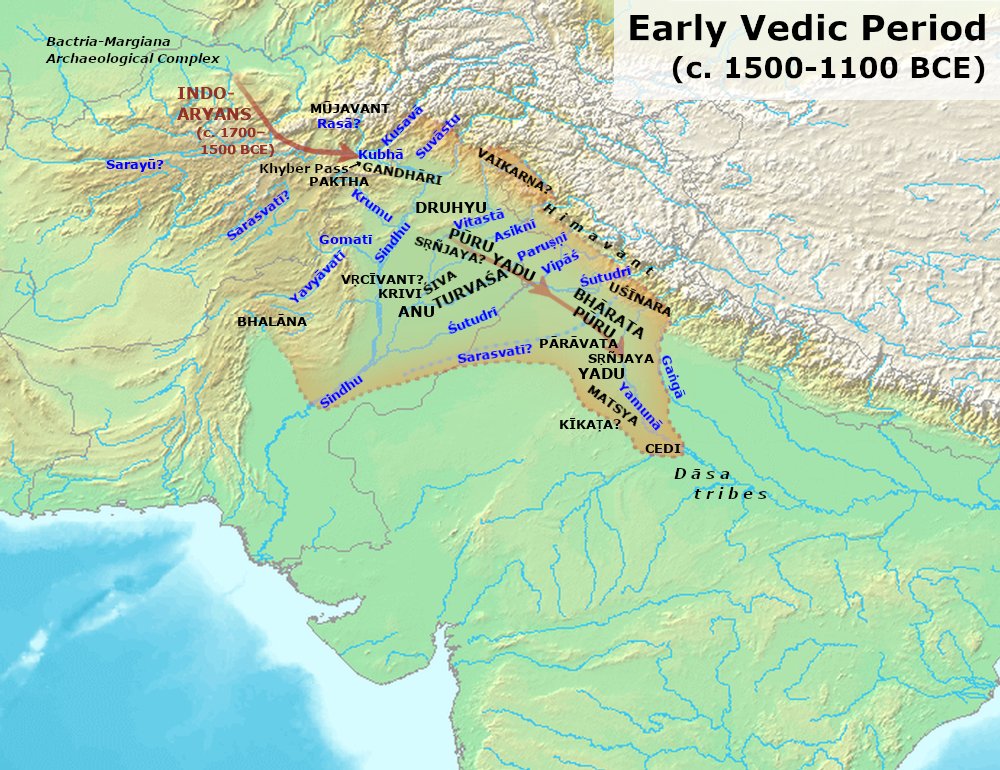
The Rigveda’s geography is precisely identifiable. The Sapta-Sindhu — “land of seven rivers” — is named in several hymns and corresponds to the basin of the Indus and its tributaries: the Sindhu (Indus), Vitasta (Jhelum), Asikni (Chenab), Parushni (Ravi), Vipas (Beas), Sutudri (Sutlej) and the now-vanished Sarasvati, with the Drishadvati flowing alongside.
This region was watered by perennial Himalayan rivers and seasonal monsoon rainfall. It offered:
- Alluvial soils suitable for the wooden plough
- River-side terraces for sowing without deep tillage
- Groundwater accessible by wells in the gaps between rivers
- Open grasslands sustaining the large cattle herds
This is the landscape that the Rigvedic hymns assume — pastoral, agrarian, and water-rich.
Wells in the Rigveda
The Rigveda names two kinds of wells: avata and kupa. The avata is generally taken as an open dug well, sometimes a step well, while the kupa is a deeper, walled or lined well. The hymns repeatedly invoke wells for drinking water for both humans and cattle, but also clearly for agriculture.
Rigveda 10.101.5 instructs farmers: “Lift up the well-bucket; pour out the water; let it irrigate the fields” — a direct reference to lift irrigation from wells. Rigveda 1.85.11 describes drawing water from a well using a leather bucket and a wooden frame, again with the explicit purpose of watering crops.
Lift Devices
The Rigveda describes the well-bucket (varatra) attached to a rope and lifted by hand. Later Vedic and post-Vedic texts develop this into the arghatta (wheel-and-bucket lift) and eventually the Persian wheel, but the early Vedic device is a simple counterweighted bucket — what later Indian agriculture called the dhenkli or shaduf. The principle is the same: lift water from the well, pour it into channels, irrigate the field.
Canals and Channels: Kulya
The word kulya in the Rigveda denotes an artificial water channel — a canal or irrigation ditch. Rigveda 5.83.8 and 8.69.12 use the term in clearly agrarian contexts. The kulya carries water from a river, well or natural channel into the fields.
While the early Vedic kulya was almost certainly small — a dug field channel rather than a major canal network — the very existence of the word implies that early Vedic farmers were doing more than rain-fed cultivation. They were actively engineering water onto the land.
River-Diversion Hymns
Several Rigvedic hymns describe Indra “releasing” the rivers — most famously by slaying the demon Vritra, who held the waters captive. While this is mythic language, scholars including D.D. Kosambi and R.S. Sharma have read these hymns as memories of early river-diversion for irrigation. The mythologisation of water-management practice into theological narrative is itself evidence that water control mattered enough to deserve theological status.
The Wooden Plough: Langala and Sira
Rigvedic agriculture rests on the wooden plough. The hymns name it in several forms:
- Langala / sira: The plough itself, drawn by oxen
- Phala: The ploughshare, sometimes of wood, sometimes tipped with copper or bronze
- Yoke (yuga): The wooden beam across the necks of two oxen
- Sita: The furrow itself — a word later personified as the goddess Sita who is said to be “born from the furrow” in the Ramayana
Rigveda 10.101.3-4 contains a complete plough hymn: yoke the oxen, fasten the plough, drive the share into the earth, let the furrows fill with seed. This is not poetic abstraction; it is a precise practical sequence.
Ox-Drawn vs Hand Cultivation
The Rigvedic plough is ox-drawn. The animals are repeatedly named in connection with ploughing — pairs of oxen yoked together. This is significant because heavy-animal traction allows deeper tillage and larger field sizes than hand-cultivation, and it links agrarian productivity directly to cattle wealth. The Rigvedic obsession with cattle is therefore not merely pastoral — cattle are also the engine of cultivation.
Barley: The Staple Cereal
The principal Rigvedic cereal is yava, conventionally translated as barley. Yava is mentioned dozens of times in the Rigveda — as food, as offering, as the standard against which other grains are measured. It was suited to the relatively cool, dry climate of the north-west and to the early Vedic agricultural calendar.
Rice (vrihi) is mentioned only in passing in the later books of the Rigveda and becomes prominent only in the Atharvaveda and later Vedic literature, when Vedic civilisation expanded eastward into the Ganga valley. Other crops mentioned in early Vedic texts include godhuma (wheat — but only in later books), masha (black gram), and tila (sesame).
Sowing, Reaping, Threshing
Rigvedic vocabulary covers the full agrarian cycle:
- Vapana: Sowing
- Lavana: Reaping
- Khala: Threshing floor
- Datra / srni: Sickle
- Musti: Sheaf
A complete farming cycle — plough, sow, irrigate, weed, reap, thresh, store — is documented in Rigvedic terminology.
Agriculture and Cattle Together
It is sometimes argued that the Rigvedic economy was purely pastoral. This view derives from the enormous prominence of cattle (gau) in the hymns: cattle as wealth, cattle as gift, cattle as raid-objective (gavishti — literally “seeking cows”), cattle as unit of value. But this prominence does not negate agriculture.
The Rigvedic economy is best described as integrated pastoral-agrarian: large cattle herds provided traction for ploughing, dung for fertilising fields, milk for the diet, and a mobile store of wealth; agriculture provided the cereal staple, the seasonal village base, and the surplus that sustained ritual and elite life.
The Ratnins and the Vis
The Rigvedic social structure — the vis (the people) divided into clans, with a rajan or chief and his purohitas (priests) — is consistent with a settled agrarian-pastoral economy. The gramani (village headman) and the kulapa (head of the household) presuppose villages, fields, and a fixed agricultural calendar.
Significance for UPSC
Rigvedic irrigation and agriculture matter for UPSC because they:
- Refute the misconception of the Rigvedic people as purely nomadic pastoralists
- Document the wooden plough, ox traction, and barley as staples
- Show wells (avata, kupa) and canals (kulya) as early irrigation infrastructure
- Reveal the agrarian-pastoral dual base of early Vedic society
- Explain the later eastward expansion of Vedic culture as the rice-wet Ganga valley was settled
Frequently Asked Questions
What does the Rigveda say about wells?
The Rigveda mentions two kinds of wells — avata (open dug well) and kupa (lined or deeper well) — used for drinking water and explicitly for irrigation. Hymns describe lifting water from wells with a leather bucket and rope and pouring it onto fields.
What is kulya in Rigvedic agriculture?
Kulya is the Rigvedic word for an artificial water channel or small canal used to carry water from a river or well to the fields. Its presence in the hymns confirms that early Vedic farmers practised channel irrigation, not only rain-fed cultivation.
What was the staple cereal of the Rigveda?
The principal Rigvedic cereal is yava, conventionally translated as barley. Rice (vrihi) is mentioned only in the later books of the Rigveda and becomes prominent in the Atharvaveda and post-Rigvedic literature as Vedic culture expanded eastward into the Ganga valley.
What plough did Rigvedic farmers use?
The Rigvedic plough was wooden, drawn by a pair of yoked oxen, with a ploughshare (phala) that was sometimes tipped with copper or bronze. The plough is called langala or sira, and the furrow it cut was called sita — later personified as the goddess Sita.
Were the Rigvedic people pastoral or agricultural?
They were both. The Rigvedic economy was an integrated pastoral-agrarian system: large cattle herds provided plough traction, dung, milk and wealth, while cultivated fields produced barley and other cereals. The prominence of cattle in the hymns does not negate the equally clear textual evidence of cultivation.
What is Sapta-Sindhu?
Sapta-Sindhu is the u0022land of seven riversu0022 — the geographical setting of the Rigveda. The seven rivers are typically identified as the Sindhu, Vitasta, Asikni, Parushni, Vipas, Sutudri and the now-vanished Sarasvati, in present-day Punjab, Haryana and eastern Afghanistan.
Did Rigvedic society practise irrigation?
Yes. The hymns mention wells (avata, kupa) used for lift irrigation, channels (kulya) for canal-like distribution, and several specific water-management practices. The mythic hymns of Indra releasing the rivers are also read by some historians as memories of early river-diversion for irrigation.
Why does Rigvedic agriculture matter historically?
It establishes that Vedic civilisation was not a purely pastoral migration into the subcontinent but a settled or semi-settled agricultural-pastoral society from its earliest documented phase. This recalibrates older models of Vedic history and aligns the textual record with the archaeology of the Painted Grey Ware culture.
Tell Google you want more of this.
Add Anantam IAS as a preferred sourceOne tap, and this site shows up more often in your own Top Stories, AI Overviews and AI Mode. Remove it any time.