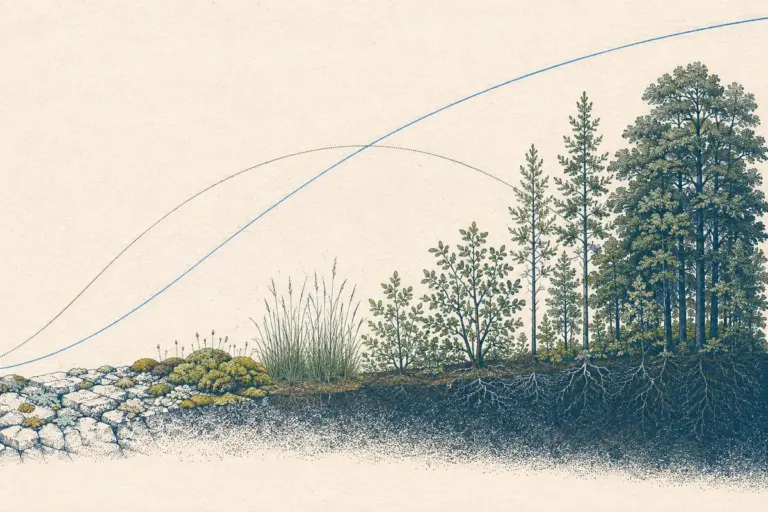
A river is not just water moving downhill. It is a moving belt of sediment, a dynamic equilibrium between erosion at the headwaters and deposition along the channel and the delta. When humans pull sand and gravel out of a riverbed faster than the catchment can supply it, the equilibrium breaks. The bed lowers, the banks erode laterally, the connection between river and aquifer weakens, and the floodplain ecology that depends on annual silt deposition starts to deteriorate. This is the core ecological logic behind the policy debate on river mining in India, a debate that now sits at the intersection of construction-sector demand, state-level revenue, environmental law, and the increasing visibility of climate-driven floods.
The policy attention has sharpened because of specific flashpoints. In 2025, the Delhi government raised concerns with the Uttar Pradesh administration about sand mining along the Yamuna, arguing that excessive extraction was weakening river embankments and increasing the risk of flooding in the national capital. Similar disputes recur on the Chambal, the Ken, the Sone, the Tons, the Krishna, and several Northeast rivers, where sand-mining mafias, contract auctions, and environmental clearances generate periodic public controversy.
For UPSC, river mining is a high-frequency GS-III topic that bridges environment, internal security, economic resources, and governance. This guide covers what river mining is, how the law regulates it, the consequences for rivers and groundwater, and the way forward toward sustainable extraction frameworks.
Quick Facts
- Definition: Extraction of sand, gravel, boulders, pebbles, and other minor minerals from riverbeds, banks, and floodplains
- Classified as: Minor mineral under the Mines and Minerals (Development and Regulation) Act, 1957
- State subject: Regulation of minor minerals is largely a state government function
- Primary central law: Environment (Protection) Act, 1986
- Central guidelines: Sustainable Sand Mining Management Guidelines, 2016
- Enforcement framework: Enforcement and Monitoring Guidelines for Sand Mining (EMGSM), 2020
- EIA threshold: All sand mining requires environmental clearance, including small leases
- Court precedent: Deepak Kumar v State of Haryana (2012) made EIA mandatory for all minor mineral leases
- Worst-affected basins: Yamuna, Chambal, Ken, Sone, Krishna, Cauvery, Brahmaputra tributaries
- Common methods: Manual extraction, suction pumps, dredgers, JCB machines from dry beds
- Construction sand demand in India: Estimated at over 700 million tonnes a year
- Alternatives: M-sand or manufactured sand, reclaimed concrete, dredged marine sand
What Is River Mining
River mining is the extraction of construction-grade aggregates, primarily sand and gravel, from active or palaeo channels of rivers. The category covers three physical zones. The riverbed is the channel itself, where sand is deposited by flowing water. Riverbanks are the immediate edges where seasonal high water leaves alluvial sediment. Floodplains are the wider geomorphic terraces that hold material accumulated over decades or centuries.
The material extracted is critically important to the construction sector. Concrete needs fine aggregate for strength and workability. Mortar, plaster, and roadwork all use sand. Reinforced cement concrete bridges, urban housing, and infrastructure projects depend on a steady supply at predictable cost. Globally, sand is the most extracted solid material after water, and India is one of the largest consumers because of its construction-driven growth model.
What makes river sand different from other forms of sand is its physical and mineralogical character. River sand is rounded and well-graded because moving water has sorted and polished the grains over geological time. This shape and size make it ideal for concrete strength. Desert sand, by contrast, is too rounded and too uniform for cement bonding. Crushed stone or M-sand can substitute, but transportation costs and granular shape impose limits.
Background and Historical Context
For centuries, river sand was extracted at a small scale by riparian communities for local construction. Bullock carts, manual digging, and traditional river-based livelihoods balanced extraction with the natural replenishment cycle. The shift came with industrial-scale construction in the second half of the twentieth century. Demand grew from urban housing, road building, dam construction, and the cement-intensive growth model that India adopted in the post-liberalisation period.
Through the 1980s and 1990s, sand mining was generally permitted under state-level minor-mineral rules with limited environmental scrutiny. Royalty was paid per truck or per cubic metre, and the state earned revenue without significant cost on the environmental side of the ledger. The Mines and Minerals (Development and Regulation) Act, 1957, treats minor minerals as a state subject, which meant that variable rules across India created opportunities for cross-border smuggling and uneven enforcement.
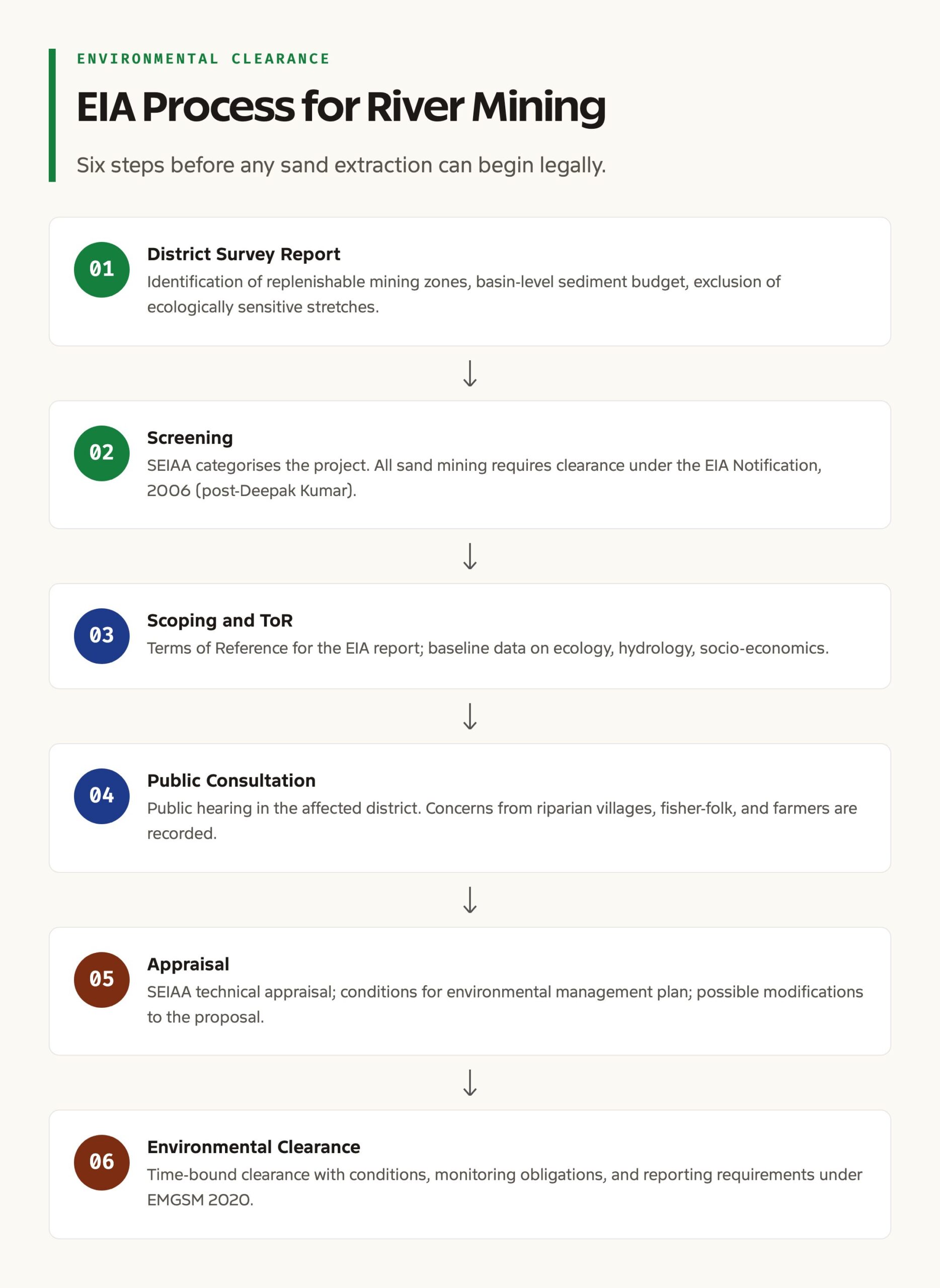
The legal turning point came with Deepak Kumar v State of Haryana, decided by the Supreme Court in February 2012. The court held that all minor mineral leases, including sand and gravel, require prior environmental clearance under the Environment (Protection) Act, 1986, regardless of the size of the lease area. The ruling overturned the prior practice of exempting small leases below a threshold area. It made the Environmental Impact Assessment framework applicable to thousands of state-level sand-mining contracts that had previously operated outside it.
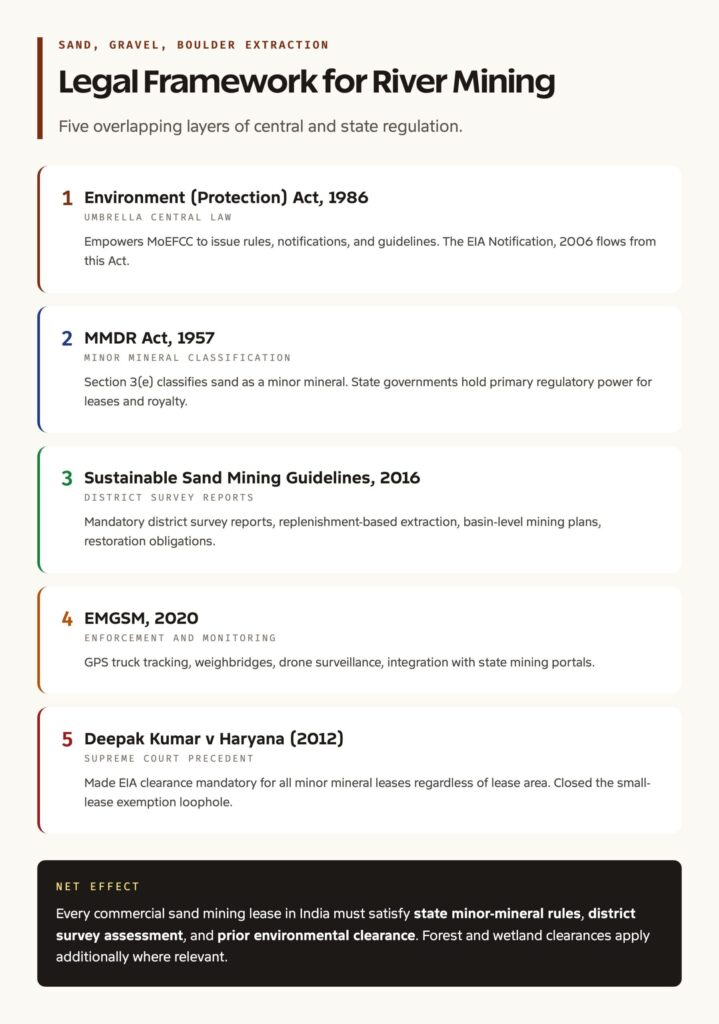
The Sustainable Sand Mining Management Guidelines were issued by the Ministry of Environment, Forest and Climate Change in 2016 to operationalise the Deepak Kumar judgement. Replenishment-based extraction, district survey reports, and basin-level mining plans were introduced. The 2020 Enforcement and Monitoring Guidelines for Sand Mining added compliance mechanisms, GPS tracking, weighbridges, and monitoring committees.
Key Provisions of the Legal Framework
Environment (Protection) Act, 1986
The umbrella central legislation that empowers MoEFCC to issue rules, notifications, and guidelines on environmental matters. Sand mining is regulated under this Act through the EIA Notification, 2006 and its subsequent amendments.
Mines and Minerals (Development and Regulation) Act, 1957
Defines sand and ordinary earth as minor minerals under Section 3(e) and gives state governments primary regulatory power. State-level rules govern lease grants, royalty, transit permits, and penalties.
Sustainable Sand Mining Management Guidelines, 2016
Issued by MoEFCC, these guidelines require district survey reports identifying replenishable mining zones, basin-level studies, mandatory environmental clearance for every lease, monitoring of pit dimensions, restoration plans, and prohibition of mining in identified ecologically sensitive stretches.
Enforcement and Monitoring Guidelines for Sand Mining (EMGSM), 2020
The compliance complement to the 2016 framework. EMGSM sets up State Environment Impact Assessment Authorities, district task forces, GPS tracking of trucks, weighbridge installations, drone surveillance, and integration with state mining portals.
Wetlands (Conservation and Management) Rules, 2017
Where rivers cross wetlands of India, the Wetland Rules add an additional protective layer that prohibits any activity that adversely affects wetland health.
Indian Forest Act, 1927 and Forest (Conservation) Act, 1980
Where river stretches pass through reserved or protected forests, additional clearances under forest law are required.
Why It Matters
River mining matters because it sits at the intersection of three high-stakes policy domains: construction, ecology, and public revenue. The construction sector contributes around eight percent of India’s GDP and employs tens of millions of workers. It depends on stable sand supply at predictable cost. Restrict sand too sharply and construction stalls or shifts to inferior substitutes. Permit too freely and rivers degrade visibly within a decade.
The ecological case for tighter regulation is documented. Riverbed lowering, lateral bank erosion, weakened river-aquifer connection, destruction of fish breeding habitat, increased turbidity, and disruption of floodplain agriculture are all empirically observed. The 2025 Delhi-UP exchange on Yamuna mining is a recent case study where lateral erosion threatened embankments protecting the capital from floods.
The revenue case is also real. State governments collect significant royalty income from sand-mining leases. Contractors generate employment, and trucking and construction value chains amplify this income. Local governments, particularly in alluvial states like Punjab, Haryana, Bihar, Andhra Pradesh, and Tamil Nadu, depend on this revenue.
The policy challenge is to set extraction at or below the natural replenishment rate of each basin, enforce the limit, and prevent the parallel illegal market that profits from the gap between regulation and enforcement.
Detailed Analysis
The technical heart of sustainable sand mining is the replenishment study. A district survey report under the 2016 guidelines is supposed to estimate annual sediment recharge in each river stretch, identify mineable zones with safe extraction depths, and recommend basin-level extraction caps. In practice, replenishment data is often weak. Many state surveys rely on dated hydrological records or surrogate estimates rather than direct sediment measurement.
Where replenishment is overestimated, extraction outpaces recharge. The bed lowers year after year. Once the bed drops below adjacent groundwater levels, the river loses its base flow, and dry-season water disappears entirely. This pattern has been documented on the Sone, the Ken, the Tons, and parts of the Krishna basin.
Lateral bank erosion follows from the same dynamic. With sediment removed from the bed, the river’s energy redirects toward the banks. Embankments crack, agricultural land collapses into the channel, and river-side villages face property loss. The Yamuna case in 2025 highlights this risk: weakened embankments translate into amplified flood risk during high-discharge events.
The aquatic ecosystem effects are equally documented. Fish breeding grounds in gravel beds are destroyed by extraction. Suction pumps and dredgers physically remove eggs and juveniles. Increased turbidity reduces light penetration, which suppresses photosynthesis in submerged plants and disrupts the food chain. Birds that depend on shallow water for foraging are displaced.
Groundwater impacts add a second-order ecological cost. Rivers and aquifers exchange water through bed sediment. Lower beds, compacted by machinery, weaken this exchange. The water table in alluvial valleys declines, and tube-well dependence rises. The connection to the broader groundwater crisis in India is direct.
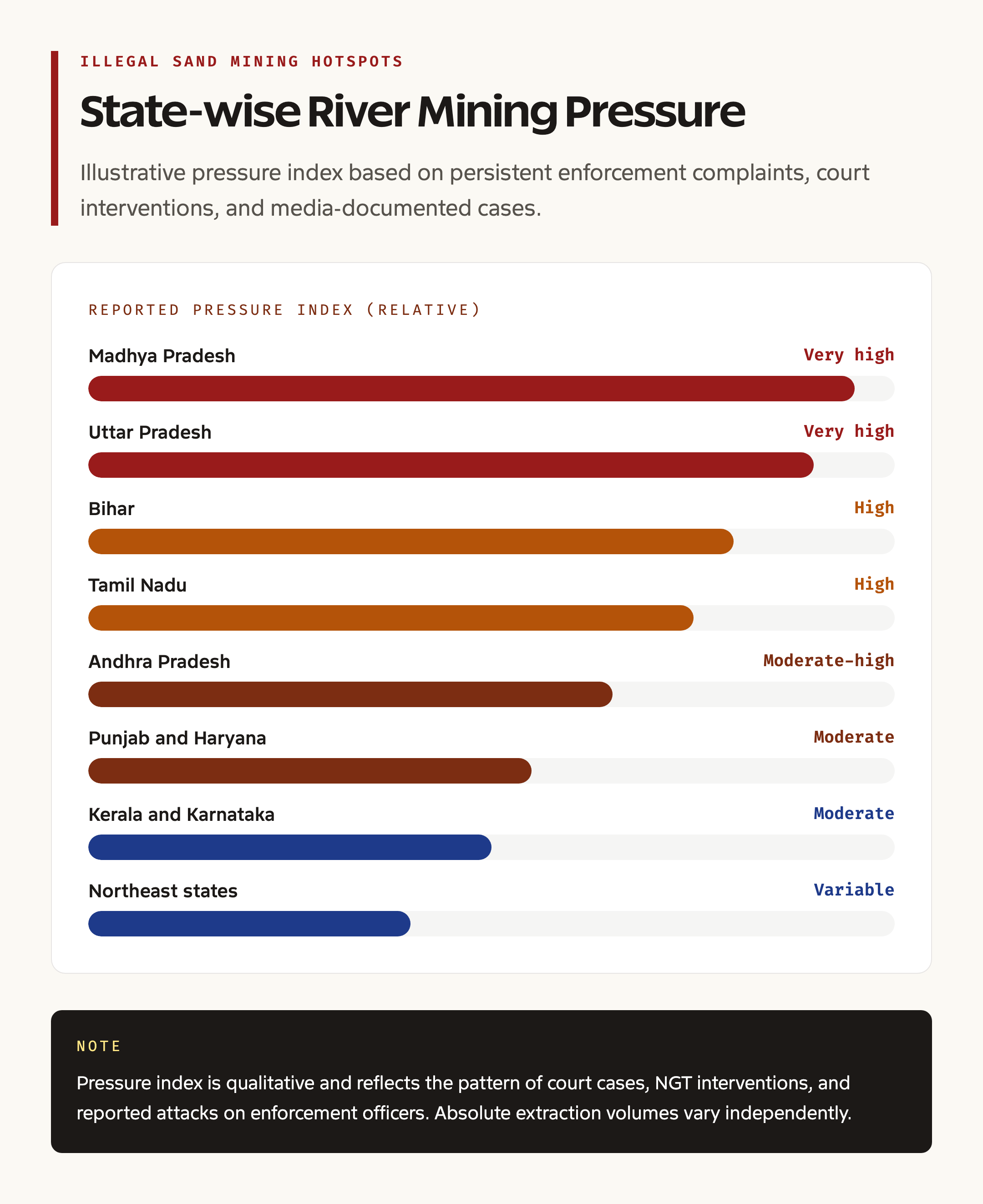
Illegal mining is the corruption dimension of the policy challenge. Where legal supply is restricted but demand is high, an illegal market emerges. Reports from Madhya Pradesh, Bihar, Uttar Pradesh, and Tamil Nadu document organised mining mafias, attacks on enforcement officers, and political patronage of illegal contractors. The 2020 enforcement guidelines tightened compliance technology, but the political-economy challenge remains.
Comparative Perspective
Globally, sand mining is regulated through varied frameworks. The European Union restricts river-bed extraction strictly under the Water Framework Directive and routes most aggregate demand to crushed-stone alternatives. The United States manages sand and gravel through the Army Corps of Engineers with strict permit conditions, particularly in navigable rivers. South-East Asian countries, including Vietnam and Cambodia, have struggled with rapid Mekong-basin extraction that has caused measurable delta subsidence.
India’s framework, in principle, matches global best practice. Mandatory EIA, replenishment studies, monitoring guidelines, and basin-level capping are all in line with international standards. The implementation gap, particularly in enforcement against illegal extraction, is the area where reform is most needed. Comparison with the Murray-Darling basin in Australia, where extraction is centrally tracked and audited, suggests that integrated digital monitoring can reduce illegal mining significantly.
Challenges
Three structural challenges define river mining policy. First, the data foundation is weak. Replenishment estimates in district survey reports are often poorly grounded. Without good data, sustainability claims are speculative.
Second, enforcement is overstretched. State mining departments and environmental authorities are under-resourced for the scale of operations. Rural enforcement officers face physical risks. Vigilance against organised illegal mining requires inter-agency coordination that is difficult to sustain.
Third, demand is rising faster than alternatives. M-sand uptake is growing but remains a small share of national demand. Reclaimed concrete aggregate, marine dredged sand, and import substitution face their own economic and environmental constraints. The construction sector’s price sensitivity means that any sharp restriction on river sand creates cost shocks.
Prelims Pointers
- Sand is a minor mineral under the MMDR Act, 1957
- Regulation of minor minerals is a state subject
- The Supreme Court in Deepak Kumar v State of Haryana (2012) made EIA clearance mandatory for all minor mineral leases
- Sustainable Sand Mining Management Guidelines were issued in 2016
- Enforcement and Monitoring Guidelines (EMGSM) were issued in 2020
- District Survey Report is the foundational document for sustainable mining planning
- Sand mining requires environmental clearance under the EIA Notification, 2006
- Yamuna sand mining became a Delhi-UP issue in 2025 due to embankment erosion
- Manufactured sand or M-sand is the most established substitute for river sand
- Heavy sand mining can lower the water table and contribute to groundwater pollution
Mains Practice Questions
- Examine the ecological consequences of river sand mining in India. What policy and technological measures can ensure sustainable extraction without crippling the construction sector?
- Discuss the legal and institutional framework for sand mining in India. Why does illegal river mining persist despite a comprehensive regulatory architecture?
- Sand is the most extracted solid material on the planet. Critically analyse the role of state government revenue, the construction lobby, and environmental institutions in shaping India’s sand-mining policy.
- Connecting river mining with the broader debate on water resources of India, evaluate the case for a dedicated central law on river-basin governance.
Way Forward
Reform priorities are reasonably clear. First, strengthen the scientific foundation of district survey reports. Direct sediment measurement, basin-level hydrological modelling, and transparent publication of replenishment estimates should be the norm. The Central Water Commission, IIT-Roorkee’s National Hydrology Institute, and state remote-sensing centres can co-produce these datasets.
Second, accelerate the M-sand transition. Tax incentives for crushed-stone aggregate, mandatory M-sand inclusion in public works contracts, and quality standards under the Bureau of Indian Standards reduce river-sand dependence. Karnataka and Tamil Nadu provide useful state-level templates.
Third, deepen enforcement technology. GPS tracking of trucks, mandatory weighbridges, drone surveillance, and integration with state mining portals are already in policy. Their consistent implementation requires political backing and adequate enforcement budgets. Whistle-blower protection for revenue and environmental officers is part of the same package.
Fourth, strengthen judicial and quasi-judicial review. The National Green Tribunal has been an important venue for sand-mining cases. Specialised river-basin benches, faster disposal, and stronger interim relief mechanisms enhance deterrence.
Fifth, link mining policy to flood and embankment management. The Yamuna 2025 case shows that lateral erosion is not a marginal issue. River sand mining must be evaluated jointly with flood management in India frameworks, particularly in trans-state river stretches.
Frequently Asked Questions
What exactly is river mining and how is it different from regular mining?
River mining is the extraction of sand, gravel, pebbles, and boulders from active riverbeds, banks, or floodplains. It is classified as minor-mineral mining under Indian law, which means regulation is largely a state subject under the MMDR Act, 1957, with central environmental conditions applied through MoEFCC notifications.
Why is river sand so important for construction?
River sand grains are rounded and well-graded by water action, making them ideal for concrete strength and workability. Desert sand and most crushed alternatives, with the exception of properly engineered M-sand, do not offer the same bonding characteristics in cement.
Is sand mining legal in India?
Sand mining is legal where it is conducted under a valid lease, with a district survey report supporting the extraction zone, and with prior environmental clearance under the Environment (Protection) Act, 1986. Mining without these clearances is illegal under the MMDR Act and the EIA Notification.
What was the 2012 Supreme Court ruling on sand mining?
In Deepak Kumar v State of Haryana, the Supreme Court ruled that all minor mineral leases, including sand and gravel, require prior environmental clearance regardless of the lease area. This brought thousands of small leases under the EIA framework that had previously been exempted.
What are the Sustainable Sand Mining Management Guidelines, 2016?
These are MoEFCC guidelines that require district survey reports, replenishment-based extraction estimates, mandatory clearance, environmental management plans, and exclusion of ecologically sensitive stretches. They operationalise the Deepak Kumar judgement.
What ecological damage does river mining cause?
Documented impacts include riverbed lowering, lateral bank erosion, weakened river-aquifer connection, lowering of the local water table, destruction of fish breeding grounds, increased turbidity, suppression of aquatic photosynthesis, and increased flood risk where embankments are exposed to undermined banks.
Why does illegal sand mining persist?
Illegal mining persists because of high construction-sector demand, inadequate enforcement capacity, profit margins on illegal extraction, and political-economy linkages. Reform requires both supply-side measures, such as scaling alternatives, and enforcement-side measures, such as digital tracking and stronger penalties.
What is M-sand and is it a real substitute for river sand?
Manufactured sand or M-sand is produced by crushing rocks to specified grain sizes and shapes that match river-sand performance for concrete. Modern M-sand meets BIS standards and is technically a full substitute. Adoption is growing but is still below half of national construction demand.
Does India have a dedicated central law on river mining?
There is no single central river-mining statute. Regulation operates through a combination of the MMDR Act, the Environment (Protection) Act, the EIA Notification, the 2016 Sand Mining Guidelines, the 2020 Enforcement Guidelines, the Forest Conservation Act, and the Wetlands Rules. State minor-mineral rules add another layer.
How does river mining connect to flood risk?
Sand mining lowers the riverbed and weakens banks. During high-discharge events, the river redirects energy laterally, eroding embankments and exposing low-lying areas to inundation. The 2025 Yamuna issue between Delhi and UP exemplifies this linkage.
Tell Google you want more of this.
Add Anantam IAS as a preferred sourceOne tap, and this site shows up more often in your own Top Stories, AI Overviews and AI Mode. Remove it any time.