Disclosure: this guide contains Amazon affiliate links. As an Amazon Associate, Anantam IAS earns from qualifying purchases — at no extra cost to you.
Satish Chandra medieval history advice can point to the old NCERT, History of Medieval India or the two-volume Medieval India: From Sultanat to the Mughals. Buying by author name alone can leave you with a reading plan for a different book.
For General Studies, I recommend using one manageable medieval-history narrative and organizing your revision around institutions and cultural developments. Keep a complete book you already understand. The larger volumes become a sensible addition when a History optional topic needs deeper reading; they shouldn’t become an automatic purchase for every aspirant.
Choose the Right Title
Satish Chandra is the credited author across these titles. The publisher and format identify which reading task you’re taking on.
| Title | Identity | Sensible Use |
|---|---|---|
| Old NCERT Medieval India | An older school-textbook title associated with Satish Chandra | Identify your copy from its title page and contents before following page references. |
| History of Medieval India | Orient BlackSwan’s single-volume title | A base for a selective GS reading plan. |
| Medieval India: From Sultanat to the Mughals | Har-Anand’s separate volumes on the Delhi Sultanat and Mughal Empire | Deeper thematic reading when your optional syllabus or a specific question requires it. |
Orient BlackSwan’s third-edition listing identifies:
- Publication year: 2026.
- Paperback ISBN: 9789369730001.
- Length: 432 pages.
- Language: English.
The Amazon listing for the third edition is a purchase option. Check the edition and ISBN before ordering. The publisher mentions its Smart App, but access conditions and the app’s teaching quality shouldn’t determine your choice without checking them yourself.
Har-Anand’s catalog distinguishes the Delhi Sultanat volume, 1206 to 1526, from the Mughal Empire volume, 1526 to 1748. Those volume boundaries don’t describe the coverage of every single-volume edition. The Indian history book selection guide can help if you still need to choose a base.
Connect Politics With Themes
You should read enough political narrative to place a ruler or institution, then return to the thematic discussion. Finishing the succession list while leaving administration and society untouched gives you a lopsided understanding.
The following map uses topic labels so an older copy remains usable. Locate the matching headings in your contents.
| Theme | What to Read Together | Study Output |
|---|---|---|
| Regional states | Political setting and regional economy or culture | A region, institution and cultural contribution card |
| Delhi Sultanat | Narrative chapters and the administration discussion | A term, function and limitation sheet |
| Mughal government | Akbar’s consolidation and later administrative discussions | A rank, payment and obligation grid |
| Society and economy | Agrarian relations, towns and trade | An explanation of who produced, collected and exchanged resources |
| Bhakti and Sufi traditions | Religious ideas with their regional setting | A thinker, teaching and context comparison |
| Cultural production | Architecture, painting and literature | A patron, form and purpose card |
A timeline is useful for locating each theme. Treat it like a route map: it places stops, but you still need to examine what happens at each stop.
Separate Rank From Revenue
The mansab and the jagir answer different questions about Mughal service. Mansab concerns an official’s rank; a jagir was an assignment of revenue used to support payment. Confusing them turns an administration answer into a claim about land ownership.
Here is an original practice exercise, not a UPSC PYQ. A learner writes: “A mansab was a piece of land owned by an officer, and every mansabdar received one.” Repair the statement before adding more detail.
| Check | Reasoning |
|---|---|
| What does the first term describe? | Mansab means rank in the service structure. It doesn’t name a parcel of land. |
| How can service be paid? | Revenue assignments called jagirs were one payment arrangement; cash payment also existed. |
| What does an assignment establish? | The right to receive assigned revenue isn’t the same as ownership of the land. |
| Why is “every” unsafe? | The cash-payment category already prevents treating the jagir arrangement as universal. |
| Corrected statement | A mansab was a service rank. Mansabdars could be paid through assigned revenue or in cash, and a revenue assignment shouldn’t be equated with land ownership. |
The NCERT account of Mughal agrarian society discusses these payment arrangements. You can then read Satish Chandra’s administration section with a sharper question: what did the official hold, what did the state assign and what obligation followed?
Think of job grade and a payment arrangement in an organization. They’re connected, but a grade doesn’t identify the source from which payment is drawn. This comparison explains the distinction only; a modern employment contract cannot explain the entire Mughal system.
Your finished revision card should contain:
- Term: Mansab.
- Meaning: Service rank.
- Related term: Jagir, an assignment of revenue.
- Qualification: Cash payment also existed.
- Error to catch: Rank, payment and land ownership collapsed into one concept.
Extend the method to an administration comparison. Give each system separate columns for authority, resources and duties. Similar-looking vocabulary should prompt a check of context before you call the systems identical.
Read Over Four Weeks
A four-week routine should alternate narrative with the themes it explains. Adjust the pace to your current understanding; there is no useful reward for completing the book with every difficult institution still blurred.
| Week | Reading Focus | Revision Task |
|---|---|---|
| First | Regional background and political sequence | Place regions and transitions on one timeline |
| Second | Sultanat narrative, government and society | Explain administrative terms without looking |
| Third | Mughal narrative, administration and economy | Complete the rank-and-revenue exercise and a thematic comparison |
| Fourth | Religious and cultural developments; weak topics | Write short answers connecting a development to its setting |
In a 40-minute session, try 20 minutes reading, 10 explaining aloud and 10 correcting your notes. If the explanation fails, reduce the next reading block. A smaller topic understood properly is progress.
Ancient-to-medieval transitions are easier to follow when you can place the earlier period. Use the published ancient Indian history explainer for a specific background gap rather than restarting the entire subject.
Set Your Reading Depth
The single-volume text isn’t a complete art-and-culture reference or a substitute for optional answer practice. The two-volume set also needs a syllabus-led stopping rule.
- GS reader: Read the core narrative and themes, then test recall before expanding.
- History optional reader: Add deeper passages for the question you’re working on, and record the evidence or interpretation gained.
- Reader with limited time: Prioritize unresolved institutions and cultural comparisons over copying long battle sequences.
- Reader considering a replacement: Compare contents and your actual gaps before buying for a new cover or edition number.
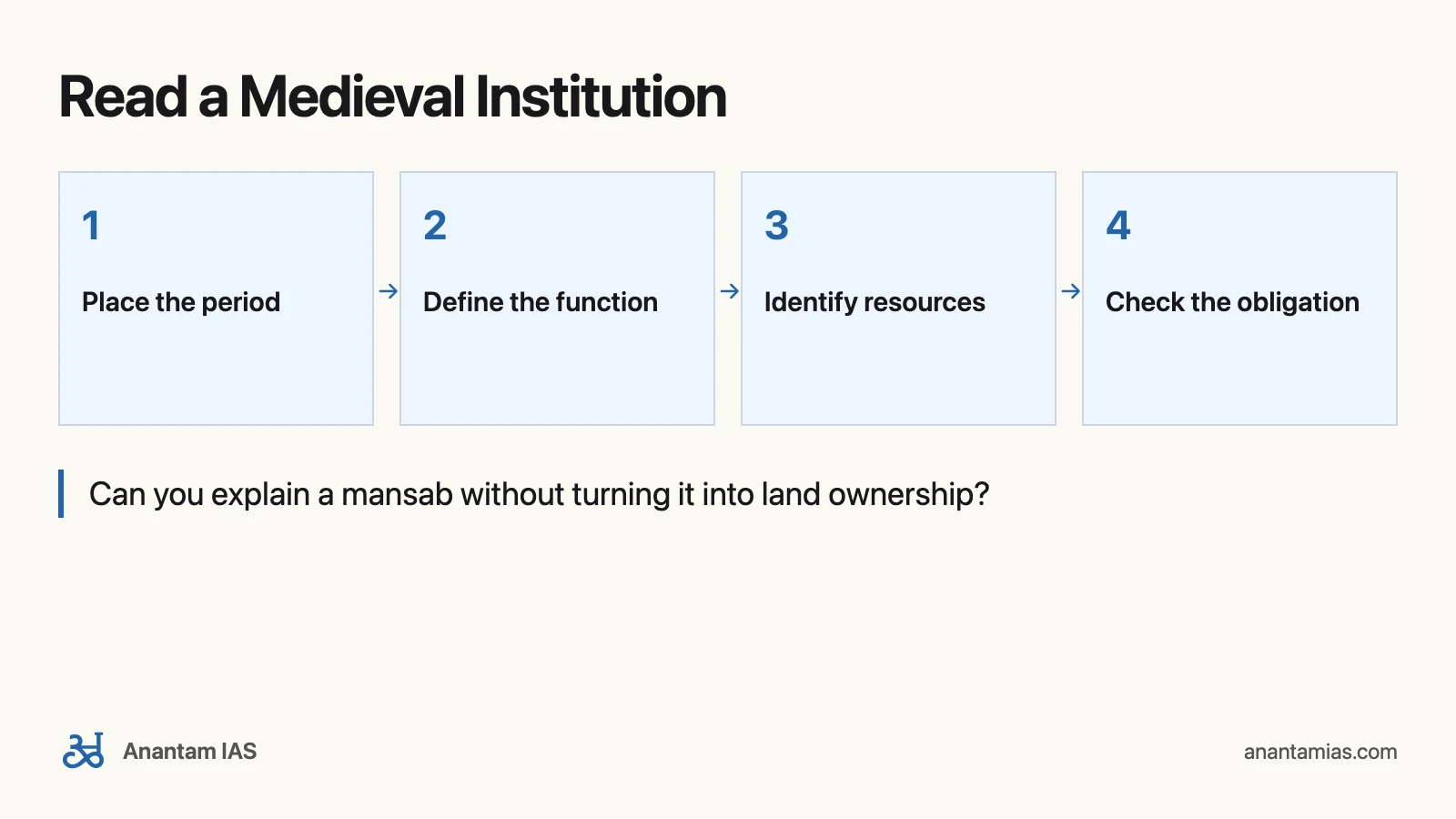
At the next revision session, explain one institution using its function, resources and limits. If those are clear, the names and dates have somewhere useful to attach.
Frequently Asked Questions
Which Satish Chandra book does this guide use?
The thematic GS plan centers on the single-volume History of Medieval India from Orient BlackSwan. The old NCERT and Har-Anand’s Sultanat-to-Mughals volumes are separate identities; match advice to your copy.
What are the third-edition details?
Orient BlackSwan’s listing identifies the English paperback third edition with publication year 2026, 432 pages and ISBN 9789369730001. Verify the copy offered before buying.
Do GS aspirants need both Har-Anand volumes?
They are a possible addition for deeper reading, especially for a defined History optional topic. A GS reader should first understand and revise the base narrative and themes before adding a larger set.
What is the difference between mansab and jagir?
Mansab refers to service rank. A jagir was an assignment of revenue used for payment. Cash payment also existed. Rank and revenue assignment should not be equated with land ownership.
Should I read only the political chapters?
Read enough narrative to locate events, then connect it to government, society, economy and culture. A succession list alone cannot explain how an institution worked or why a cultural development mattered.
Does the Smart App make this edition essential?
The publisher lists an accompanying app, but this guide does not verify access or evaluate its teaching quality. Check those conditions yourself and choose the book for the material you need.
Tell Google you want more of this.
Add Anantam IAS as a preferred sourceOne tap, and this site shows up more often in your own Top Stories, AI Overviews and AI Mode. Remove it any time.