Disclosure: this guide contains Amazon affiliate links. As an Amazon Associate, Anantam IAS earns from qualifying purchases — at no extra cost to you.
Indian ancient history is where most UPSC aspirants lose 6–8 Prelims marks every year — not because the content is hard, but because they treat 4,000 years of civilization as one undifferentiated blur. Indus Valley, Vedic, Mahajanapadas, Mauryan, post-Mauryan, Gupta — each phase has its own polity, economy, religion, and source base. Confuse the Rigvedic chiefdom with Mauryan bureaucracy and you’ll fumble the question. The fix isn’t more reading. It’s a phase-by-phase chronological grid you can revise in 45 minutes… and that’s exactly what this article builds. From the Mehrgarh Neolithic (~7000 BCE) to Harsha’s death (647 CE), with the dates, dynasties, and key events that actually appear on the paper.
What is Indian ancient history? (UPSC scope)
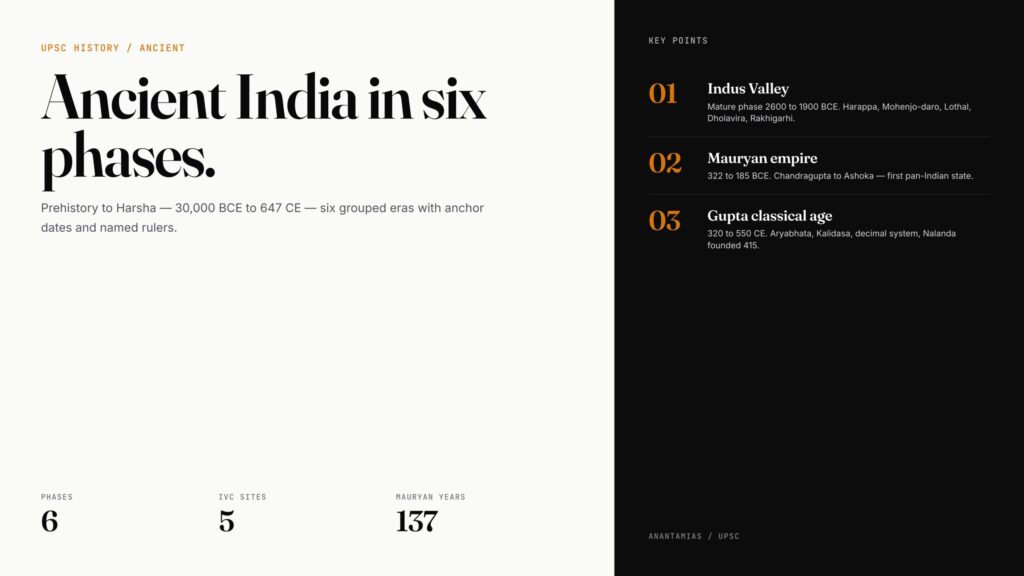
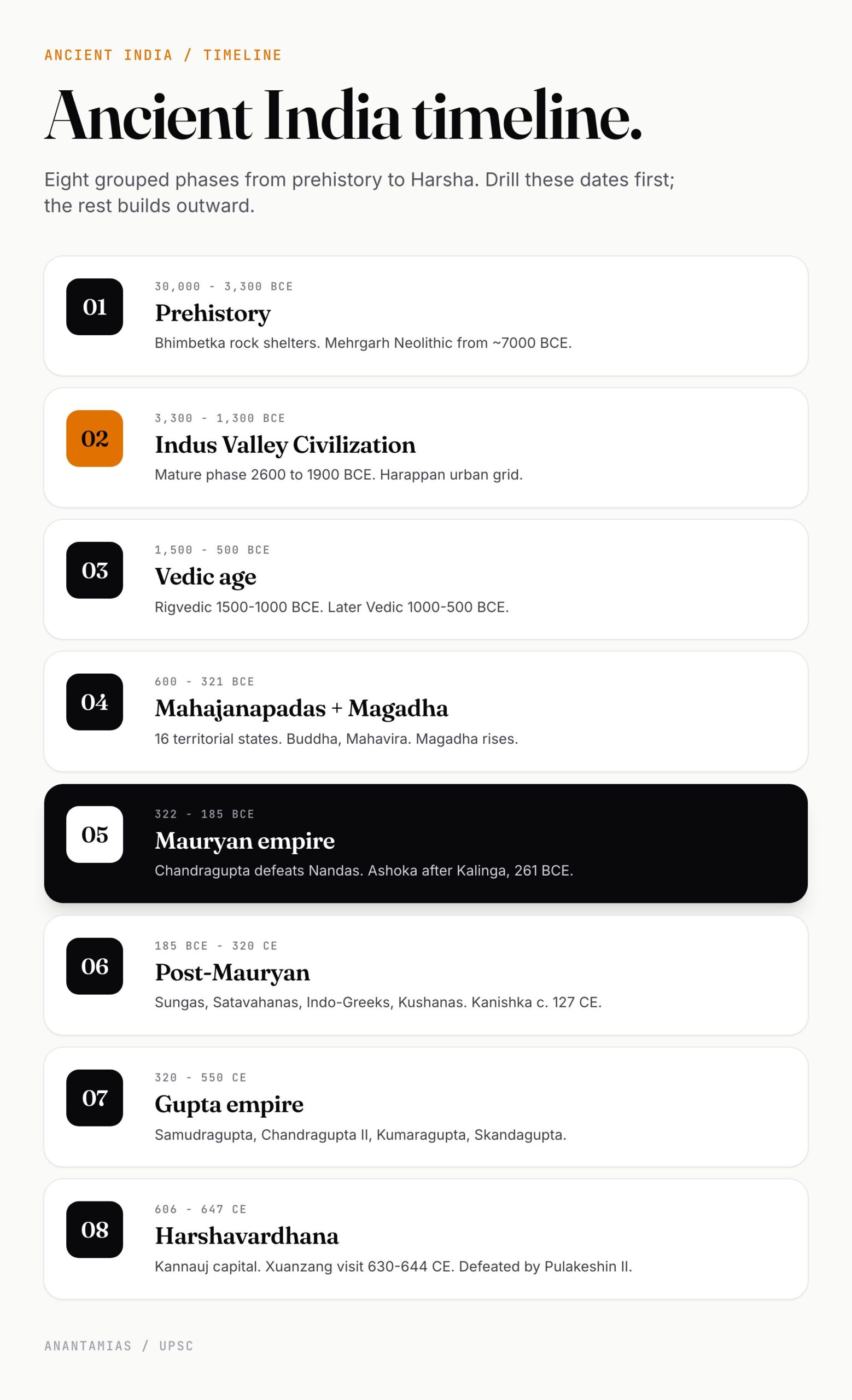
Indian ancient history for UPSC covers the period from prehistoric stone-age cultures (~30,000 BCE) through the death of Harshavardhana (647 CE), spanning six major phases: Prehistory and Indus Valley (~3300–1300 BCE), Vedic Age (~1500–500 BCE), Mahajanapadas and Magadhan rise (~600–321 BCE), Mauryan Empire (322–185 BCE), Post-Mauryan period (185 BCE–320 CE), and Gupta Empire and Harsha (320–647 CE).
- Indus Valley Civilization — c. 3300–1300 BCE — Bronze Age urban civilization with planned cities, standardized weights, undeciphered script.
- Vedic Period — c. 1500–500 BCE — Rigvedic (1500–1000 BCE) + Later Vedic (1000–500 BCE) — Sanskrit literature, varna system, transition to monarchy.
- Mahajanapadas — c. 600–321 BCE — 16 territorial states across northern India (Buddhist Anguttara Nikaya list).
- Mauryan Empire — 322–185 BCE — founded by Chandragupta Maurya, peaked under Ashoka, first pan-Indian empire.
- Post-Mauryan — 185 BCE–320 CE — Sungas, Kanvas, Satavahanas, Indo-Greeks, Kushanas — fragmented but culturally vibrant.
- Gupta Empire — 320–550 CE — “Classical Age” of Indian culture, Sanskrit literature, decimal system, temple architecture.
Phase 1 — Prehistory and the Indus Valley Civilization
Stone Age India breaks into Paleolithic (~30,000–10,000 BCE — Bhimbetka rock shelters), Mesolithic (~10,000–8000 BCE — microliths, early animal domestication), and Neolithic (~7000–3000 BCE — agriculture, pottery, the earliest village at Mehrgarh in Balochistan).
The Chalcolithic transition (~3000 BCE) led directly into the Bronze Age Indus Valley Civilization — also called the Harappan Civilization after the first excavated site. Mature phase: c. 2600–1900 BCE.
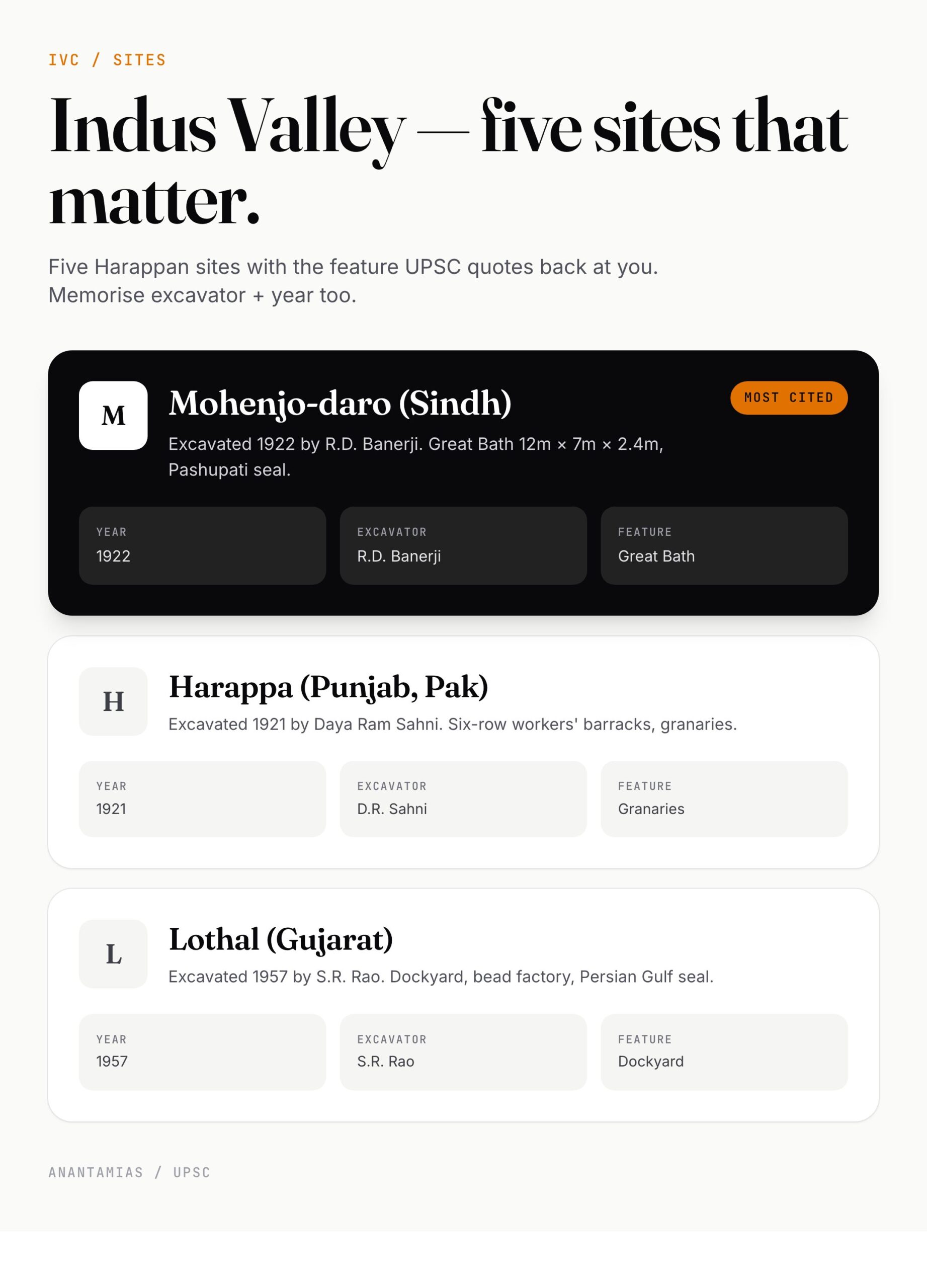
Five sites you must know cold:
- Harappa (Punjab, Pakistan, excavated 1921 by Daya Ram Sahni) — granaries, six-row workers’ barracks, R-37 cemetery.
- Mohenjo-daro (Sindh, Pakistan, excavated 1922 by R.D. Banerji) — Great Bath (12m × 7m × 2.4m), Great Granary, Pashupati seal.
- Lothal (Gujarat, excavated 1957 by S.R. Rao) — dockyard, bead factory, Persian Gulf seal.
- Dholavira (Gujarat, excavated 1989 by R.S. Bisht, UNESCO World Heritage 2021) — three-part division (citadel/middle town/lower town), 10-character signboard.
- Rakhigarhi (Haryana, ongoing excavation since 1997, ASI) — largest IVC site by area (~350 hectares); 2019 DNA study on a female skeleton showed no Steppe ancestry, suggesting an indigenous Harappan population.
Decline (~1900–1300 BCE): no single cause. Climate shift (Saraswati/Ghaggar drying), tectonic activity, decline of Mesopotamian trade, and migration of populations eastward into the Ganga plains all contributed. Aryan invasion theory has been replaced by Aryan migration hypothesis — and even that is contested by recent aDNA work.
Recent updates aspirants miss: the 2024 Sinauli chariot dating (Uttar Pradesh) confirmed a pre-1900 BCE copper-age burial culture with chariots, expanding the late-Harappan horizon. The 2025 Kotada Bhadli excavation in Kutch revealed a Harappan caravanserai — published in ASI bulletins.
Phase 2 — The Vedic Period (c. 1500–500 BCE)
The Vedic period splits cleanly in two.
Rigvedic Age (c. 1500–1000 BCE) — composition of the Rigveda, ten mandalas (books), 1,028 hymns. Pastoral economy. Cattle (gomat) as wealth. Tribal polity — jana (tribe) headed by rajan (chief), advised by sabha (elders) and samiti (general assembly). Battles like the Battle of Ten Kings (Dasharajna) on the Ravi between Sudas and a confederation. No varna rigidity yet — varna originally meant “color/category.”
Later Vedic Age (c. 1000–500 BCE) — composition of Yajurveda, Samaveda, Atharvaveda, Brahmanas, Aranyakas, early Upanishads. Iron technology spread. Settled agriculture in the Ganga-Yamuna doab. Tribal janas hardened into territorial janapadas (states). Varna system became hereditary and hierarchical. Kingship became sacred — coronation rituals like Rajasuya, Ashvamedha, Vajapeya emerged. Gods shifted from Indra/Agni/Varuna to Vishnu/Shiva/Prajapati.
| Feature | Rigvedic | Later Vedic |
|---|---|---|
| Economy | Pastoral, cattle | Settled agriculture, iron |
| Polity | Tribal jana | Territorial janapada |
| Varna | Fluid, occupational | Rigid, hereditary |
| Religion | Indra, Agni, Varuna | Vishnu, Shiva, Prajapati |
| Geography | Sapta Sindhu (NW) | Ganga-Yamuna doab |
| Literature | Rigveda only | Sama, Yajur, Atharva, Brahmanas, Upanishads |
Phase 3 — Mahajanapadas and the Rise of Magadha (c. 600–321 BCE)
By the 6th century BCE, the Buddhist Anguttara Nikaya lists 16 Mahajanapadas — Anga, Magadha, Kashi, Kosala, Vajji, Malla, Chedi, Vatsa, Kuru, Panchala, Matsya, Surasena, Assaka, Avanti, Gandhara, Kamboja. Some republics (Vajji, Malla), most monarchies.
Of these, four powers — Magadha, Kosala, Vatsa, Avanti — competed for supremacy. Magadha won.
Why Magadha?
- Iron deposits in Rajgir hills.
- Fertile Ganga plains for surplus.
- River-fortified capital (Pataliputra at the confluence of Ganga, Son, Gandak).
- Successive ambitious dynasts.
Magadha dynasties before the Mauryas:
- Haryanka (~544–413 BCE) — Bimbisara, Ajatashatru (contemporary of Buddha and Mahavira)
- Shishunaga (~413–345 BCE) — annexed Avanti
- Nanda (~345–321 BCE) — Mahapadma Nanda + 8 sons; vast army, immense wealth, defeated by Chandragupta Maurya
The 6th century BCE was also when Buddhism and Jainism emerged. Buddha (c. 563–483 BCE per traditional dating; some recent scholars push to c. 480–400 BCE) founded Buddhism after his enlightenment at Bodh Gaya. Mahavira (c. 599–527 BCE) was the 24th Tirthankara of Jainism — not its founder, technically. Both rejected Vedic ritualism and the varna hierarchy.
Phase 4 — The Mauryan Empire (322–185 BCE)
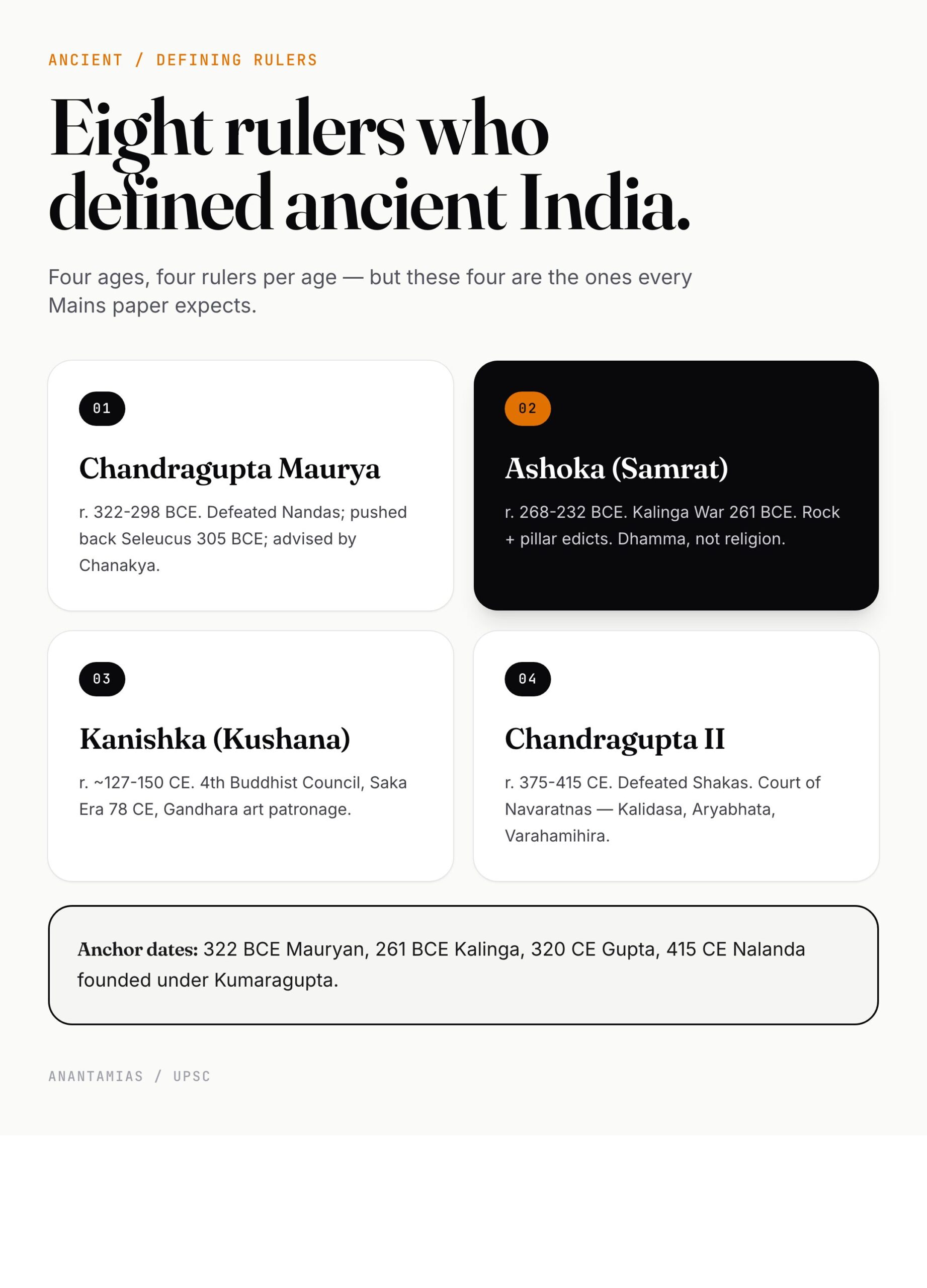
Founded by Chandragupta Maurya (r. 322–298 BCE), advised by Chanakya (Kautilya, author of the Arthashastra). Defeated the Nandas. Pushed back Seleucus I Nicator in 305 BCE — gained eastern Iran, marriage alliance, 500 war elephants. Megasthenes was sent as Seleucid ambassador and wrote Indica (preserved in fragments). Megasthenes’ account is our richest non-Indian source on Mauryan India.
Bindusara (r. 298–273 BCE) — extended into the Deccan; called Amitraghata (“slayer of foes”). Maintained Hellenistic diplomatic ties.
Ashoka (r. 268–232 BCE) — the Mauryan Empire‘s peak. The Kalinga War (~261 BCE) is described in Rock Edict XIII — 100,000 killed, 150,000 deported. Ashoka adopted Dhamma — a moral code, not a religion. He erected pillar edicts and rock edicts across the empire (extending from Afghanistan to Karnataka). Samrat Ashoka sent missions to Sri Lanka (Mahinda and Sanghamitra), Burma, and the Hellenistic world.
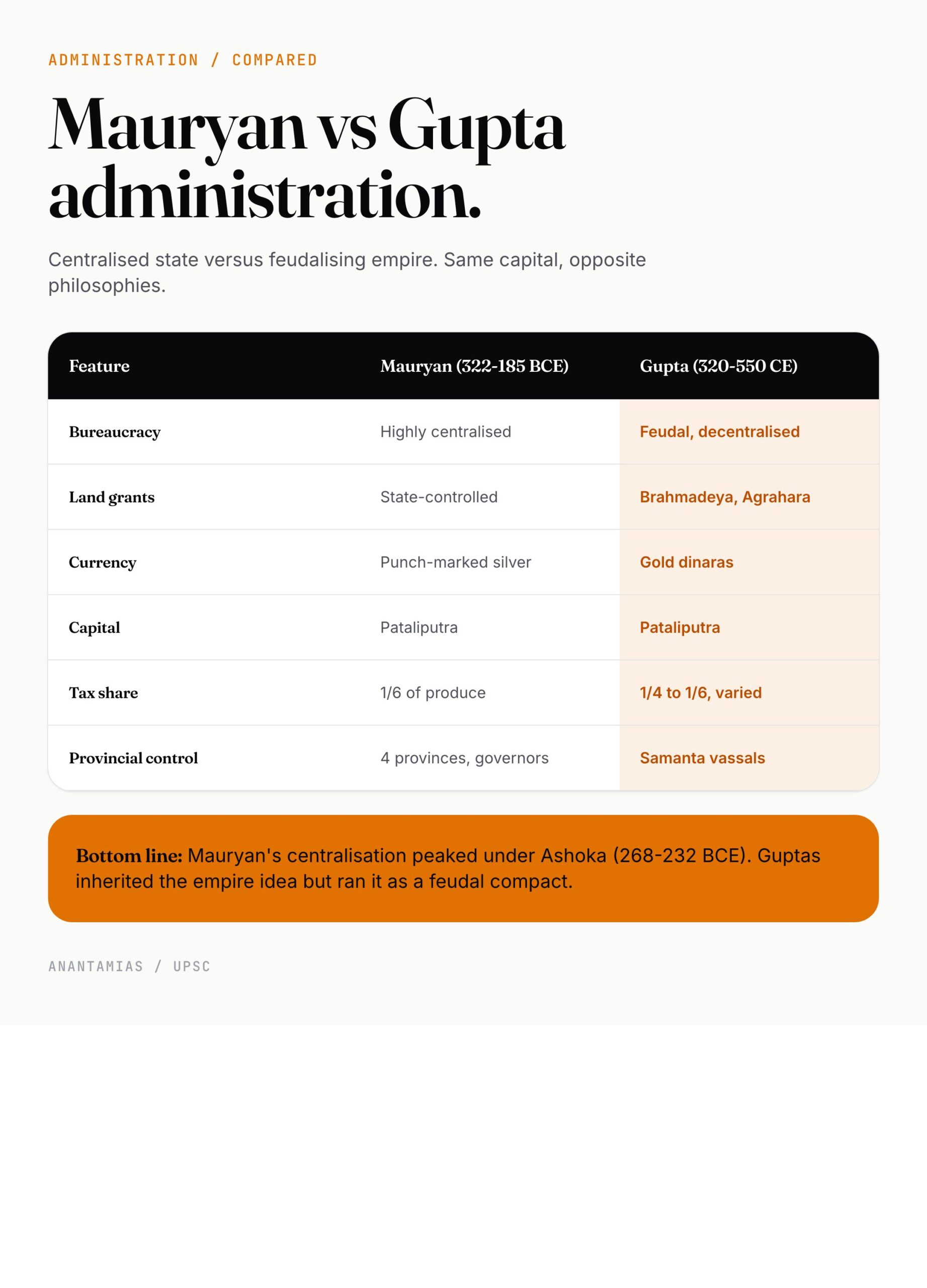
Mauryan administration:
- Centralized monarchy with a council of ministers (mantri parishad).
- Empire divided into 4 provinces (Taxila, Ujjain, Suvarnagiri, Tosali), capital Pataliputra.
- District-level officers — Pradeshikas, Rajukas, Yuktas.
- Highly organized intelligence, taxation (1/6 of produce per Arthashastra), and a standing army.
Decline (185 BCE) — last ruler Brihadratha assassinated by his commander Pushyamitra Sunga, who founded the Sunga dynasty. Reasons for decline: oppressive bureaucracy, weak successors, financial strain from welfare projects, Brahmanical reaction to Ashokan Buddhism (Sharma’s interpretation), Greek invasions in the northwest.
Phase 5 — The Post-Mauryan Period (185 BCE–320 CE)
The post-Mauryan period is fragmented but culturally rich. Five major powers:
- Sungas (185–73 BCE) — Pushyamitra Sunga; revived Brahmanism; built the Bharhut and Sanchi stupa railings.
- Kanvas (73–28 BCE) — short-lived Brahmin successor dynasty.
- Satavahanas (1st century BCE–3rd century CE) — Deccan power; Gautamiputra Satakarni (~106–130 CE) defeated the Shakas; issued lead coins; matrilineal naming.
- Indo-Greeks (2nd–1st centuries BCE) — Menander/Milinda (debate with Buddhist monk Nagasena recorded in Milindapanha); introduced Greek-style coinage with bilingual legends; Hellenistic art influence on Gandhara.
- Kushanas (1st–3rd centuries CE) — Kanishka (r. ~127–150 CE per Rabatak inscription dating), held the 4th Buddhist Council (Kashmir), patronized Mahayana Buddhism, gold coinage, Gandhara and Mathura art schools, Kanishka’s era began 78 CE — the Saka Era still used in India’s national calendar.
This period also saw the rise of the Sangam Age in the Tamil south (c. 300 BCE–300 CE) — Cheras, Cholas, Pandyas — recorded in Sangam literature, an extraordinary classical Tamil corpus.
Phase 6 — The Gupta Empire (320–550 CE)
The Gupta Empire is the “Classical Age” — though calling any age “golden” is a simplification.
Chandragupta I (r. 319/320–335 CE) — founded the dynasty; married Licchavi princess Kumaradevi; began the Gupta Era (319/320 CE).
Samudragupta (r. 335–375 CE) — described in Allahabad Pillar Inscription (composed by Harisena) as having defeated 9 northern kings, 12 southern kings (in his Dakshinapatha campaign), and received tribute from frontier states. Performed Ashvamedha. Sometimes called “India’s Napoleon” (V.A. Smith).
Chandragupta II ‘Vikramaditya’ (r. 375–415 CE) — defeated Western Kshatrapas (Shakas); extended empire to Gujarat coast. Court housed the Navaratnas (nine gems) — including Kalidasa (poet), Aryabhata (astronomer-mathematician), Varahamihira (astronomer), Dhanvantari (medicine). Chinese pilgrim Faxian/Fa-Hien visited (~399–414 CE).
Kumaragupta I (r. 415–455 CE) — founded Nalanda University.
Skandagupta (r. 455–467 CE) — defeated the Hunas (Hephthalites) — but the wars exhausted the treasury. Silver content of Gupta coins debased after his reign.
Gupta cultural achievements:
- Decimal system and concept of zero — refined and transmitted (later passed to the Arab world via the 8th-century Brahmasphutasiddhanta of Brahmagupta, post-Gupta).
- Aryabhata (476 CE) — Aryabhatiya — pi to 4 decimal places, heliocentric hint, 24-hour earth rotation.
- Kalidasa — Abhijnanasakuntalam, Meghaduta, Raghuvamsa, Kumarasambhava.
- Temple architecture — Nagara style emerged; Dashavatara Temple at Deogarh, Bhitargaon brick temple.
- Sculpture — Sarnath and Mathura schools mature; standing Buddha image canon.
Decline: Huna invasions (5th–6th centuries), feudalization (rise of samanta system), provincial fragmentation. Last significant ruler — Vishnugupta — by mid-6th century.
The aftermath — Harsha and the long 7th century (606–647 CE)
Harshavardhana of Pushyabhuti dynasty (r. 606–647 CE), capital Kannauj, reunited northern India briefly. Defeated by Pulakeshin II of the Chalukyas at the Narmada (~634 CE). Patron of Hieun Tsang/Xuanzang (Chinese pilgrim, 630–644 CE in India). Author of Harshacharita by Banabhatta. After Harsha’s death, India entered the early medieval phase.
How to revise indian ancient history in 60 minutes
- Sites table (10 min) — IVC sites + features.
- Vedic comparison (10 min) — Rigvedic vs Later Vedic.
- Mahajanapadas + Magadha rise (10 min) — list of 16, four powers.
- Mauryan succession + edicts (15 min) — Chandragupta → Bindusara → Ashoka, edict numbers.
- Post-Mauryan dynasties (5 min) — Sungas, Satavahanas, Kushanas timeline.
- Gupta succession + cultural list (10 min) — Samudragupta → Chandragupta II → Kumaragupta → Skandagupta + Navaratnas.
Source priority for revision: R.S. Sharma’s *India’s Ancient Past* > NCERT Old (Sharma) > NCERT New (Themes I) > Mauryan Empire notes.
Common misconceptions UPSC aspirants make
- “The IVC script has been deciphered.” It hasn’t. Best efforts (Asko Parpola, Iravatham Mahadevan) propose Dravidian or proto-Munda affiliations, but no consensus.
- “Aryan invasion is the accepted theory.” Outdated. Current consensus: gradual Indo-Aryan migration from the Pontic-Caspian steppe (~2000–1500 BCE), confirmed by 2019 Rakhigarhi aDNA + 2018 Narasimhan et al. study.
- “Ashoka invented Buddhism.” No. He patronized it. Buddha lived c. 200 years before Ashoka.
- “The Gupta Era and the Vikram Era are the same.” They’re not. Vikram Era began 57 BCE; Gupta Era 319/320 CE; Saka Era (Kanishka) 78 CE.
- “Mauryan economy was capitalist.” It was state-managed per Kautilya’s Arthashastra — closer to dirigisme than free market.
Why this matters for UPSC
Prelims — IVC sites and features (asked 2017, 2019, 2022, 2024), Mauryan administration (asked 2018, 2021), Gupta cultural achievements (2020), Buddhist councils (2019, 2023). Expect at least 2 ancient history questions per Prelims paper.
Mains GS-1 — Indian culture (Mauryan/Gupta art, Sanskrit literature), source criticism (inscriptions, foreign accounts), continuity-and-change essays.
Essay — themes like “Cultural unity beneath political diversity” or “India’s classical achievements” tap directly into ancient history.
Frequently Asked Questions
: When did the Indus Valley Civilization decline and why?
~1900–1300 BCE. Causes: climate change (Saraswati drying), declining Mesopotamian trade, tectonic shifts, eastward population movement. Not a single-cause collapse.
: What was the difference between Rigvedic and Later Vedic society?
Rigvedic was pastoral, tribal, fluid in varna. Later Vedic was agricultural, territorial, with rigid hereditary varna and emerging monarchy.
: Why did Magadha emerge as the dominant Mahajanapada?
Iron deposits in Rajgir, fertile Ganga plains, fortified Pataliputra, ambitious successive dynasts — Haryanka, Shishunaga, Nanda — culminating in the Mauryas.
Why is the Gupta Age called the Classical Age?
Sanskrit literature peak (Kalidasa), mathematics (Aryabhata, decimal system), astronomy, temple architecture canon, sculpture school maturity. But the term u0022Golden Ageu0022 oversimplifies — it ignores the rigid varna hardening and the decline of women’s status documented in Smriti texts.
Who was Harshavardhana?
Last great ancient ruler of north India (r. 606–647 CE), capital Kannauj. Patron of Xuanzang. Defeated by Pulakeshin II of Chalukyas. After his death, north India fragmented into early medieval kingdoms.
What sources do historians use for ancient India?
Archaeological (sites, pottery, coins), epigraphic (Ashokan edicts, Allahabad Pillar, copperplate grants), literary (Vedas, Puranas, Buddhist Tripitaka, Jain Agamas), foreign accounts (Megasthenes, Faxian, Xuanzang), numismatic (punch-marked coins, Gupta gold dinaras).
Q4: What was Ashoka’s Dhamma? A moral and ethical code — non-violence, religious tolerance, respect for elders, care for animals, truthfulness. Not Buddhism per se. Inscribed on rock and pillar edicts across the empire.
Tell Google you want more of this.
Add Anantam IAS as a preferred sourceOne tap, and this site shows up more often in your own Top Stories, AI Overviews and AI Mode. Remove it any time.