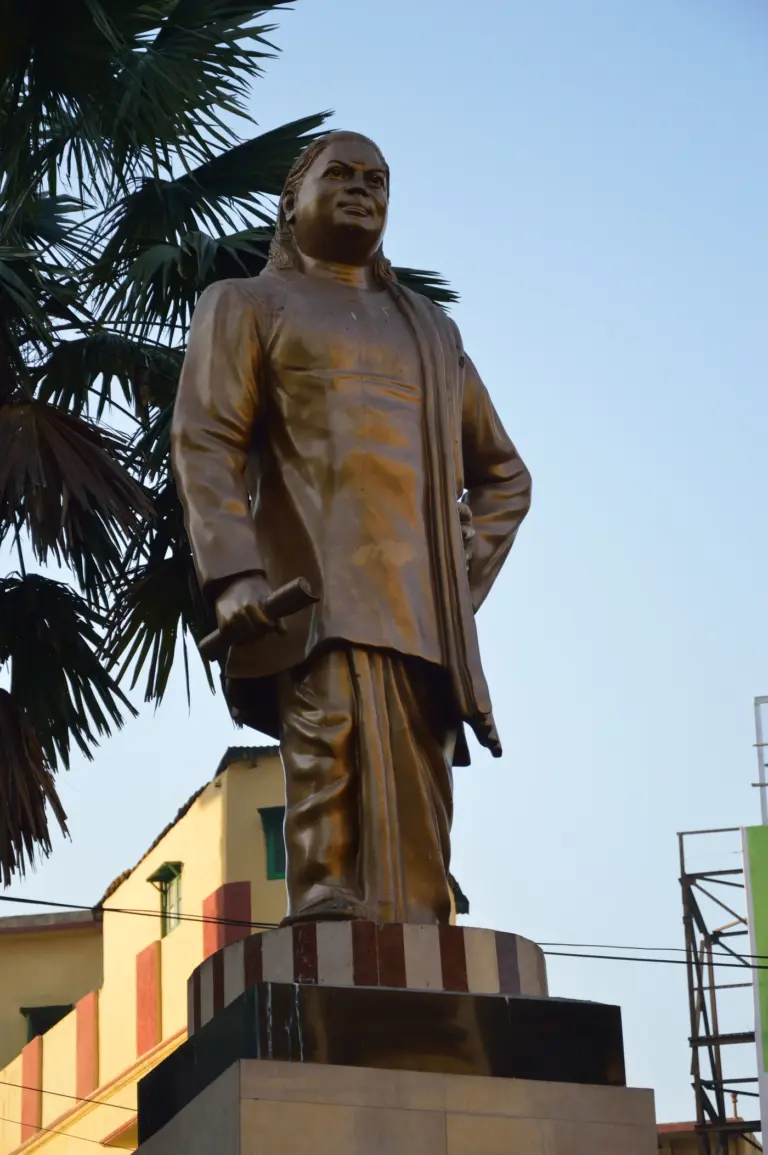
Satyendra Nath Bose (1894–1974) was an Indian theoretical physicist whose work on quantum statistics fundamentally changed our understanding of subatomic particles. His 1924 paper — sent directly to Albert Einstein after being rejected by a British journal — led to the development of Bose-Einstein statistics and the theoretical prediction of the Bose-Einstein condensate (a new state of matter). An entire class of subatomic particles — bosons — is named after him.
For UPSC, Bose represents India's contributions to world-class science. He appears in Science & Technology questions and is relevant for understanding India's scientific heritage.
Early Life and Education
Satyendra Nath Bose was born on January 1, 1894 in Calcutta (now Kolkata). His father, Surendranath Bose, was an accountant in the East Indian Railway Company.
Education:
- Studied at Hindu School and Presidency College, Calcutta
- Topped the MSc examination in Mixed Mathematics at the University of Calcutta (1915)
- His classmate and lifelong friend was Meghnad Saha (of the Saha ionisation equation)
- Joined the University of Calcutta as a lecturer in 1916, later moved to the newly established University of Dhaka (1921)
Bose was self-taught in many areas of physics. He learned German to read Einstein's papers in the original and French to access other European scientific literature — at a time when translations were scarce.
The 1924 Paper: A Revolution in Quantum Physics
The Problem
In the early 1920s, physicists were struggling to explain Planck's radiation law — the formula describing how a black body emits radiation. Planck's formula worked empirically but lacked a fully satisfactory theoretical derivation from first principles.
Bose's Solution
In 1924, while lecturing on radiation theory at the University of Dhaka, Bose developed a novel statistical method to derive Planck's law. His key insight: photons (light quanta) are indistinguishable from each other — you cannot tell one photon apart from another. This seems obvious now, but it was revolutionary at the time.
Classical statistics (Maxwell-Boltzmann) assumed that particles could be individually tracked. Bose showed that for photons, you had to count states differently — leading to what we now call Bose-Einstein statistics.
The Letter to Einstein
Bose submitted his paper to the Philosophical Magazine (a British journal). It was rejected. Undeterred, Bose sent the paper directly to Albert Einstein in Berlin with a cover letter asking for his opinion and help with publication.
Einstein immediately recognised the paper's importance. He:
- Translated it personally into German
- Submitted it to the prestigious Zeitschrift für Physik with his own recommendation
- Extended Bose's method from photons to atoms, creating the full Bose-Einstein statistics
Einstein's extension predicted that at extremely low temperatures, atoms obeying Bose-Einstein statistics would collapse into a single quantum state — the Bose-Einstein condensate (BEC). This prediction was experimentally confirmed in 1995 by Eric Cornell and Carl Wieman, who won the Nobel Prize for it.
Bosons: Named After Bose
Paul Dirac coined the term "boson" in 1945–47 to describe all particles that obey Bose-Einstein statistics. These include:
| Particle | Role |
|---|---|
| Photon | Carrier of electromagnetic force |
| Gluon | Carrier of strong nuclear force |
| W and Z bosons | Carriers of weak nuclear force |
| Higgs boson | Gives mass to particles (discovered 2012 at CERN) |
| Graviton | Hypothetical carrier of gravity |
The other class of particles — fermions — obeys Fermi-Dirac statistics and is named after Enrico Fermi and Paul Dirac.
When the Higgs boson was discovered at CERN in 2012, global media noted that half of its name honoured an Indian physicist.
Academic Career
| Period | Position |
|---|---|
| 1916–1921 | Lecturer, University of Calcutta (with Meghnad Saha) |
| 1921–1945 | Reader and later Professor, University of Dhaka |
| 1924–1926 | Research stay in Europe (worked with Einstein in Berlin, Marie Curie in Paris) |
| 1945–1956 | Khaira Professor of Physics, University of Calcutta |
| 1956–1958 | Vice-Chancellor, Visva-Bharati University (Shantiniketan) |
European Sojourn (1924–1926)
After the 1924 paper, Bose went to Europe on a research fellowship. He worked in Einstein's laboratory in Berlin and later at Marie Curie's Radium Institute in Paris. He also met other leading physicists including de Broglie and Langevin.
Despite this extraordinary access to the world's best physicists, Bose did not complete a doctoral thesis. He never received a PhD — his MSc remained his highest formal qualification. Yet he was appointed a full professor at Dhaka based purely on his published work.
Beyond Physics
Bose was not a narrow specialist. His intellectual interests ranged widely:
Languages: Fluent in Bengali, English, German, and French. He advocated for scientific education in Bengali.
Music and Literature: Deep interest in Bengali literature and Indian classical music.
National Science Policy: After independence, Bose served on scientific advisory committees and advocated for building India's scientific infrastructure.
Rajya Sabha Member: Nominated to the Rajya Sabha (1952–1958), where he contributed to science policy discussions.
The Nobel Prize Question
Bose was never awarded the Nobel Prize — a fact widely considered an oversight. Several reasons are discussed:
- The Nobel Committee historically favoured experimental discoveries over theoretical contributions (though Einstein himself won for theoretical work)
- Bose published relatively few papers after 1924 — he focused on teaching and institution-building rather than a prolific research career
- The Bose-Einstein condensate was not experimentally confirmed until 1995 (Bose died in 1974)
- Colonial-era biases in the global scientific community may have played a role
When the BEC was experimentally confirmed in 1995, Cornell and Wieman won the Nobel. When the Higgs boson was confirmed in 2012, Peter Higgs and François Englert won the Nobel. In both cases, Bose's foundational contribution was acknowledged but not awarded.
Honours and Recognition
| Honour | Year |
|---|---|
| Fellow of the Royal Society (FRS) | 1958 |
| Padma Vibhushan | 1954 |
| National Professor | 1959 (appointed by the Government of India) |
| S.N. Bose National Centre for Basic Sciences | Founded in Kolkata in his honour |
UPSC Relevance
GS3 (Science & Tech): Quantum physics, India’s scientific contributions, Bose-Einstein statistics/condensate.
GS4 (Ethics): Perseverance despite rejection, intellectual integrity, choosing teaching over personal glory.
Key Prelims facts:
- Born: January 1, 1894, Calcutta
- Died: February 4, 1974, Calcutta
- Key contribution: Bose-Einstein statistics (1924)
- Particles named: Bosons (by Paul Dirac)
- Worked with: Einstein (Berlin), Marie Curie (Paris)
- Never received a PhD or Nobel Prize
- Padma Vibhushan: 1954
- Fellow of the Royal Society: 1958
- Higgs boson (discovered 2012) — "boson" named after Bose
Tell Google you want more of this.
Add Anantam IAS as a preferred sourceOne tap, and this site shows up more often in your own Top Stories, AI Overviews and AI Mode. Remove it any time.