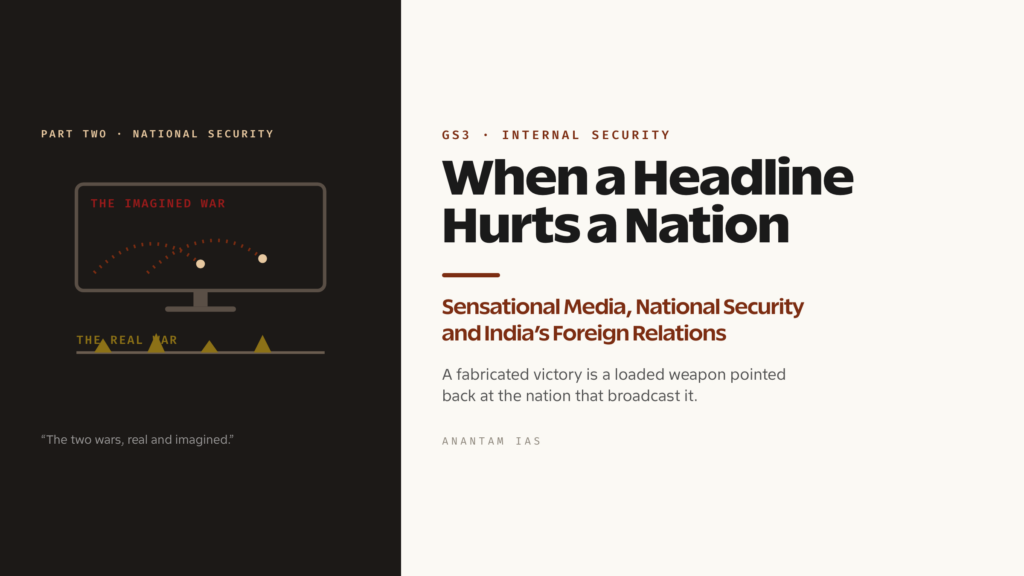
When the missiles flew during Operation Sindoor in May 2025, a second conflict opened on the studio floor. The International Federation of Journalists called it exactly that — “the two wars, real and imagined.” In a blog dated 25 June 2025, BOOM fact-checker Ritika Jain wrote for the IFJ that “while India and Pakistan were exchanging heavy fire, the news channels were engaged in an entirely different (fictional) war.” That second war had no front line and no casualty count, but its damage was real. It misled citizens, handed adversaries ready-made propaganda, muddied India’s image abroad and complicated diplomacy. A headline, it turns out, can hurt a nation.
This is the central tension of our series on media ethics in the age of virality. A free press is one of democracy’s load-bearing walls, and aggressive scrutiny of the state is not the problem. The problem is what happens when the metric shifts from being right to being first. During a security crisis, that shift stops being a newsroom failure and becomes a strategic vulnerability.
The anatomy of a “victory” that never happened
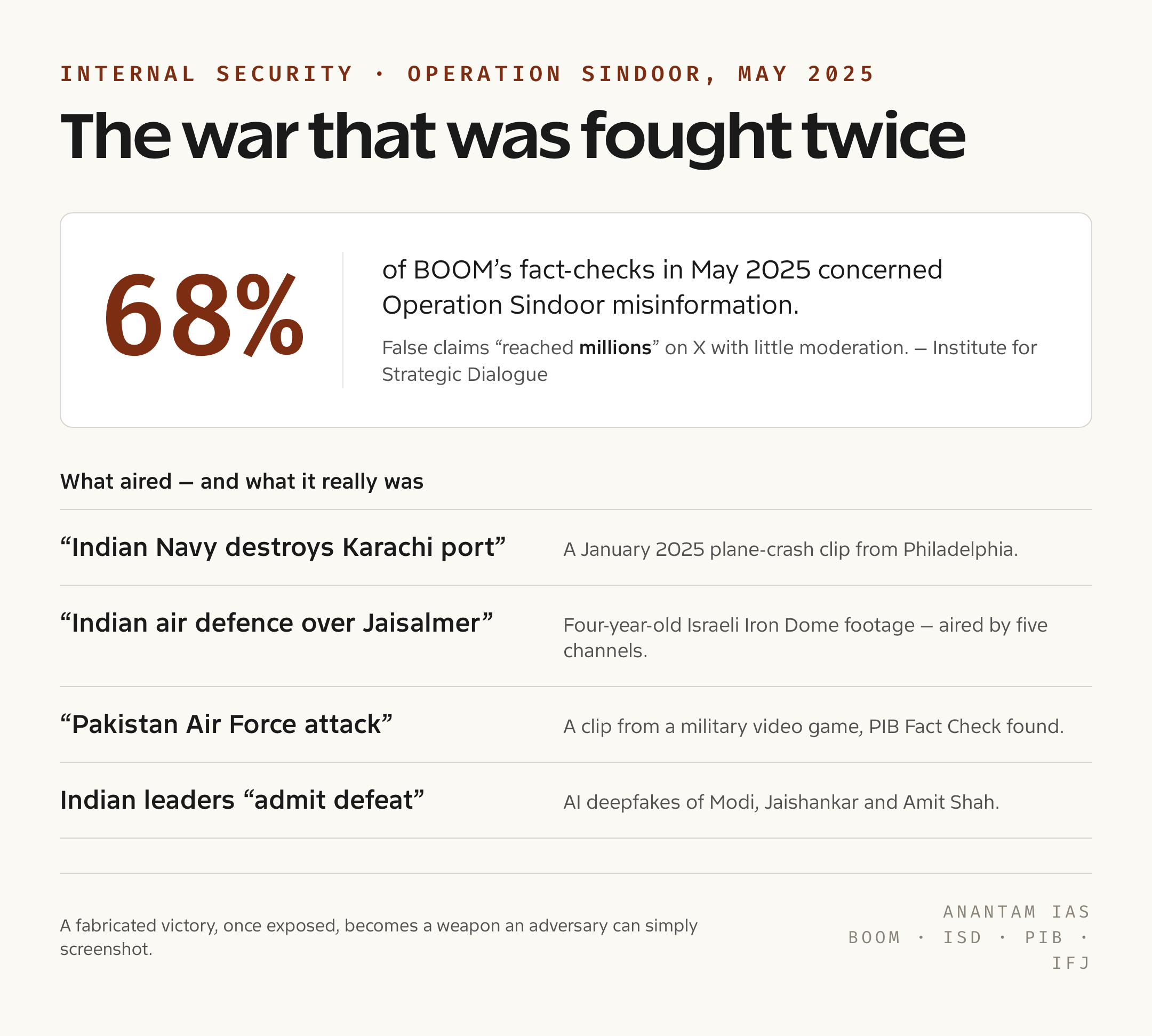
Look at what actually aired and circulated. The IFJ blog documented foreign footage repackaged as Indian operations — Israeli airstrikes on Gaza, a US plane crash relabelled as an attack on Karachi Port, an Iranian missile strike on Israel passed off as Indian action. PIB Fact Check traced one widely shared “Pakistan Air Force attack” clip to a military simulation video game. Five channels — Aaj Tak, ABP News, Times Now Navbharat, NDTV and India TV — ran four-year-old footage of Israel’s Iron Dome as live Indian air defence over Jaisalmer, according to a complaint filed by Citizens for Justice and Peace (CJP) before the broadcast regulator. None of this was journalism. It was theatre dressed as news.
The scale was not marginal. The Institute for Strategic Dialogue, in its analysis titled “Missiles and misinformation: False claims about the India-Pakistan clashes reach millions on X,” found that fabricated claims racked up millions of views with little or no moderation, often using AI-generated content, and that some of this online fiction “successfully crossed into national news media, effectively creating a reinforcing cycle.” Social media manufactured the lie; television laundered it into something that looked official; the audience had no way to tell the difference. BOOM reported that 68% of its fact-checks in May 2025 concerned Operation Sindoor misinformation.
Here is the part that should worry every patriot who cheered along. A fabricated “victory” is a loaded weapon pointed back at the nation that broadcast it. The moment a triumphant claim — a port destroyed, a city captured, an enemy leader surrendering — is exposed as false, the loss is not just to one channel’s ratings. It is to national credibility. An adversary’s information operation does not need to invent Indian falsehoods; it can simply screenshot ours. When deepfakes of Indian leaders “apologising and admitting defeat” went viral, as both the IFJ and PIB documented, they fed precisely on the credibility gap that breathless, unverified coverage had already opened. Hand your opponent a fake of your own making, and you have done their work for them.
The war room as a stage set
The recycled clips are symptoms. The underlying condition is a format — the prime-time studio rebuilt as a war room, complete with glowing maps, countdown clocks, animated missiles arcing across screens and anchors narrating combat that no reporter on the ground had confirmed. The IFJ noted animated sequences of Indian missiles intercepting Pakistani drones aired without any “simulation” label, leaving viewers to assume they were watching real-time battle. The operating principle, as Jain put it, became “report first, don’t bother verifying it — later or at all.”
This format inflames rather than informs by design. A map with arrows demands escalation the way a stage demands a third act. Restraint does not rate. So the studio reaches for the most dramatic available claim, and dramatic claims during a live conflict are, almost by definition, the unverified ones. The audience is left more frightened, more certain and more wrong — a combination that narrows the space any government has to act with cool heads. This is where the ethical question turns sharply national: the line between patriotism and jingoism. Patriotism can hold the state accountable and still want the nation to prevail. Jingoism wants the spectacle of victory so badly it stops checking whether the victory is real. The first strengthens a country. The second, as Sindoor showed, leaves it exposed.
Disinformation is now a security domain, not a side effect
Treating all this as a media-standards lapse undersells it. Information warfare and cyber warfare are recognised national-security threats, and the synthetic-media tools that drove the Sindoor information war — AI voice cloning, lip-sync deepfakes, generative video — are getting cheaper and more convincing each year. The ISD’s framing of “missiles and misinformation” in one breath is the point: in a modern crisis, the contest for the narrative runs parallel to the contest on the ground, and a society that cannot distinguish a real strike from a video-game clip has a defensive gap as concrete as any unguarded border.
There is a foreign-relations cost layered on top. India spends enormous diplomatic capital cultivating its image as a stable, responsible power — the substance of its soft power. Every cycle of jingoistic fabrication that international outlets then debunk chips at that image, making India look less like the mature democracy it is and more like the caricature its rivals would prefer. Diplomacy depends on the assumption that what India’s institutions say can be trusted. Sensational media that gets caught lying spends down that trust on everyone’s behalf, with no say from the people who will need it at the negotiating table. For students tracking how this connects to statecraft, our coverage of governance and the running daily current affairs brief trace these threads through specific cases.
The anxiety this breeds is itself becoming a security variable. In the 2026 Edelman Trust Barometer, 65% of respondents said they feared hostile foreign actors were injecting falsehoods into their national media to inflame domestic divisions — precisely the opening that a sensation-first press leaves for an adversary to exploit.
What responsible crisis reporting looks like
None of this argues for a muzzled press or for swallowing government claims whole. The fix is craft and restraint, not silence. A few principles, most of them already on the books:
- Source from the centre, not the timeline. During an operation, the authoritative channels are the official briefings — PIB, the Ministry of External Affairs and the armed forces’ own spokespersons. A viral X post is a lead to verify, never a fact to broadcast.
- Label what is not real. Animation, simulation, file footage and unconfirmed claims must be marked as such, every time. The Iron Dome footage caused harm only because it was presented as live and local.
- Respect operational security. The Ministry of Information and Broadcasting’s advisory during the crisis, grounded in Rule 6(1)(p) of the Cable Television Networks Rules, restricts live coverage of anti-terror and defence operations to periodic official briefings until they conclude. That is not censorship; it is the difference between reporting a war and leaking it.
- Honour the Programme Code. The Cable Television Networks Act and its Programme Code already bar content that endangers national security or incites communal hatred. The CJP complaints — including News18’s false identification of an Indian religious scholar as a slain Pakistani terrorist — were filed precisely because these standards exist and were breached.
- Correct loudly. A retraction buried after the fact does not undo a falsehood broadcast at full volume. Accountability bodies such as the broadcast regulator have ordered takedowns, but the better discipline is to not air the unverified claim in the first place.
The test of a free press is not whether it can shout during a crisis. It is whether it can keep its head while the country loses its own — whether it can love the nation enough to tell it the truth, especially the inconvenient, unglamorous truth that stays unaired because no one could verify it. Operation Sindoor was a reminder that the imagined war can wound the real one. The remedy is not less journalism. It is more of the real thing.
Frequently Asked Questions
What does the IFJ mean by the “two wars” during Operation Sindoor?
In a blog dated 25 June 2025, BOOM fact-checker Ritika Jain wrote for the International Federation of Journalists that alongside the real India-Pakistan military exchange in May 2025, news channels waged “an entirely different (fictional) war” — a parallel conflict of false claims, recycled footage and AI-generated content. The phrase captures how the contest for the narrative ran alongside the contest on the ground.
How widely did the false claims actually spread?
The Institute for Strategic Dialogue found that false claims about the clashes “reached millions” of views on X with little moderation, often using AI-generated content, and that some crossed from social media into national news, creating a reinforcing cycle. BOOM reported that 68% of its May 2025 fact-checks concerned Operation Sindoor misinformation.
Which examples of fabricated or recycled footage were documented?
PIB Fact Check traced one viral “Pakistan Air Force attack” clip to a military video game. The IFJ documented Gaza airstrike footage, a US plane-crash video and an Iranian missile strike all relabelled as Indian operations. CJP’s complaints before the broadcast regulator cited five channels airing four-year-old Iron Dome footage as live Indian air defence over Jaisalmer, and News18 misidentifying an Indian religious scholar as a slain Pakistani terrorist.
Why is sensational war coverage a national-security problem and not just bad journalism?
Fabricated “victory” claims, once exposed, erode national credibility and can be weaponised by adversaries — deepfakes of Indian leaders “admitting defeat” fed on exactly that credibility gap. Information and cyber warfare are recognised security threats, and synthetic media makes the gap exploitable. It also damages India’s image abroad and complicates diplomacy, which depends on the assumption that Indian institutions can be trusted.
What rules govern responsible reporting during military operations in India?
The Ministry of Information and Broadcasting issued an advisory, grounded in Rule 6(1)(p) of the Cable Television Networks Rules, restricting live coverage of anti-terror and defence operations to periodic official briefings until they conclude. The Cable Television Networks Act and its Programme Code also bar content endangering national security. Responsible practice means sourcing from official briefings (PIB, MEA, the armed forces), labelling animation and file footage, and observing operational-security restraint.
Practice Questions
Prelims MCQs
1. Live coverage of anti-terror and defence operations was restricted to periodic official briefings during recent crises. This restriction is grounded in which provision?
- (a) Section 66A of the IT Act
- (b) Rule 6(1)(p) of the Cable Television Networks Rules
- (c) Section 124A of the IPC
- (d) The Official Secrets Act schedule
Answer: (b) Rule 6(1)(p) of the Cable Television Networks Rules underpins the Ministry of Information and Broadcasting advisory limiting live coverage of such operations.
2. The phrase “the two wars, real and imagined” describing media coverage of Operation Sindoor is associated with which body?
- (a) The Press Council of India
- (b) The International Federation of Journalists
- (c) The Election Commission of India
- (d) NITI Aayog
Answer: (b) An IFJ blog (June 2025) used the phrase to capture the parallel “fictional war” of false claims fought in studios.
3. According to the Institute for Strategic Dialogue’s analysis, the spread of false claims during the India–Pakistan clashes was notable because:
- (a) It was confined to fringe websites
- (b) Fabricated claims reached millions on social media and some crossed into national news, creating a reinforcing cycle
- (c) It was promptly removed by all platforms
- (d) It originated only from foreign state media
Answer: (b) The ISD found false claims “reached millions” with little moderation, with some crossing from social media into mainstream news.
4. Why is hostile information warfare now treated as a national-security domain rather than a mere media lapse?
- (a) Because it always involves physical sabotage
- (b) Because cheap synthetic media can fabricate convincing “evidence” that adversaries can exploit
- (c) Because it is banned under the Geneva Convention
- (d) Because it only affects social media companies
Answer: (b) AI voice cloning and deepfakes make a society’s inability to tell real from fake a concrete defensive gap that adversaries can weaponise.
5. The Programme Code that bars broadcast content endangering national security or inciting communal hatred is issued under which law?
- (a) The Press and Registration of Books Act
- (b) The Cable Television Networks (Regulation) Act
- (c) The Prasar Bharati Act
- (d) The Disaster Management Act
Answer: (b) The Programme Code is framed under the Cable Television Networks (Regulation) Act and its Rules.
Mains Practice Questions
- “A fabricated victory is a loaded weapon pointed back at the nation that broadcast it.” Examine how sensational, unverified crisis reporting can become a national-security vulnerability. (15 marks, 250 words)
- Distinguish between patriotism and jingoism in the context of war reporting. Why does the studio “war room” format inflame rather than inform? (15 marks, 250 words)
- Disinformation during a security crisis carries a foreign-relations cost, not just a domestic one. Discuss with reference to India’s soft power and diplomatic credibility. (15 marks, 250 words)
- “The fix is craft and restraint, not silence.” Suggest principles for responsible crisis reporting that protect both press freedom and operational security. (10 marks, 150 words)
- Information warfare and cyber warfare are now recognised security threats. Analyse the institutional and societal preparedness India needs to counter synthetic-media disinformation. (10 marks, 150 words)
Tell Google you want more of this.
Add Anantam IAS as a preferred sourceOne tap, and this site shows up more often in your own Top Stories, AI Overviews and AI Mode. Remove it any time.