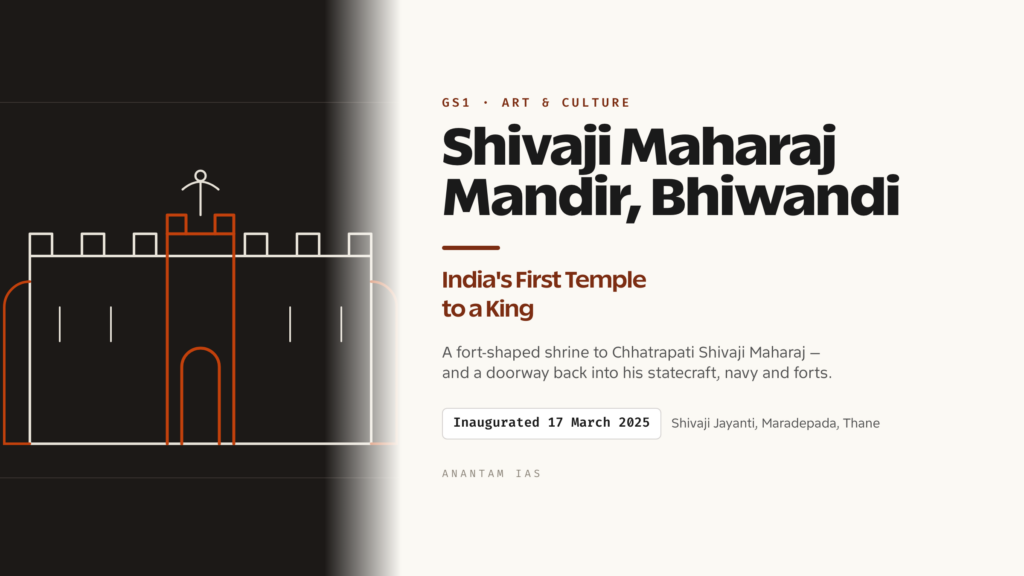
The Shivaji Maharaj Mandir in Bhiwandi — at Maradepada in Thane district, Maharashtra — is widely described as India’s first temple dedicated solely to Chhatrapati Shivaji Maharaj. Built by the Shivkranti Pratishthan Trust and shaped like a Maratha fort, it was inaugurated on 17 March 2025 (Shivaji Jayanti) by Chief Minister Devendra Fadnavis, and enshrines a 6.5-foot bronze statue of the king sculpted by Arun Yogiraj — the artist behind the Ram Lalla idol at Ayodhya.
Most temples enshrine a god. The one that opened at Bhiwandi in Thane district enshrines a king. On 17 March 2025, on the day Maharashtra marks Shivaji Jayanti, Chief Minister Devendra Fadnavis inaugurated what is being called India’s first temple dedicated solely to Chhatrapati Shivaji Maharaj — not a statue in a park, not a memorial samadhi, but a working mandir where a 17th-century ruler is honoured with the rituals usually reserved for the divine. At its heart stands a 6.5-foot bronze figure of the king, sculpted by Arun Yogiraj, the same artist who carved the Ram Lalla idol installed at Ayodhya.
That single decision — to build a temple, not a museum — is the story worth holding onto. A man born in 1630 is now an object of daily devotion, his shrine wrapped in a fort-style wall complete with bastions. For a UPSC aspirant, the Bhiwandi mandir is less a tourism note than a doorway. It reopens the questions examiners keep returning to: how Shivaji built a state from almost nothing, why his model of governance and warfare still gets studied, and what it means when a nation turns a historical king into a living symbol.
What the Bhiwandi Temple Actually Is
Let’s get the facts exact, because the news hook has been muddled in older write-ups. The temple sits at Maradepada in Bhiwandi taluka of Thane district, built by the Shivkranti Pratishthan Trust and designed by architect Vijaykumar Patil. It was inaugurated on 17 March 2025 by Chief Minister Fadnavis, with the Deputy Chief Minister also in attendance. Reports at the opening said the state intends to grant it the status of a pilgrimage site.
The architecture is the message. The shrine proper covers about 2,500 square feet, but it sits inside a roughly 5,000-square-foot boundary built to look like a Maratha fort — bastions, a patrol-style pathway along the walls, and a towering entrance gate. The sabha mandap, or assembly hall, rises about 42 feet, and the complex carries dozens of sculpted panels narrating scenes from Shivaji’s life. The trust describes the place, tellingly, as “an emotional fort for all” — a stand-in for the real hill forts that ordinary devotees may never climb.
And that is the heritage shift in miniature. A samadhi at Raigad or a statue at a traffic circle asks to be visited and admired. A temple asks to be worshipped — with aarti, with prayer, with the rhythm of a religious calendar. The Bhiwandi mandir moves Shivaji across that line, from a figure of history into a figure of devotion. Whether that is a fitting tribute or an over-reach is exactly the kind of debate UPSC loves, and we’ll come back to it. First, the man the shrine is built around.
The King the Shrine Honours
Shivaji Bhosale was born on 19 February 1630 at Shivneri Fort near Junnar, to Shahaji Bhosale, a military commander who served the Deccan sultanates, and Jijabai, who raised and shaped him in Shahaji’s long absences. He grew up in a Deccan carved between the Mughals to the north and the Bijapur and Ahmednagar sultanates around him — a world where a Maratha noble’s family held land at the pleasure of larger powers. Shivaji’s life’s work was to turn that dependence on its head.
He began young, taking hill forts in the Pune region in the 1640s and welding local Maratha chiefs into a fighting force loyal to him rather than to any sultan. His ambition had a name: Hindavi Swarajya, self-rule, a polity run by and for the people of the land rather than by distant imperial courts. The early decades were a long contest of forts and raids against Bijapur and then the Mughal empire under Aurangzeb. The turning points read like a syllabus in themselves — the killing of the Bijapur general Afzal Khan at Pratapgarh in 1659, the daring night raid that wounded the Mughal commander Shaista Khan at Pune in 1663, the two lucrative sacks of the Mughal port of Surat, the humbling Treaty of Purandar in 1665 that forced him to surrender forts, his theatrical escape from Agra in 1666, and the open-field victory at Salher in 1672 that proved the Marathas could beat a Mughal army in a set-piece battle, not just a skirmish.
The capstone came on 6 June 1674. At Raigad, in an elaborate ceremony presided over by the Varanasi scholar Gaga Bhatt, Shivaji was crowned Chhatrapati — “lord of the umbrella,” a sovereign in his own right. Water from sacred rivers was poured over him; he took titles such as Haindava Dharmoddharak. The coronation was not just pageantry. It was a legal and political declaration that the Maratha polity was a kingdom, equal in dignity to any empire, with its own era and its own laws. He died at Raigad on 3 April 1680, but the state he built outlasted him by well over a century.
How Shivaji Built and Ran a State
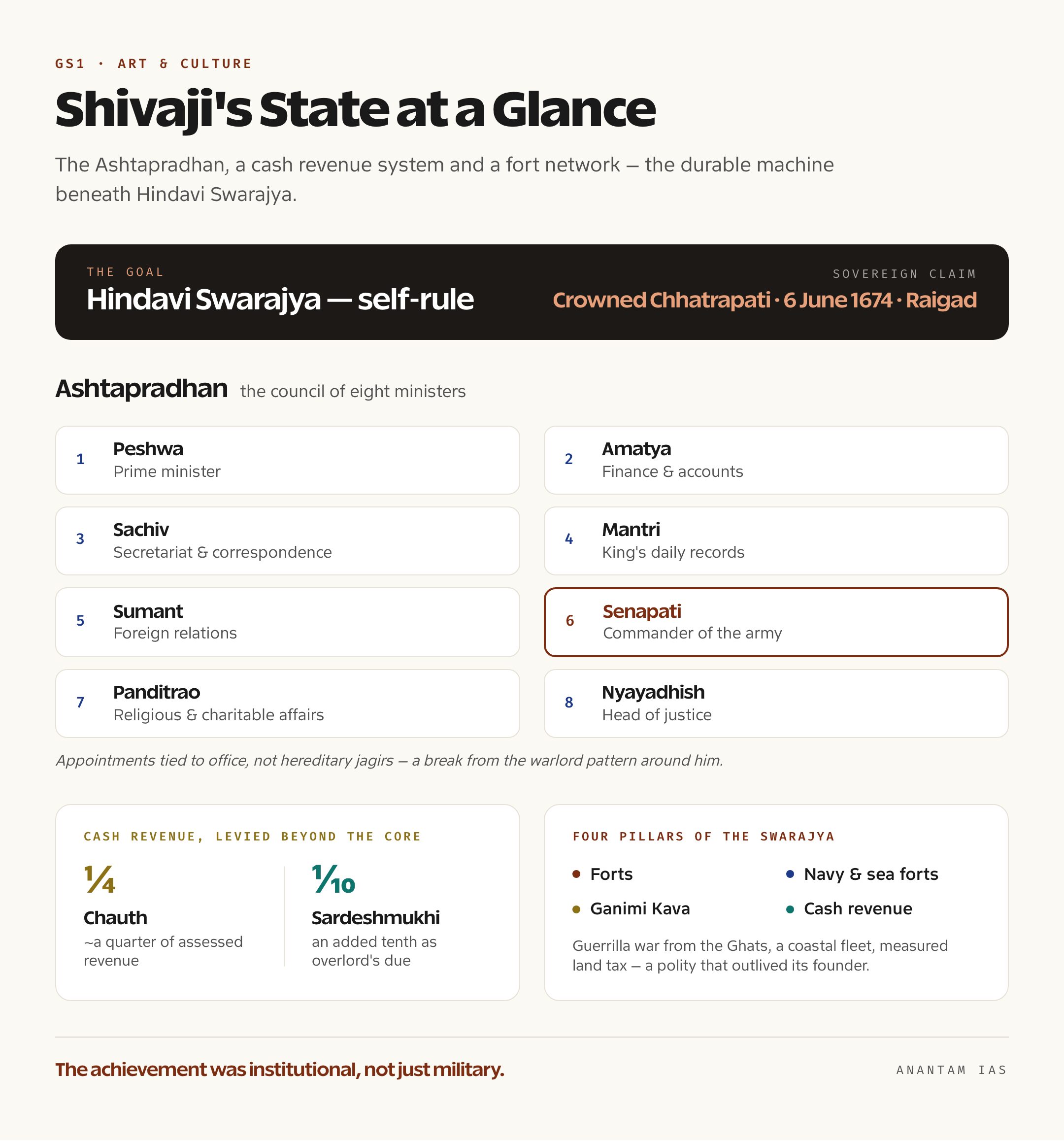
Here is where Shivaji earns his place in the answer scripts, because conquering forts is common in history while building durable institutions is rare. His government rested on the Ashtapradhan, a council of eight ministers, each heading a department. The Peshwa was the prime minister; the Amatya handled finance and accounts; the Sachiv ran the secretariat and correspondence; the Mantri kept records of the king’s daily affairs; the Sumant managed foreign relations; the Senapati commanded the army; the Panditrao oversaw religious and charitable matters; and the Nyayadhish headed justice. Crucially, under Shivaji these posts were appointments tied to performance, not hereditary fiefs — a deliberate break from the jagirdari pattern around him, even if some offices, like the Peshwa, later hardened into dynasties.
His revenue system was just as considered. Shivaji discouraged the older jagir model — granting land in lieu of salary, which tended to create independent warlords — and pushed instead toward cash assessment of land based on actual measurement, an approach owing something to the Deccan administrator Malik Ambar. From territories outside his direct control he levied two famous taxes that became the engine of later Maratha expansion: Chauth, roughly a quarter of the assessed revenue, and Sardeshmukhi, an additional tenth claimed as a hereditary overlord’s due. These were not random plunder; they were a structured demand that bought protection and recognised Maratha supremacy, and they let the state fund itself far beyond its core lands.
Two features deserve a line because they cut against lazy assumptions. First, Shivaji’s army and administration were not closed to Muslims — he employed Muslim officers, gunners and sailors, and his quarrel was with imperial overlordship, not with a faith. Second, he invested in the unglamorous machinery of rule: forts garrisoned under divided command so no single officer could turn rebel, careful records, and a standing force paid largely in cash. The result was a polity that could survive the loss of its founder, which is the truest test of statecraft.
The Navy and the Art of Guerrilla War
So how did a regional chief hold off the largest empire in the subcontinent? Two answers, and both still get taught in war colleges. The first is Ganimi Kava — the guerrilla method. Rather than meet a heavier Mughal or Bijapur army head-on, Shivaji used speed, surprise and terrain. Light, lightly-burdened cavalry struck supply lines and isolated garrisons, then melted back into the hills before a counter-blow could land. Forts perched on ridges turned the Western Ghats into a defensive maze where numbers mattered less than knowledge of the ground. It was a strategy of the weaker side refusing to fight on the stronger side’s terms — and it worked for decades.
The second answer is the one Indians rediscover every Navy Day: Shivaji built a navy. He grasped early that the Konkan coast could not be defended from land alone, with the Portuguese, the British and the Siddis of Janjira all probing from the sea. So he raised a fleet and ringed the coast with sea forts, the most famous being Sindhudurg, begun on a rocky island in the 1660s, and Vijaydurg, which he captured and strengthened. This is why he is so often called the father of the Indian Navy, and why the modern Navy’s ensign carries his royal seal. The maritime tradition he founded was carried to its height a generation later by admirals like Kanhoji Angre, who dominated the western seas into the early 18th century — proof that Shivaji had built something institutional, not personal.
It is no accident that the Bhiwandi temple is shaped like a fort. The forts were the spine of the Swarajya — administrative centres, treasuries, garrisons and refuges all at once. Recreating that silhouette around a shrine is a way of saying that the building and the king are inseparable: you cannot honour Shivaji without invoking the stone-and-mortar system through which he ruled.
Why His Memory Still Moves India
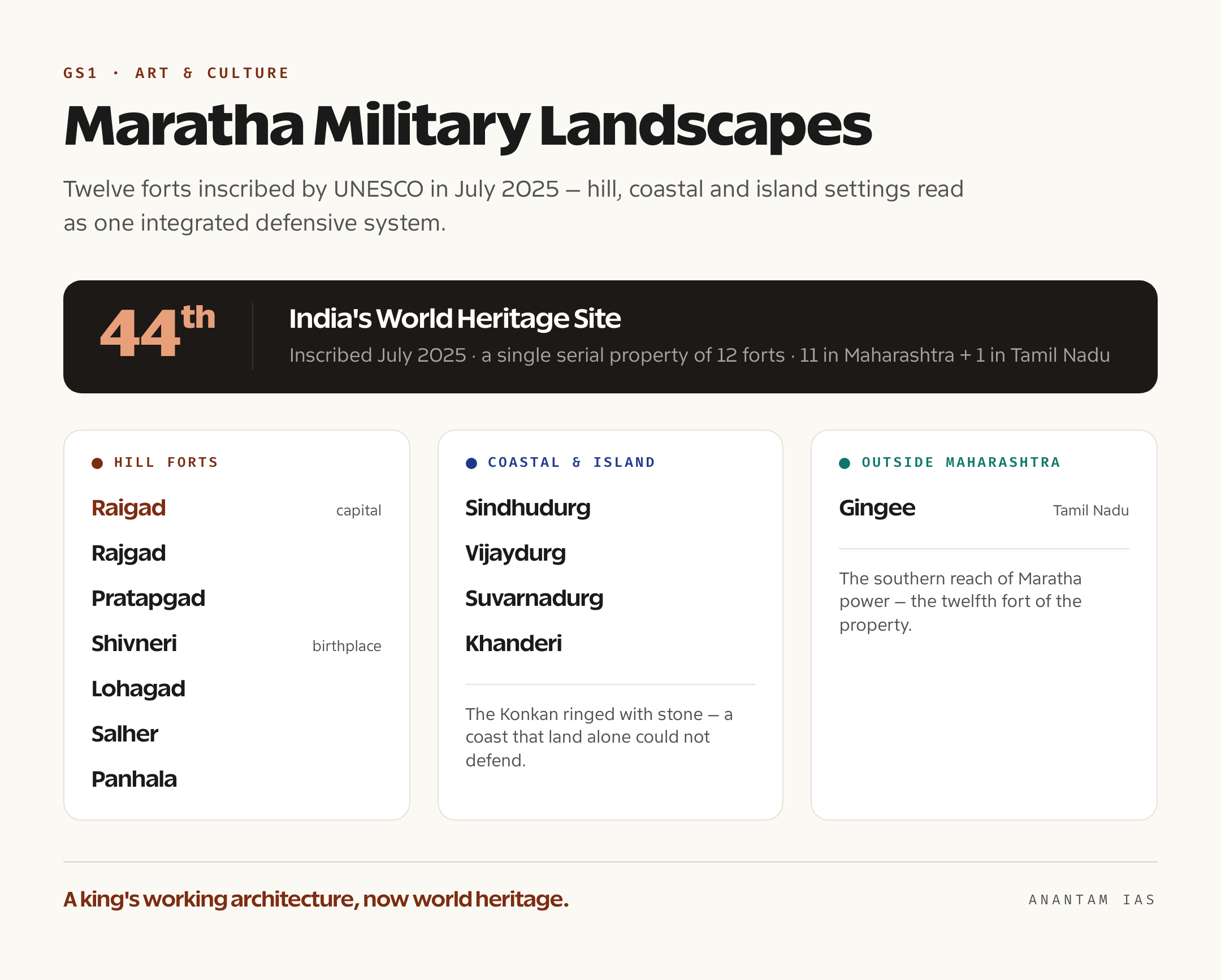
The forts make the cleanest bridge from history to the present. In July 2025, UNESCO inscribed the “Maratha Military Landscapes of India” on its World Heritage List, India’s 44th World Heritage Site. The serial property gathers twelve forts built or adapted by the Marathas — Raigad, Rajgad, Pratapgad, Shivneri, Lohagad, Salher, Panhala, the sea forts Sindhudurg, Vijaydurg, Suvarnadurg and Khanderi in Maharashtra, and Gingee in Tamil Nadu — recognised for how their hill, coastal and island settings formed one integrated defensive system. A king’s working architecture is now treated as world heritage, and the Bhiwandi mandir is the popular, devotional echo of that same surge of pride.
But Shivaji’s hold on the Indian imagination is older than any inscription. In the late 19th century, Bal Gangadhar Tilak revived Shivaji Jayanti as a public festival, deliberately turning a regional hero into a rallying point for an emerging national movement against colonial rule. Through the 20th century and into our own, his name has anchored Marathi identity, fuelled party politics, and supplied a shorthand for courage, self-rule and resistance. The proposed Shiv Smarak, a colossal offshore memorial in the Arabian Sea off Mumbai, and now the Bhiwandi temple, are two faces of the same impulse — the urge to give an idea a physical, visitable, even worshipable form.
That impulse is worth examining rather than simply celebrating, and a strong UPSC answer does both. A temple to a king raises real questions about how a secular republic should commemorate historical figures, about the line between civic memory and religious devotion, and about who gets to claim a hero’s mantle. None of that diminishes Shivaji. It shows, rather, that he remains genuinely contested ground — which is precisely why a 345-year-old king can still make news when a community decides to build him a shrine.
For Your Mains Answer
This topic feeds GS Paper 1 on its medieval-history side (the rise of the Marathas, Shivaji’s administration, art and architecture) and on its modern-and-society side (how heritage, memory and commemoration shape regional and national identity). It can also surface in GS Paper 2 on the politics of identity, and in the Essay paper on heritage, leadership or the uses of the past. Treat the Bhiwandi temple as a live hook into the deeper story of Maratha statecraft.
How to Build the Answer
Open with the news, then pivot fast to substance. A line on the 2025 temple establishes currency; the body should be about Shivaji’s institutions — the Ashtapradhan, the cash-based revenue system, Chauth and Sardeshmukhi, the fort network, the navy and Ganimi Kava. Close on legacy: the 2025 UNESCO inscription, Tilak’s revival of Shivaji Jayanti, and the modern memorialisation. The arc news → statecraft → legacy → balanced reflection fits almost any question on this theme.
Common Mistakes to Avoid
Don’t reduce Shivaji to a list of battles; examiners reward the institutional story over a fight-by-fight chronicle. Don’t get the temple’s date wrong — it opened in March 2025, not earlier. Don’t flatten his religious policy into a slogan in either direction; he employed Muslims and fought empires, not a faith. And don’t dodge the commemoration debate — engaging it shows maturity.
A Compact Answer Spine
Hindavi Swarajya as the goal → forts and Ganimi Kava as the method → Ashtapradhan and cash revenue (Chauth, Sardeshmukhi) as the institutions → the navy and sea forts as foresight → 1674 coronation as the legal claim to sovereignty → legacy via Tilak, the 2025 UNESCO landscapes and the Bhiwandi temple → a balanced note on memory and commemoration.
Diagram or Flowchart Idea
Draw a simple wheel with “Hindavi Swarajya” at the hub and eight spokes for the Ashtapradhan ministries, then a side-bar listing the four pillars — forts, navy, Ganimi Kava, cash revenue. A clean institutional diagram like this signals that you understand the system, not just the man.
A Balanced-Conclusion Line
Something like: “Shivaji’s enduring claim on India rests less on his battles than on the institutions he built — and the temples and World Heritage tags raised in his name show a nation still negotiating how to remember a king who made self-rule thinkable.”
How to Use Data Without Cramming
Anchor with a few unforgettable specifics, not a flood: born 1630, crowned 6 June 1674, died 1680; the eight-minister Ashtapradhan; Chauth a quarter and Sardeshmukhi a tenth; the 2025 UNESCO inscription of twelve forts as India’s 44th World Heritage Site; the temple opened 17 March 2025. Six precise facts carry more weight than twenty vague ones.
FAQ
When and where was India’s first Shivaji Maharaj temple inaugurated? The temple at Maradepada in Bhiwandi, Thane district of Maharashtra, was inaugurated on 17 March 2025 — Shivaji Jayanti — by Chief Minister Devendra Fadnavis. Built by the Shivkranti Pratishthan Trust, it is widely described as India’s first temple dedicated solely to Chhatrapati Shivaji Maharaj, with a 6.5-foot statue sculpted by Arun Yogiraj.
What was the Ashtapradhan? The Ashtapradhan was Shivaji’s council of eight ministers, each running a department — the Peshwa (prime minister), Amatya (finance), Sachiv (secretariat), Mantri (records), Sumant (foreign affairs), Senapati (army), Panditrao (religious affairs) and Nyayadhish (justice). Under Shivaji these were appointments tied to office rather than hereditary grants, which made his administration unusually durable.
What were Chauth and Sardeshmukhi? They were two Maratha levies. Chauth was roughly a quarter of the assessed revenue of a territory, collected in return for protection and recognition of Maratha supremacy. Sardeshmukhi was an additional tenth claimed as a hereditary overlord’s right. Together they funded the state’s expansion far beyond its core lands.
Why are Shivaji’s forts now a UNESCO World Heritage Site? In July 2025, UNESCO inscribed the “Maratha Military Landscapes of India” — twelve hill, coastal and island forts including Raigad, Shivneri, Sindhudurg and Gingee in Tamil Nadu — as India’s 44th World Heritage Site. They were recognised as an integrated defensive system that used terrain to sustain Maratha power, the same fort tradition the Bhiwandi temple deliberately evokes in its design.
Practice Questions
Prelims MCQs
- The Bhiwandi temple inaugurated in March 2025 is significant because it is described as:
(a) the oldest surviving Shivaji-era fort temple
(b) India’s first temple dedicated solely to Chhatrapati Shivaji Maharaj
(c) the largest Hemadpanti temple in the Konkan
(d) a UNESCO-protected monument.
Answer: (b) — It is widely reported as the first mandir built to worship Shivaji Maharaj himself, not a fort-era shrine or a protected monument. - With reference to Shivaji’s Ashtapradhan, consider the ministers: which one headed the army?
(a) Amatya
(b) Sachiv
(c) Senapati
(d) Panditrao.
Answer: (c) — The Senapati was the commander-in-chief; the Amatya handled finance, the Sachiv the secretariat, and the Panditrao religious affairs. - Chauth and Sardeshmukhi were:
(a) two grades of military rank in the Maratha navy
(b) revenue levies of roughly one-fourth and one-tenth respectively
(c) categories of fort under divided command
(d) titles conferred at Shivaji’s coronation.
Answer: (b) — Chauth was about a quarter of assessed revenue and Sardeshmukhi an additional tenth claimed as an overlord’s due. - Shivaji’s coronation as Chhatrapati took place in which year and at which fort?
(a) 1659 at Pratapgarh
(b) 1666 at Agra
(c) 1674 at Raigad
(d) 1680 at Sindhudurg.
Answer: (c) — He was crowned at Raigad on 6 June 1674, in a ceremony presided over by Gaga Bhatt. - The “Maratha Military Landscapes of India,” inscribed by UNESCO in 2025, includes a fort located outside Maharashtra at:
(a) Golconda in Telangana
(b) Gingee in Tamil Nadu
(c) Chittorgarh in Rajasthan
(d) Hampi in Karnataka.
Answer: (b) — Eleven of the twelve forts are in Maharashtra; Gingee (Senji) in Tamil Nadu is the twelfth, and the property is India’s 44th World Heritage Site.
Mains Practice Questions
- “Chhatrapati Shivaji Maharaj’s greatest achievement was not military but institutional.” Critically examine with reference to his administrative and revenue systems. (15 marks, 250 words)
- Discuss the strategic logic behind Shivaji’s fort network and the doctrine of Ganimi Kava, and assess why these forts merited inscription as a UNESCO World Heritage property. (15 marks, 250 words)
- Evaluate the view that Shivaji laid the foundations of Indian naval power. How far is the modern Indian Navy’s invocation of his legacy historically justified? (10 marks, 150 words)
- How did Shivaji’s coronation of 1674 transform the Maratha polity from a regional resistance into a sovereign state? (10 marks, 150 words)
- The building of a temple to a historical king raises questions about how a secular republic should commemorate its past. Discuss with reference to the recent memorialisation of Chhatrapati Shivaji Maharaj. (15 marks, 250 words)
Tell Google you want more of this.
Add Anantam IAS as a preferred sourceOne tap, and this site shows up more often in your own Top Stories, AI Overviews and AI Mode. Remove it any time.