In December 2025, Australia did something no country had tried before: it switched off social media for everyone under sixteen. Facebook, Instagram, TikTok, Snapchat, YouTube and the rest were given a year’s warning and then, on 10 December, legally barred from letting under-16s hold accounts — with fines of up to A$49.5 million for platforms that didn’t take “reasonable steps” to keep them out. Governments from Britain to India watched closely, because Australia had turned a noisy parenting argument into hard law. The question underneath it is one that now sits at the centre of social policy everywhere: what did the smartphone do to childhood, and should the state step in to undo it?
That question matters for India more than almost anywhere, and not as an abstract Western worry. India has the largest population of young internet users on earth, the cheapest mobile data in the world, and a survey-confirmed reality that nearly nine in ten teenagers already have a smartphone at home. For a UPSC aspirant, “smartphones and childhood” is a textbook GS1 Society topic — it braids together adolescence, family, education, mental health, gender and technology — and a live governance problem, because India’s new data-protection rules are about to put children’s online lives under a legal regime for the first time. This piece lays out the thesis driving the global panic, the serious scientific fight over whether it’s true, the wave of laws it has triggered, and exactly where India fits.
The Anxious Generation: How Childhood Went Phone-Based
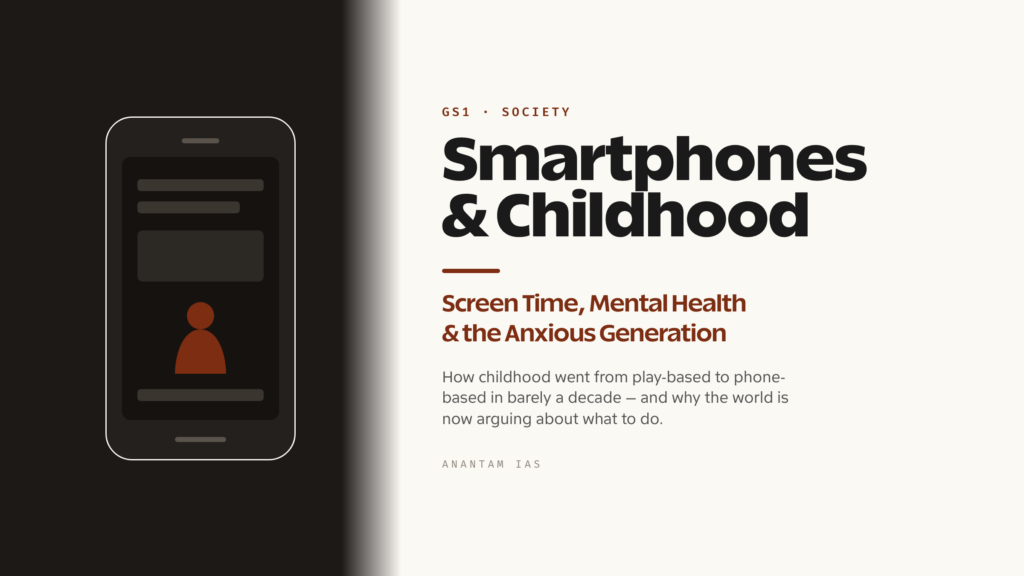
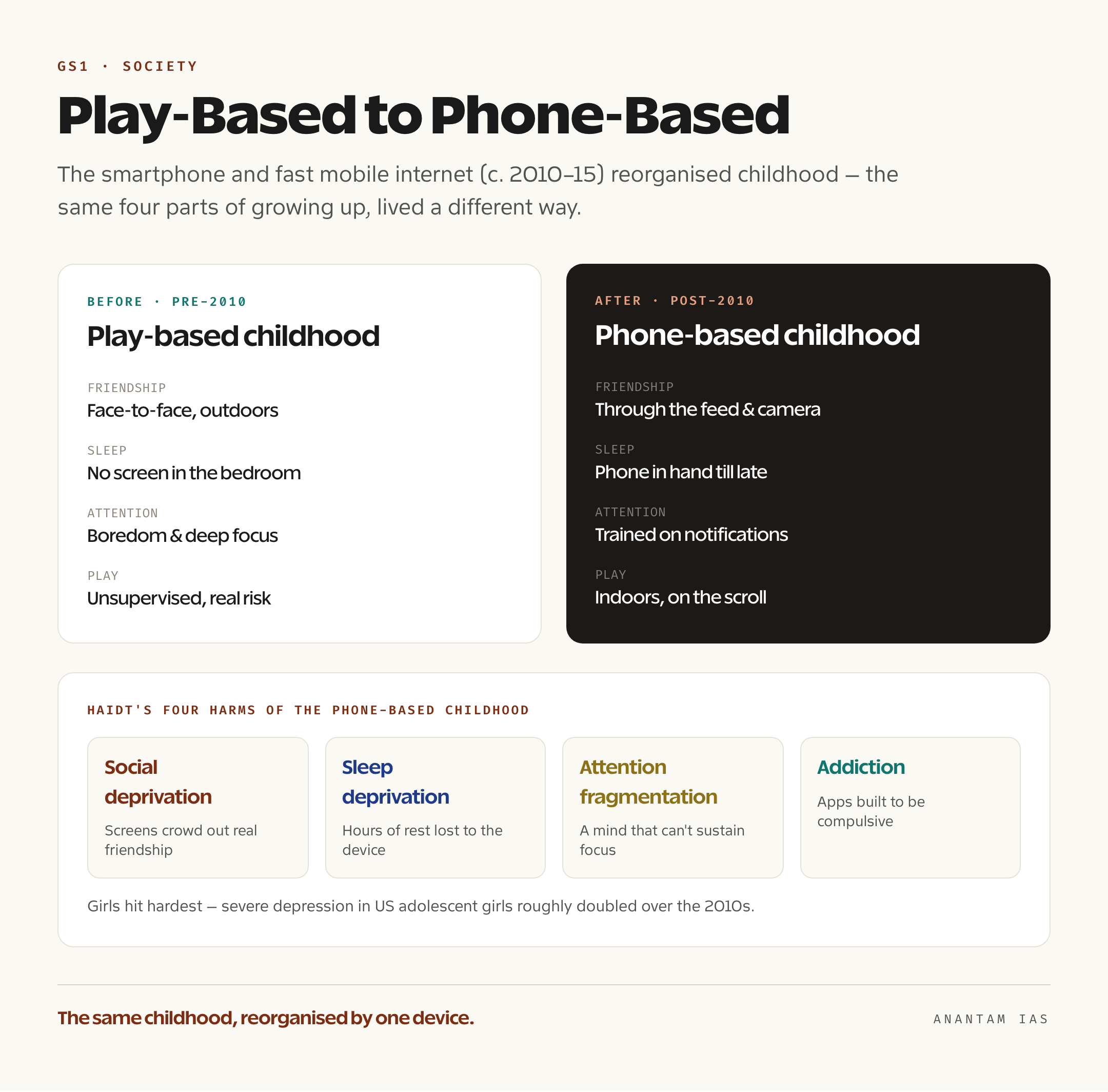
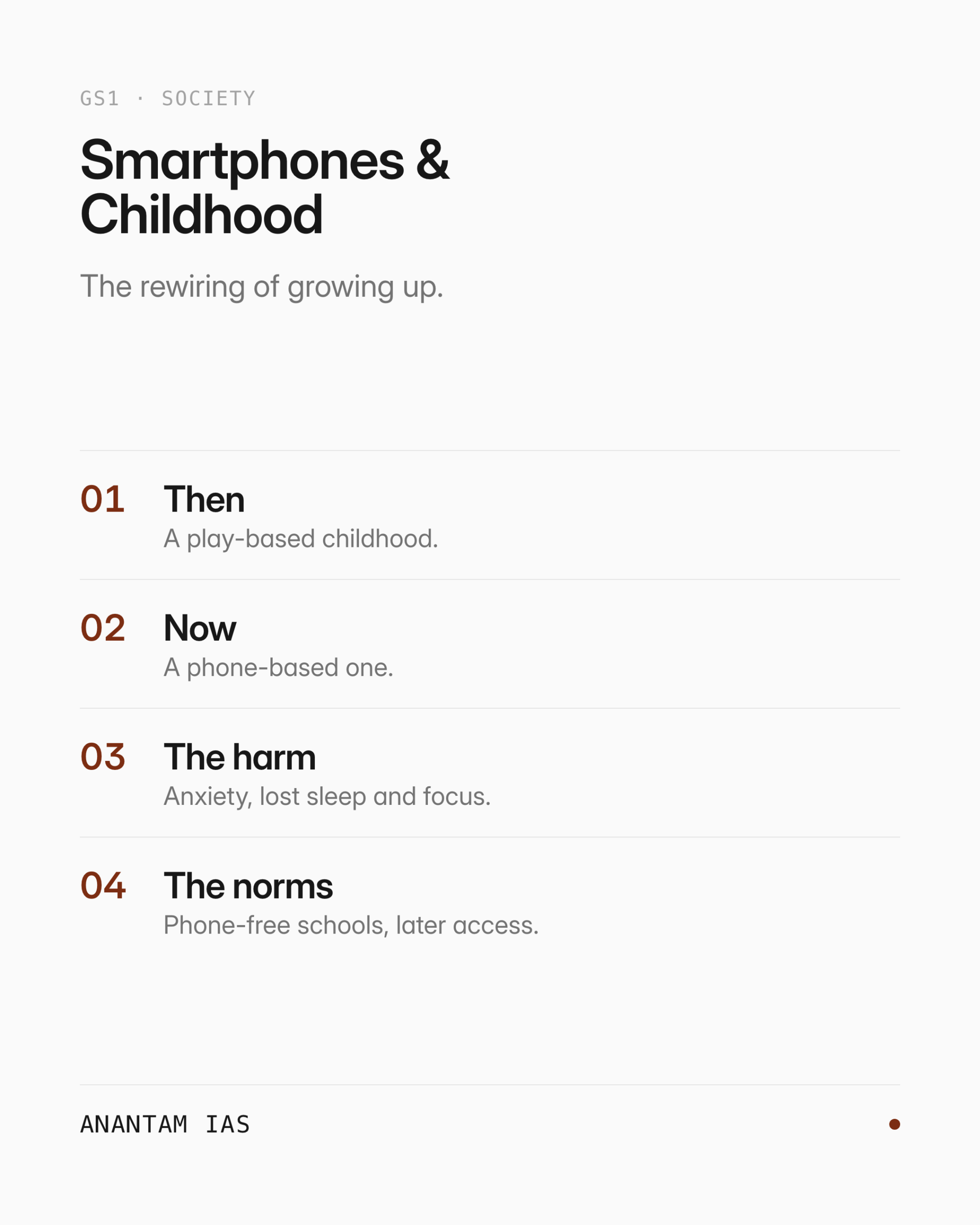
The intellectual engine of this whole debate is a 2024 book by the American social psychologist Jonathan Haidt, The Anxious Generation: How the Great Rewiring of Childhood Is Causing an Epidemic of Mental Illness. Haidt’s claim is simple to state and explosive in effect. Between roughly 2010 and 2015, he argues, childhood was quietly rewired — it shifted from a play-based childhood, built on unsupervised outdoor play, real-world friendship and boredom, to a phone-based childhood, lived through the front-facing camera and the infinite scroll. The trigger was the arrival of the smartphone with a good camera (around 2010) and the high-speed mobile internet that made social media feel like a place you lived rather than a thing you checked. A generation that hit puberty with that device in hand, Haidt says, is the first to grow up this way — and it is paying a price in its mental health.
His evidence is a set of graphs that show, across the United States, Britain and other rich countries, rates of teen anxiety, depression, self-harm and suicide staying flat through the 2000s and then bending sharply upward in the early 2010s, just as smartphones became near-universal among teenagers. The rise, crucially, is steepest among girls. In the US, rates of severe depression in adolescent girls roughly doubled over the 2010s; sleep collapsed, with the share of older teens getting seven hours or less rising from about a third to nearly half between 2010 and 2021. Haidt’s explanation is that the phone-based childhood inflicts four specific harms: social deprivation (screen time crowding out face-to-face friendship), sleep deprivation (the phone in the bedroom stealing hours of rest), attention fragmentation (a mind trained on notifications losing the capacity for sustained focus), and addiction (apps engineered with variable rewards to be compulsively used). Girls, he argues, are hit hardest because their social lives migrated most fully onto platforms built around appearance, comparison and social exclusion.
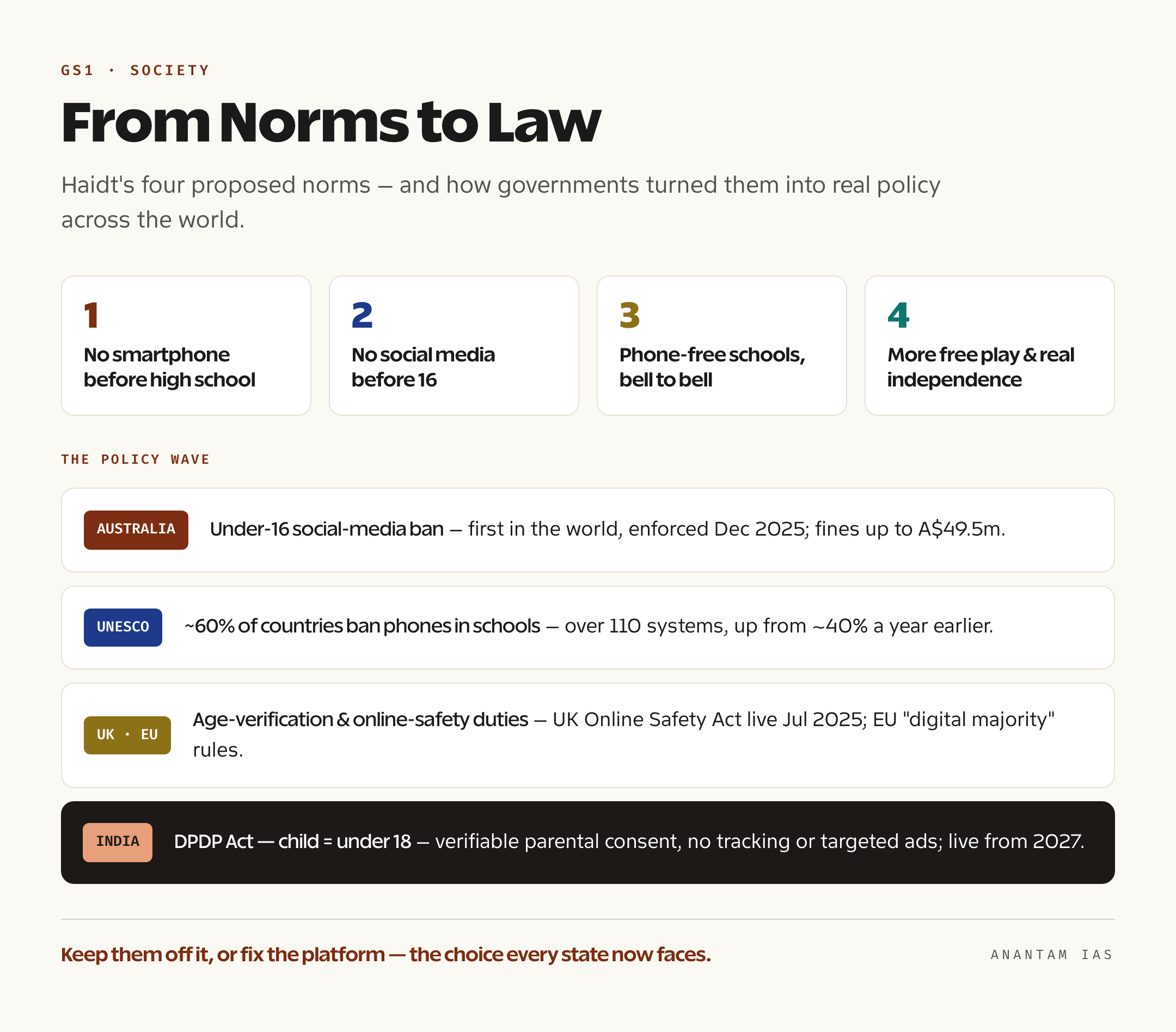
From this diagnosis Haidt draws four blunt prescriptions — the four norms that have become the rallying cry of a movement. First, no smartphones before high school — give younger children a basic phone for calls and texts, not a portal to the entire internet. Second, no social media before sixteen, the age he treats as a floor for handling algorithmic platforms. Third, phone-free schools — devices locked away “bell to bell,” from arrival to dismissal, so the school day is reclaimed for learning and real interaction. Fourth, more independence, free play and responsibility in the real world — letting children roam, take risks and grow competent offline. The norms are deliberately collective: any one family that bans the phone leaves its child isolated, so the fix only works if whole schools, towns and countries move together. That insight — that this is a coordination problem, not a willpower problem — is what turned a book into a policy agenda.
The Evidence Fight: Correlation, Causation and the Nuance
Here is where a careful answer pulls ahead of a lazy one, because the Haidt thesis is contested by serious scientists, and a UPSC candidate who knows both sides looks far sharper than one who simply repeats the alarm. The sharpest published rebuttal came from the developmental psychologist Candice Odgers, who reviewed the book in the journal Nature and accused Haidt of mistaking correlation for causation. Her core point is the one every social-science student should be able to make: two lines rising together — smartphone adoption and teen distress — do not prove that one caused the other. Much of the research, Odgers argued, finds the link between social-media use and depression to be small and inconsistent, and the direction of the arrow is genuinely unclear. It may be reverse causation — teenagers who are already anxious or depressed retreating into their phones and using them more — rather than the phone making well children ill. Other critics noted that the same decade brought a financial crisis, rising academic pressure, climate dread and a real increase in willingness to report mental illness, any of which could lift the curves.
Haidt’s reply is that he and his collaborators assembled not just correlations but experimental studies — trials in which people are randomly assigned to cut back on social media and tend to feel better — and that the weight of evidence, taken together, points to causation. The honest position, and the one to write in an exam, is that the science is unsettled at the level of proof but suggestive at the level of pattern. There is wide agreement that problematic or compulsive smartphone use is associated with worse anxiety, depression and sleep, and that sleep loss and displaced face-to-face time are plausible mechanisms. There is much less agreement that ordinary use harms the average child, or that the device is the single cause of a complex generational shift. The mature framing treats the smartphone as a powerful risk amplifier for vulnerable children rather than a poison that harms everyone equally.
That nuance has a direct policy payoff, and it is why this debate refuses to settle. If the harm is real and large, sweeping bans look justified. If the harm is modest and concentrated, blunt bans may do little good while costing children the genuine benefits of connection — friendship at a distance, learning, identity, support for isolated or marginalised kids who find their people online. So the evidence fight is not academic hair-splitting. It decides whether the right tool is a legal prohibition, a school rule, better platform design, digital-literacy education, or some mix of all four. Keep that link between what we know and what we should do visible, and any answer on this topic gains depth.
The Global Policy Wave: Bans, Age Checks and School Rules
Whatever the science finally shows, governments have stopped waiting for it. The clearest landmark is Australia’s Online Safety Amendment (Social Media Minimum Age) Act, passed in November 2024 and enforced from December 2025, which bars under-16s from holding accounts on a named list of platforms and pushes the burden of age-checking onto the companies, who must use facial age-estimation, ID documents or behavioural inference rather than the wink-and-nod of a self-declared birthday. It is the first national under-16 ban in the world, and it is being treated everywhere as a test case — proof of concept if it works, cautionary tale if age-verification proves leaky or pushes children onto worse, unregulated corners of the internet.
Schools are the other front, and here the movement is already global. By UNESCO’s count, by early 2026 close to 60% of the world’s countries — over 110 education systems — had some form of national ban on phones in schools, up sharply from around 40% a year earlier, after UNESCO itself called for keeping smartphones out of classrooms unless they clearly aid learning. France was an early mover, banning phones in primary and lower-secondary schools; England has tightened guidance pressing schools to go phone-free through the day; and in the United States, roughly twenty states — from California’s Phone-Free School Act to measures in Florida, Ohio and Indiana — have legislated bell-to-bell restrictions. The third front is age verification and online-safety law. The UK’s Online Safety Act, whose child-safety duties took effect in July 2025, requires platforms to use “highly effective age assurance” to keep children away from harmful content; the European Union is pushing members toward “digital majority” rules; and a revived Kids Online Safety Act has moved through the US Congress. The common thread is a shift of responsibility from parents and children to platforms and the state — a recognition that a coordination problem needs a collective fix.
None of this is settled or uncontroversial. Digital-rights groups warn that hard age-verification can mean mass identity collection, surveillance and exclusion, that bans are easily bypassed with borrowed logins or VPNs, and that locking teenagers out of mainstream platforms does nothing about the underlying design that makes those platforms compulsive. The policy debate, in other words, has split into two camps: those who want to keep children off the platforms (age bans, school prohibition) and those who want to fix the platforms themselves (safer defaults, no algorithmic feeds for minors, no targeted ads, “duty of care” obligations). For India, watching this play out abroad is not idle — it is a preview of choices the country is now starting to make.
The India Angle: Cheap Data, Young Users and the DPDP Rules
India’s version of this story has a scale all its own. The country had over 800 million internet users at the start of 2025 and is heading past a billion, on the back of the cheapest mobile data in the world — around 10 cents a gigabyte — and an average data appetite that has rocketed from a few dozen megabytes a decade ago to roughly 24 gigabytes a month per user. With a median age under 30 and about a quarter of the population under fourteen, India’s online crowd is overwhelmingly young, and the smartphone reached its children faster than seatbelts, sex education or any framework for handling it ever did. A 2024 government-backed survey captured the result starkly: nearly 90% of children aged 14 to 16 have a smartphone at home, and about 76% had used one for social media in the past week — more than the 57% who had used it for studying. The phone-based childhood Haidt describes is not a forecast for India; it is already here, layered on top of intense exam pressure, where screens and stress overlap in a way Indian families know intimately.
India’s first real legal answer is the Digital Personal Data Protection (DPDP) Act, 2023 and its DPDP Rules, 2025. Crucially, the Act defines a “child” as anyone under 18 — a far higher bar than the United States, where the children’s-privacy law (COPPA) draws the line at 13. Before processing a child’s personal data, a platform — an ed-tech app, a game, a social network — must obtain verifiable parental consent, checking that the user is a minor, that the consenting adult is a genuine parent or guardian, and that the adult is who they claim to be, with mechanisms that can lean on government-backed identity tools such as DigiLocker. The rules also flatly bar companies from tracking, behaviourally monitoring or serving targeted advertising to children — striking directly at the engagement-maximising design Haidt blames for the harm. These children’s-data obligations become enforceable in May 2027, giving platforms a runway to build age-assurance and consent systems.
But the Indian approach reveals its own tensions, and naming them is what lifts an answer. Verifiable parental consent and reliable age-checking are extraordinarily hard to do without large-scale identity collection, which collides with privacy — the very right the Act exists to protect. A blanket under-18 consent rule sits awkwardly with the reality of independent older teenagers and with edtech, on which millions of Indian students now depend. And data law, however good, does only part of the job: it governs how platforms handle children’s information, not how much time children spend staring at them or whether schools go phone-free — questions India has barely begun to legislate. The likely Indian path is not a single Australian-style ban but a blend: data-protection rules, slowly spreading school phone policies, and a heavy bet on digital literacy — teaching children, parents and teachers to use the device well rather than trying to wall it off entirely. The same impulse to protect rest and attention from always-on technology runs through India’s wider conversation about the right to disconnect, and through the broader public debate about mental health in India — both worth reading alongside this one.
For Your Mains Answer
This is a high-value GS Paper 1 (Indian Society) topic — it touches adolescence and the family, the changing role of education, the position of women and girls, and the social effects of technology and globalisation. It also feeds GS Paper 2 (children’s rights, regulation, the DPDP Act, the state’s role in welfare and protection) and offers a rich, balanced theme for the Essay paper on technology, freedom and the young. The skill examiners reward here is balance: present the alarm and the rebuttal, the global wave and the Indian specifics, and resolve them into a calibrated, evidence-aware judgement rather than a moral panic.
How to Build the Answer
Move in a clear arc. Open with the shift — play-based to phone-based childhood — and Haidt’s four harms and four norms. Then introduce the counter-evidence (Odgers, correlation versus causation, reverse causation) to show you read critically. Pivot to the policy wave (Australia’s under-16 ban, the UNESCO school-phone count, UK and EU age-verification) as the world’s response. Land in India: the scale of young, cheap-data users, the 90%/76% survey figures, and the DPDP Act’s under-18 consent and no-targeting rules. Close by weighing the options — ban, regulate the platform, or educate — into a measured verdict. Define, contest, contextualise, localise, evaluate.
Common Mistakes to Avoid
Don’t present the screens-cause-depression claim as settled science — flag the causation debate, and you instantly read as more rigorous. Don’t treat smartphones as purely harmful; name the genuine benefits (learning, connection, support for isolated kids) so your judgement is balanced. Don’t confuse the DPDP age line (under 18) with global norms (often 13) — the difference is examinable. And don’t reach only for bans as the solution; the strongest answers weigh prohibition against platform redesign and digital literacy.
A Compact Answer Spine
Smartphone + fast mobile internet (c. 2010-15) → play-based childhood becomes phone-based (Haidt) → four harms: social/sleep deprivation, attention fragmentation, addiction; girls hardest hit → four norms: no smartphone before high school, no social media before 16, phone-free schools, more free play → BUT evidence is contested (Odgers: correlation not causation; possible reverse causation) → policy wave anyway: Australia’s under-16 ban (Dec 2025), ~60% of countries ban phones in schools (UNESCO), UK/EU age-verification → India: 800 mn+ users, cheapest data, ~90% of 14-16s have a phone (76% on social media) → DPDP Act: child = under 18, verifiable parental consent, no targeting/tracking, enforceable 2027 → verdict: blend regulation, platform redesign and digital literacy, not a single ban.
Diagram or Flowchart Idea
Sketch a simple two-state arrow: “Play-based childhood (pre-2010)” → “Phone-based childhood (post-2010)”, with the four harms branching off it. Beside it, a short ladder of responses rising from “do nothing” through “school phone bans” and “platform redesign” to “under-16 ban / DPDP rules”. The visual captures both the diagnosis and the spectrum of cures at a glance.
A Balanced-Conclusion Line
A line that lands the marks: “The smartphone did not simply enter childhood — it reorganised it, and the task before India is less to ban the device than to rebuild the offline childhood it displaced, pairing the DPDP Act’s guardrails with phone-free classrooms and genuine digital literacy, so a young nation grows up connected without growing up anxious.”
How to Use Data Without Cramming
Carry just five anchors: India’s 800 million-plus internet users on the world’s cheapest data; ~90% of 14-16-year-olds with a home smartphone and 76% using it for social media; Australia’s under-16 ban from December 2025; UNESCO’s finding that close to 60% of countries now restrict phones in schools; and the DPDP Act’s under-18 child definition with consent rules live from 2027. Attribute them plainly — “a 2024 government survey found”, “by UNESCO’s count” — rather than scattering numbers loose.
Frequently Asked Questions
What is “The Anxious Generation” thesis in one line?
It is Jonathan Haidt’s 2024 argument that between roughly 2010 and 2015 childhood was “rewired” from a play-based to a phone-based one — built around smartphones and social media — and that this shift caused a rise in teen anxiety, depression, self-harm and sleep loss, hitting girls hardest, through four harms: social deprivation, sleep deprivation, attention fragmentation and addiction.
Is it proven that smartphones and social media cause youth mental-health problems?
No, not conclusively. Critics like psychologist Candice Odgers argue Haidt mistakes correlation for causation, and that the link in most studies is small, inconsistent, and possibly runs the other way (already-distressed teens using phones more). There is firmer agreement that problematic or compulsive use is linked to worse anxiety, depression and sleep, so the fair view treats the phone as a risk amplifier for vulnerable children rather than a universal cause.
What has Australia done, and are other countries following?
Australia passed a law in 2024, enforced from December 2025, barring under-16s from social-media accounts and fining platforms that fail to keep them out — the first national under-16 ban. It has not acted alone: by UNESCO’s count close to 60% of countries now restrict phones in schools, and the UK and EU are tightening age-verification and online-safety rules for children.
How does India regulate children online under the DPDP Act?
The Digital Personal Data Protection Act, 2023 and its 2025 Rules define a “child” as anyone under 18, require verifiable parental consent before processing a child’s data, and bar tracking, behavioural monitoring and targeted advertising aimed at children. These children’s-data obligations are set to become enforceable in May 2027. India has no Australian-style account ban; its likely path mixes data rules, school phone policies and digital literacy.
Practice Questions
Prelims MCQs
- The book The Anxious Generation, central to the debate on smartphones and childhood, argues that childhood shifted from a play-based to a phone-based form mainly during which period?
(a) 1995-2000
(b) 2010-2015
(c) 2018-2022
(d) 2005-2008
Answer: (b) Jonathan Haidt dates the “great rewiring” to roughly 2010-2015, when smartphones with cameras and fast mobile internet became near-universal among teenagers. - Under India’s Digital Personal Data Protection Act, 2023, a “child” is defined as a person below the age of:
(a) 13 years
(b) 16 years
(c) 18 years
(d) 21 years
Answer: (c) The DPDP Act sets the threshold at under 18, higher than the US COPPA standard of under 13, aligning with India’s age of majority. - Which country became the first to enforce a nationwide ban on social-media accounts for users under 16?
(a) United Kingdom
(b) France
(c) United States
(d) Australia
Answer: (d) Australia’s Online Safety Amendment (Social Media Minimum Age) Act, passed in 2024, came into force in December 2025. - The DPDP Rules, 2025 specifically prohibit platforms from doing which of the following with respect to children?
(a) Allowing them to create email accounts
(b) Tracking, behavioural monitoring and targeted advertising directed at children
(c) Offering any educational content
(d) Storing data on Indian servers
Answer: (b) The rules bar tracking, behavioural monitoring and targeted advertising aimed at children, and require verifiable parental consent before processing their data. - In the scientific debate over the Anxious Generation thesis, the criticism associated with psychologist Candice Odgers is best summarised as:
(a) The harms are far worse than Haidt claims
(b) Haidt mistakes correlation for causation, and the link may run in reverse
(c) Smartphones have no effect on teenagers at all
(d) Only boys, not girls, are affected
Answer: (b) Odgers’s Nature review argued the evidence is largely correlational, often small and inconsistent, and that distressed teens may simply use phones more (reverse causation).
Mains Practice Questions
- “Childhood has shifted from being play-based to phone-based.” Critically examine this claim and its implications for the mental health of adolescents in India. (15 marks, 250 words)
- The relationship between screen time and youth mental health is “suggestive in pattern but unsettled in proof.” Discuss, distinguishing correlation from causation, and explain why this distinction matters for policy. (15 marks, 250 words)
- Examine the global policy responses to children’s social-media use — from under-16 bans to school phone prohibitions and age-verification laws. What lessons do they hold for India? (15 marks, 250 words)
- Evaluate the provisions of the Digital Personal Data Protection Act, 2023 relating to children’s data. To what extent do they protect minors online, and what tensions do they create? (10 marks, 150 words)
- “For a young nation with the cheapest data in the world, regulating childhood online is as much about literacy as about law.” Discuss India’s options for protecting children in the digital age. (15 marks, 250 words)
Tell Google you want more of this.
Add Anantam IAS as a preferred sourceOne tap, and this site shows up more often in your own Top Stories, AI Overviews and AI Mode. Remove it any time.