In early 2025, two of India’s most admired industrialists handed the country a question it has been arguing about ever since. Infosys co-founder N. R. Narayana Murthy urged young Indians to work seventy-hour weeks to lift the nation out of poverty. Weeks later L&T chairman S. N. Subrahmanyan went further, floating a ninety-hour week and asking, half in jest, “How long can you stare at your wife?” The remarks lit a fuse. Young professionals pushed back hard, many of them still shaken by the 2024 death of a twenty-six-year-old EY employee whose family blamed crushing workload. “We are humans, not resources,” ran one widely shared reply. The fight was never really about hours on a clock. It was about where work ends and a life begins.
That boundary has been dissolving for a decade, and the smartphone did most of the dissolving. The same hybrid and remote arrangements that freed people from the commute also tethered them to the inbox at 11 pm. Out of that pressure two ideas have moved from fringe to mainstream: the right to disconnect, which says you are allowed to switch off after hours, and the four-day week, which asks whether we need to work five days at all. France made the first one law in 2017; Australia followed in 2024; thousands of British workers have lived the second in a national trial. For a UPSC aspirant, this sits squarely in GS Paper 1’s society syllabus, where it touches changing social structures, the effects of technology, mental health, gender and the future of work, and it gives you a rare topic where Indian debate and global experiment line up neatly.
What the Right to Disconnect Actually Means
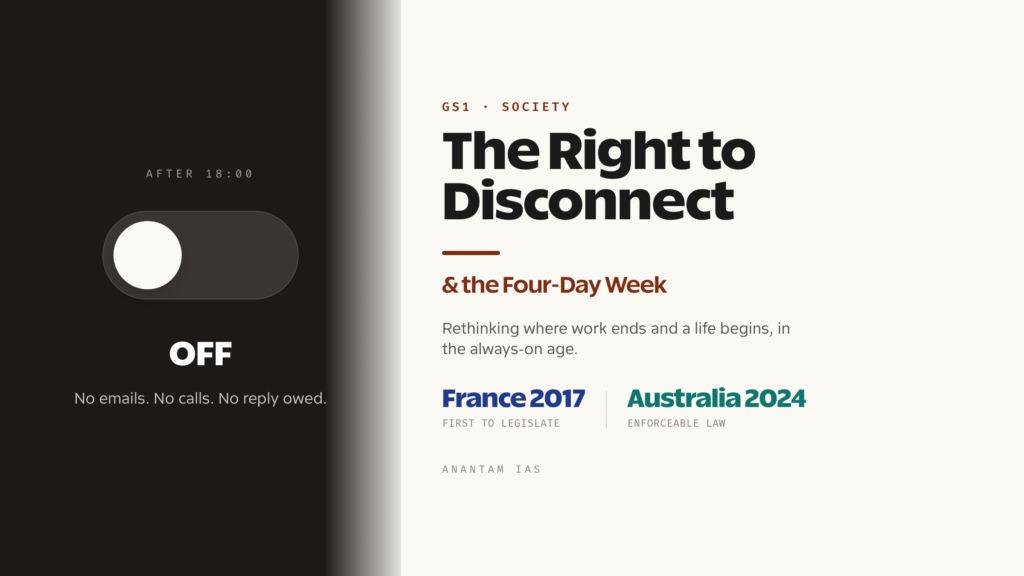
Strip away the slogans and the right to disconnect is a simple idea: an employee has the right not to engage in work-related communication, no emails, no calls, no messages, outside of agreed working hours, and the right not to be penalised for staying silent. It does not ban your boss from sending a midnight email. It removes the obligation to answer one. In a world where the office now lives in your pocket, that small shift, from “always reachable” to “reachable on terms,” is the whole point.
The rationale is built on health, not convenience. The World Health Organization formally recognises burnout as an occupational phenomenon, a syndrome of exhaustion, cynicism and reduced effectiveness caused by chronic workplace stress. And the joint WHO-ILO estimates put the human cost in stark terms: long working hours are linked to roughly 745,000 deaths a year worldwide from stroke and heart disease. The blurring of work and home that hybrid work brought has made this worse, not better. A Deloitte India survey found nearly half of professionals reporting burnout, with eroded work-life boundaries among the biggest drivers. So the right to disconnect is best understood as a labour-law expression of the right to health and rest, an attempt to draw a line that technology rubbed out.
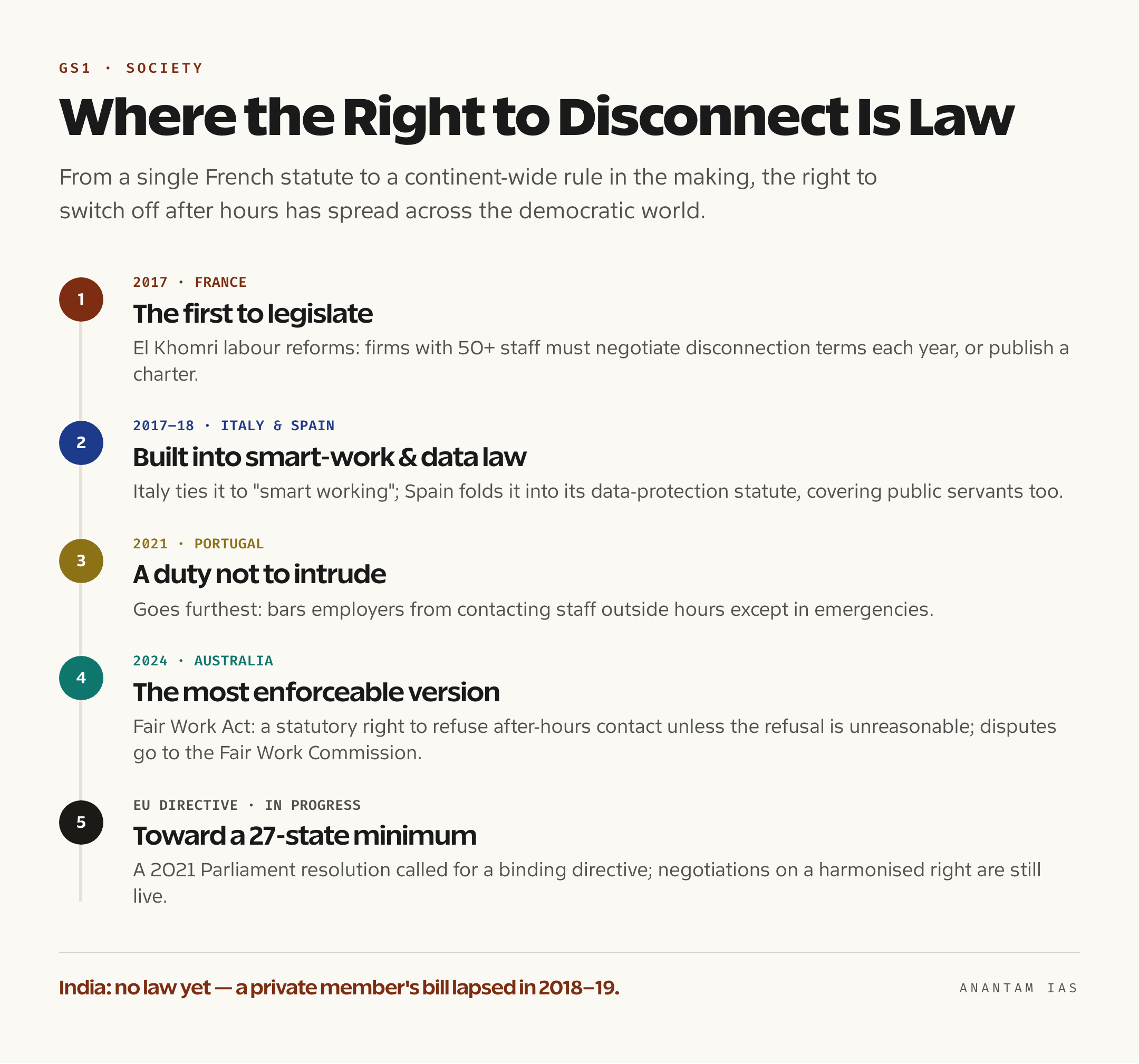
France was the pioneer. Its 2017 law, part of the El Khomri labour reforms, did not impose a single national rule but required firms with fifty or more employees to negotiate the terms of disconnection with worker representatives each year, or publish a charter if talks failed. Italy moved the same year, building disconnection into its law on “smart working.” Spain followed in 2018, tying the right into its data-protection statute so that it covers public servants too. The model that runs through all of them is process over prohibition: the state mandates that the conversation happen and that boundaries be set, then lets each workplace fix the details.
How Far the Idea Has Spread, and the Four-Day Week Beside It
The most consequential recent step came from Australia. In February 2024 its Parliament passed the Closing Loopholes amendments to the Fair Work Act, giving employees a statutory right to refuse to monitor, read or respond to contact from an employer outside working hours, unless that refusal is unreasonable. Whether a refusal is reasonable turns on factors such as the worker’s role, how the contact is made, and whether they are paid to be available, and disputes can go to the Fair Work Commission. It is the clearest, most enforceable version yet, and it has become the reference point for every country now weighing its own law.
Europe is moving to lock the right in across the bloc. The European Parliament adopted a resolution in 2021 calling on the Commission to propose a directive making the right to disconnect a minimum standard for all twenty-seven member states, and negotiations on binding rules are still live, with social partners and lawmakers shaping what a harmonised right would look like. Portugal has gone its own way, banning employers from contacting staff outside hours except in emergencies and even making it the employer’s duty not to intrude. The direction of travel is unmistakable: rest after hours is being reframed from a perk into a right.
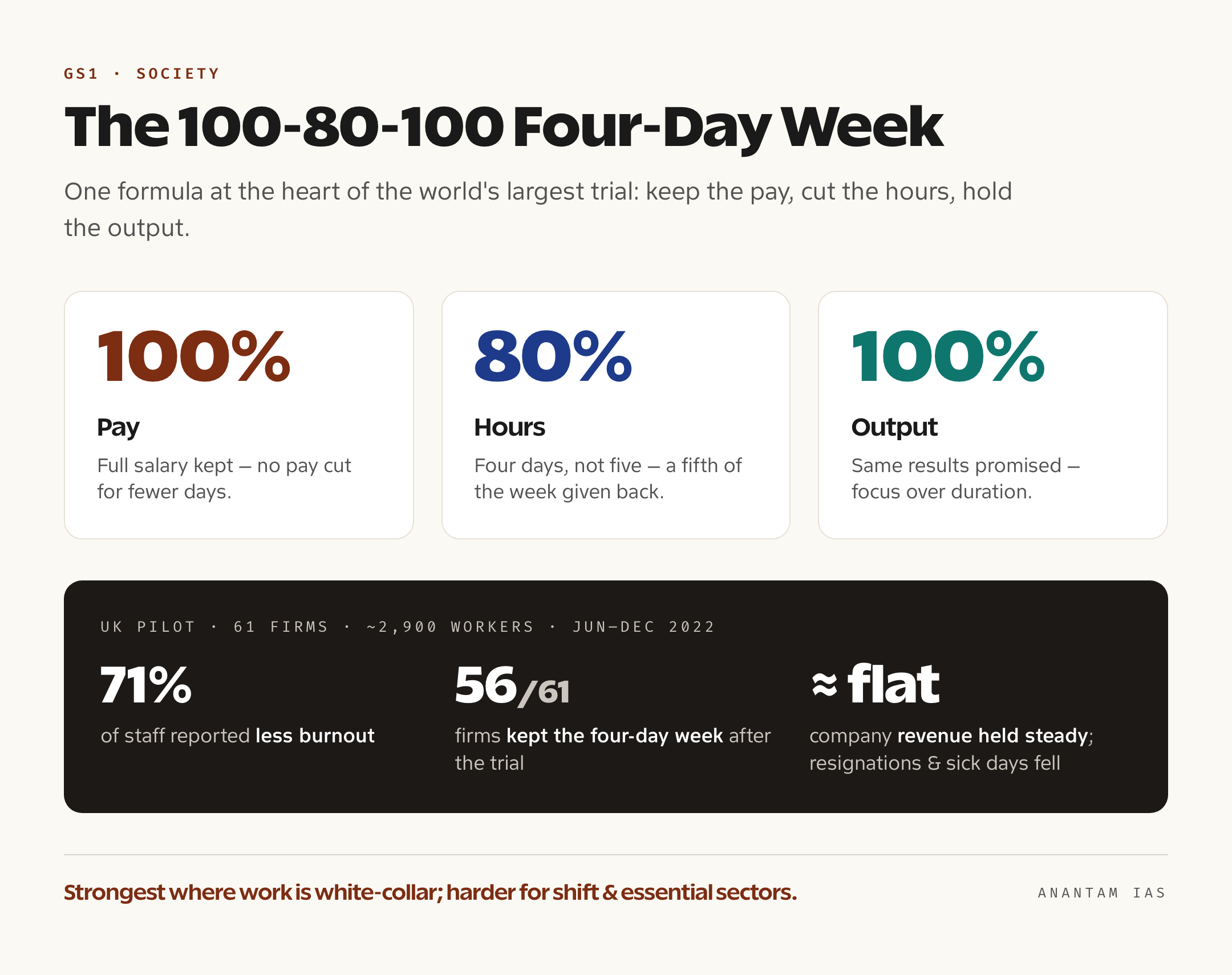
The right to disconnect protects the edges of the working day. The four-day week attacks its length. The most cited version is the 100-80-100 model, the heart of the UK’s landmark 2022 pilot run by 4 Day Week Global with Cambridge and Boston College researchers: workers keep 100 per cent of pay, drop to 80 per cent of hours, and commit to delivering 100 per cent of output. Sixty-one companies and around 2,900 employees took part from June to December 2022. The results were striking. Burnout fell for 71 per cent of staff, the number of sick days dropped, and resignations fell sharply, while company revenue held broadly steady. Of the sixty-one firms, fifty-six kept the four-day week going after the trial ended. Iceland had pointed the way earlier: public-sector trials between 2015 and 2019 cut hours with no loss of pay and found wellbeing rising “dramatically” while productivity held, leading most Icelandic workers onto shorter weeks.
The Bigger Argument: Hustle Culture, Hybrid Work and the Gig Trap
Behind these two reforms sits a deeper quarrel about what work is for. On one side is hustle culture, the belief, voiced in those seventy- and ninety-hour-week remarks, that effort measured in raw hours is the engine of growth, and that a developing nation cannot afford to slow down. On the other is a growing body of evidence that beyond a point, more hours buy less output, not more, because tired people make mistakes, fall ill and quit. The four-day-week trials are the empirical heart of that rebuttal: they suggest that focus, not duration, drives results, and that a rested worker can match a frazzled one in fewer days.
Hybrid work sharpened the stakes. Remote arrangements can reduce burnout by giving people autonomy, but the same flexibility can backfire when it becomes a licence for the workday to swallow the evening. Researchers describe an “always-on” culture in which the absence of a commute home, the old physical signal that work was over, leaves many people unable to mentally clock out at all. The right to disconnect is, in a sense, the missing off-switch for the remote era, an attempt to rebuild a boundary that the office used to provide automatically.
And the debate cannot stop at salaried desk workers, because that is not where India’s labour mostly lives. The fastest-growing slice of the workforce is the gig and platform economy, the delivery riders, cab drivers and micro-taskers whose “flexibility” often means no fixed hours, no paid leave, no guaranteed minimum and an algorithm that can switch off their income without notice. For them the problem is not after-hours emails but a structural precarity that the right to disconnect, designed for employees, barely touches. As the rise of the no-collar economy reshapes who works and how, any honest answer on work-life balance has to ask whether new rights will reach the most vulnerable workers or only the already-protected.
India’s Position: A Bill That Keeps Lapsing and a Long-Hours Culture
India has no statutory right to disconnect. The closest it has come is a private member’s bill. In December 2018, NCP MP Supriya Sule introduced the Right to Disconnect Bill in the Lok Sabha, reintroducing it in 2019; it proposed an Employees’ Welfare Authority and a negotiated charter so that workers could refuse after-hours contact without penalty. Like almost all private member’s bills, it lapsed without becoming law, and the idea has since been revived in fresh attempts, a sign that the demand is real even as the legislation stalls. India’s four labour codes, which consolidate dozens of older laws on wages, social security, industrial relations and occupational safety, set rules on working hours and overtime but say nothing about digital availability after the shift ends. You can read the wider picture in our explainer on India’s labour codes and Shram Shakti Niti.
The reason the debate bites in India is the sheer length of the working week. ILO data indicates that around half of India’s workforce puts in 49 hours or more a week, with average weekly hours near 46.7, well above the United Kingdom’s 35.9 or Japan’s 36.6. Layer onto that a culture in which availability is read as commitment, where answering the boss at midnight is treated as loyalty rather than overreach, and the cost in stress, illness and attrition becomes a national, not personal, problem. The seventy-hour-week remarks did not invent that culture; they put a microphone to it.
So what would a sensible Indian path look like? Most analysts argue against simply copy-pasting a Western statute, because India’s labour market is far more informal and unequal. A workable design would combine statutory clarity with sectoral flexibility, recognising that a hospital, a newsroom and a software firm cannot all switch off the same way; it would lean on collective negotiation in the French style rather than a blanket ban; and it would consciously stretch coverage toward gig and contract workers, not just the salaried middle class. The four-day week, meanwhile, is more likely to arrive firm-by-firm than by law, as some Indian startups already experiment with compressed weeks. The realistic near-term win is cultural and contractual, written into company policy and collective agreements, with statute following once the idea has proven itself, rather than leading.
For Your Mains Answer
This is a high-value topic for GS Paper 1, where the society syllabus covers the effects of globalisation and technology on Indian society, changing social structures, urbanisation, and the social dimensions of health and the workforce. It also feeds GS Paper 2 on the rights of vulnerable sections and welfare legislation, GS Paper 3 on the gig economy and labour reform, and the Essay paper on themes of work, rest, technology and human dignity. The skill examiners reward here is balance: hold the growth-and-discipline argument and the health-and-dignity argument in the same answer, then judge between them with evidence.
How to Build the Answer
Open by naming the tension, the always-on workplace versus the right to rest, then define both reforms cleanly. Move through a chain: why the problem arose (hybrid work, the smartphone, hustle culture), what the right to disconnect does and where it is law (France 2017, Australia 2024), what the four-day week is and what the evidence shows (the 100-80-100 model, the UK pilot’s burnout and retention gains), the counter-arguments (feasibility for shift and essential sectors, the gig workers it misses), and finally India’s position (no law, a lapsed bill, the longest hours, the seventy-hour debate). Close with a calibrated verdict on the Indian path. That arc, problem, reforms, evidence, critique, India, judgement, fits almost any framing of the question.
Common Mistakes to Avoid
Don’t treat the right to disconnect as a ban on after-hours email; it removes the duty to respond, not the employer’s ability to send. Don’t claim India has such a law; the bill lapsed and was never enacted. Don’t present the four-day week as proven everywhere; the strongest evidence is from white-collar pilots, and shift-based and essential sectors raise genuine feasibility doubts. And don’t forget the gig worker, an answer that only protects salaried staff misses the most precarious half of the workforce and will read as incomplete.
A Compact Answer Spine
Always-on hybrid work + hustle culture → burnout, recognised by WHO; long hours linked to ~745,000 deaths a year → right to disconnect = right to refuse after-hours contact without penalty → France 2017 (negotiate or charter), Italy/Spain, Portugal ban, Australia 2024 (Fair Work Act), EU directive in progress → four-day week = 100-80-100 model; UK 2022 pilot, 71% less burnout, fewer resignations, 56 of 61 firms continued; Iceland trials → critiques: shift/essential sectors, gig workers excluded → India: no law, Supriya Sule bill (2018/2019) lapsed, ~half the workforce works 49+ hours, 70/90-hour debate → way forward: statutory clarity + sectoral flexibility + collective negotiation + gig coverage.
Diagram or Flowchart Idea
Draw a simple two-axis sketch: a horizontal arrow for the length of the week (five days shrinking to four) and a vertical line marking the end of the working day (with an “off-switch” labelled right to disconnect). Around it, place three boxes, health (burnout, WHO), productivity (UK pilot results), and coverage (the gig gap). One clean visual that shows both reforms attacking the same problem from different sides.
A Balanced-Conclusion Line
A line that lands the marks: “The right to disconnect and the four-day week are not anti-work; they are attempts to make work sustainable, and for India the task is not to copy a Western statute but to draw a humane boundary that reaches the gig worker as surely as the executive.”
How to Use Data Without Cramming
You need only a handful of anchors: France 2017 and Australia 2024 (the legal bookends), the 100-80-100 model and 71 per cent less burnout (the four-day-week proof), ~745,000 deaths a year from long hours (the health stake), and ~half of India’s workforce at 49+ hours (the Indian scale). Attribute them plainly, “the joint WHO-ILO estimate,” “the UK’s 2022 four-day-week pilot,” rather than scattering numbers loose.
Frequently Asked Questions
What is the right to disconnect in simple terms?
It is the right of an employee not to engage in work-related communication, emails, calls or messages, outside agreed working hours, and not to be penalised for not responding. It does not stop an employer from sending a message after hours; it removes the worker’s obligation to answer one. France legislated it first in 2017, and Australia gave it statutory teeth in 2024 through its Fair Work Act.
What is the four-day week and does it actually work?
The leading version is the 100-80-100 model: workers keep 100 per cent of pay, work 80 per cent of the hours, and aim to deliver 100 per cent of output. The UK’s 2022 pilot of 61 companies found burnout fell for 71 per cent of staff, sick days and resignations dropped, revenue held steady, and 56 of the 61 firms kept the four-day week afterwards. The strongest evidence is from white-collar workplaces; shift-based and essential sectors are harder cases.
Does India have a right to disconnect?
No. India has no statutory right to disconnect. A private member’s bill introduced by MP Supriya Sule in 2018 and reintroduced in 2019 proposed one but lapsed, as such bills almost always do. India’s four labour codes regulate working hours and overtime but say nothing about after-hours digital availability, leaving the issue to company policy and the broader work-culture debate.
Why has this become a big debate in India recently?
Because high-profile calls for seventy- and ninety-hour work weeks collided with rising concern about burnout, intensified by the 2024 death of a young EY employee whose family cited overwork. India already has among the longest working weeks in the world, with around half its workforce at 49 hours or more, so the question of where work should stop touches a real and growing strain.
Practice Questions
Prelims MCQs
- Which country was the first to legislate a formal “right to disconnect” for employees?
(a) Australia
(b) France
(c) Portugal
(d) Spain
Answer: (b) France enacted the right in 2017 as part of the El Khomri labour reforms, requiring large firms to negotiate disconnection terms or publish a charter. - The “100-80-100” model associated with the four-day week refers to which of the following?
(a) 100 employees, 80 hours, 100 days
(b) 100 per cent pay, 80 per cent of hours, 100 per cent of output
(c) 100 per cent attendance, 80 per cent leave, 100 per cent bonus
(d) 100 firms, 80 weeks, 100 surveys
Answer: (b) Workers retain full pay and commit to full output while working 80 per cent of their usual hours. - With reference to the right to disconnect in India, which statement is correct?
(a) It is guaranteed under the four labour codes
(b) It was enacted through a 2019 government bill
(c) A private member’s bill on it was introduced but lapsed
(d) It is protected as a fundamental right under Article 21
Answer: (c) MP Supriya Sule’s Right to Disconnect Bill (2018, reintroduced 2019) lapsed; India has no statutory right to disconnect. - The World Health Organization classifies “burnout” as:
(a) A clinical mental disorder
(b) An occupational phenomenon
(c) A communicable disease
(d) A lifestyle choice
Answer: (b) WHO recognises burnout as an occupational phenomenon resulting from chronic, unmanaged workplace stress, not as a standalone medical condition. - Which 2024 law gave employees a statutory right to refuse after-hours work contact unless the refusal is unreasonable?
(a) Italy’s Smart Working Law
(b) Spain’s data-protection statute
(c) Australia’s Fair Work Act amendments
(d) Portugal’s emergency-contact rule
Answer: (c) Australia’s Closing Loopholes amendments to the Fair Work Act introduced an enforceable right to disconnect in 2024.
Mains Practice Questions
- “The always-on workplace has made the right to rest as important as the right to work.” In this light, examine the concept of the right to disconnect and its relevance to Indian society. (15 marks, 250 words)
- Critically evaluate the four-day work week as a response to burnout and falling work-life balance. Should India consider it, and for which sectors? (15 marks, 250 words)
- Discuss how hybrid and remote work have blurred the boundary between professional and personal life, and assess the social consequences of an “always-on” culture. (15 marks, 250 words)
- The right to disconnect is designed for salaried employees, yet India’s fastest-growing workforce is in the gig economy. Analyse this gap and suggest how worker protections can be made more inclusive. (10 marks, 150 words)
- “India’s long-hours culture is celebrated as discipline but increasingly carries a public-health cost.” Comment, with reference to the recent debate on extended work weeks. (15 marks, 250 words)
Tell Google you want more of this.
Add Anantam IAS as a preferred sourceOne tap, and this site shows up more often in your own Top Stories, AI Overviews and AI Mode. Remove it any time.