Field capacity, wilting point and available water capacity are the three thresholds that describe what a soil can actually give a plant. They are usually learned as definitions and then misapplied, because the intuitive answer to which soil holds most water for a crop is wrong. A clay holds far more water than a sand and gives up proportionately less of it.
Getting this right is the difference between describing soil texture and explaining irrigation scheduling.
The Three Thresholds
| Threshold | Definition | What it depends on |
|---|---|---|
| Saturation | Every pore filled with water, air excluded | Total porosity |
| Field capacity | The water retained after gravity has finished draining, roughly 2 to 3 days after saturation | Pore size distribution; higher in fine-textured soils |
| Permanent wilting point | The content at which a plant can no longer extract water and wilts irrecoverably | Clay content and surface area; higher in fine soils |
| Available water capacity | Field capacity minus wilting point: the water a crop can actually use | The difference, which peaks in loams |
Why Loam Beats Both Sand and Clay
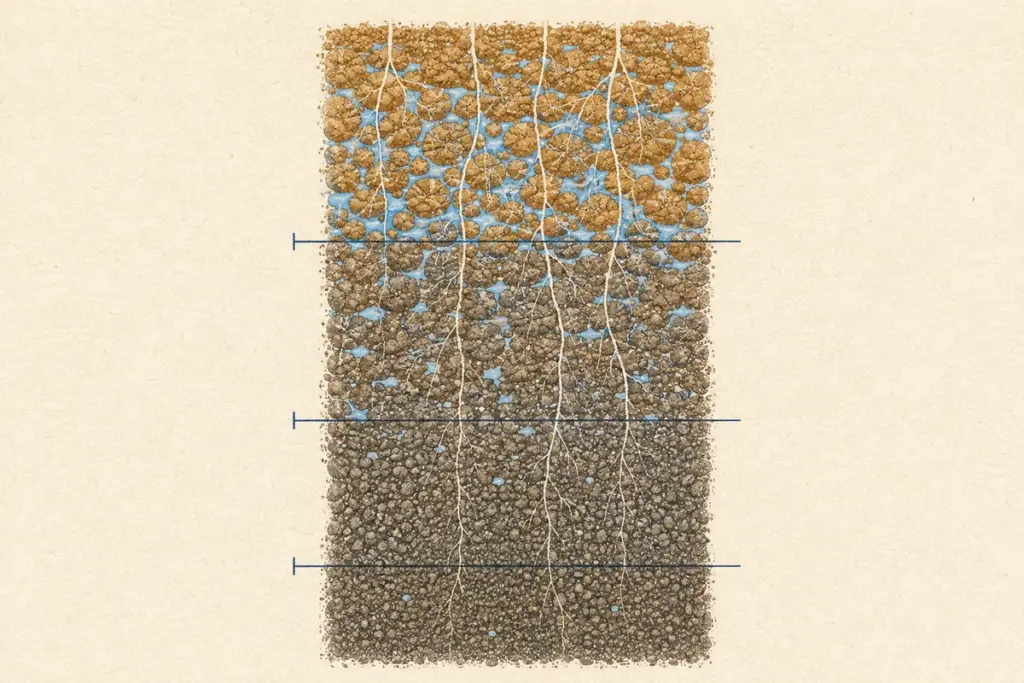
This is the point the definitions conceal. Water is held in soil by two forces: capillary tension in the pores and adsorption onto particle surfaces. Fine particles have vastly more surface area, so a clay holds much more water in total. But the same forces that hold it also hold it too tightly for roots to extract.
- A sand has large pores, drains fast, and so has a low field capacity. Its wilting point is also very low, since there is little surface to grip water. Available water is small because field capacity is small.
- A clay has a very high field capacity. Its wilting point is also very high, because much of that water is bound at tensions beyond root suction. Available water is modest because the two large numbers nearly cancel.
- A loam has an intermediate field capacity and a comparatively low wilting point, so the gap between them is the widest. Available water capacity peaks in loams and silt loams, which is why they are the most agriculturally forgiving soils.
Field capacity tells you how much water the soil holds. Available water capacity tells you how much of it the plant can have. Only the second matters.
Organic Matter and Structure
Texture is not the whole story, and this is where the concept becomes usable for policy rather than only for classification.
- Organic matter raises available water capacity substantially, because it holds water at tensions plants can overcome and improves aggregation. A rise of 1 percentage point in soil organic carbon can add meaningfully to plant-available water in the root zone.
- Structure matters as much as texture. A compacted soil has lost its larger pores, so it drains poorly and roots cannot penetrate to reach what water there is.
- Rooting depth multiplies everything. Available water capacity is expressed per unit depth, so a deep soil holds far more usable water than a thin one of the same texture. A shallow soil on a slope may have excellent texture and still fail a crop in a dry spell.
Why This Matters for Indian Agriculture
Three practical consequences follow, and they connect this to dry farming and to irrigation policy.
- Irrigation scheduling. Water should be applied before the soil approaches wilting point but not so often that it drains past the root zone. That interval is set by available water capacity and rooting depth, not by a calendar.
- Dry farming depends on it entirely. Roughly half of India’s net sown area is unirrigated, and every dry-farming practice, deep ploughing, mulching, contour bunding, wide spacing, is an attempt to raise the water stored and available in the profile between rains.
- The black soils of the Deccan are the classic case. Regur has a very high clay content and a very high field capacity, and it holds moisture through a long dry season, which is why the trap country grows cotton without irrigation. Its wilting point is also high, so the available fraction is smaller than the total suggests, and the crop still fails in a genuinely bad year.
Measuring It
Soil water is measured as a tension rather than a quantity, because tension is what determines whether a root can extract it. Field capacity corresponds to about -33 kilopascals (one third of an atmosphere) and permanent wilting point to about -1500 kilopascals (15 atmospheres) in the conventional laboratory definition.
Those figures are conventions rather than physical constants. Different crops wilt at somewhat different tensions, and the field values depend on structure and on how the measurement was made. Quoting them with that qualification attached is more accurate than quoting them as fixed.
What is field capacity?
The water a soil retains after gravitational drainage has effectively ceased, roughly 2 to 3 days after saturation. It corresponds conventionally to a soil water tension of about -33 kilopascals.
What is the permanent wilting point?
The soil moisture content at which a plant can no longer extract water and wilts irrecoverably. It corresponds conventionally to a tension of about -1500 kilopascals, and it is higher in fine-textured soils because clay holds water tightly.
What is available water capacity?
The difference between field capacity and permanent wilting point: the water a crop can actually extract. It is the only one of the three thresholds that matters agronomically, since the rest of the soil’s water is either drained away or held too tightly to use.
Which soil texture holds the most available water?
Loams and silt loams. A sand has low field capacity so little water to give. A clay has a very high field capacity but an equally high wilting point, so the two nearly cancel. The gap between them is widest in intermediate textures.
How does organic matter affect available water?
It raises it substantially, both by holding water at tensions plants can overcome and by improving aggregation and pore structure. This is one of the main reasons soil organic carbon matters for rainfed agriculture.
Why does available water capacity matter for dry farming?
Because about half of India’s net sown area is unirrigated, and every dry-farming practice, from deep ploughing and mulching to contour bunding and wide spacing, is an attempt to increase the water stored and available in the root zone between rains.
Practice Questions
Prelims
1. Available water capacity is defined as
- (a) saturation minus field capacity
- (b) field capacity minus permanent wilting point
- (c) total porosity minus air space
- (d) field capacity plus wilting point
Answer: (b)
2. Field capacity conventionally corresponds to a soil water tension of about
- (a) -10 kPa
- (b) -33 kPa
- (c) -500 kPa
- (d) -1500 kPa
Answer: (b)
3. Available water capacity is generally highest in
- (a) coarse sands
- (b) loams and silt loams
- (c) heavy clays
- (d) gravelly soils
Answer: (b)
4. A clay soil has a modest available water capacity because
- (a) its field capacity is low
- (b) its wilting point is also very high
- (c) it drains too quickly
- (d) it has no organic matter
Answer: (b)
5. Which of the following would NOT increase plant-available water in a field?
- (a) Raising soil organic carbon
- (b) Relieving compaction
- (c) Increasing rooting depth
- (d) Increasing bulk density
Answer: (d)
Mains
- Define field capacity, permanent wilting point and available water capacity. (10 marks)
- Explain why available water capacity is highest in loams rather than in clays. (10 marks)
- Discuss the role of soil organic matter and soil structure in determining plant-available water. (15 marks)
- “Dry farming is the management of available water capacity.” Examine this statement for the Indian rainfed tracts. (15 marks)
- Explain how soil water thresholds should govern irrigation scheduling, and why calendar-based irrigation is inefficient. (20 marks)
Tell Google you want more of this.
Add Anantam IAS as a preferred sourceOne tap, and this site shows up more often in your own Top Stories, AI Overviews and AI Mode. Remove it any time.