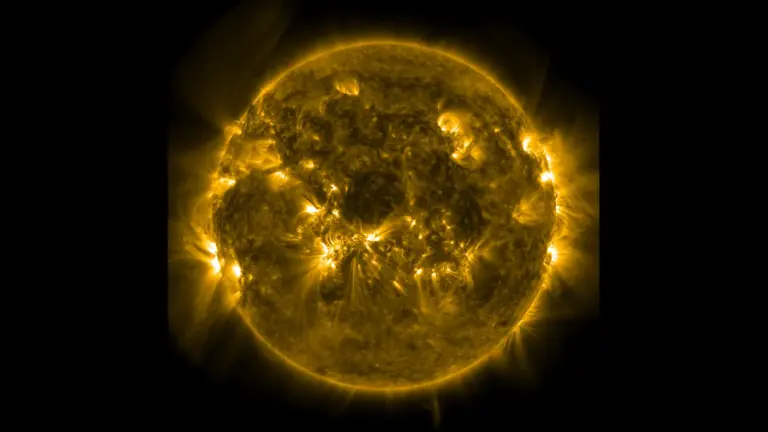
The Sun is not a steady lamp. It is a magnetised plasma whose temper rises and falls on an 11-year clock, and the peak of each cycle, called Solar Maximum, is when the Earth’s electrical, navigational, and orbital infrastructure is most exposed. Solar Cycle 25, which began in December 2019, reached its peak in 2024-25 with sunspot counts higher than the previous cycle and a string of extreme geomagnetic storms that lit up auroras as far south as Ladakh, Rajasthan, and the Mediterranean.
The mechanism is simple to state and difficult to model. Roughly every eleven years the Sun’s magnetic poles flip; in the middle of that flip, twisted magnetic field lines burst through the surface and snap, releasing radiation, charged particles, and bulk plasma into the solar system. From an exam standpoint, three terms recur in newspaper headlines and prelims questions: sunspots, solar flares, and coronal mass ejections. From a policy standpoint, the headlines about damaged satellites, blacked-out grids, and disrupted GNSS receivers are the actual stakes.
This guide rebuilds the topic from first principles. It walks through the Sun’s anatomy, the physics of the cycle, the four flavours of solar activity, the impact on Earth, and the global telescope and probe network watching the Sun in real time. It is written for UPSC GS-III (science and technology, disaster management) and prelims (sci-tech, geography, current affairs), but the same scaffolding works for any aspirant who needs to convert a four-line news brief into a complete answer.
Quick Facts
- Solar Cycle length: ~11 years (Schwabe cycle), part of a longer 22-year magnetic Hale cycle
- Current cycle: Solar Cycle 25, started December 2019
- Solar Maximum: Reached in 2024-25 (peaked higher than Cycle 24)
- Indicator: Maximum number of sunspots visible on the photosphere
- Sun’s surface temperature: ~5,500 degrees Celsius (photosphere)
- Corona temperature: 1 to 3 million Kelvin
- Solar flare travel time to Earth: ~8 minutes (radiation, speed of light)
- CME travel time to Earth: 1 to 3 days (slower bulk plasma)
- Largest recorded geomagnetic storm: Carrington Event, 1859
- India’s first solar mission: Aditya-L1 (launched September 2023)
What is Solar Maximum
Solar Maximum is the period of greatest solar activity within an 11-year cycle, identified by the highest sunspot count, the highest frequency of solar flares, and the highest rate of coronal mass ejections. It is not a single day; it is a rolling window of 12 to 24 months centred on the smoothed monthly sunspot peak. Astronomers declare a maximum retrospectively, by looking at smoothed averages, because monthly counts are too noisy to flag the peak in real time.
The phenomenon is driven by the Sun’s differential rotation. The equator rotates faster than the poles (roughly 25 days versus 35 days), which winds the internal magnetic field tighter and tighter until twisted flux ropes erupt through the surface as sunspots. As the cycle progresses, the polarity of the leading sunspot in each hemisphere reverses; one full magnetic flip takes 22 years (the Hale cycle), meaning two consecutive 11-year sunspot cycles have opposite polarities.
Background and Historical Context
Sunspot observation predates modern astronomy. Chinese astronomers recorded sunspots visible to the naked eye through atmospheric haze as early as 800 BCE. Galileo’s telescope, in 1610, made systematic observation possible, but it was Heinrich Schwabe in 1843 who, after 17 years of daily observations, established the ~11-year periodicity that now bears his name. Rudolf Wolf at the Zurich Observatory standardised the sunspot number, and the modern numbered cycles were retroactively defined back to Cycle 1 starting in 1755.
The Carrington Event of September 1, 1859, named for the British astronomer Richard Carrington who observed a brilliant white-light flare, is the benchmark extreme storm. It induced telegraph wire fires across Europe and North America and produced auroras visible at Cuba and Hawaii. A repeat today would damage transformers, cripple GPS, fry low-Earth-orbit satellites, and inflict trillion-dollar economic losses. Insurance industry stress tests treat a Carrington-class event as a tail risk equivalent to a major earthquake.
The most recent quiet stretch was the Maunder Minimum, roughly 1645 to 1715, when sunspot activity nearly vanished and Northern Hemisphere winters became markedly colder (the Little Ice Age). The lesson is that the Sun’s variability matters not just for satellites but for terrestrial climate, agriculture, and historical record.
Anatomy of the Sun: Interior Layers
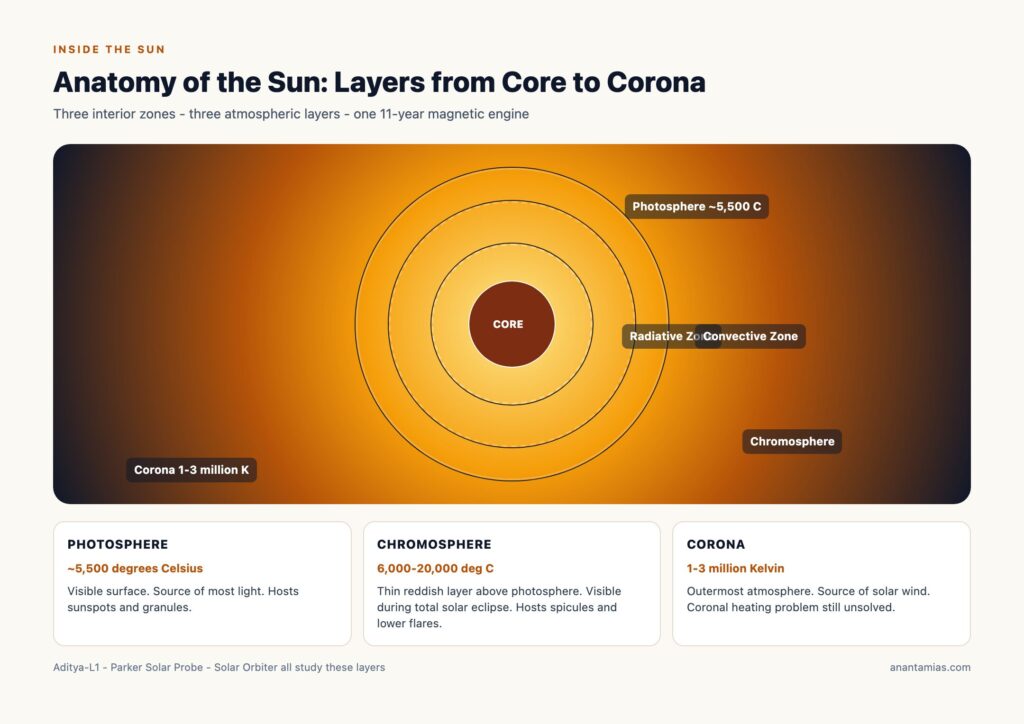
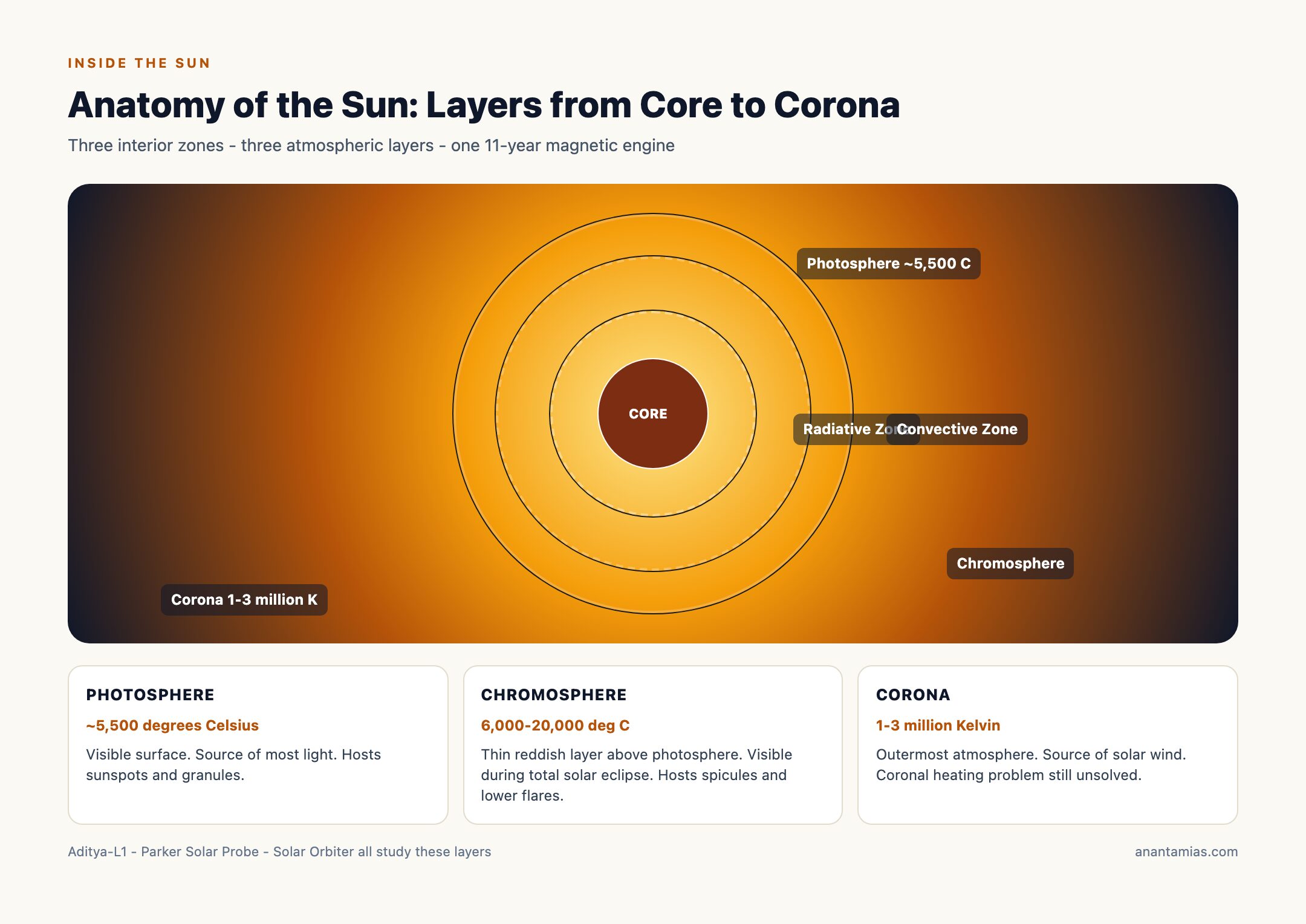
The Sun is a plasma ball roughly 1.4 million kilometres across, structured in concentric layers.
| Layer | Position | Key Property |
|---|---|---|
| Core | Innermost | Site of nuclear fusion (hydrogen to helium), ~15 million Kelvin |
| Radiative Zone | Outward from core | Energy transferred by photon diffusion; photons take thousands to millions of years to escape |
| Convective Zone | Outermost interior | Energy transferred by convection currents; hot plasma rises, cools, sinks; produces granulation |
The core converts about 4 million tonnes of mass into energy every second via the proton-proton chain, releasing photons, neutrinos, and gamma rays. By the time those photons emerge into space, they have been absorbed and re-emitted billions of times. The radiative zone is where this slow random walk happens. The convective zone is where bulk fluid motion takes over, producing the granulated cellular pattern visible on the photosphere.
Anatomy of the Sun: Atmospheric Layers
| Layer | Position | Temperature | Key Features |
|---|---|---|---|
| Photosphere | Visible surface | ~5,500 degrees Celsius | Sunspots, granules, source of most visible light |
| Chromosphere | Above photosphere | 6,000 to 20,000 degrees Celsius (rises outward) | Spicules, lower portions of solar flares; visible during total eclipse as a thin reddish ring |
| Corona | Outermost atmosphere | 1 to 3 million Kelvin | Source of solar wind; visible during total eclipse |
The corona’s temperature being hundreds of times higher than the photosphere’s is one of solar physics’ great open puzzles, called the coronal heating problem. Wave heating, magnetic nano-flares, and turbulent reconnection are the leading hypotheses. NASA’s Parker Solar Probe was launched in 2018 specifically to fly through the corona and gather in-situ measurements.
The 11-Year Solar Cycle Mechanism
The Solar Cycle is best understood as a magnetic dynamo with three phases.
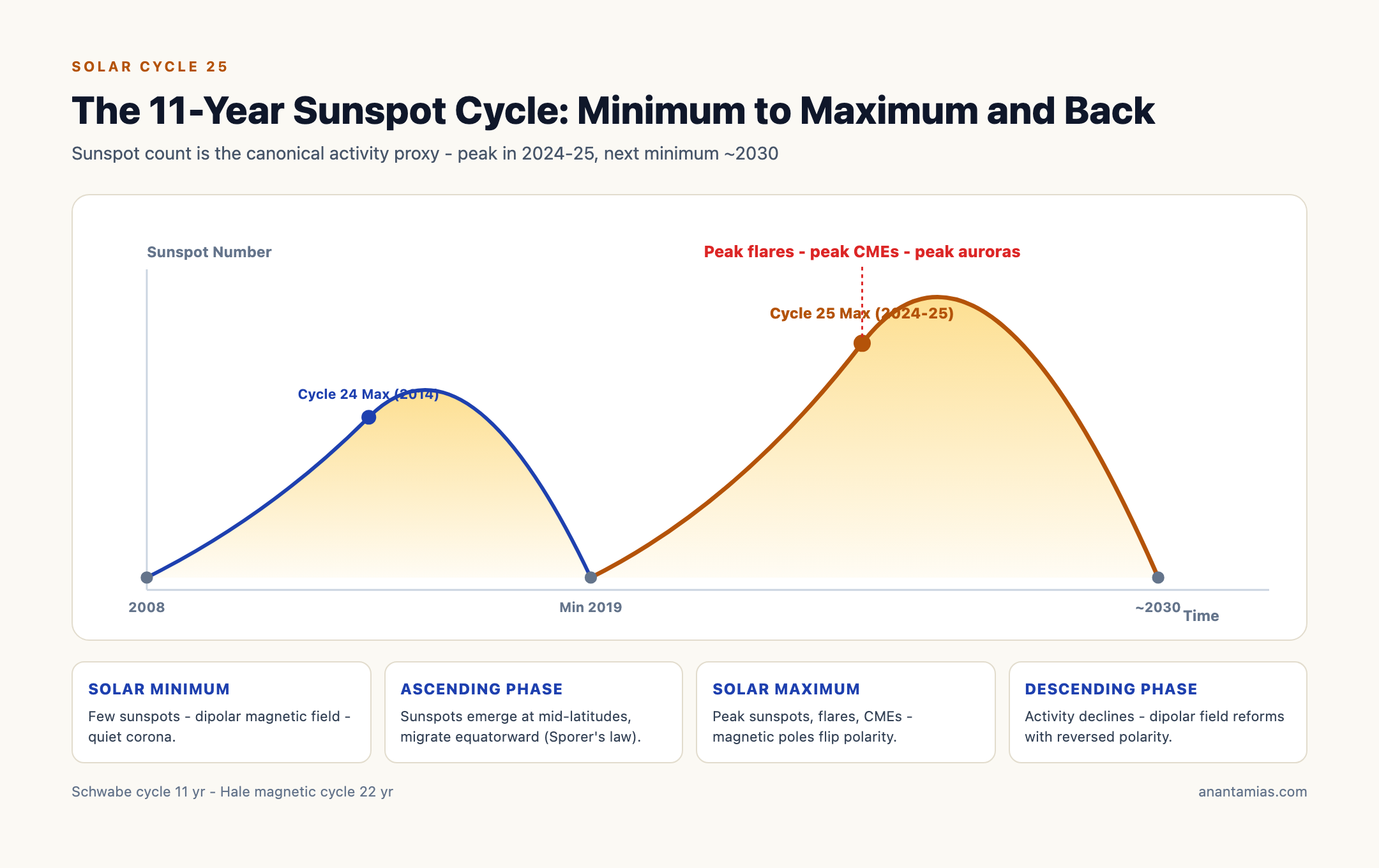
Solar Minimum: Few or no sunspots; the Sun’s magnetic field is approximately dipolar (like a bar magnet) and aligned with the rotation axis. The Sun appears quiet; the corona is symmetric.
Ascending Phase: Sunspots begin appearing at mid-latitudes (~30 to 35 degrees) in both hemispheres. The differential rotation winds the dipolar field into toroidal flux ropes that surface as sunspot pairs with opposite magnetic polarity (Hale’s polarity law). The sunspot zone migrates equatorward as the cycle progresses (Sporer’s law), producing the classic “butterfly diagram” when latitude is plotted against time.
Solar Maximum: Maximum sunspot count, maximum flare and CME rate, and the magnetic poles reverse polarity. The Sun’s magnetic field becomes complex and multi-polar.
Descending Phase and New Minimum: Sunspot count declines, the dipolar field re-establishes itself with opposite polarity, and the cycle restarts. A full magnetic cycle (two sunspot cycles) takes ~22 years.
Sunspots: Cool Patches with Strong Fields
Sunspots are dark, planet-sized regions on the photosphere where intense magnetic fields (thousands of Gauss versus the Earth’s ~0.5 Gauss) inhibit convective heat transport from below. The cooler interior (~3,500 degrees Celsius versus the surrounding ~5,500 degrees Celsius) makes them appear dark by contrast. They occur in pairs of opposite magnetic polarity and last from days to months. The number of sunspots, smoothed over months, is the canonical proxy for solar activity.
Solar Flares: Light-Speed Radiation Bursts
A solar flare is a sudden brightening on the Sun caused by magnetic reconnection, when twisted magnetic field lines snap and re-connect into lower-energy configurations, releasing energy across the electromagnetic spectrum (radio to gamma). Flares are classified by peak X-ray flux into A, B, C, M, and X categories, with X being the most intense and each letter a tenfold increase. Radiation from a flare travels at the speed of light and reaches Earth in roughly 8 minutes.
Impacts on Earth: immediate radio blackouts on the dayside (high-frequency communication, GPS pseudo-range errors), enhanced ionospheric currents, and elevated radiation dose for high-altitude flights and astronauts.
Coronal Mass Ejections: The Slow Punch
A coronal mass ejection (CME) is a large bubble of magnetised plasma (billions of tonnes) ejected from the corona at speeds of 250 to 3000 kilometres per second. CMEs travel slower than flare radiation, taking 1 to 3 days to reach Earth. When a CME’s embedded magnetic field is oriented southward (opposite to Earth’s northward field), it couples efficiently with the magnetosphere and triggers a geomagnetic storm.
Impacts on Earth: geomagnetic storms classified G1 to G5 by NOAA. Auroras at unusually low latitudes; induced currents in long power lines that can trip transformers; satellite drag in low-Earth orbit; charging of spacecraft electronics; degradation of GNSS positioning. The May 2024 Gannon storm (G5) tripped grids in Sweden, damaged a number of South African transformers, and produced auroras visible across India.
Why It Matters: Space Weather Stakes
Modern infrastructure depends on assets exposed to solar weather. The 2019-2025 expansion of low-Earth-orbit constellations (Starlink, OneWeb, China’s Guowang) has multiplied the number of satellites at risk. A single February 2022 geomagnetic storm caused the loss of 38 newly launched Starlink satellites because the heated upper atmosphere expanded and produced enough drag to deorbit them.
Power grids built before space-weather mitigation was a design criterion remain exposed. Quebec’s 1989 nine-hour blackout, caused by a March geomagnetic storm, is still the canonical case study. Aviation routes over the polar regions are diverted during major events because high-frequency radio degrades. GNSS-dependent applications, from precision agriculture to aircraft landings, lose accuracy. And the financial timestamping infrastructure that depends on satellite-distributed time signals can drift outside tolerance.
Major Missions to the Sun
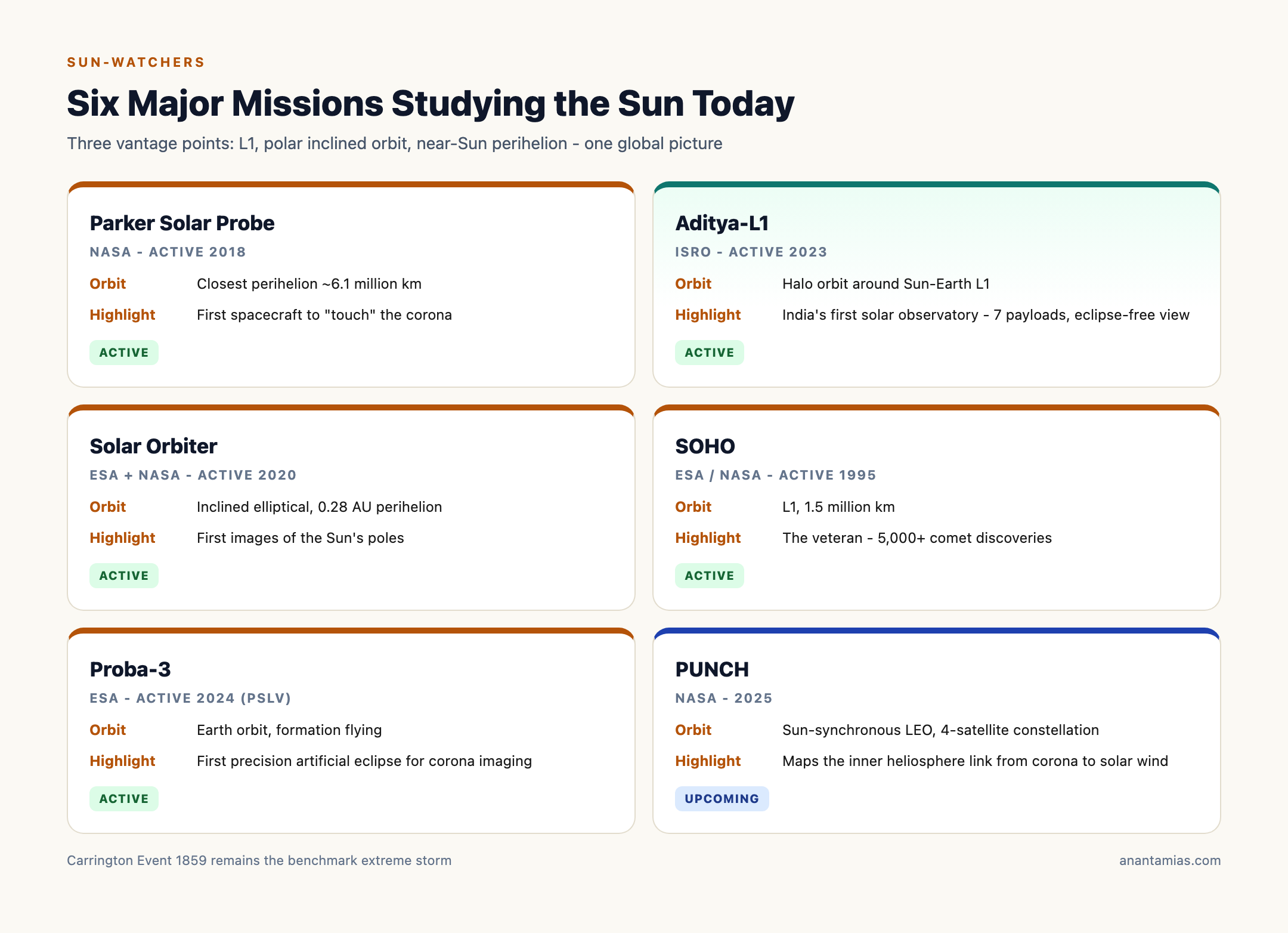
| Mission | Agency | Launch | Position | Key Capability |
|---|---|---|---|---|
| SOHO | ESA/NASA | 1995 | L1 | The veteran; discovered 5000+ comets |
| Parker Solar Probe | NASA | 2018 | Closest perihelion ~6.1 million km | First to “touch” the corona |
| Solar Orbiter | ESA/NASA | 2020 | Inclined orbit, 0.28 AU | First images of solar poles |
| Aditya-L1 | ISRO | September 2023 | L1 (1.5 million km) | India’s first solar observatory |
| Proba-3 | ESA | 2024 (PSLV launched) | Earth orbit | First precision formation flying for artificial eclipses |
| PUNCH | NASA | 2025 | Sun-synchronous LEO | Constellation of 4 satellites mapping inner heliosphere |
Aditya-L1, launched on September 2, 2023, on a PSLV-C57, reached its halo orbit around the Earth-Sun L1 point in January 2024. It carries seven payloads, including the Visible Emission Line Coronagraph (VELC) and the Solar Ultraviolet Imaging Telescope (SUIT), and provides continuous coverage of the corona and chromosphere unobstructed by Earth’s eclipses.
Prelims Pointers
- The Solar Cycle (Schwabe cycle) has a period of approximately 11 years.
- The full magnetic cycle (Hale cycle) is 22 years.
- Sunspots are cooler regions on the photosphere (~3,500 degrees Celsius versus surrounding ~5,500 degrees Celsius).
- The corona is hotter (1 to 3 million K) than the photosphere; the puzzle is called the coronal heating problem.
- Solar flares travel at the speed of light, reaching Earth in 8 minutes; CMEs take 1 to 3 days.
- Geomagnetic storm classification is G1 (minor) to G5 (extreme) by NOAA.
- The Carrington Event of 1859 is the benchmark extreme geomagnetic storm.
- Aditya-L1 is India’s first dedicated solar observatory, placed at L1.
- Parker Solar Probe was the first spacecraft to enter the corona (2021).
- The Maunder Minimum (1645 to 1715) coincided with the Little Ice Age.
- Sporer’s law: sunspots appear at mid-latitudes early in the cycle and migrate equatorward.
- Hale’s polarity law: leading and following sunspots have opposite polarity, reversing every 11-year cycle.
Mains Practice Questions
- GS-III: “Space weather is no longer an esoteric concern but a national infrastructure risk.” Examine the impact of solar maximum on satellite, power grid, and GNSS infrastructure. Discuss India’s preparedness. (250 words)
- GS-III: Explain the structure of the Sun and the mechanism of the 11-year solar cycle. How do sunspots, solar flares, and coronal mass ejections differ in their origin, propagation, and impact on Earth? (250 words)
- GS-III: Discuss the contribution of Aditya-L1 to solar science and to India’s space weather capability. How does it complement missions such as Parker Solar Probe and Solar Orbiter? (150 words)
- GS-III: Describe the major mechanisms proposed to explain the coronal heating problem. Why is the corona hotter than the photosphere despite being further from the energy source? (150 words)
Way Forward
India needs a layered space-weather posture. First, real-time monitoring: Aditya-L1 must be backed by ground-based magnetograms, an Indian space weather operations centre under MoES (the National Centre for Medium Range Weather Forecasting and the Indian Centre for Space Physics already do parts of this), and routine publication of geomagnetic forecasts to grid operators, telecom regulators, and the aviation regulator.
Second, infrastructure hardening. Power Grid Corporation should commission GIC (geomagnetically induced current) studies on the Northern, Western, and Southern grids, install neutral-current monitors on critical transformers, and pre-position spares. ISRO and TRAI should jointly prescribe space-weather operational procedures for satellite operators (including foreign constellations licensed to operate in Indian airspace).
Third, scientific deepening. Aditya-L1 is a beginning; the next mission should target the solar poles or a Sun-Earth L4/L5 point for stereoscopic coverage. Indian institutions should join the SKA, the Daniel K. Inouye Solar Telescope user community, and the Solar Orbiter consortium to multiply the science return from Aditya-L1’s data.
Fourth, public communication. Auroras at Indian latitudes during the May 2024 storm produced public excitement but also exposed the lack of a single trusted Indian voice on space weather. A regular bulletin in Hindi and English from MoES, modelled on NOAA’s Space Weather Prediction Center, would close the gap between scientific knowledge and citizen awareness.
The Sun will not stop misbehaving on a 22-year clock. The question is whether the next Solar Maximum, expected around 2035-36, finds India better instrumented, better hardened, and better governed than it is today.
Frequently Asked Questions
What is Solar Maximum and how often does it occur?
Solar Maximum is the period of greatest solar activity within the Sun’s 11-year cycle, marked by the highest count of sunspots, flares, and coronal mass ejections. It recurs approximately every 11 years; the current Solar Cycle 25 reached its maximum in 2024-25.
Why are sunspots dark and what causes them?
Sunspots are regions on the photosphere where strong magnetic fields (thousands of Gauss) inhibit heat convection from below. They are about 2,000 degrees Celsius cooler than their surroundings, which makes them appear dark by contrast. Sunspots come in pairs of opposite magnetic polarity and are the visible footprint of the Sun’s magnetic dynamo.
What is the difference between a solar flare and a coronal mass ejection?
A solar flare is a burst of electromagnetic radiation that travels at the speed of light and reaches Earth in 8 minutes, causing immediate radio blackouts. A coronal mass ejection (CME) is a slower bulk eruption of magnetised plasma that takes 1 to 3 days to reach Earth and triggers geomagnetic storms when its magnetic field opposes Earth’s.
How can solar storms affect daily life on Earth?
Major geomagnetic storms can damage power transformers (causing blackouts), increase satellite drag and electronics damage, degrade GPS accuracy, force aircraft to divert from polar routes, and disrupt high-frequency radio. The Quebec blackout of 1989 and the loss of 38 Starlink satellites in February 2022 are well-known cases.
What was the Carrington Event?
The Carrington Event of September 1859 is the most intense geomagnetic storm on record. Telegraph wires caught fire across Europe and North America, and auroras were visible as far south as Cuba and Hawaii. A repeat today would inflict trillion-dollar damage on power, satellite, and communication infrastructure.
What is Aditya-L1 and what does it observe?
Aditya-L1 is India’s first dedicated solar observatory, launched by ISRO in September 2023 and placed in a halo orbit around the Sun-Earth L1 point. It carries seven payloads, including a coronagraph (VELC) and a UV imaging telescope (SUIT), and observes the photosphere, chromosphere, and corona continuously without eclipse interruptions.
What is the corona and why is it so hot?
The corona is the Sun’s outermost atmosphere, extending millions of kilometres into space. Its temperature is 1 to 3 million Kelvin, hundreds of times hotter than the photosphere below it. The mechanism, called the coronal heating problem, is still debated; leading candidates include magnetic wave heating and reconnection-driven nano-flares.
How are geomagnetic storms classified?
NOAA classifies geomagnetic storms on a G1 (minor) to G5 (extreme) scale. G1 storms cause minor power grid fluctuations and weak auroras at high latitudes. G5 storms can blow transformers, ground polar flights, and produce auroras visible at tropical latitudes, as happened across India during the May 2024 Gannon storm.
What was the Maunder Minimum?
The Maunder Minimum, from roughly 1645 to 1715, was a period when sunspot activity nearly vanished and Northern Hemisphere winters became markedly colder, contributing to the Little Ice Age. It demonstrates that the Sun’s variability has long-term climatic implications, not only short-term space-weather effects.
Which countries have active solar missions and why does it matter for India?
NASA (Parker Solar Probe, PUNCH), ESA (Solar Orbiter, Proba-3), ESA-NASA (SOHO), ISRO (Aditya-L1), and JAXA all run active solar missions. International data sharing via networks like the Heliophysics Big Year coordinates observations during Solar Maximum. India’s participation through Aditya-L1 secures access to global datasets and a seat at the table when forecasting standards are set.
Tell Google you want more of this.
Add Anantam IAS as a preferred sourceOne tap, and this site shows up more often in your own Top Stories, AI Overviews and AI Mode. Remove it any time.