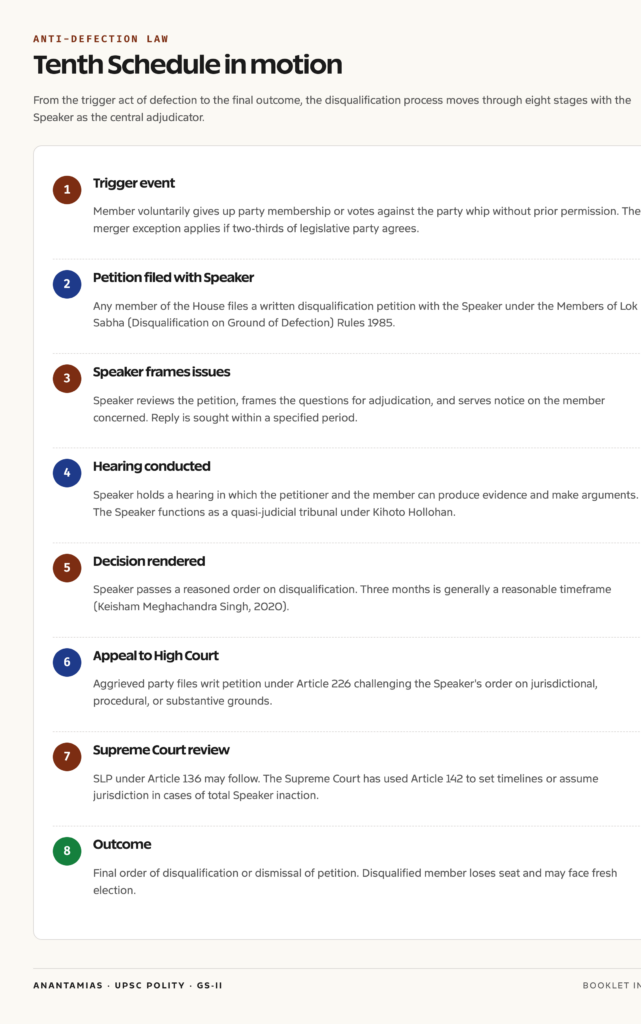
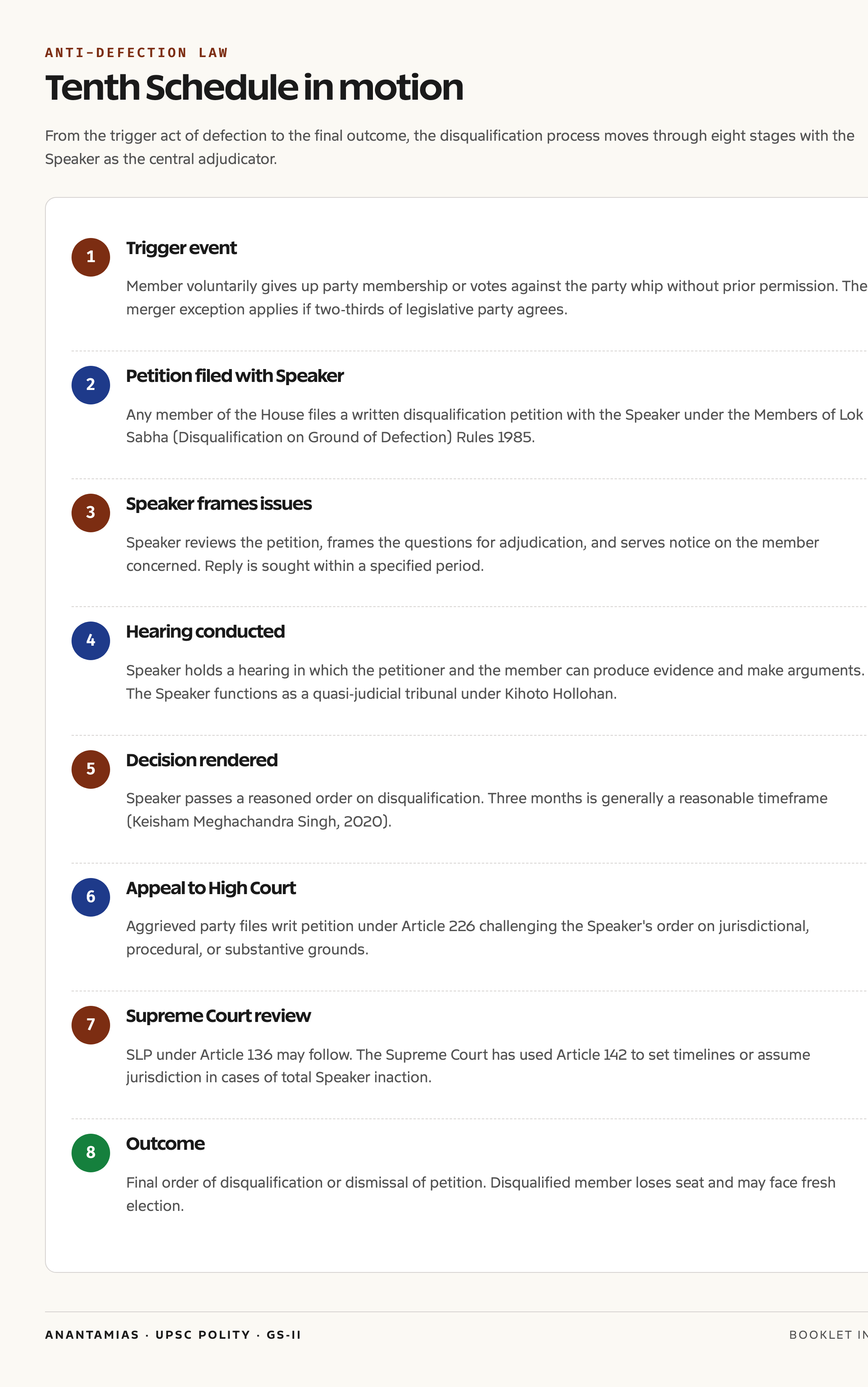
The Tenth Schedule of the Indian Constitution was supposed to end the practice of legislators switching parties for cabinet posts and personal advantage. It built a clear rule. A member who voluntarily gives up party membership or votes against the party whip is disqualified, and the Speaker of the House decides whether the disqualification has been triggered. The architecture looked airtight in 1985. Three decades later, it has become clear that the weak link is not the rule itself but the office that applies it.
Speakers across states have repeatedly sat on disqualification petitions for months and years, allowing defectors to vote in confidence motions, hold ministerial portfolios, and complete entire legislative sessions while their cases gather dust. The Supreme Court has called this trend a defeat of the Tenth Schedule’s purpose. The Court has now built up a small body of doctrine that allows it to direct Speakers to decide within reasonable timeframes, and that allows it to step in under Article 142 when Speakers refuse.
This article walks through the mechanics of the problem, the leading judgments that shape the doctrine, and the long-running debate about whether the Speaker should retain disqualification powers at all. The reform proposal, which surfaces every few years, is to transfer the function to an independent tribunal headed by retired judges. The case for the proposal has only grown stronger as inaction cases have piled up.
Quick Facts on Speaker’s Role under the Tenth Schedule
A short orientation set before deeper analysis.
- Constitutional source: Tenth Schedule of the Indian Constitution, inserted by the 52nd Amendment Act of 1985.
- Speaker as adjudicator: Paragraph 6 of the Tenth Schedule makes the Speaker the final authority on questions of disqualification under the schedule.
- Quasi-judicial nature: The Supreme Court in Kihoto Hollohan (1992) held that the Speaker functions as a tribunal when deciding disqualification petitions.
- Reasonable timeframe: The Court in Keisham Meghachandra Singh (2020) suggested three months as the generally reasonable period for deciding disqualification petitions.
- Article 142: The Court can use Article 142 to remove cases from the Speaker’s jurisdiction or pass orders itself if the Speaker fails to act.
- Judicial review: Permitted only after the Speaker has rendered a final decision, except in cases of total inaction.
- Reform proposal: Transfer of disqualification jurisdiction to an independent tribunal headed by retired judges, recommended by several Supreme Court benches and the Election Commission.
What the Tenth Schedule Actually Says
The Tenth Schedule disqualifies a member of Parliament or a state legislature on two main grounds. First, voluntarily giving up membership of the political party on whose ticket the member was elected. Second, voting or abstaining contrary to the direction of the political party without prior permission and without the disagreement being condoned within fifteen days.
Two exceptions soften the rule. A merger of one-third of a legislative party with another party is protected, although the threshold was raised to two-thirds by the 91st Amendment Act of 2003. Independent members cannot be disqualified on the merger ground because they have no party. Nominated members are bound to declare a party affiliation within six months, and disqualification rules apply to them after that.
Paragraph 6 of the schedule designates the Speaker of the House, or the Chairman in case of the Rajya Sabha or Legislative Council, as the authority to decide disqualification questions. Paragraph 7, which originally barred judicial review of disqualification decisions, was struck down as unconstitutional by the Supreme Court in Kihoto Hollohan because it amounted to amending Article 368 procedure for routine constitutional change.
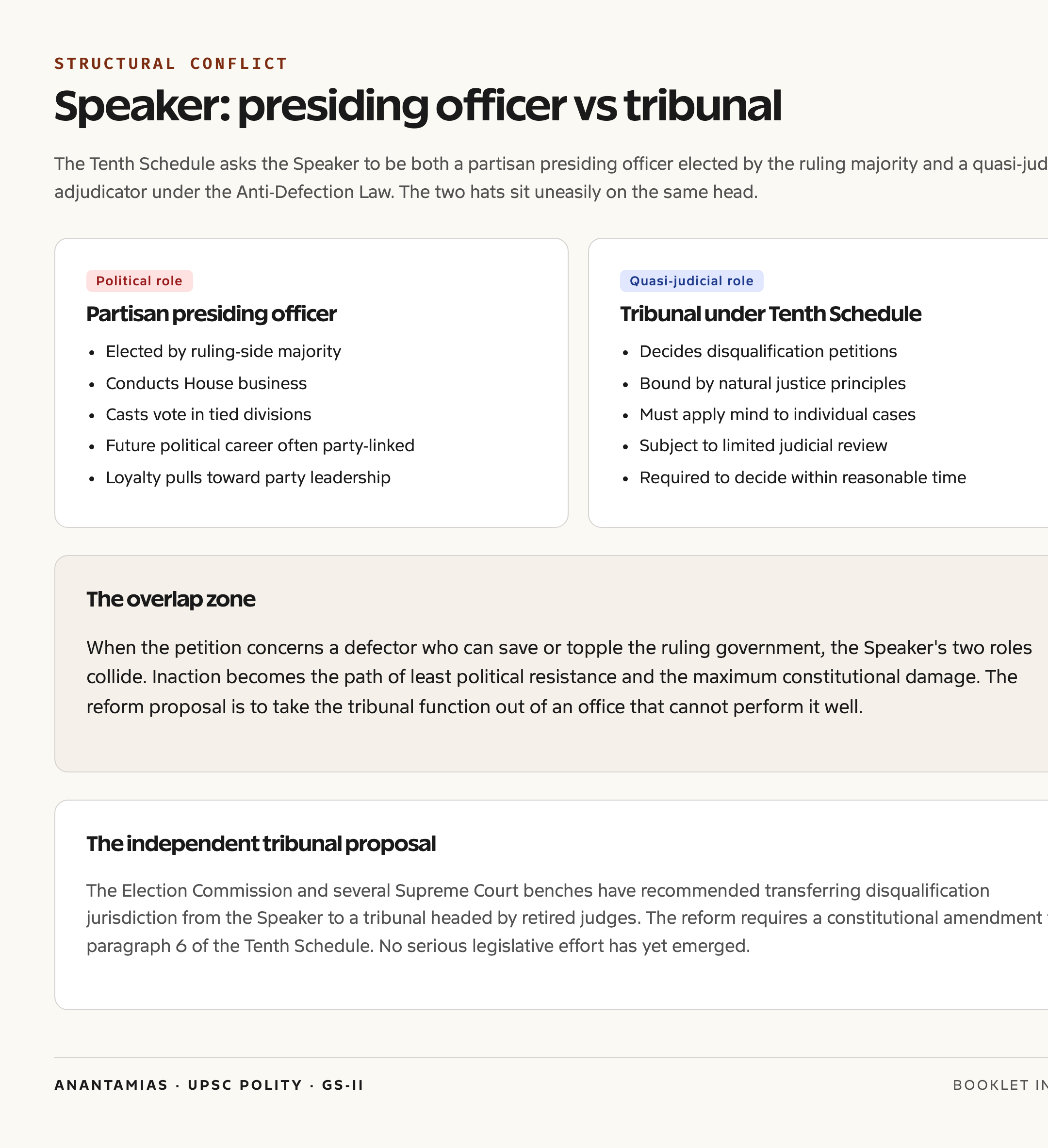
The Speaker therefore wears two hats while deciding disqualification petitions. The first is the political hat of a presiding officer elected by a partisan majority. The second is the quasi-judicial hat of an adjudicator bound by principles of natural justice. The mismatch is the source of the problem.
Background and Historical Context
The Anti-Defection Law was a direct response to the Aaya Ram Gaya Ram era of the late 1960s and 1970s, when legislators in Haryana and other states routinely changed parties between morning and evening, sometimes within the same day, to follow whichever side was forming the government. The 52nd Amendment Act of 1985 inserted the Tenth Schedule and gave the Speaker the power to enforce party discipline through disqualification.
The Constitution’s framers had not anticipated this kind of opportunism, and the original document gave Speakers no role in disqualification beyond procedural rulings. The 1985 amendment fundamentally changed the office. The Speaker became, in effect, a one-person tribunal on a politically volatile question. Within a few years of the schedule taking effect, the first wave of constitutional challenges reached the Supreme Court.
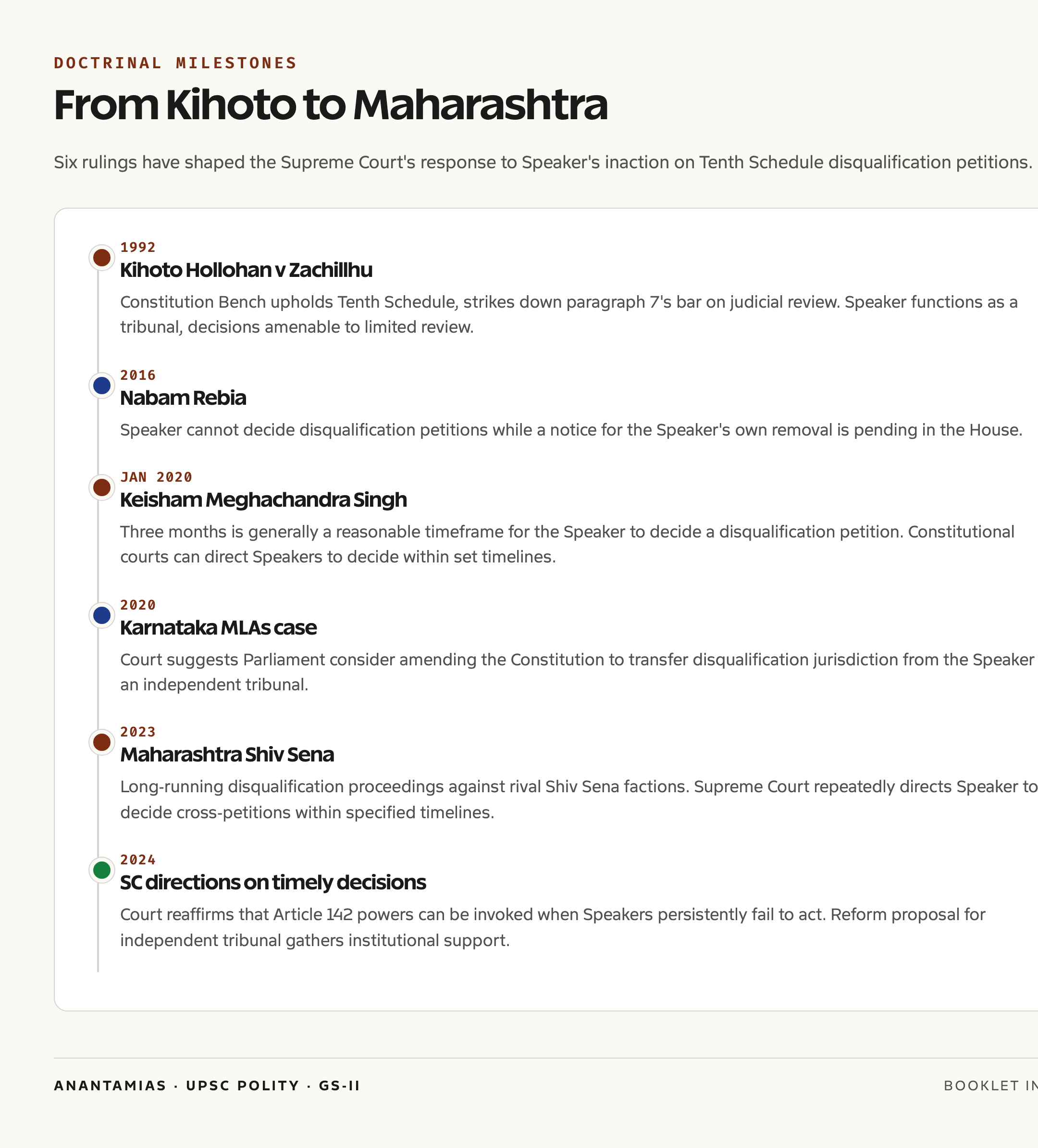
Kihoto Hollohan v Zachillhu in 1992 was the foundational ruling. A Constitution Bench upheld the Tenth Schedule with a critical caveat. The bar on judicial review under paragraph 7 was unconstitutional because it sought to insulate the Speaker’s decisions from court scrutiny without following the special amendment procedure for changes to Articles 132 and 136. The judgment also held that the Speaker, while deciding disqualification petitions, acts as a tribunal whose decisions are amenable to limited judicial review.
The cases that followed clarified the boundaries. Ravi S Naik v Union of India (1994) reinforced the Speaker’s quasi-judicial function. Rajendra Singh Rana (2007) recognised that judicial review extends to procedural fairness and substantive correctness. Nabam Rebia (2016) added the rule that a Speaker cannot decide disqualification petitions if a notice for the Speaker’s own removal is pending. Keisham Meghachandra Singh (2020) introduced the three-month reasonable-timeframe doctrine.
The Karnataka MLAs case of 2020 and the Maharashtra Shiv Sena case in 2023 showcased the inaction problem at its worst. Speakers in both states delayed disqualification decisions for so long that the political crisis they were meant to resolve had passed by the time any ruling came. The Supreme Court’s frustration with this pattern led to the directions and observations summarised in this article.
Key Provisions and the Quasi-Judicial Framework
The Speaker’s role under the Tenth Schedule is shaped by four overlapping legal sources.
Constitutional. The Tenth Schedule itself sets out the grounds for disqualification, the merger exception, and the designation of the Speaker as adjudicator. Article 122 and Article 212 protect parliamentary and state legislature proceedings from court interference, but the Speaker’s tribunal role under the Tenth Schedule has been carved out as an exception.
Statutory and rule-based. The Members of Lok Sabha (Disqualification on Ground of Defection) Rules, 1985, and parallel rules in state legislatures, set out the procedural framework. Petitions must be filed in writing, the member must be served, a hearing must be held, and a reasoned order must be passed. The rules do not, however, prescribe a binding timeline for decision.
Judicial. The Supreme Court has built a doctrine on top of the constitutional and statutory framework. Decisions must be made within reasonable time, generally three months. Judicial review is permitted on substantive and procedural grounds. Article 142 powers can be invoked in cases of total inaction.
Conventional. A presiding officer of a house traditionally exercises non-partisan authority. The convention has been honoured in the breach more often than in the observance under the Tenth Schedule, partly because Speakers are elected on the strength of ruling-party support and rarely break with their political background.
Why the Inaction Problem Matters
Three reasons explain why Speaker’s inaction is treated as a serious constitutional problem rather than as a mere administrative delay.
Defeat of the schedule’s purpose. The Tenth Schedule was designed to deter defections by attaching swift disqualification to the act. Delay converts disqualification into a paper threat. A defector who can switch sides, vote on a confidence motion, hold a ministerial portfolio, and complete a legislative term while the petition is pending has effectively neutralised the law.
Distortion of government formation. Several recent cases have involved disqualification petitions filed during attempts to form or topple state governments. A Speaker who delays decisions can in effect choose which side benefits from the legislative arithmetic. The Karnataka and Maharashtra episodes both illustrate this distortion.
Erosion of constitutional trust. A constitutional adjudicator who refuses to adjudicate undermines confidence in the broader system. The Court’s repeated frustration in recent rulings is not just about specific cases but about the cumulative effect on the legitimacy of legislative discipline.
Detailed Analysis: Reasonable Time and Article 142 Powers
Two doctrinal innovations have given the Court tools to address Speaker’s inaction.
Reasonable time. The Keisham Meghachandra Singh ruling of 2020 introduced the three-month reasonable-timeframe doctrine. The Court held that in the absence of exceptional circumstances, three months is generally a reasonable period for the Speaker to decide a disqualification petition. The figure is not a rigid statutory deadline but a benchmark that the Court will use to assess delay. Speakers who exceed it without justification are vulnerable to judicial direction.
Article 142 powers. The Court has held that if a Speaker repeatedly fails to act despite directions, the Court can use Article 142 to do complete justice. This can take several forms. The Court can direct the Speaker to decide within a specific deadline. It can transfer the matter to a constitutional court for decision. In extreme cases, it can pass orders that effectively decide the disqualification question itself, although this remains controversial and is used rarely.
The combination of these two doctrines significantly narrows the Speaker’s space for inaction. A Speaker who sits on a petition for more than three months without recorded reason can be summoned by the Court to explain. Continued inaction can lead to direct judicial intervention.
The Maharashtra Shiv Sena disqualification proceedings in 2023 and 2024 illustrate how this works in practice. The Supreme Court repeatedly directed the Maharashtra Speaker to decide the cross-petitions filed by both factions of the Shiv Sena within specified timelines. When deadlines slipped, the Court extended them with strong observations. The eventual decision rendered by the Speaker, while controversial on substance, was reached within a court-monitored timeframe rather than at the Speaker’s leisure.
Comparative Frame: Leading Cases and Their Holdings
The doctrine on Speaker’s role under the Tenth Schedule has emerged through five major cases that any answer on this topic must reference.
| Case | Year | Key Holding |
|---|---|---|
| Kihoto Hollohan v Zachillhu | 1992 | Tenth Schedule constitutional but paragraph 7 bar on judicial review struck down. Speaker acts as a tribunal subject to limited review. |
| Ravi S Naik v Union of India | 1994 | Speaker is a neutral adjudicator under the schedule, not a political officer for this purpose. |
| Rajendra Singh Rana | 2007 | Judicial review extends to procedural fairness and substantive correctness of disqualification decisions. |
| Nabam Rebia v Deputy Speaker | 2016 | Speaker cannot decide disqualification petitions while a resolution for the Speaker’s own removal is pending. |
| Keisham Meghachandra Singh v Hon’ble Speaker | 2020 | Three months is generally a reasonable timeframe for deciding disqualification petitions. Constitutional courts can direct Speakers to decide within set timelines. |
The Court has continued to expand the doctrine in subsequent cases involving Karnataka, Goa, Manipur, and Maharashtra. The trend is clear. Judicial supervision of the Speaker’s quasi-judicial role under the Tenth Schedule has become more active, more specific, and more willing to use Article 142 to override delay.
Challenges and Open Questions
Several challenges remain unresolved despite the recent jurisprudence.
The structural conflict of interest. A Speaker is elected by the ruling majority and depends on continued political support for advancement. Asking the same person to render a quasi-judicial decision on whether members of the ruling or opposition party should be disqualified creates an unavoidable conflict. No procedural safeguard fully addresses this.
The intermediate-stage problem. Kihoto Hollohan held that judicial review is available only after the Speaker’s final decision, except in cases of total inaction. The boundary between ordinary delay and total inaction is fuzzy. Litigants and courts have struggled to determine when intervention is appropriate before the Speaker has formally ruled.
Manchurian motion strategy. Defectors and Speakers have sometimes coordinated strategies in which the Speaker disqualifies opposition members quickly while delaying decisions on ruling-side members. The selectivity is hard to challenge directly because each individual case can be defended on its own facts.
The independent tribunal proposal. The Supreme Court in the Karnataka MLAs case of 2020 explicitly suggested that Parliament should consider amending the Constitution to transfer disqualification jurisdiction from the Speaker to an independent tribunal headed by retired judges. The Election Commission has supported similar proposals for decades. No serious legislative effort has yet emerged.
Whip and intra-party democracy. The Tenth Schedule penalises voting against the party whip, which means that even legitimate disagreement with party leadership can trigger disqualification. Whether the schedule should apply only to confidence motions and money bills, or only to specified categories of votes, is an open structural debate.
Prelims Pointers
A compact list of facts most likely to appear in objective questions.
- The Tenth Schedule was inserted by the 52nd Amendment Act of 1985.
- The 91st Amendment Act of 2003 raised the merger threshold to two-thirds of the legislative party.
- Paragraph 6 of the Tenth Schedule designates the Speaker as the authority on disqualification.
- Paragraph 7 of the Tenth Schedule, which barred judicial review, was struck down in Kihoto Hollohan (1992).
- Three months is the generally reasonable timeframe for deciding disqualification petitions, after Keisham Meghachandra Singh (2020).
- Constitutional courts can direct Speakers to decide within set timelines.
- The Supreme Court can invoke Article 142 to do complete justice in cases of total Speaker inaction.
- A Speaker cannot decide disqualification petitions while a resolution for the Speaker’s removal is pending, after Nabam Rebia (2016).
- Independent members cannot be saved by the merger exception.
- Nominated members must declare party affiliation within six months and become subject to disqualification rules thereafter.
- The Members of Lok Sabha (Disqualification on Ground of Defection) Rules, 1985 govern procedure in the Lok Sabha.
Mains Practice Questions
These are the kinds of analytical prompts the topic invites.
- Discuss the constitutional and judicial framework that governs the Speaker’s role under the Tenth Schedule. Has the three-month reasonable-timeframe doctrine been effective in addressing Speaker’s inaction?
- The Speaker functions both as a partisan presiding officer and as a quasi-judicial tribunal under the Tenth Schedule. Examine the structural conflict and discuss reform proposals.
- Critically analyse the Supreme Court’s use of Article 142 in cases of Speaker’s inaction on defection petitions.
- Should disqualification under the Tenth Schedule be transferred from the Speaker to an independent tribunal? Discuss the constitutional, institutional, and political dimensions.
- The Anti-Defection Law was meant to strengthen party discipline but has been criticised for stifling intra-party democracy. Examine the trade-off and suggest reforms.
Way Forward
The reform path involves three measures, of which only one requires constitutional amendment.
Statutory codification of the three-month timeline. The Members of Lok Sabha rules and parallel state rules can be amended to incorporate a binding three-month timeline, with deemed-decision rules if the Speaker fails to act. This is achievable through ordinary procedural amendment, no constitutional change required.
Mandatory speaking orders with public reasons. Disqualification decisions should be reasoned, published, and accessible. The current practice in some states of cryptic orders that leave the reasoning opaque undermines both judicial review and public confidence.
Constitutional amendment for an independent tribunal. The deeper structural fix is transfer of jurisdiction from the Speaker to a tribunal headed by retired judges of the Supreme Court or the High Courts, with assessor support from senior advocates and parliamentary experts. Such a tribunal could decide cases across all legislatures, reducing inconsistency and breaking the conflict of interest at source. The Election Commission has long supported the proposal, and several Supreme Court benches have endorsed it. What is required is parliamentary will.
The Speaker’s office is meant to be a non-partisan custodian of the legislative chamber. The Tenth Schedule placed it in an impossible position by asking it to be a non-partisan tribunal while remaining a partisan office. Inaction is the predictable consequence. The reform agenda is to take the tribunal function out of an office that cannot perform it well, while leaving the chamber’s traditional non-partisan duties intact. That is the constitutional logic the Court has been pushing toward in case after case, and the legislative response is overdue.
Frequently Asked Questions
What is the Tenth Schedule of the Constitution?
The Tenth Schedule, inserted by the 52nd Amendment Act of 1985, contains the Anti-Defection Law. It disqualifies members of Parliament and state legislatures who voluntarily give up party membership or vote against the party whip without permission. The schedule designates the Speaker of the House, or the Chairman of the Council, as the authority to decide disqualification questions. The merger exception, originally requiring one-third of the legislative party, was raised to two-thirds by the 91st Amendment Act of 2003.
Why does the Speaker decide defection cases?
The framers of the 52nd Amendment chose the Speaker because the office was meant to be non-partisan and familiar with the conduct of legislative business. The choice has been criticised on the ground that the Speaker is elected by the ruling majority and depends on political support, which conflicts with the quasi-judicial nature of the disqualification function. The Supreme Court in Kihoto Hollohan upheld the constitutional design but emphasised that the Speaker, while exercising disqualification powers, acts as a tribunal subject to judicial review.
What is the three-month rule for defection petitions?
The Supreme Court in Keisham Meghachandra Singh v Hon’ble Speaker (2020) held that three months is generally a reasonable period for the Speaker to decide a disqualification petition, in the absence of exceptional circumstances. The figure is a benchmark, not a binding statutory deadline. Speakers who exceed three months without recorded justification are vulnerable to judicial direction, including direct deadlines set by constitutional courts.
Can the Supreme Court decide a disqualification petition itself?
In extreme cases of total Speaker inaction, the Supreme Court has invoked Article 142 to remove the disqualification proceeding from the Speaker’s jurisdiction or to pass orders that effectively decide the question. This is treated as an exceptional measure, used rarely, and only after the Speaker has been given clear opportunities to act. The general rule remains that the Speaker decides first and the Court reviews afterwards, except in cases of demonstrated and persistent inaction.
What did Kihoto Hollohan decide?
The Constitution Bench in Kihoto Hollohan v Zachillhu (1992) upheld the Tenth Schedule but struck down paragraph 7, which had attempted to bar judicial review of the Speaker’s disqualification decisions. The Court held that the Speaker, while deciding such petitions, functions as a tribunal whose decisions are amenable to limited review on grounds of jurisdictional error, mala fides, or violation of constitutional principles and natural justice. The case remains the foundational authority on the Speaker’s role under the schedule.
What is the Nabam Rebia principle?
In Nabam Rebia v Deputy Speaker (2016), the Supreme Court held that a Speaker cannot decide disqualification petitions against members while a resolution for the Speaker’s own removal is pending in the House. The principle prevents a Speaker facing removal from using disqualification powers to manipulate the legislative arithmetic in their own favour. The rule has practical consequences in unstable state legislatures where the Speaker’s continuation is itself a contested question.
Should disqualification powers be moved to an independent tribunal?
Several Supreme Court benches and the Election Commission have recommended transferring disqualification jurisdiction from the Speaker to an independent tribunal headed by retired judges. The reform would address the structural conflict between the Speaker’s partisan and quasi-judicial roles. It would require a constitutional amendment to the Tenth Schedule, paragraph 6 specifically. No serious legislative initiative has yet been moved despite the recommendations.
How does the merger exception work?
A merger of one legislative party with another is protected from the Anti-Defection Law if at least two-thirds of the original legislative party agrees to the merger. The 91st Amendment Act of 2003 raised the threshold from the original one-third. Members who join the merger are not disqualified, while members who refuse the merger and remain in the original party are also protected. The merger must be of legislative parties, not of the political parties at the organisational level outside the legislature.
What happens if a Speaker is themselves accused of defection?
A Speaker who is accused of voluntarily giving up party membership or voting against the whip is subject to the same disqualification rules as any other member. The Supreme Court has held that the Speaker cannot decide such a petition involving themselves. The matter is generally referred to the Deputy Speaker, or in extraordinary cases, to a member elected for the limited purpose. The structural conflict has rarely arisen in practice but remains a live theoretical question.
What is the difference between defection and floor crossing?
Defection is the formal disqualification ground under the Tenth Schedule, requiring either voluntary giving up of party membership or voting against the whip. Floor crossing is the older parliamentary term for any movement of legislators across party lines, regardless of whether the movement triggers disqualification. The Aaya Ram Gaya Ram era of the 1960s and 1970s involved floor crossing without legal consequences, which was precisely what the Tenth Schedule was designed to address. After 1985, defection in the legal sense is a subset of floor crossing, distinguished by the disqualification consequence.
Tell Google you want more of this.
Add Anantam IAS as a preferred sourceOne tap, and this site shows up more often in your own Top Stories, AI Overviews and AI Mode. Remove it any time.