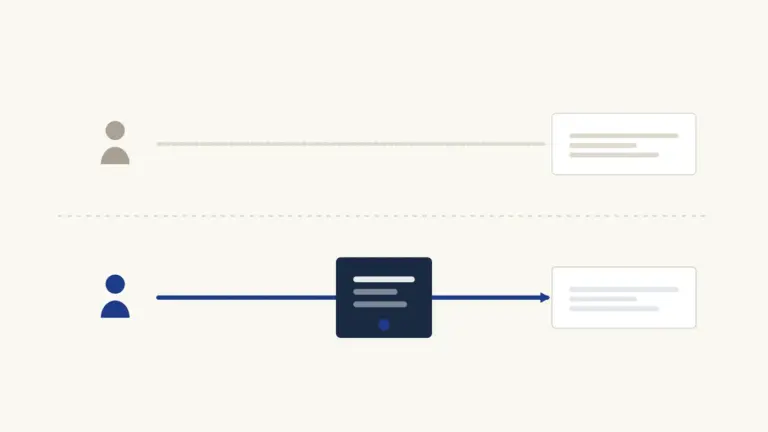

The Special Marriage Act, 1954 (SMA) is India’s secular marriage legislation that allows any two individuals to marry regardless of their religion, caste, or creed. Unlike personal law marriages (governed by Hindu Marriage Act, Muslim Personal Law, Indian Christian Marriage Act, etc.), the SMA provides a civil, religion-neutral legal framework for solemnising and registering marriages. It is a critical topic for UPSC — touching upon fundamental rights, secularism, personal law reform, and the debate around the Uniform Civil Code (UCC).
Historical Background
The roots of the SMA lie in the 19th-century reform movement:
- Special Marriage Act, 1872 — Enacted during British rule, primarily to legalise Brahmo Samaj marriages and inter-faith unions. However, it required that persons marrying under it renounce their personal law, which was a significant deterrent.
- Special Marriage Act, 1954 — Replaced the 1872 Act. Crucially, it does not require the parties to renounce their religion. Any Indian citizen can marry under the SMA while retaining their religious identity.
- The Act extends to all of India except Jammu & Kashmir (where it now applies after the abrogation of Article 370 in 2019).
- It also applies to Indian citizens abroad (Section 19 — marriage before a diplomatic or consular officer).
Conditions for Marriage Under the SMA
Section 4 of the Act lays down the conditions for a valid marriage:
| Condition | Requirement |
|---|---|
| Age | Bridegroom must be at least 21 years; bride must be at least 18 years |
| Mental capacity | Neither party should be of unsound mind or incapable of giving valid consent |
| Consent | Free consent of both parties (not obtained by force or fraud) |
| Monogamy | Neither party should have a living spouse at the time of marriage |
| Prohibited relationships | Parties should not fall within the degrees of prohibited relationship (as specified in the Schedule), unless custom permits such marriage |
These conditions are broadly similar to those in the Hindu Marriage Act, 1955, but are religion-neutral.
Procedure — The 30-Day Notice Requirement
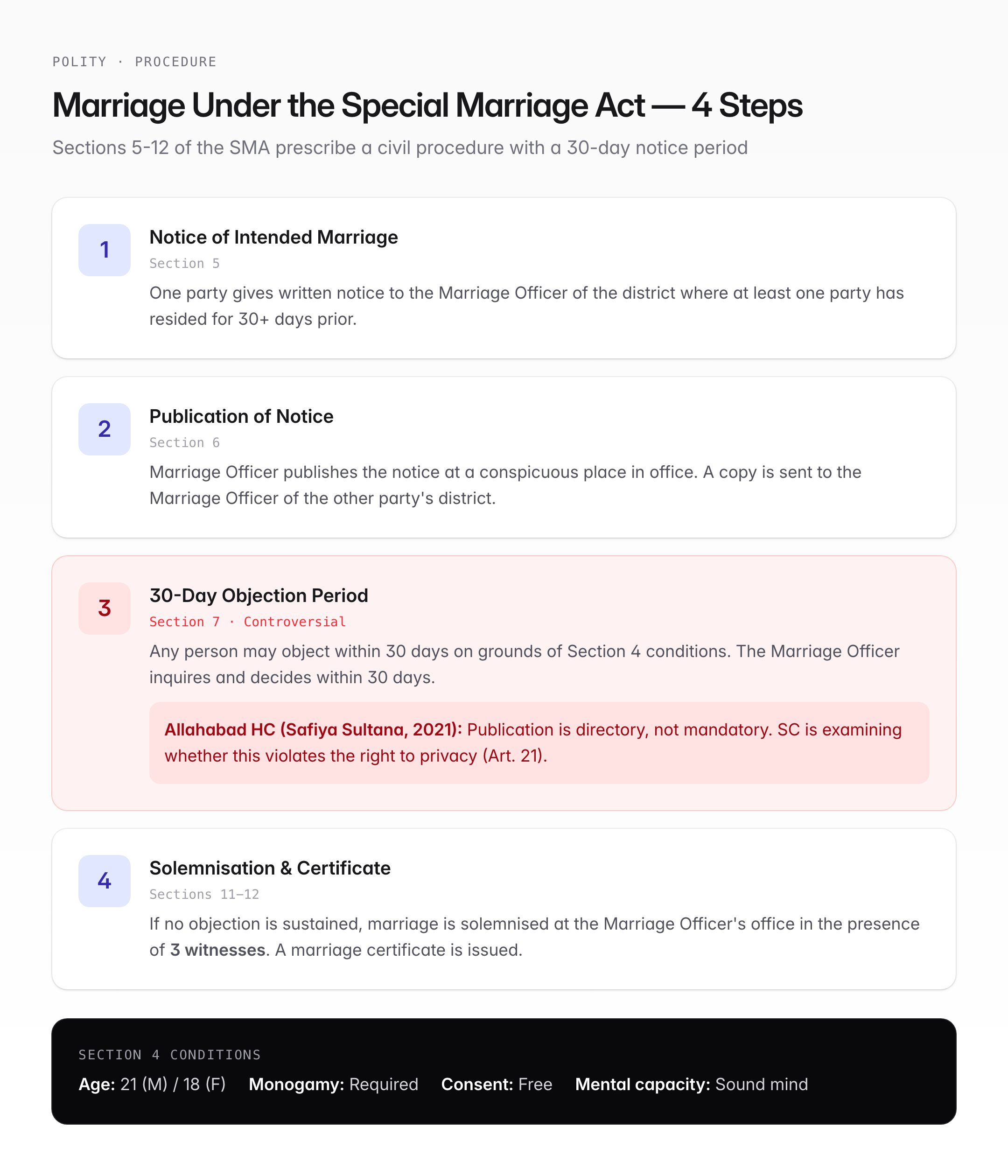
The procedure under the SMA (Sections 5-8) is one of its most debated aspects:
Step 1: Notice of Intended Marriage (Section 5)
- One of the parties must give written notice to the Marriage Officer of the district in which at least one party has resided for at least 30 days prior to the date of notice.
Step 2: Publication of Notice (Section 6)
- The Marriage Officer publishes the notice by affixing a copy at a conspicuous place in the office.
- The notice is also sent to the Marriage Officer of the district where the other party resides.
Step 3: Objection Period — 30 Days (Section 7)
- Any person may object to the marriage within 30 days of the publication of notice.
- Objections must be on the ground that the marriage would contravene one or more conditions under Section 4.
- The Marriage Officer must inquire into the objection and decide within 30 days.
Step 4: Solemnisation (Section 11-12)
- If no objection is sustained, the marriage is solemnised at the office of the Marriage Officer.
- The marriage is performed in the presence of three witnesses.
- A marriage certificate is issued.
The 30-Day Notice Controversy
The 30-day public notice requirement has been widely criticised because:
- It effectively publicly discloses the intention to marry, which can expose interfaith couples to family pressure, intimidation, and vigilante interference.
- Multiple High Courts have observed that the notice provision can be misused, particularly in cases of inter-religious marriages.
- The Allahabad High Court in Safiya Sultana v. State of UP (2021) held that publication of notice is not mandatory and the parties can request the Marriage Officer not to publish it.
- However, the Supreme Court in a 2021 reference considered whether the 30-day notice provision infringes on the right to privacy (Article 21). The matter remains under judicial consideration.
Difference from Personal Law Marriages
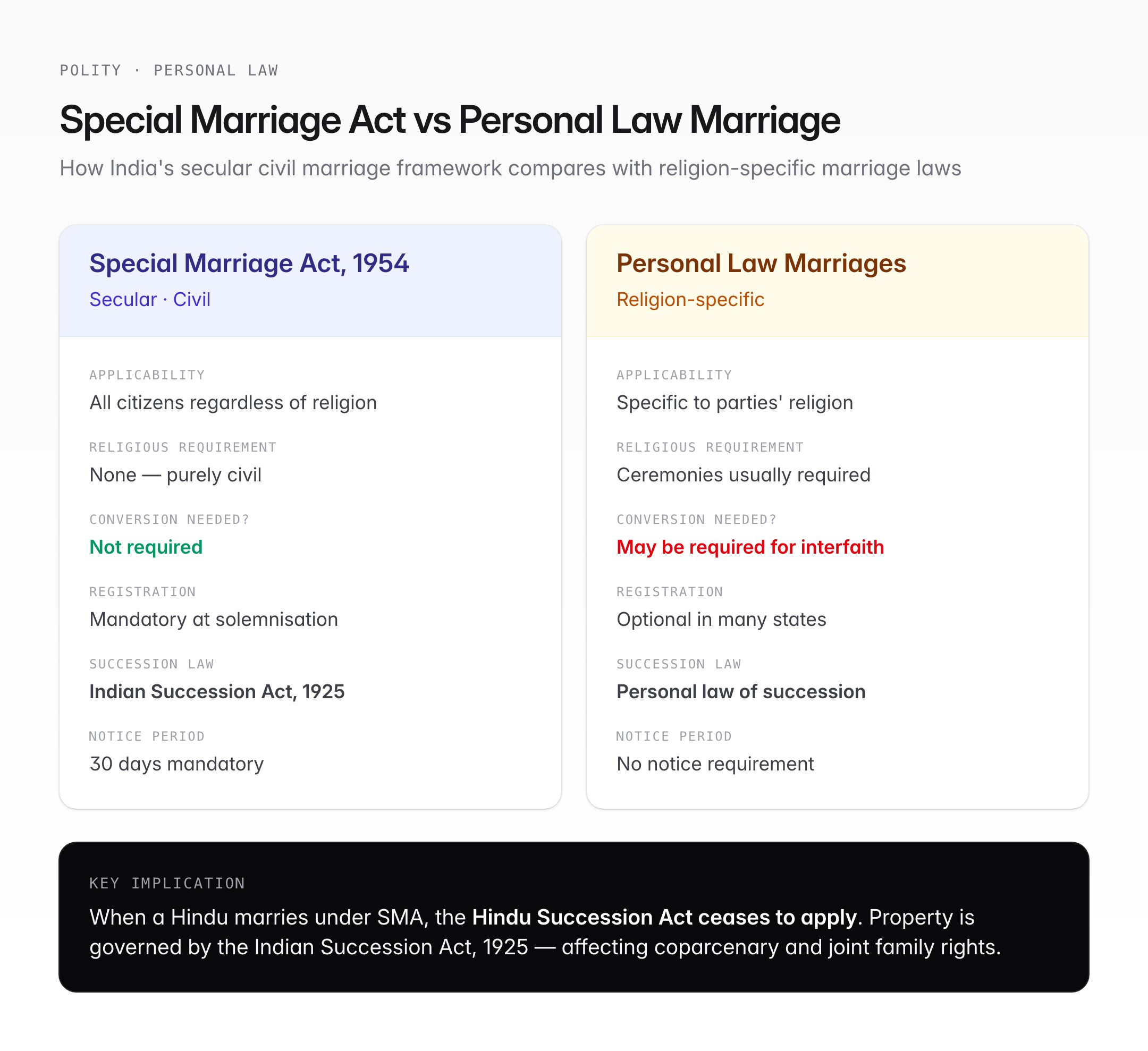
| Feature | Special Marriage Act, 1954 | Personal Law Marriages |
|---|---|---|
| Applicability | All citizens regardless of religion | Specific to the religion of the parties |
| Religious requirement | None; purely civil | Religious ceremonies usually required |
| Conversion | Not required | May be required for inter-faith marriage under personal law |
| Registration | Mandatory (marriage is registered at solemnisation) | Optional in many states (varies) |
| Succession law | Indian Succession Act, 1925 applies (not personal law of succession) | Personal law of succession applies |
| Divorce | Under SMA provisions | Under respective personal law |
| Notice period | 30 days mandatory | No notice requirement |
Important note on succession: When a Hindu marries under the SMA, the Hindu Succession Act ceases to apply to them, and the Indian Succession Act, 1925 governs their property and inheritance. This has significant implications for joint family property and coparcenary rights.
Interfaith and Inter-Caste Marriages
The SMA is the primary legal route for interfaith and inter-caste marriages in India:
- It provides a religion-neutral alternative to conversion followed by marriage under personal law.
- The government's incentive schemes for inter-caste marriages (such as the Dr. Ambedkar Scheme for Social Integration through Inter-Caste Marriage) often require registration under the SMA.
- Despite legal protections, couples continue to face social stigma, honour violence, and family opposition, making the SMA's role both legally and socially significant.
Key Supreme Court Cases
| Case | Year | Significance |
|---|---|---|
| Lily Thomas v. Union of India | 2000 | SC held that a Hindu husband cannot convert to Islam solely to contract a second marriage while the first subsists — conversion for bigamy is not valid |
| Lata Singh v. State of UP | 2006 | SC affirmed that adults have the right to marry anyone of their choice; directed police to protect interfaith/inter-caste couples |
| Shafin Jahan v. Asokan K.M. (Hadiya case) | 2018 | SC upheld the right to choose one's partner as part of Article 21 (right to life and personal liberty) |
| Safiya Sultana v. State of UP | 2021 | Allahabad HC ruled that the 30-day notice under SMA is directory, not mandatory |
| Reference on SMA notice provisions | 2021-ongoing | SC is examining whether the 30-day notice violates Article 21 (privacy) |
Recent Controversies and Developments
- Anti-conversion laws — Several states have enacted laws requiring prior approval or notice for conversion for marriage, which critics argue effectively target interfaith marriages under the SMA.
- Uniform Civil Code (UCC) debate — The SMA is often cited as a model for the UCC, since it already provides a common civil marriage framework. Uttarakhand's UCC Act (2024) draws parallels with SMA provisions.
- Privacy concerns — The public notice requirement remains under judicial scrutiny, with privacy advocates arguing it violates the Puttaswamy judgment (2017) on the right to privacy.
UPSC Relevance
GS Paper II — Polity: Fundamental rights (Articles 14, 15, 21, 25); personal laws; Uniform Civil Code (Article 44 — Directive Principles).
GS Paper I — Society: Secularism; social reform; inter-community relations.
Prelims key facts:
- The Special Marriage Act was enacted in 1954, replacing the 1872 Act.
- It allows marriage regardless of religion or caste without requiring conversion.
- Section 4 specifies conditions: minimum age (21/18), monogamy, free consent, mental capacity.
- A 30-day notice period (Section 5-7) is mandatory, though courts have questioned its mandatory nature.
- Marriage under SMA is governed by the Indian Succession Act, 1925 for property matters — not personal law.
- The SMA applies to Indian citizens abroad (Section 19).
- The Hadiya case (2018) affirmed the right to choose one's partner under Article 21.
- The SMA is often discussed in the context of Article 44 (Uniform Civil Code).
Tell Google you want more of this.
Add Anantam IAS as a preferred sourceOne tap, and this site shows up more often in your own Top Stories, AI Overviews and AI Mode. Remove it any time.