
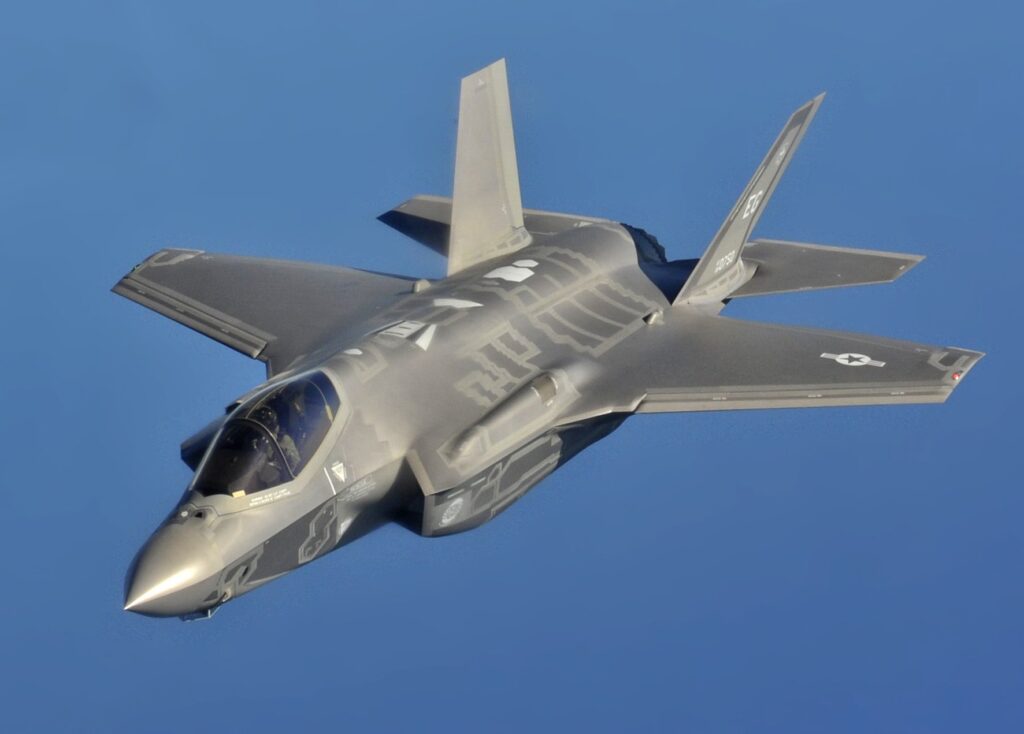
Stealth technology is the engineering practice of making an aircraft, ship, or missile harder for enemy radar, infrared sensors, and other detection systems to find and track. The goal is not to be invisible — no real platform achieves that — but to shrink the distance at which an adversary can detect, identify, and engage the target. A stealth fighter that a radar would have spotted at three hundred kilometres might only become visible at thirty, by which time it has already launched its weapons or escaped the engagement envelope.
Two ideas sit at the heart of stealth in aircraft: shaping the airframe so that radar energy bounces away from the source, and coating critical surfaces with materials that absorb radar waves rather than reflect them. Both techniques reduce what engineers call radar cross section, abbreviated RCS. A lower RCS means a smaller, fainter return on the enemy’s screen.
| Stealth combat aircraft | Country | Status |
|---|---|---|
| F-22 Raptor | United States | Fifth-generation, in service |
| F-35 Lightning II | United States | Fifth-generation, in service |
| Chengdu J-20 | China | Fifth-generation, in service |
| Sukhoi Su-57 | Russia | Fifth-generation, in service |
| AMCA | India | Fifth-generation, under development |
What Radar Cross Section Means
Radar cross section is a measure of how strongly a target reflects radar energy back to the transmitter. A large airliner with a flat metal skin and dangling antennas might have an RCS of one hundred square metres. A well-designed stealth fighter aims for a fraction of a square metre, sometimes far smaller in the front-facing aspect that matters most when flying towards an enemy.
Shaping the Airframe
Stealth shaping uses flat or gently curved panels arranged so that incoming radar waves bounce off in directions other than back towards the radar. Sharp angles, exposed engine inlets, vertical tail surfaces, and weapons hanging on external pylons all act as bright reflectors. Stealth designs hide the engine compressor face behind serpentine inlets, carry weapons internally, blend the wing into the fuselage, and angle vertical surfaces inward.
The classic example is the angular F-117, designed in the 1970s using early computer modelling. Modern designs like the F-22, F-35, Chinese J-20, and the planned Indian Advanced Medium Combat Aircraft (AMCA) use smoother shapes that combine stealth with aerodynamic performance.
Radar-Absorbent Materials
Shaping alone is not enough. Edges, gaps around panels, and the cockpit canopy still reflect radar energy. Radar-absorbent material, or RAM, is a coating or composite layer that converts radar energy into a small amount of heat, reducing the reflected signal. RAM is applied as paint, tile, or built into the composite skin during manufacturing.
Crucially, RAM is designed to absorb radar waves, not to scatter them in random directions. Scattering radar energy more widely would actually make a target easier to detect by modern bistatic radar networks. The job of RAM is to remove energy from the return path entirely.
RAM coatings are expensive to maintain. A scratch, a missing screw, or weather damage degrades stealth performance, and stealth aircraft typically need climate-controlled hangars and specialised paint shops.
What Stealth Does Not Hide
Stealth reduces radar signature, but it does not eliminate every form of detection. Infrared sensors track engine heat and skin friction. Acoustic sensors and ground observers see and hear aircraft that fly low. Bistatic and passive radar systems use widely separated transmitters and receivers to detect targets that conventional radar misses. Long-wavelength radars, sometimes called counter-stealth radars, can detect stealth aircraft at longer ranges than standard X-band sets, though with less precision.
Stealth is also direction-dependent. Most stealth aircraft are designed primarily to be hard to see from the front. From the side or rear, the RCS is usually larger. This is why stealth fighters fly attack profiles that keep the nose pointed at the threat for as long as possible.
Stealth Beyond Aircraft
Stealth principles apply to other platforms. Naval vessels use angled superstructures, reduced antenna clutter, and infrared-cooled exhausts. Submarines rely on quiet propulsion, anechoic tiles, and depth control to evade sonar, which is the underwater equivalent of radar. Missile designs increasingly incorporate low-observable shaping. India’s BrahMos and AMCA programmes both pay attention to signature reduction.
India’s Stealth Programmes
India’s flagship stealth aircraft programme is the AMCA, a fifth-generation fighter under development by the Aeronautical Development Agency (ADA) and Hindustan Aeronautics Limited. The design uses internal weapon bays, blended wing-body shaping, and serpentine inlets. The Cabinet Committee on Security cleared the roughly ₹15,800-crore AMCA prototype-development phase in March 2024, and in May 2025 the Defence Ministry approved an industry-partnership execution model that lets private firms compete alongside HAL to build the prototypes. A first flight is targeted around 2028, with induction later in the 2030s. India also operates upgraded Rafale and Su-30 MKI fighters with reduced-signature features and is investing in stealth research at DRDO labs and academic institutions.
For related context, see our explainers on fighter jet generations and the Agni missile family.
Why Stealth Matters
Stealth is not a magic shield. It is a way to buy time and distance in a contested battlespace. A stealthy aircraft can penetrate defended airspace, strike a target, and exit before being engaged. In an era of dense air defence networks and long-range surface-to-air missiles, that capability is the difference between a successful strike package and unacceptable losses. Every major air power is now investing in stealth platforms, counter-stealth sensors, or both.
FAQs
What is stealth technology?
Stealth technology is a set of design and material techniques that reduce a platform’s radar, infrared, and other signatures, making it harder for enemy sensors to detect and track.
Does stealth make an aircraft invisible?
No. Stealth reduces detection range, sometimes dramatically, but no aircraft is truly invisible. Detection becomes harder, not impossible.
How does radar cross section reduction work?
Through airframe shaping that deflects radar energy away from the source and radar-absorbent materials that convert incoming energy into heat.
What is radar-absorbent material?
A coating or composite layer designed to absorb radar waves and convert their energy into heat, reducing the signal reflected back to the radar.
Does RAM scatter radar energy?
No. RAM is designed to absorb energy, not scatter it. Scattering would help bistatic radar networks detect the target.
Can stealth aircraft be detected at all?
Yes, by long-wavelength radars, infrared sensors, bistatic networks, and visual observation, especially from the side or rear. Stealth raises the cost of detection rather than preventing it.
Does India have a stealth fighter?
The AMCA is India’s indigenous fifth-generation stealth fighter under development by ADA and HAL. India also operates upgraded fourth-generation fighters with some signature-reduction features.
Why is stealth expensive?
Stealth shapes are aerodynamically demanding, RAM coatings need careful application and maintenance, internal weapon bays add complexity, and the aircraft typically require climate-controlled hangars and specialised maintenance facilities.
Tell Google you want more of this.
Add Anantam IAS as a preferred sourceOne tap, and this site shows up more often in your own Top Stories, AI Overviews and AI Mode. Remove it any time.





