Disclosure: this guide contains Amazon affiliate links. As an Amazon Associate, Anantam IAS earns from qualifying purchases — at no extra cost to you.
The total amendment of indian constitution count is one of those numbers aspirants think they know — until a Prelims question pins them down on the latest. As of April 2026, the Constitution of India has been amended 106 times since 1950. The 107th amendment hasn’t been enacted yet. This guide gives you the exact count, the year-wise distribution, the most-amended articles, the procedure under Article 368, and the basic structure doctrine that limits Parliament’s amending power. Let me walk you through it the way an examiner expects you to know it.
How many total amendments have been made to the Indian Constitution?
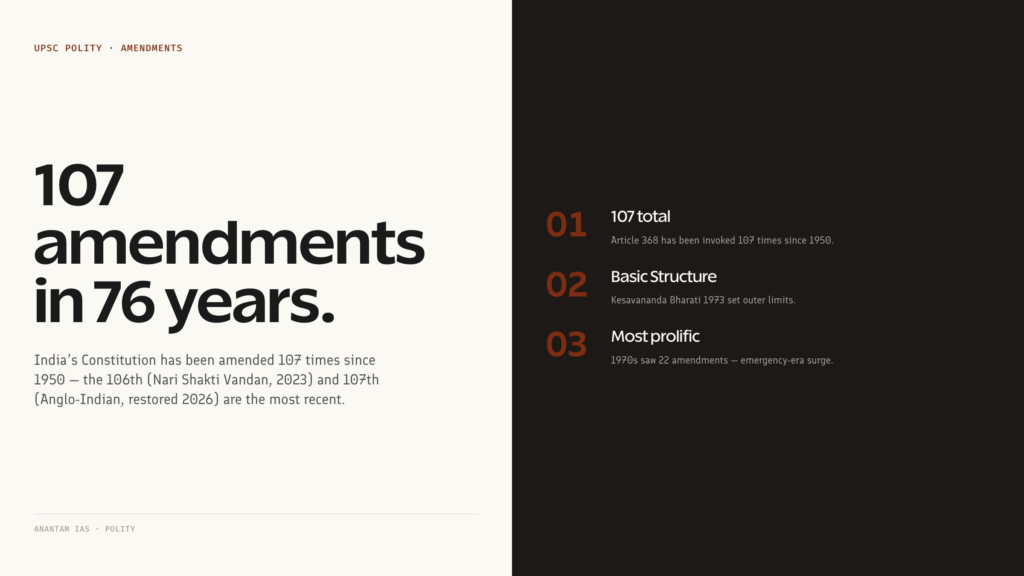
As of April 2026, the Indian Constitution has been amended 106 times. The first amendment was passed in 1951 (less than 18 months after the Constitution came into force on 26 January 1950); the latest is the 106th Amendment Act, 2023 (Women’s Reservation Act, Nari Shakti Vandan Adhiniyam), which received Presidential assent on 28 September 2023, and was brought into force by a gazette notification on 16 April 2026 — though the one-third reservation for women remains inoperative pending the first post-notification census and the subsequent delimitation exercise.
- Total amendments (April 2026) — 106
- Constitutional period covered — 1950 to 2026 (76 years)
- Average pace — roughly 1 amendment every 8.5 months
- Constitutional basis for amendment — Article 368, Part XX
- Basic structure limit — Kesavananda Bharati v. State of Kerala (1973)
What does “amendment” mean under Article 368?
Article 368 (Part XX of the Constitution) is the source of Parliament’s amending power. It allows Parliament to amend by way of addition, variation, or repeal any provision of the Constitution — subject to the basic structure doctrine.
Three things to know upfront:
- Amendments require formal legislative procedure — not executive order, not delegated legislation.
- Three types of amendments exist under Article 368, distinguished by majority required.
- Even a properly-passed amendment can be struck down by the Supreme Court if it violates basic structure.
That last point is the crucial one. Most coaching notes get this wrong. Here’s the correct reading of Article 31C and Article 368: Parliament’s power to amend is constituent, not legislative — but it is still bounded by the basic structure ruling.
The three types of amendments — by procedure
Numbered. Examiners ask this every cycle.
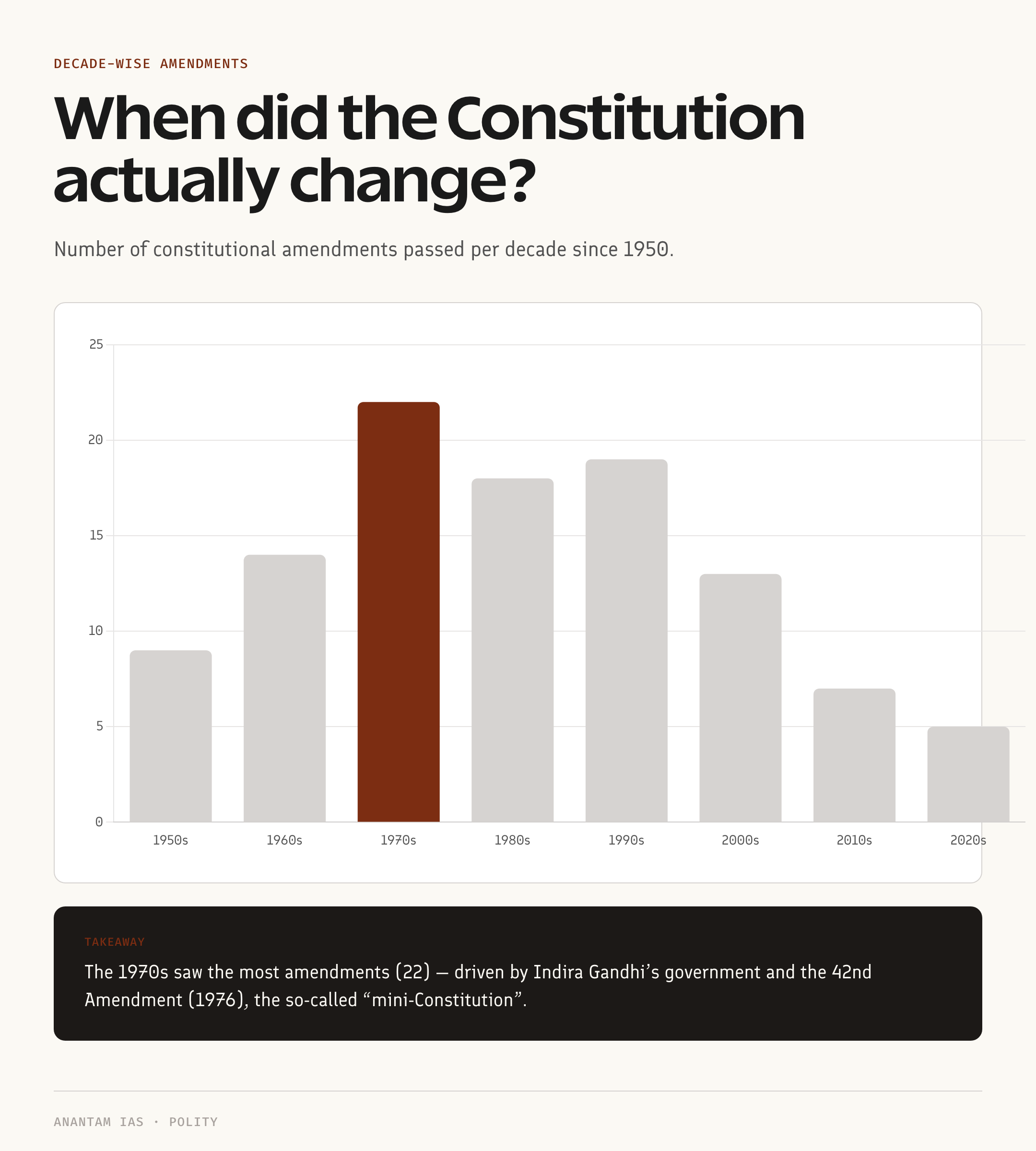
Type 1: By Simple Majority (not technically under Article 368)
- Requires a simple majority of members present and voting in each House
- Examples: Admission of new states (Article 2), creation of new states (Article 3), changes to citizenship (Article 11), official languages (Article 343)
- Honestly, these aren’t always classified as “constitutional amendments” by purists — they amend the Constitution but use ordinary legislative procedure
Type 2: By Special Majority (Article 368)
- Requires majority of the total membership of each House AND two-thirds majority of members present and voting
- Used for most amendments, including: Fundamental Rights, DPSP, expanding/restricting Parliamentary powers
- Roughly 60% of the 106 amendments fall in this category
Type 3: By Special Majority + Ratification by Half the States (Article 368)
- Special majority in Parliament + ratification by at least one-half of state legislatures
- Used for federal-structure amendments: Articles 54, 55 (Election of President), Article 73 (executive power of Union), Article 162 (executive power of states), Articles 241, Chapter IV of Part V, Chapter V of Part VI, Chapter I of Part XI, Article 368 itself, Lists I, II, III in Seventh Schedule, representation of states in Parliament
- Roughly 25-30% of amendments require this route
Year-wise / decade-wise distribution of amendments
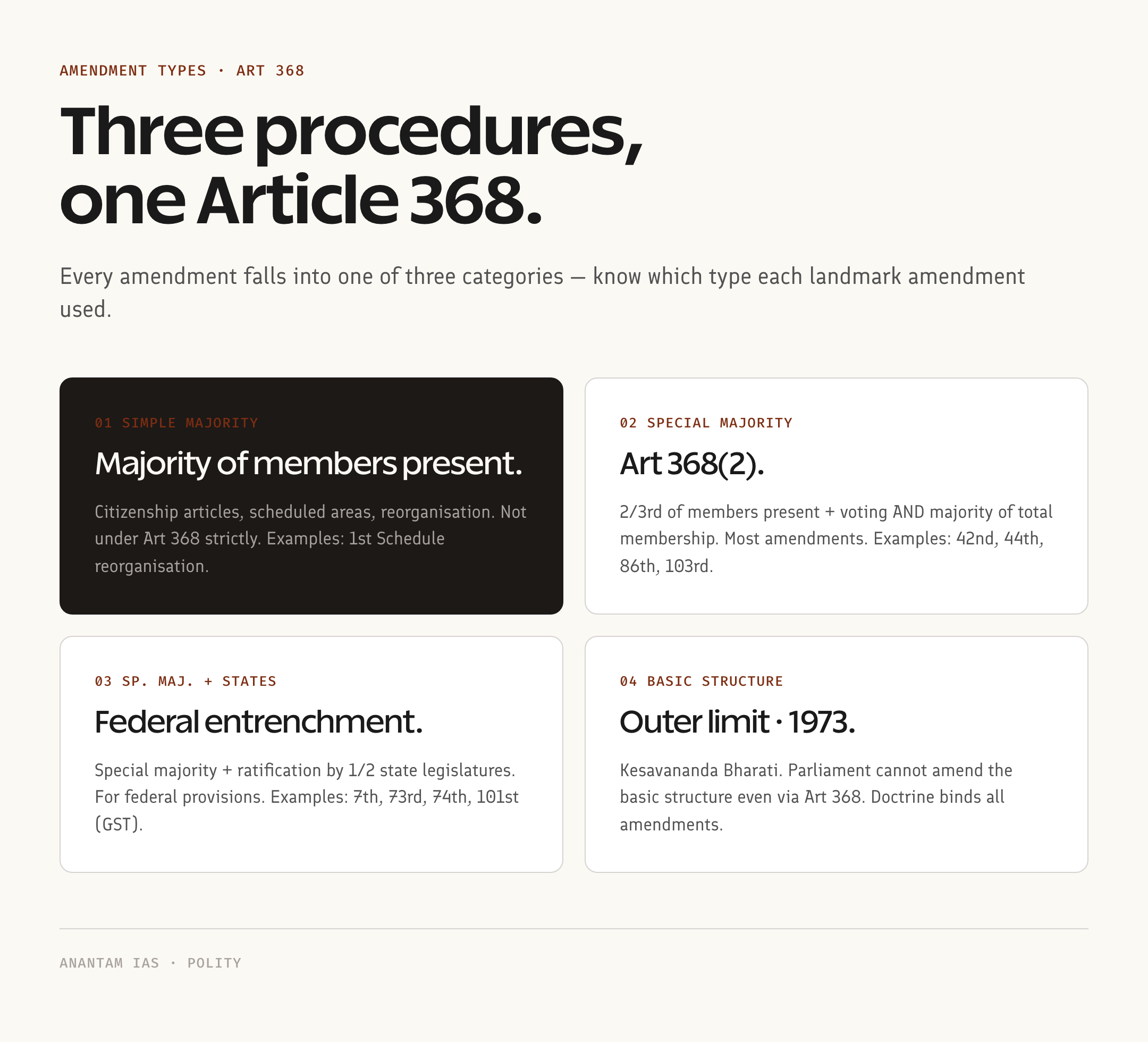
This is where Mains GS-II answers earn marks. The pace of constitutional amendment in India isn’t uniform.
| Decade | Amendments Passed | Notable |
|---|---|---|
| 1950s | 1st – 9th (9 total) | First Amendment 1951 (9th Schedule, free speech limits) |
| 1960s | 10th – 23rd (14 total) | Nehru-Indira transition era |
| 1970s | 24th – 45th (22 total) | Emergency-era spike, including 42nd Amendment |
| 1980s | 46th – 60th (15 total) | 52nd (Anti-Defection), 58th (Hindi authoritative text) |
| 1990s | 61st – 79th (19 total) | 73rd, 74th (Panchayati Raj, Urban Local Bodies) |
| 2000s | 80th – 94th (15 total) | 86th (Right to Education) |
| 2010s | 95th – 102nd (8 total) | 99th (NJAC, struck down), 101st (GST) |
| 2020-26 | 103rd – 106th (4 total) | 103rd (EWS), 104th (SC/ST), 105th (OBC), 106th (Women’s Reservation) |
The 1970s were the peak decade — 22 amendments, more than any other ten-year window. The Emergency (1975-77) drove the spike. The 1980s and 1990s averaged roughly 1.7 amendments per year. The 2010s slowed to 0.8 per year. The 2020s pace has been one amendment every 16 months — slower than the historical average.
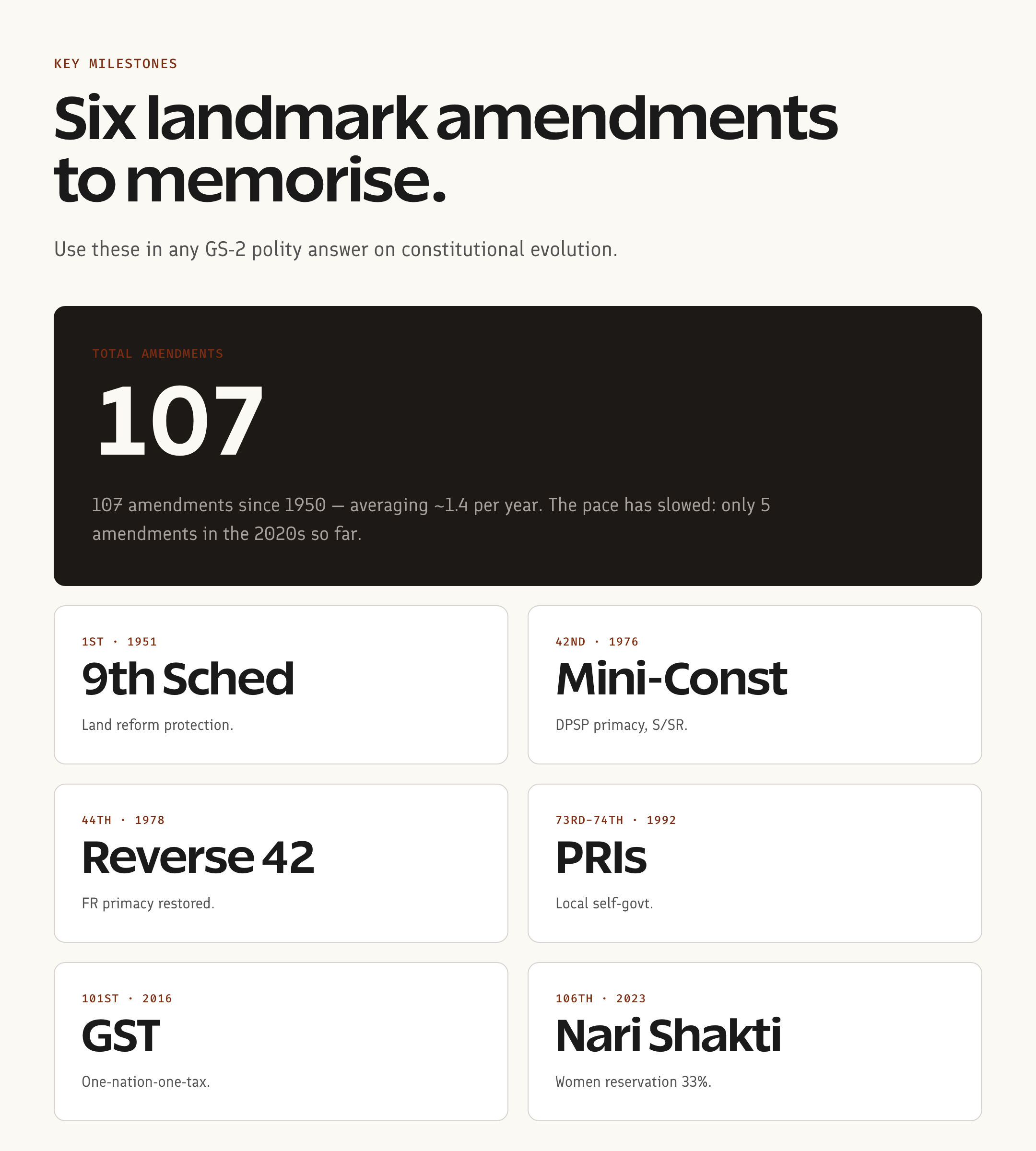
The most-tested amendments — what every aspirant must know
Six amendments appear in Prelims/Mains/Interview almost every year. Memorise these in priority order.
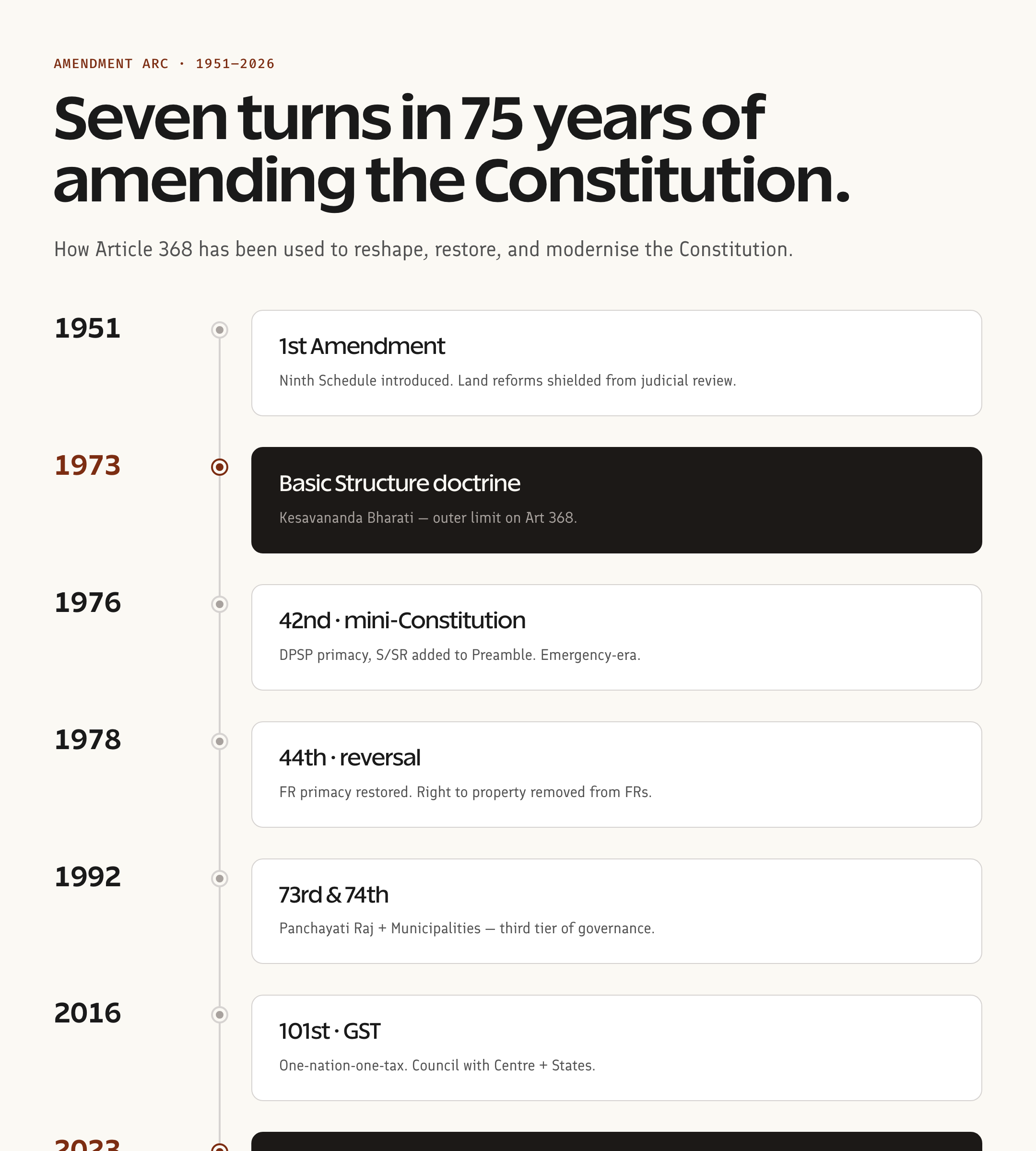
- First Amendment, 1951 — Added 9th Schedule, restricted free speech for “public order, friendly relations with foreign states, incitement to offence.” Validated land reform laws.
- 42nd Amendment, 1976 (“Mini-Constitution”) — Added “Socialist, Secular” to Preamble; added Fundamental Duties (Part IVA, Article 51A); altered the FR-DPSP relationship; reduced judicial review scope. Most controversial amendment in Indian constitutional history.
- 44th Amendment, 1978 — Reversed many 42nd Amendment changes; restored ordinary judicial review; made Right to Property (formerly Article 31) a legal right under Article 300A instead of a Fundamental Right; restricted Emergency provisions.
- 73rd & 74th Amendments, 1992 — Constitutionalised Panchayati Raj Institutions (Part IX) and Urban Local Bodies (Part IXA). Required by the Indian federal experiment to formalise local self-government.
- 101st Amendment, 2016 — Introduced the Goods and Services Tax (GST). Restructured the centre-state fiscal compact for indirect taxation.
- 106th Amendment, 2023 — Women’s Reservation Act (Nari Shakti Vandan Adhiniyam). One-third reservation for women in Lok Sabha and State Legislative Assemblies. See 106th Amendment for full text and timeline.
Most-amended articles — the inside data
Some articles attract amendments far more than others. Quick rankings:
- Article 31 — amended/restructured 9+ times (eventually moved out of Part III by 44th Amendment, becoming Article 300A)
- First Schedule — amended 30+ times (every state reorganisation)
- Seventh Schedule — amended 25+ times (Centre-State legislative lists)
- Article 368 itself — amended by 24th and 42nd Amendments
- Article 19 — amended 4 times (free speech / restrictions)
- Ninth Schedule — added 1951, expanded 280+ times
Note: “amended” includes addition, variation, and repeal. The First and Seventh Schedules churn most because state boundaries and legislative subjects change.
Basic structure doctrine — the constitutional limit
This is the most-tested concept after the count itself. Kesavananda Bharati v. State of Kerala (1973), decided 7-6 by a 13-judge Constitution Bench, held: Parliament cannot amend the basic structure of the Constitution under Article 368.
The court did not enumerate basic structure exhaustively, but subsequent cases identified these as basic-structure-protected:
- Supremacy of the Constitution
- Republican and democratic form of government
- Secular character
- Separation of powers (Legislature, Executive, Judiciary)
- Federal character
- Sovereignty and unity of India
- Welfare state (DPSP)
- Judicial review
- Rule of law
- Free and fair elections
- Parliamentary system
- Independence of judiciary
- Limited power of Parliament to amend
- Effective access to justice
- Powers of the Supreme Court under Articles 32, 136, 141, 142
If you remember one case from this chapter, make it Kesavananda Bharati. Examiners have asked it directly in 2014, 2017, 2019, 2022, and 2024.
Provisions of Article 368 — text-level breakdown
For Mains, knowing the structure of Article 368 word-for-word helps.
Article 368(1) — Parliament’s power to amend, by way of addition/variation/repeal.
Article 368(2) — Procedure: Bill in either House → passed by majority of total membership AND two-thirds present and voting → ratification by half the states for federal-structure amendments → presidential assent.
Article 368(3) — “Nothing in Article 13 shall apply to any amendment made under this article” (added by 24th Amendment, 1971) — meaning constitutional amendments are not “law” within Article 13(2). This was the legislative response to Golaknath v. State of Punjab (1967).
Article 368(4) — No amendment shall be questioned on any ground (added by 42nd Amendment) — struck down in Minerva Mills v. Union of India (1980) as violating basic structure.
Article 368(5) — There is no limitation on Parliament’s amending power (added by 42nd Amendment) — also struck down in Minerva Mills (1980).
That last point matters. Sub-clauses (4) and (5) — added by the Emergency-era 42nd Amendment — were judicially erased. The current operational text of Article 368 has only sub-clauses (1), (2), and (3).
Significance of constitutional amendments
Why does the total amendment count matter? Three reasons examiners reward.
One — adaptability without rigidity. The Constitution allows itself to evolve. Without Article 368, India would have needed a new constitution every 25 years. Compare this to the rigidity of the US Constitution, amended only 27 times in 235+ years.
Two — legislative response to judicial interpretation. When the Supreme Court rules in a way Parliament dislikes, Parliament can amend. The 9th Schedule expansion (after Sankari Prasad), the 24th Amendment (after Golaknath), and the 42nd Amendment (an attempted response to Kesavananda) all illustrate this dynamic.
Three — federal-state balance recalibration. GST (101st), Panchayati Raj (73rd, 74th), state reorganisations — amendments recalibrate the centre-state fiscal and political compact. The Constitution today is meaningfully different from what it was in 1950.
The full list lives at Constitutional Amendments — Important List. The procedural deep-dive is at Constitutional Amendment Process. For background on the document being amended, see Indian Constitution: Salient Features and Preamble of Indian Constitution.
Why this matters for UPSC
The total amendments in indian constitution count appears in:
- Prelims — direct factual MCQ, almost every year. 2014, 2017, 2019, 2022, 2024 all had questions.
- Mains GS-II — “Examine Parliament’s amending power under Article 368 in light of basic structure doctrine” — recurring framing
- Essay — “Living Constitution: India’s Article 368 in Practice” type prompts
- Interview — guaranteed if Polity is your optional or background
If you’re prepping for Prelims, you’ll see Article 368 questions every other year. The pattern is real.
Common misconceptions
Myth 1: “There have been 105 amendments.” Stale. The 106th was passed in September 2023. As of April 2026, total is 106.
Myth 2: “108 amendments have been made.” Some sources count amendment bills introduced, not enacted. As enacted Acts, the count is 106.
Myth 3: “Parliament can amend any provision of the Constitution.” No. Basic structure cannot be amended. Kesavananda (1973) settled this.
Myth 4: “The 9th Schedule provides absolute immunity.” Wrong. I.R. Coelho v. State of Tamil Nadu (2007) held that any law placed in the 9th Schedule after 24 April 1973 (the Kesavananda date) is subject to basic structure review. See 9th Schedule of Indian Constitution.
Myth 5: “Constitutional amendments are ‘laws’ subject to Article 13(2).” Article 368(3) overrules this. Amendments are exercises of constituent power, not legislative power. Confirmed in Sajjan Singh (1965) and codified by 24th Amendment (1971).
How to revise this in 30 minutes
- 5 min — Memorise the count: 106 amendments as of April 2026; latest = 106th (Women’s Reservation, 2023)
- 5 min — Three types under Article 368: simple / special / special+ratification
- 5 min — The “Big Six” amendments: 1st, 42nd, 44th, 73rd-74th, 101st, 106th
- 5 min — Basic structure doctrine: Kesavananda (1973), 13-judge bench, 7-6 majority
- 5 min — Article 368 sub-clause status: (1)(2)(3) operational; (4)(5) struck down by Minerva Mills (1980)
- 5 min — Quick scan of 104th, 105th, and 106th amendment one-pagers
Source priority: Laxmikanth Chapter 11 → indiacode.nic.in (Constitution text) → PRS Legislative Research briefs → SC judgement summaries on livelaw.in.
Frequently Asked Questions
: What is the total amendment of Indian Constitution as of 2026?
As of April 2026, there have been 106 amendments to the Indian Constitution since it came into force on 26 January 1950. The most recent is the 106th Amendment Act, 2023 (Women’s Reservation Act).
: What is the difference between the 42nd and 44th Amendments?
The 42nd Amendment (1976), passed during the Emergency, expanded Parliament’s powers, added u0022Socialist, Secularu0022 to the Preamble, and restricted judicial review. The 44th Amendment (1978), passed by the Janata government, reversed many of these changes — restoring judicial review, moving Right to Property to Article 300A, and limiting Emergency provisions.
: How many types of amendments are there under Article 368?
Three types: amendment by simple majority (e.g., admission of new states), by special majority (most amendments, including those affecting Fundamental Rights and DPSP), and by special majority plus ratification by at least one-half of state legislatures (federal-structure amendments like Article 54, 55, 368 itself).
: What is the basic structure doctrine and which case established it?
The basic structure doctrine, established in Kesavananda Bharati v. State of Kerala (1973) by a 7-6 majority of a 13-judge Constitution Bench, holds that Parliament cannot amend provisions that form the u0022basic structureu0022 of the Constitution — including supremacy of the Constitution, secularism, federalism, separation of powers, and judicial review.
: Which is the longest constitutional amendment?
The 42nd Amendment, 1976 (the u0022Mini-Constitutionu0022) is widely considered the longest and most far-reaching. It made approximately 56 changes to the Constitution, altering the Preamble, Fundamental Rights, DPSP, judicial review scope, and Article 368 itself.
: Can the Preamble be amended?
Yes. The 42nd Amendment (1976) amended the Preamble by adding u0022Socialistu0022, u0022Secularu0022, and u0022Integrityu0022. The Supreme Court in Kesavananda Bharati (1973) confirmed that the Preamble can be amended, but its basic structure cannot be altered.
: What is the 106th amendment of the Indian Constitution?
The 106th Amendment Act, 2023 — Nari Shakti Vandan Adhiniyam — provides one-third reservation for women in the Lok Sabha and State Legislative Assemblies, including reserved SC/ST seats. It received Presidential assent on 28 September 2023. Implementation depends on the next census and delimitation exercise.
: What was the 105th amendment of the Indian Constitution?
The 105th Amendment, 2021 restored the power of state governments to identify and notify Other Backward Classes (OBCs) for state-level lists. This was a response to the May 2021 Supreme Court ruling in Maratha Reservation case that had read-down state powers post the 102nd Amendment.
Tell Google you want more of this.
Add Anantam IAS as a preferred sourceOne tap, and this site shows up more often in your own Top Stories, AI Overviews and AI Mode. Remove it any time.