Every few years an old idea returns to the centre of India’s economic debate wearing new clothes — and in the run-up to recent elections, with states racing to put cash directly into citizens’ hands, that idea has been Universal Basic Income. It sounds almost too simple to be serious: instead of running hundreds of leaky welfare schemes, the government just pays every person a fixed sum of money, no questions asked, and lets them decide what to do with it. No forms, no eligibility tests, no inspector deciding who deserves help. For its admirers it is the cleanest anti-poverty tool ever proposed. For its critics it is a fiscal fantasy that would either bankrupt the state or pay the rich to do nothing.
What makes UBI worth understanding properly — rather than as a slogan — is that India has already flirted with it more seriously than almost any country. The government’s own Economic Survey of 2016-17 devoted a whole chapter to it, real pilots have run in Madhya Pradesh, and schemes like PM-KISAN and the wave of monthly cash transfers to women now look a lot like UBI in everything but name. For a UPSC aspirant this is prime territory: it sits at the meeting point of poverty, welfare reform, fiscal policy and the future of work, and it rewards anyone who can hold the case for and the case against in the same answer without collapsing into either.
What a Universal Basic Income Actually Is
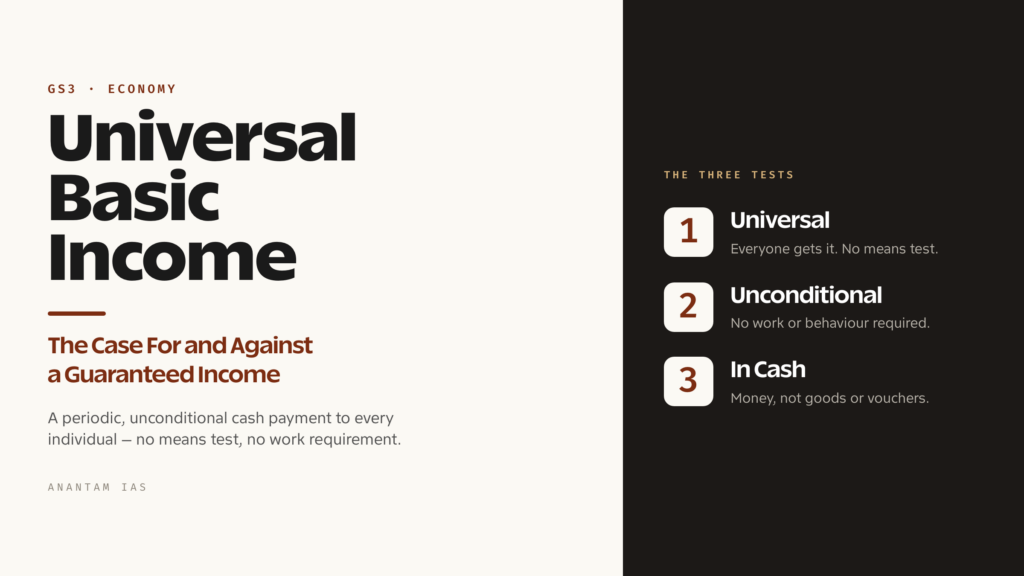
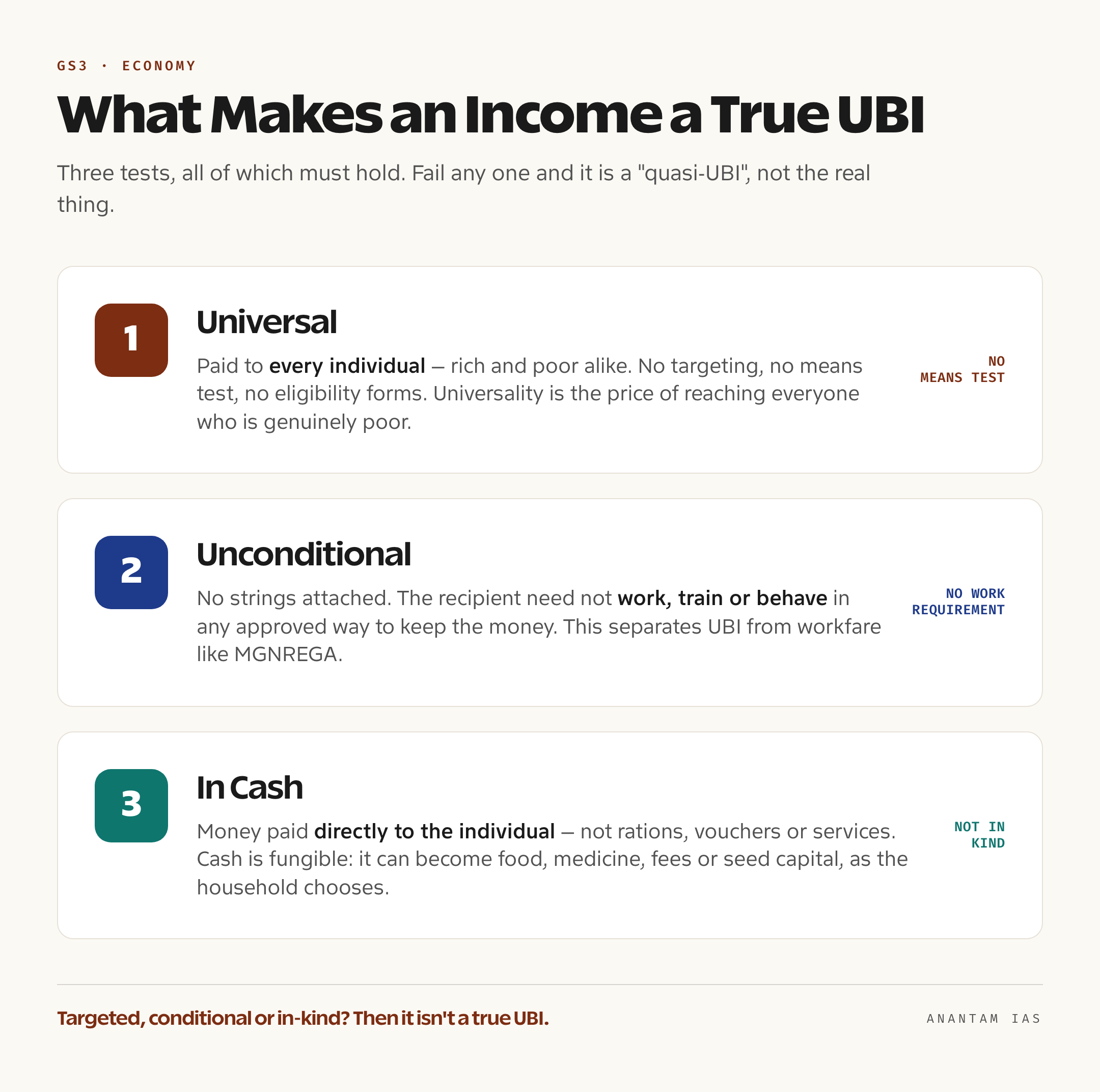
Strip away the rhetoric and a Universal Basic Income is defined by three features, each of which has to be present for the idea to count as UBI at all. The first is that it is universal — paid to every individual in the country, rich and poor alike, with no targeting and no means test. This is the feature people find hardest to swallow, because it means handing money to a billionaire as well as a daily-wage labourer. But it is deliberate. The moment you start testing who is poor enough to qualify, you rebuild the very machinery of forms, verification and exclusion that UBI was meant to abolish. Universality is not waste for its own sake; it is the price of simplicity and of reaching everyone who is genuinely poor.
The second feature is that it is unconditional — there are no strings attached. The recipient does not have to work, look for work, attend a training programme, send their children to school, or behave in any approved way to keep the money. This separates UBI sharply from conditional cash transfers and from workfare schemes like MGNREGA, where payment is tied to a hundred days of manual labour. The logic is one of trust and agency: the state assumes that adults know better than a distant bureaucracy how to spend money on their own lives, and it refuses to police the poor as a condition of helping them.
The third feature is that it is paid in cash, directly to the individual, usually as a regular monthly or periodic transfer rather than as goods, vouchers or subsidised services. Cash is fungible — it can become food, medicine, school fees, a bus ticket or seed capital for a tiny business, depending on what the household most needs. Put the three together and you get the textbook definition the economist Guy Standing and others have long argued for: a periodic, unconditional cash payment delivered to all individuals on an equal basis. It is worth distinguishing UBI from its weaker cousins. A scheme that targets only farmers is not universal. One that demands work is not unconditional. One that hands out free rations rather than money is not cash. Most “quasi-UBI” schemes you will read about fail at least one of these tests — which is exactly why the purist debate and the political reality keep pulling apart.
The Case For: Why Supporters Want a Guaranteed Income
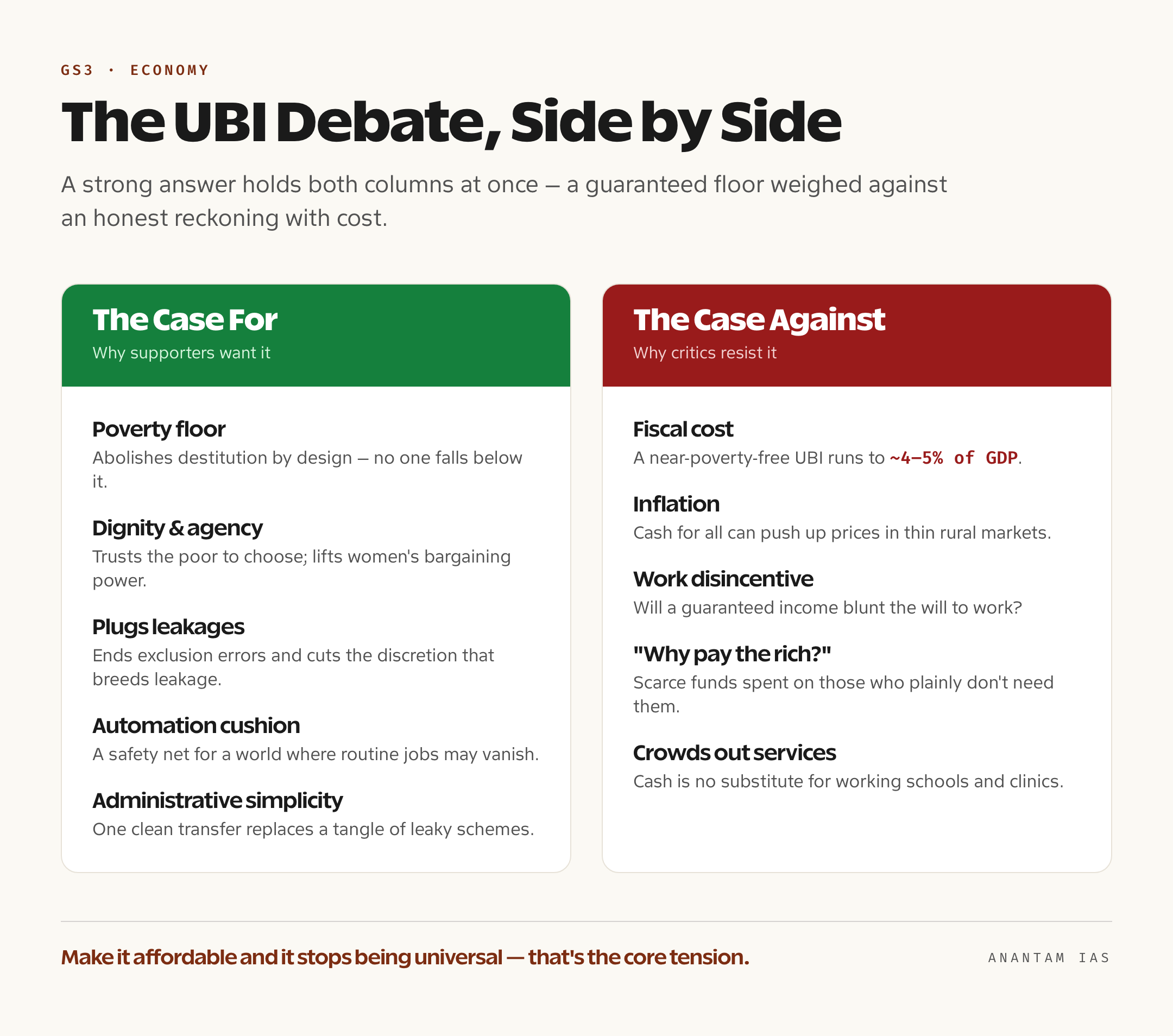
The strongest argument for UBI is also the simplest — it guarantees a floor below which no one can fall. By putting a fixed sum in every account, it abolishes destitution by design rather than hoping that growth or a patchwork of schemes will eventually reach the poorest. And because it is unconditional, it protects exactly the people India’s welfare system most often misses: the migrant worker with no local ration card, the informal labourer between jobs, the widow who cannot produce the right documents. The 2016-17 Economic Survey leaned heavily on this point, arguing that UBI promotes social justice by treating every citizen as deserving of a basic claim on the nation’s resources.
A second argument is about dignity and agency. Conventional welfare tells the poor what they may have — this many kilos of subsidised grain, this gas cylinder, this particular service. Cash tells them nothing; it trusts them to choose. Evidence from pilots, discussed below, repeatedly shows that the poor spend transfers on food, health, schooling and small enterprise rather than on alcohol or idleness, puncturing the old paternalist fear. There is a related point about agency for women: when the money is paid to her rather than to “the household”, a woman’s bargaining power inside the family rises, which is one reason so many of India’s recent cash schemes are addressed to women.
The third argument is administrative, and it is the one that wins over hard-nosed economists. India runs an enormous tangle of subsidies and welfare schemes — on food, fertiliser, fuel, and much else — and a large share of that spending leaks away through corruption, ghost beneficiaries, and the costs of running the machinery. Worse, targeting produces two kinds of error: inclusion errors, where the non-poor capture benefits meant for the poor, and exclusion errors, where genuinely poor people are wrongly left out. The Economic Survey’s argument was blunt: a universal transfer eliminates exclusion errors entirely, because nobody is left off the list, and it slashes the discretion that breeds leakage. Replace the leaky pipes with a single clean transfer, the case goes, and you may help the poor more while wasting less.
The fourth argument is about the future. As automation and artificial intelligence threaten to hollow out routine jobs, some thinkers — including in Silicon Valley — argue that UBI is the cushion a society will need when paid work can no longer be guaranteed to all. Whether or not that future arrives on schedule, the worry has pushed UBI from the fringe into mainstream policy conversation. Taken together, the case for UBI is that it offers a poverty floor, restores dignity, plugs welfare leakages and exclusion errors, cushions technological disruption, and does all of it with radically less administrative complexity than the system it would replace.
The Case Against: Cost, Inflation and the Work Question
The objections are at least as serious, and the first is money. A genuinely universal income is staggeringly expensive. The Economic Survey itself, doing the arithmetic, found that even a modest UBI set at a level meant to bring poverty down to near zero would cost somewhere around 4 to 5 per cent of GDP — far more than India can painlessly afford on top of, or even instead of, existing spending. To make the sums work, the Survey had to quietly abandon strict universality, proposing a “quasi-universal” version covering about 75 per cent of the population and excluding the better-off, which it costed at around 4.9 per cent of GDP. The honest critic points out the contradiction: the moment you make UBI affordable, you make it neither universal nor unconditional, and you bring back the targeting it was supposed to kill.
The second objection is inflation. Hand cash to everyone at once and, if the supply of goods does not expand to match, prices may simply rise — eroding the real value of the transfer, especially for the poor who hold little else. In thin rural markets a sudden flood of demand can push up the cost of exactly the food and essentials the money was meant to buy. The third, and most politically charged, is the work-disincentive worry: if people are paid whether or not they work, will some choose not to? The fear is that a guaranteed income blunts the incentive to take a job, learn a skill, or strive — a particular anxiety in a country that needs to pull millions into productive employment, not out of it.
The fourth objection is the one ordinary voters voice first — why pay the rich? Spending scarce public money on people who plainly do not need it strikes many as indefensible when the same rupees could be concentrated on the poor. And the fifth is about what UBI might crowd out. If a cash transfer is funded by gutting spending on public health, education, nutrition or infrastructure, the poor could end up with a little more money in hand but worse schools, clinics and roads to spend it on — a bad bargain. Cash, the critics insist, is no substitute for functioning public services. This is the heart of the running debate over so-called “freebies”: where lies the line between a genuine social safety net and fiscally reckless populism that buys votes while wrecking state budgets? The Supreme Court has repeatedly been drawn into that question, and it has no settled answer.
What the Evidence Says: Pilots from Madhya Pradesh to Kenya
Because UBI is so contested in theory, the real-world experiments matter enormously — and India ran one of the most instructive of them all. Between 2011 and 2012, in a set of villages in Madhya Pradesh, the Self-Employed Women’s Association (SEWA), working with the economist Guy Standing and funded by UNICEF, paid every adult and child an unconditional monthly sum — starting around 200 rupees per adult and 100 per child, later raised — with a comparison group receiving nothing. The findings cut against the pessimists. Recipient households were more likely to improve nutrition, get medical treatment, invest in better sanitation and energy, send children to school, and start small businesses. Crucially, people did not work less; many worked more, often shifting from wage labour to their own farming or enterprise. Women’s standing in the household improved when the money came through them.
The pattern holds across the world’s larger experiments. In Finland, a two-year trial paid 2,000 unemployed people a flat 560 euros a month with no conditions; employment effects were small either way, but recipients reported clearly better mental health, less stress and more security. In Kenya, the charity GiveDirectly is running the largest and longest UBI study ever attempted, paying thousands of villagers a basic income for up to twelve years; early results showed lower food insecurity, more enterprise and investment, and — again — no collapse in the will to work. In Stockton, California, a city scheme giving 125 residents 500 dollars a month found that employment among recipients actually rose, partly because the cash bought the stability to look for better jobs. Across this body of evidence two findings recur with striking consistency: unconditional cash improves food security, health and schooling, and the dreaded mass withdrawal from work simply does not show up. What no pilot can settle, though, is the question of scale — whether a payment to a few thousand people, funded from outside, tells you anything reliable about paying a billion people from a national budget. That gap between pilot and population is where the honest UBI debate still lives.
The India Debate: From the Economic Survey to PM-KISAN and “Freebies”
India’s tryst with UBI runs through one landmark document. The Economic Survey of 2016-17, authored under then Chief Economic Adviser Arvind Subramanian, devoted its ninth chapter — pointedly titled as a conversation “with and within the Mahatma” — to making the intellectual case for UBI while weighing Gandhi’s likely unease at handing out unearned money. It framed the choice as UBI versus the existing JAM-enabled welfare state, where JAM stands for the Jan Dhan bank accounts, Aadhaar identity and Mobile connectivity that together make direct cash transfers technically possible at scale. The Survey’s verdict was carefully hedged: UBI was “a powerful idea whose time, even if not ripe for implementation, is ripe for serious discussion.” It is the closest any Indian government has come to officially entertaining the policy.
Since then, India has not adopted a true UBI — but it has built a sprawling patchwork of schemes that share its DNA. PM-KISAN pays 6,000 rupees a year to landholding farmers in three instalments, straight into their accounts, with no conditions on how it is spent. States have gone further: Telangana’s Rythu Bandhu and Odisha’s KALIA put cash in farmers’ hands per acre or per family, and a powerful new wave of schemes — Maharashtra’s Ladki Bahin paying women 1,500 rupees a month, Jharkhand’s Maiya Samman paying 1,000, and similar programmes elsewhere — transfer money directly to women. None of these is universal, and most are targeted by occupation or gender, so they are quasi-UBI at best. But they have normalised the core mechanic: the state can pay citizens directly and reliably, and they vote like it.
That very success has reopened the “freebies” debate that now shadows every discussion of UBI in India. Critics — including some at the Reserve Bank and in the courts — warn that competitive cash promises at election time are straining state finances, with several states devoting a large and rising share of budgets to such transfers while capital spending on roads, schools and hospitals is squeezed. Defenders counter that a cash floor for the poor is welfare, not waste, and that calling it a “freebie” is a way of delegitimising redistribution. The unresolved question — where does a justified safety net end and unsustainable populism begin? — is exactly the question UBI forces into the open. India, in other words, is edging toward a basic-income reality through the back door of targeted cash schemes, without ever having had the honest national debate about cost, universality and what to cut that a real UBI would demand.
UBI vs Universal Basic Services: A Necessary Distinction
One distinction trips up aspirants constantly, so it is worth nailing down. Universal Basic Income and Universal Basic Services are rival answers to the same problem, and they are not the same thing. UBI gives people cash and lets them buy what they need in the market. Universal Basic Services (UBS) gives people things — free or near-free public healthcare, education, transport, housing and digital access — provided directly by the state, so that the essentials of a decent life are guaranteed in kind rather than in rupees. Where UBI trusts the individual and the market, UBS trusts collective provision and worries that cash alone cannot build a hospital or a school. The two are often posed as opposites, though many economists argue for a sensible blend: strong public services for what markets supply badly, topped up with cash for the flexibility only money can give.
For India the contrast is practical, not academic. A pure UBI would put the entire welfare budget into individual accounts and leave citizens to purchase health and schooling — risky where private provision is thin, costly or low-quality. A UBS-first approach would instead pour money into strengthening public clinics, schools and transport. The smartest position in an answer is rarely an absolute one. It is to recognise that cash and services solve different failures: cash fixes the problem of the state not knowing what each family needs, while services fix the problem of markets pricing the poor out of essentials. The genuinely difficult policy question is not whether India should choose UBI or UBS, but which mix of the two, funded how, and at the cost of which existing subsidies.
For Your Mains Answer
This is a high-value topic for GS Paper 3, which covers the Indian economy, inclusive growth, government budgeting, and issues of poverty and resource mobilisation, and it bleeds into GS Paper 2 wherever welfare schemes and governance are tested. It is also a ready-made Essay topic on social justice, the welfare state, and the future of work. The examiner is not looking for a verdict — they are looking for balance, structure, and a few precise anchors. The skill this article models is the one to copy: define the idea crisply, marshal the case for and against, ground both in evidence, and locate India’s actual position between the two.
How to Build the Answer
Open with the definition, not an opinion — state the three features (universal, unconditional, cash) in one tight sentence, because a wrong or vague definition sinks the whole answer. Then move in a clear arc: the case for (poverty floor, dignity, plugging leakages and exclusion errors, automation, simplicity), the case against (fiscal cost, inflation, work disincentive, paying the rich, crowding out services), the evidence (Madhya Pradesh, Finland, Kenya, Stockton — note that work effort did not fall), and India’s reality (the 2016-17 Economic Survey, then PM-KISAN and the women’s cash schemes as quasi-UBI). Close with the UBI-versus-UBS distinction and a balanced line. That structure — define, for, against, evidence, India, evaluate — fits almost any phrasing of the question.
Common Mistakes to Avoid
Don’t confuse UBI with conditional or targeted schemes — PM-KISAN and MGNREGA are not UBI, because one is targeted and the other demands work; call them “quasi-UBI” and explain why. Don’t claim pilots prove people stop working; the evidence is the opposite, and saying so is itself a mark-winning point. Don’t ignore the cost: an answer that cheers UBI without naming the 4-5 per cent of GDP figure reads as naive. And don’t merge UBI with Universal Basic Services — keeping them distinct shows conceptual clarity examiners reward.
A Compact Answer Spine
UBI = periodic, unconditional cash payment to all individuals → three features: universal (no means test), unconditional (no work requirement), cash → for: poverty floor, dignity/agency, plugs leakages + exclusion errors, automation cushion, administrative simplicity → against: ~4-5% of GDP cost, inflation risk, work disincentive, “why pay the rich”, may crowd out public services → evidence: SEWA Madhya Pradesh, Finland, Kenya/GiveDirectly, Stockton — cash improves nutrition/health/schooling, work effort doesn’t fall → India: Economic Survey 2016-17 (UBI vs JAM, quasi-universality at ~75%), now PM-KISAN + state cash transfers to women as de facto quasi-UBI → verdict: a blended UBI-and-UBS approach, fiscally honest about what it replaces.
Diagram or Flowchart Idea
Sketch a simple two-column balance: “Arguments For” against “Arguments Against”, with the three defining features (universal, unconditional, cash) boxed across the top as the shared definition. Beside it, a small spectrum line running from “Targeted schemes (PM-KISAN)” to “True UBI”, marking where India actually sits. This signals at a glance that you grasp both the concept and India’s halfway position.
A Balanced-Conclusion Line
A line that lands the marks: “Universal Basic Income is less a finished blueprint than a discipline — it forces India to ask honestly what it owes every citizen, what its leaky welfare system costs, and how much it can afford; the realistic path is not cash instead of services, but a calibrated blend of the two, paid for by cutting what genuinely wastes.”
How to Use Data Without Cramming
You need only a handful of anchors, not a dossier: the three features (universal, unconditional, cash); the Economic Survey’s ~4.9 per cent of GDP quasi-universal cost; PM-KISAN’s 6,000 rupees a year; and one pilot finding (SEWA Madhya Pradesh — better nutrition, schooling and enterprise, no fall in work). Attribute them plainly — “the 2016-17 Economic Survey estimated”, “the SEWA pilot found” — rather than scattering numbers without a source.
Frequently Asked Questions
What is Universal Basic Income in simple terms?
A Universal Basic Income is a fixed sum of money the government pays regularly to every individual in the country, with no conditions attached. It has three defining features: it is universal (everyone gets it, rich or poor, with no means test), unconditional (you don’t have to work or behave in any particular way to receive it), and paid in cash (not as goods, food or vouchers) directly into the individual’s account. Any scheme that targets only some people, or demands work, or hands out goods rather than money, is not a true UBI.
Did the Indian government ever propose a UBI?
Not as an actual programme, but it came close to a serious official endorsement. The Economic Survey of 2016-17 devoted a full chapter to UBI, framing it as a possible replacement for India’s leaky web of subsidies and welfare schemes, made feasible by the JAM trinity of Jan Dhan accounts, Aadhaar and mobile phones. It estimated a quasi-universal version covering about 75 per cent of people at roughly 4.9 per cent of GDP and called UBI “a powerful idea whose time… is ripe for serious discussion.” No government has since adopted a true UBI.
Is PM-KISAN a Universal Basic Income?
No — it is a “quasi-UBI” at most. PM-KISAN pays 6,000 rupees a year, unconditionally and in cash, which matches two of UBI’s three features. But it is targeted at landholding farmers rather than universal, so it fails the universality test. The same is true of state schemes paying monthly cash to women, such as Maharashtra’s Ladki Bahin or Jharkhand’s Maiya Samman: they share UBI’s cash-and-no-strings mechanic but are targeted by occupation or gender, not paid to all.
What is the difference between UBI and Universal Basic Services?
UBI gives people cash and lets them buy what they need in the market; Universal Basic Services (UBS) gives people the services themselves — free or near-free healthcare, education, transport and housing — provided directly by the state. UBI trusts the individual and the market; UBS trusts collective public provision. They are rival answers to the same problem of guaranteeing a decent minimum, and many economists favour a blend rather than choosing one outright.
Practice Questions
Prelims MCQs
- Which of the following are essential, defining features of a true Universal Basic Income (UBI)?
(a) It is targeted at the poorest 25 per cent, conditional on work, and paid in cash
(b) It is universal, unconditional, and paid in cash directly to individuals
(c) It is universal, conditional on school attendance, and paid as food and services
(d) It is targeted at farmers, unconditional, and paid in kind
Answer: (b) A true UBI must be universal (no means test), unconditional (no work or behaviour requirement), and paid in cash to the individual. - The concept of Universal Basic Income was discussed in detail in which official Indian document?
(a) The Fifteenth Finance Commission report
(b) The Economic Survey 2016-17
(c) The NITI Aayog Three-Year Action Agenda
(d) The Union Budget 2019-20 speech
Answer: (b) The Economic Survey 2016-17 devoted a full chapter to UBI, framing it against the existing JAM-enabled welfare system. - With reference to the “JAM” trinity often linked to UBI delivery in India, JAM stands for:
(a) Jan Dhan, Aadhaar and Mobile
(b) Jan Suraksha, Aadhaar and MGNREGA
(c) Jan Dhan, Atal Pension and Mudra
(d) Janani, Aadhaar and Mobile
Answer: (a) JAM refers to Jan Dhan bank accounts, Aadhaar identity, and Mobile connectivity, the plumbing that makes direct cash transfers possible at scale. - Which of the following is correctly described as a “quasi-UBI” scheme rather than a true Universal Basic Income?
(a) A scheme paying every citizen an equal sum with no conditions
(b) PM-KISAN, which pays a fixed annual sum only to landholding farmers
(c) MGNREGA, which guarantees wages for manual work
(d) The Public Distribution System, which supplies subsidised grain
Answer: (b) PM-KISAN is unconditional and paid in cash but targeted at farmers, so it fails the universality test and is quasi-UBI; MGNREGA fails the unconditionality test and the PDS is in kind. - Evidence from major basic-income pilots in Madhya Pradesh, Finland and Kenya most consistently found that unconditional cash transfers:
(a) caused a large fall in recipients’ willingness to work
(b) improved nutrition, health and schooling without reducing work effort
(c) led mainly to higher spending on alcohol and tobacco
(d) had no measurable effect on poverty or well-being
Answer: (b) Across pilots, cash improved food security, health and education, and the feared mass withdrawal from work did not occur.
Mains Practice Questions
- Define Universal Basic Income and discuss the arguments for and against adopting it in India. (15 marks, 250 words)
- “The moment a Universal Basic Income is made affordable, it ceases to be universal.” Critically examine this tension in the light of the Economic Survey 2016-17’s proposal for a quasi-universal basic income. (15 marks, 250 words)
- Examine the evidence from basic-income pilots in India and abroad. To what extent can findings from small pilots guide a national-scale UBI policy? (15 marks, 250 words)
- Distinguish between Universal Basic Income and Universal Basic Services. Which approach is better suited to India’s needs, and why? (10 marks, 150 words)
- India’s recent proliferation of cash-transfer schemes has revived the “freebies” debate. Discuss whether such schemes amount to a back-door Universal Basic Income, and assess their implications for fiscal federalism and welfare policy. (15 marks, 250 words)
Tell Google you want more of this.
Add Anantam IAS as a preferred sourceOne tap, and this site shows up more often in your own Top Stories, AI Overviews and AI Mode. Remove it any time.